







Abstract
The increasing prevalence of extended-spectrum β-lactamase (ESBL)-producing Escherichia coli (E. coli) highlights the growing issue of multidrug resistance within the food processing chain. This study aimed to determine the prevalence, antimicrobial resistance profiles, molecular genetic structures, and genetic diversity of ESBL-producing E. coli isolated from pork, cutting boards, and knives. A total of 90 samples were collected from 10 local markets in Southern Thailand. ESBL-producing E. coli were identified in 9 samples (10%), with knife samples showing the highest contamination rate (5/90, 5.55%). The ESBL-producing E. coli isolates exhibited high-level resistance to ampicillin (100%), ceftriaxone (88.89%), and cefpodoxime (88.89%), followed by tetracycline (77.78%). Multidrug resistance was detected in 88.89% (8/9) of ESBL-producing E. coli isolates and 28.26% (13/46) of all E. coli isolates. All presumptive ESBL-producing isolates carried ESBL resistance genes (9/9, 100%), with bla CTX-M-1 being the most prevalent (6/9, 66.67%). Additionally, the tetA gene was frequently detected in ESBL-producing E. coli (6/9, 66.67%) and in all E. coli isolates (16/46, 34.78%). Overall, E. coli O157:H7 was identified in 5 isolates (10.87%). The genetic relatedness analysis revealed that five ESBL-producing E. coli isolates were closely related to E. coli ATCC 23502. Our findings confirm a high prevalence of ESBL-producing E. coli carrying resistance genes in knife samples, underscoring the importance of proper sanitary handling practices to minimize microbial contamination in pork retail shops.
Introduction
Antimicrobial resistance (AMR) is a critical global health issue. Prominent multidrug-resistant (MDR) pathogenic bacteria, including Escherichia coli, Klebsiella pneumoniae, methicillin-resistant Staphylococcus aureus, and vancomycin-resistant enterococci, are commonly found in the environment and are significant sources of human infections (Fahim et al., 2025; Wintersdorff et al., 2016). The overuse and misuse of antibiotics on livestock farms have contributed to increased AMR among bacteria in animal habitats (Ketkhao et al., 2021). The rising transmission of AMR through the food chain poses a serious global health threat, reducing the effectiveness of antibiotics, increasing morbidity and mortality rates, and potentially resulting in an estimated ten million deaths annually by 2050 (Akullian et al., 2018; O’Neill, 2014; WHO, 2021).
Extended-spectrum β-lactamase (ESBL)-producing E. coli carries resistance genes against beta-lactam antibiotics (Schmithausen et al., 2018) and can cause both nosocomial and zoonotic infections, including serious conditions such as bacteremia and urinary or respiratory tract infections (Teklu et al., 2019). ESBL-producing bacteria represent a significant and growing global health threat, often exhibiting resistance not only to beta-lactams-mediated by plasmid-encoded enzymes (Bajpai et al., 2017) but also to other important antibiotic classes such as tetracyclines, colistin (polymyxin E), aminoglycosides, and fluoroquinolones. This resistance is primarily driven by bla CTX-M, bla TEM, bla SHV, bla OXA, and Mcr (Boonyasiri et al., 2014; Lee et al., 2020; Wu et al., 2024). The rise of such multidrug resistance is a major concern in both human and veterinary medicine (Chandrasekaran et al., 2014), severely limiting treatment options for infections. Therefore, identifying sources of ESBL-producing E. coli exposure is crucial for informing public health strategies and reducing the risk of infectious diseases.
Pork is a widely consumed animal product both in Thailand and globally. In 2020, it was estimated that over six million pigs were slaughtered for consumption in Thailand (OECD /FAO, 2021). Meat and meat products can become contaminated with AMR bacteria at various points along the food chain, from slaughterhouses to processing facilities. Consumer handling practices-such as cross-contamination, insufficient cooking, and the increasing consumption of raw meat-further contribute to the spread of AMR. Notably, genetic analyses have revealed significant similarities between bacterial strains found in food animals and those in humans, particularly E. coli (Leverstein-van et al., 2011; Rega et al., 2021; Rincón-Gamboa et al., 2021). Previous studies detect the ESBL-resistant E. coli in meat, swine, and the environment; however, few reports specifically address ESBL-producing E. coli contamination in pork retail environments (Mitsuwan et al., 2023; Sornsenee et al., 2022). Therefore, in this study, we aimed to determine the occurrence, antimicrobial resistance profiles, molecular genetic characteristics, and genetic diversity of extended-spectrum β-lactamase-producing E. coli isolated from pork retail shops in Southern Thailand.
Materials and Methods
Sample collection
A total of 90 samples were collected from 30 pork retail shops across ten fresh markets in four districts of Nakhon Si Thammarat, Thailand, between August 2023 and November 2023. The samples included 30 pork samples, 30 cutting board samples, and 30 knife samples. Markets were selected using a nonprobability convenience sampling method based on their accessibility. At each retail shop, more than 25 g of pork was collected for bacterial culture. Cutting boards and knives were swabbed, and the swabs were placed in transport media. All samples were collected in sterile containers, maintained at 4°C, and processed for testing within 24 h.
Isolation and identification ESBL-producing E. coli
Approximately 25 g of each pork sample, as well as each cutting board and knife swab sample, were enriched in 225 mL and 100 mL of 0.1% buffered peptone water (Oxoid, UK), respectively, and incubated at 37°C for 18–24 h. The enriched samples were then streaked onto MacConkey agar (MCA) (Oxoid, UK) supplemented with 1 µg/mL of cefotaxime (Hoechst Marion Roussel, USA) and incubated at 37°C for 24 h. Suspected E. coli colonies, appearing pink on MCA, were subcultured onto Eosin Methylene Blue (EMB) agar (HiMedia, India) and incubated at 37°C for another 24 h. Colonies exhibiting a metallic green sheen on EMB agar, indicative of E. coli, were further cultured on tryptic soy agar (HiMedia, India) and incubated at 37°C for 24 h. All suspected isolates were identified and confirmed as E. coli using matrix-assisted laser desorption ionization/time-of-flight mass spectrometry (MALDI-TOF MS) at the Office of Scientific Instrument and Testing, Prince of Songkla University.
Screening and confirmation of presumptive ESBL-producing isolates
The confirmed E. coli isolates were evaluated for ESBL production using the combination disk test with cefotaxime (30 μg), cefotaxime/clavulanic acid (30/10 μg), ceftazidime (30 μg), and ceftazidime/clavulanic acid (30/10 μg), following the Clinical and Laboratory Standards Institute (CLSI) guidelines (CLSI, 2019). Phenotypic ESBL-producing isolates were identified by inhibition zones of ≤ 27 mm for cefotaxime (CTX) and ≤22 mm for ceftazidime around the respective discs, as described in a previous study (Romyasamit et al., 2021).
Antimicrobial susceptibility testing
The antibiotic susceptibility profiles of ESBL-producing E. coli isolates from pork retail environments were evaluated using the disk diffusion method. The antibiotics tested included ampicillin (AMP, 10 μg), cefpodoxime (CPD, 10 μg), imipenem (IPM, 10 μg), meropenem (MEM, 10 μg), tetracycline (TE, 10 μg), gentamicin (CN, 10 μg), aztreonam (ATM, 30 μg), and ceftriaxone (CRO, 30 μg). The inoculated plates were incubated at 37°C for 18–24 h. Inhibition zones were measured and interpreted according to CLSI, 2019 guidelines.
DNA extraction and detection of antibiotic resistance genes
DNA was extracted from all confirmed E. coli isolates using a Geneaid Biotech® (Taiwan) kit. All positive samples were screened for genes encoding ESBLs. Eight ESBL-encoding genes, the E. coli O157:H7 gene, and three antimicrobial resistance genes were detected using polymerase chain reaction (PCR) amplification to identify the presence of bla TEM, bla SHV, bla OXA , bla CTX-M-1 , bla CTX-M-9 , bla GES , bla VEB , bla PER, eaeAO157:H7, tetA, tetB, and tetC. Specific primers and optimal annealing temperatures were used for each target gene during PCR, following established protocols (Abayneh et al., 2019; Lugsomya et al., 2018; Seenama et al., 2019).
Multilocus sequence typing and phylogenetic analysis
Seven housekeeping genes of E. coli (adk, fumC, gyrB, icd, mdh, purA, and recA) were analyzed to examine phylogenetic relationships. Specific primers and optimal annealing temperatures were used for PCR amplification of each gene (Seenama et al., 2019). The PCR products were sequenced using Sanger sequencing technology (Macrogen®, Seoul, Korea). The resulting equence data were uploaded to the E. coli multilocus sequence typing (MLST) database (https://pubmlst.org/organisms/escherichia-spp.) for allele profile identification. Phylogenetic analysis was performed using Molecular Evolutionary Genetics Analysis (MEGA) software (version 11.0; https://www.megasoftware.net/).
Statistical analysis
Descriptive statistics were used to summarize the percentages of E. coli, ESBL-producing E. coli, antibiotic susceptibility profiles, AMR genes, and ESBL-encoding genes. The prevalence of antibiotic resistance genes among E. coli isolates from the three sample types was compared using the Chi-square test or Fisher’s exact test, as appropriate. A p value of <0.05 was considered statistically significant.
Results
Prevalence of ESBL-producing E. coli
Out of the 90 samples collected from the three sample types, 46 (51.11%) were identified as E. coli positive: 20 isolates (22.22%) from pork samples, 14 isolates (15.56%) from knife samples, and 12 isolates (13.33%) from cutting board samples. Among these, 9 isolates were confirmed as ESBL-producing E. coli. The highest prevalence of ESBL-producing E. coli was observed in knife samples (5.55%), followed by pork samples (3.33%) and cutting board samples (1.11%) (Table 1).
Prevalence of E. coli and Extended-Spectrum β-Lactamase-Producing E. coli Isolated from Pork Retail Shops in Local Markets
ESBL, extended-spectrum β-lactamase.
Antibacterial susceptibility phenotype
Eight antibiotic agents from five different classes were used to assess antimicrobial susceptibility. Among all E. coli isolates, the highest resistance was observed to AMP (78.26%), followed by TE (69.56%) and CPD (26.09%). In contrast, the isolates were highly susceptible to MEM (100%), IPM (97.82%), and ATM (86.96%). For ESBL-producing isolates specifically, 100% (9/9) were resistant to AMP, 88.89% (8/9) to CRO, and 88.89% (8/9) to CPD, followed by 77.78% (7/9) resistance to TE. All ESBL-producing isolates were fully susceptible to both MEM and IPM (100%, 9/9). Susceptibility to CN and ATM was observed in 33.33% (3/9) of ESBL isolates (Table 2).
Antibiotic Susceptibility Profiles of E. coli and Extended-Spectrum β-Lactamase-Producing E. coli Isolated from Pork Retail Shops in Local Markets
AMP, Ampicillin; ATM, Aztreonam; CN, Gentamicin; CPD, Cefpodoxine; CRO, Ceftriaxone; ESBL, extended-spectrum β-lactamase; I, intermediate; IPM, Imipenem; MEM, Meropenem; R, resistance; S, susceptibility; TE, Tetracycline.
Multidrug-resistant pattern
MDR is defined as resistance to at least three classes of antibiotics. Five distinct antimicrobial resistance profiles were identified in this study. MDR was detected in 28.26% (13/46) of E. coli isolates and 88.89% (8/9) of ESBL-producing isolates. The most frequent resistance pattern among E. coli isolates was AMP-CRO-CPD-CN-TE (13.04%), followed by AMP-CRO-CPD-CN (4.35%), AMP-CRO-CPD-TE (4.35%), AMP-CN-TE (4.35%), and AMP-ATM-CRO-CPD-CN-TE (2.17%). For ESBL-producing isolates, the most common resistance profile was AMP-CRO-CPD-CN-TE (44.44%), followed by AMP-CRO-CPD-TE (22.22%), AMP-CRO-CPD-CN (11.11%), and AMP-ATM-CRO-CPD-CN-TE (11.11%) (Table 3).
Antimicrobial Resistant Pattern of E. coli and ESBL-Producing E. coli Isolated from Pork Retail Shop in Local Markets
AMP, Ampicillin; ATM, Aztreonam; CN, Gentamicin; CPD, Cefpodoxine; CRO, Ceftriaxone; ESBL, extended-spectrum β-lactamase; TE, Tetracycline.
Molecular detection of ESBL encoding genes and antibiotic-resistant genes
The most frequent genotypes among ESBL-producing isolates were bla CTX-M-1 (66.67%), followed by bla OXA (55.55%), bla CTX-M-9 (33.33%), bla GES (22.22%), bla VEB (22.22%), and bla SHV (11.11%). bla TEM and bla PER were not detected in this study. The EWUCB12-2 isolate carried the most resistance genes, including bla SHV, bla OXA, bla CTX-M-1, and bla CTX-M-9 (Table 4). Among the TE resistance genes in ESBL isolates, tetA was the most prevalent (66.67%), followed by tetB (55.55%) and tetC (33.33%) (Table 4). E. coli O157:H7 was detected in 5 isolates (10.87%) overall (Table 5), most commonly in pork samples (4 isolates, 8.69%) and in one knife sample (2.17%), but not in any cutting board samples. bla TEM was not detected in any sample. The highest prevalence of bla OXA was in pork samples (5 isolates, 10.87%), while knife and cutting board samples each had two positive isolates (4.35%). bla SHV was detected in one pork sample and one cutting board sample. There were no significant differences in the prevalence of bla TEM, bla SHV, and bla OXA (p = 1.0). However, significant differences were observed among the TE resistance genes tetA, tetB, and tetC (p = 0.009) (Table 5). tetA was most frequently detected in pork isolates (9 isolates, 19.56%), followed by cutting board isolates (4 isolates, 8.69%) and knife isolates (3 isolates, 6.52%). Six knife isolates were positive for tetB, while only one pork sample was positive for tetC.
ESBL-Encoding Genes and Tetracycline Resistant Gene in ESBL-Producing E. coli Isolated from Pork Retail Shops in Local Markets (N = 9)
ESBL, extended-spectrum β-lactamase.
Detection of O157:H7 Gene and Antibiotic-Resistant Genes in Representative E. coli Isolates (N = 46)
Multilocus sequence typing
The relationship between the MLST-based dendrogram and the distribution of ESBL genes in E. coli is illustrated in Figure 1. The WU2024E1 isolate was found to closely match sequence type (ST) ST6799 in the database, which has been isolated from food and humans in Cambodia, Laos, and Bangladesh. The WU2024E2 isolate closely matched ST2379 and ST4718, which have been identified in humans and poultry in China. WU2024E3 closely matched ST170, a type found in humans, livestock, and poultry in Ghana, Vietnam, Spain, China, and Croatia. Additionally, ST665 has been identified in shellfish, poultry, companion animals, and food in the United States and Australia. The WU2024E4 isolate was closely related to ST1344, found in poultry and food in the United States. The WU2024E5 isolate closely matched ST695, which has been reported in humans, food, poultry, and wild animals in Spain, Cambodia, Italy, Kenya, the United States, and Australia. Furthermore, ST3111 has been recognized in humans in China, while ST4727 did not have a specified sample type in the database. Genetic comparisons were made between WU2024E1–E5 isolates, E. coli ATCC reference strains, Shigella dysenteriae, and closely related ST. The five isolates formed a distinct cluster with very high bootstrap values (Fig. 1). Notably, the E. coli ATCC 23502 strain was more closely related to these five isolates (98% identity) than to other ATCC reference strains.
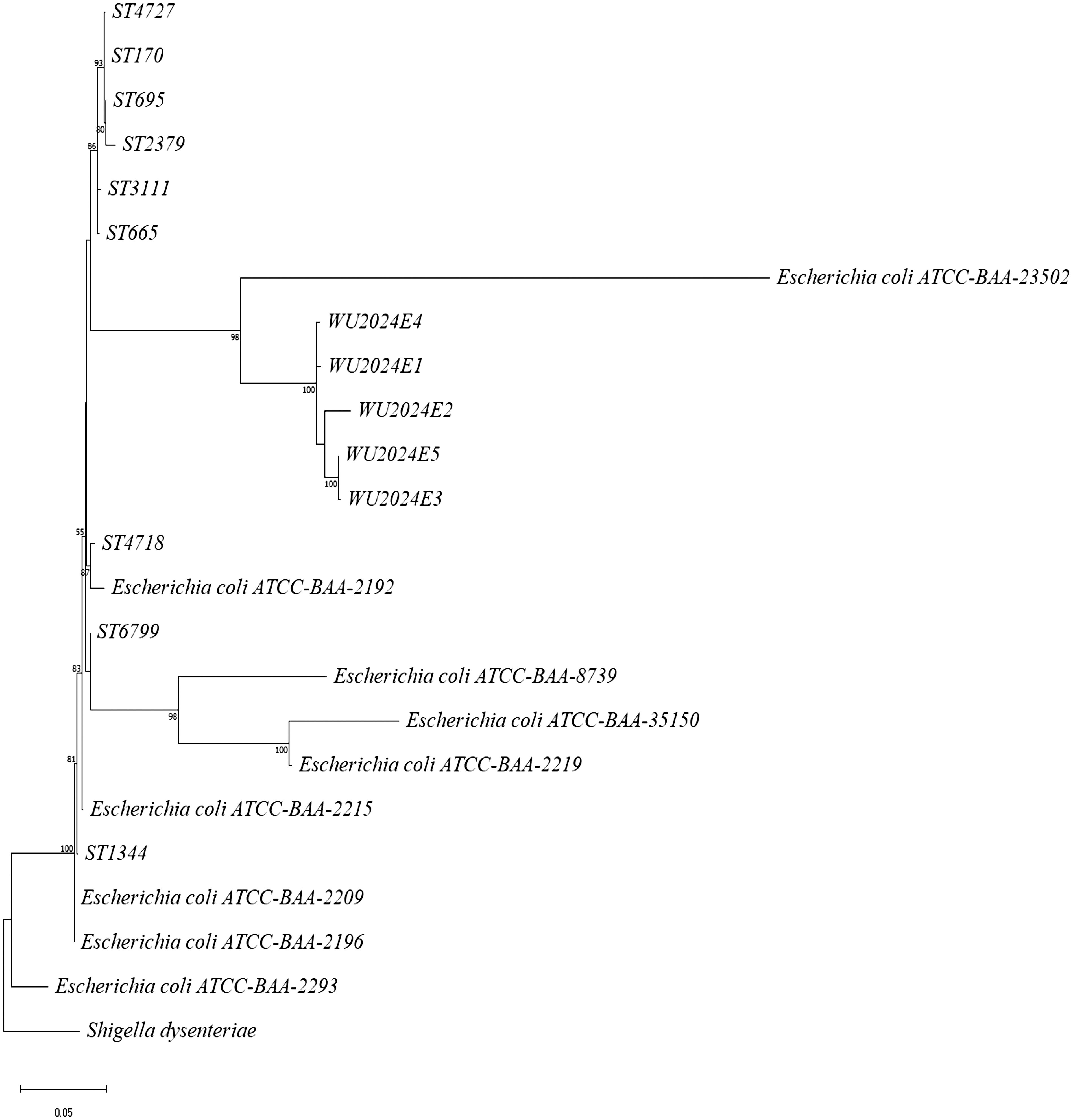
MLST dendrogram created based on seven housekeeping genes of the five ESBL-E. coli isolates from pork retail shops. ESBL, extended-spectrum β-lactamase; MLST, multilocus sequence typing.
Discussion
The inappropriate use of antibiotics has heightened global public health concerns regarding the emergence of antimicrobial resistance. Food animal production, such as swine production chains, serves as a primary source of zoonotic pathogens (Founou et al., 2016). One significant risk factor for the widespread dissemination of ESBL-producing bacteria in humans is the consumption of food contaminated with these pathogens (Lazarus et al., 2015). In this study, ESBL-producing E. coli was most frequently detected in knife samples, highlighting the increased risk of contamination during pork processing due to poor hygienic practices. The percentage of ESBL-producing E. coli in pork from markets in this study was 3.33%, which is lower than reported in previous studies from Chiang Mai, Thailand (69%) (Srichumporn et al., 2022), China (11.76%) (Ye et al., 2018), and the United Kingdom (<7%) (Randall et al., 2017). Previous studies have reported ESBL resistance phenotypes in knife and chopping board swabs at 0% and 20%, respectively. In comparison, the prevalence in knife swabs was higher in this study, while the prevalence in chopping board swabs was lower (Abayneh et al., 2019). Contaminated knives can directly transfer MDR bacteria to other food items, including cooked or ready-to-eat foods that are not intended for further processing. This cross-contamination bypasses any potential bacterial reduction that might occur during the cooking of raw products. The extensive use of antibiotics has contributed to the emergence of antibiotic-resistant bacteria, which is a key factor in the development of antimicrobial resistance (Kawamura et al., 2017). However, this study collected samples from multiple sources, which may have contributed to the lower detection rate of ESBL-producing E. coli compared to studies focusing solely on pork samples.
The World Health Organization recommends the use of third-generation cephalosporins for treating multidrug-resistant infections. Extended-spectrum cephalosporins play a critical role in both human and veterinary medicine (Zamudio et al., 2022). However, the widespread emergence of ESBLs and plasmid-mediated β-lactamases has led to increasing resistance to third-generation cephalosporins (Harris, 2015; Zamudio et al., 2022). In this study, all E. coli isolates showed high resistance to AMP (78.26%), followed by TE (69.57%). Among ESBL-producing isolates, resistance to AMP was 100%, and resistance to cephalosporins was 88.89%, a reflection of the extensive use of these antibiotics in animal production in Thailand (Nuangmek et al., 2018). Additionally, antibiotics used as growth promoters in animal feed often belong to the same chemical families as those used to treat human infections. Antibiotics have been commonly added to animal feed to promote growth and prevent disease in pigs (Bergspica et al., 2020). The highest resistance to TE (100%) was reported by Iancu et al. (2025), consistent with previous research in Southern Thailand by Mitsuwan et al. (2023), which found high levels of resistance to AMP and TE, as well as ESBL-encoding genes in E. coli from swine farms and their environments. In this study, the carbapenem antibiotics IPM and MEM showed high efficacy against ESBL-producing E. coli isolates (97.82% and 100% susceptibility, respectively), aligning with previous reports from China (95%) and Thailand (over 98%) (Bubpamala et al., 2018). However, the potential circulation of carbapenem resistant resistance bacteria between swine and humans (Bonardi et al., 2022) remains a critical global health concern, as carbapenems are often considered the “last line of defense” against severe MDR Gram-negative infections (Hansen, 2021). The previous study on the plasmid-mediated colistin-resistance gene mcr-1 in E. coli from pig farms in Jiangxi reveals a high prevalence of resistance, indicating a significant risk of transmission to humans through the food chain (Wu et al., 2024). Contamination during slaughtering, processing, or handling of animal products, as well as the consumption of raw or undercooked meat, could further expose humans to these resistant pathogens (Almansour et al., 2023; EFSA, 2025).
In this study, multiple MDR patterns were observed in both E. coli (five patterns) and ESBL-producing E. coli (four patterns). Eight ESBL-encoding genes were investigated: bla TEM, bla SHV, bla OXA, bla CTX-M-1, bla CTX-M-9, bla GES, bla VEB, and bla PER. The bla CTX-M-1 gene was the most frequently detected, followed by bla OXA and bla CTX-M-9, consistent with previous findings (Srichumporn et al., 2022). However, bla TEM and bla PER were not detected in this study. Community-onset infections, such as urinary tract infections and sepsis, are often linked to E. coli strains carrying the bla CTX-M gene, suggesting that these genes may facilitate the spread of ESBLs from animals to humans through the food chain (Zurfluh et al., 2015). The convergence of high MDR rates in ESBL-producing E. coli highlights the urgent need for comprehensive strategies to combat antibiotic resistance across the One Health spectrum, encompassing human health, animal health, and the environment. Effective surveillance, responsible antimicrobial stewardship in both human and veterinary medicine, and robust food safety practices are essential to mitigate this growing public health threat. Previous studies worldwide have also identified similar resistance gene profiles in humans, farm animals, and food (Bubpamala et al., 2018; Gundran et al., 2019; Lugsomya et al., 2018; Nuangmek et al., 2018). Notably, bla OXA (28.57%) was detected in retail pork samples in China (Abayneh et al., 2019). TE resistance genes, such as tetA, tetB, and tetC, were also examined in this study. Among the isolates, tetA (33.78%) was the most commonly detected resistance gene, followed by tetB (15.22%) and tetC (2.17%). This finding aligns with previous studies, although tetC was not detected by Mitsuwan et al. (2023). The detection of bla CTX-M and tetA in bacteria from animals and food products indicates a direct pathway for human exposure through contaminated food, increasing the risk of introducing antibiotic resistance into the human gut microbiome. While direct transfer and infection may not always occur, the presence of these genes in foodborne pathogens increases the potential for resistance to spread to other human-associated bacteria, including pathogens. In this study, E. coli O157:H7 was detected in 10.87% of isolates, primarily from pork samples (8.69%), which is similar to findings from Alberta, Canada (1.4% in pigs, 1.8% in carcasses; Essendoubi et al., 2020). It was also recovered from knives (2.17%) but not from cutting boards. The concurrent high prevalence of multidrug-resistant, ESBL-producing E. coli in retail pork environments underscores the urgent need for stringent sanitation protocols to prevent the dissemination of foodborne pathogens and antibiotic resistance genes during meat processing (Erickson et al., 2015). Overall, phylogenetic analysis revealed high genetic similarity between ESBL-producing E. coli isolates from different sources and known global STs. This underscores the importance of continuous surveillance and molecular typing to track the emergence and distribution of resistant E. coli strains in both human and animal populations. The identified sequence types (e.g., ST6799, ST2379, ST4718, ST1344, ST170, and ST695) were associated with both human and animal sources across Southeast Asia and globally, suggesting the potential zoonotic transmissions and the clonal spreads through foodborne and environmental routes. These findings align with global and regional MLST data, highlighting the public health relevance of these high-risk clones in Egypt, Jordan, and China (Ramadan et al., 2020; Zueter et al., 2024).
Conclusions
This study is the first to investigate ESBL-producing E. coli contamination in pork retail shops across Southern Thailand, highlighting significant public health and food safety concerns. The identification of knives as a key point of contamination suggests that pork retail environments may act as reservoirs for drug-resistant microorganisms, posing a risk to human health through the food chain. To mitigate this risk, it is essential to enforce strict food safety regulations, provide comprehensive hygiene training for market vendors, and establish routine surveillance systems throughout the pork supply chain.
Footnotes
Acknowledgments
The authors would like to thank Walailak University grant (WU-IRG-66-274), Akkhraratchakumari Veterinary College grant, and One Health Research Center, Walailak University, Thailand, for their support.
Authors’ Contributions
R.B., S.I., P.S., and S.B. conceived and designed the experiments. R.B., P.S., W.M., and S.I. collected the data, analyzed, and interpreted the data. R.B., S.I., P.S., S.B., and Y.M. wrote the article. S.B. and Y.M. corrected the grammar of the article. All the authors have read and approved the final article.
Ethics Approval
Ethical approval was not required for this study. Biosafety certification was approved by Institutional Biosafety Committee (WU-IBC-65-019). The shopkeepers were informed and consented before the samples collected in this study.
Author Disclosure Statement
No competing financial interests exist.
Funding Information
This work was funded by Walailak University grant (WU-IRG-66-274) and Akkhraratchakumari Veterinary College grant.