







Abstract
Pentatrichomonas hominis is a zoonotic pathogen with a wide host range, yet epidemiological data in mink and raccoon dogs remain sparse. This study investigates the prevalence of P. hominis in these species by analyzing 498 fecal samples collected from Hebei, Shandong, Liaoning, Jilin, and Heilongjiang provinces in China. Results revealed an overall infection rate of 9.64% (48/498, 95% confidence interval 7.19–12.58), with mink showing a 0.36% infection rate (1/276) and raccoon dogs 21.17% (47/222). Female animals had higher infection rates (9.87%, 47/476) than males (4.55%, 1/22). Adults exhibited higher infection rates (10.31%, 46/446) compared with juveniles (3.85%, 2/52). Phylogenetic analysis identified the CC1 genotype in all P. hominis detected. This study provides important epidemiological data on P. hominis infection in mink and raccoon dogs across five provinces, offering new insights into its regional distribution and transmission dynamics. These findings contribute to the development of more effective control strategies in the future.
Introduction
Pentatrichomonas hominis (formerly Trichomonas hominis) is a zoonotic pathogen belonging to the class Trichomonadida, phylum Parabasalia (Mahittikorn et al., 2021). This parasite exists only in the trophozoite stage, which is its infectious form, and does not produce cysts (Inoue et al., 2015). Trophozoites exhibit strong environmental resistance, enabling survival outside the host for extended periods, and transmission occurs primarily via the fecal-oral route (Li et al., 2014). P. hominis is not host-specific and is widely distributed in the intestines of various animals including dogs, cats, cattle, sheep, and non-human primates (Bastos et al., 2018; Li et al., 2020; Li et al., 2018; Li et al., 2016).
Notably, this parasite is also capable of infecting humans. Studies have reported an infection rate of up to 13.8% among school-aged children in Egypt and a prevalence of 1% in children under 14 years of age in Australia, suggesting its strong zoonotic potential (Abdo et al., 2022; Meloni et al., 1993). Although P. hominis is primarily associated with gastrointestinal disorders in hosts, recent research suggests a close association with respiratory tract infections, urinary tract infections, and gastrointestinal cancers in humans (Mantini et al., 2009; Silva et al., 2022; Zhang et al., 2019). Therefore, the presence of P. hominis not only threatens animal health but also poses a potential risk to public health, particularly concerning its pathogenic potential in children and immunocompromised individuals.
Advances in molecular biology, particularly the use of nested polymerase chain reaction (PCR), have made the detection of P. hominis more precise (Gookin et al., 2007). The three most common genotypes identified are CC1, CC2, and CC3 (Li et al., 2016), with CC1 being particularly significant due to its detection in goats, foxes, and humans, highlighting its zoonotic potential (Li et al., 2020; Li et al., 2018; Song et al., 2023). These insights emphasize the need for robust monitoring and control of P. hominis infections, particularly where zoonotic transmission is a concern.
Mink and raccoon dogs, as economically important species in China’s farming industry (Wang et al., 2022), are potential hosts for P. hominis. The health of these animals is crucial for both industry sustainability and public health. Previous studies, such as those by Song et al. (2023) and Li et al. (2017), have reported infection rates of 33.6% (195/581) in Henan and Hebei provinces and 48.33% (29/60) in mink and 53.33% (32/60) in raccoon dogs in Jilin Province, respectively. However, these studies are limited and do not comprehensively reflect the infection status of P. hominis in farmed wildlife across China.
This study aims to address these gaps by providing broader data and critical references for the prevention and control of zoonotic diseases. Considering the growing reports of P. hominis in human clinical cases and its detection in multiple animal hosts, monitoring its prevalence in farmed wildlife is essential. This is vital for reducing disease transmission, enhancing the economic benefits of farming, and ensuring both animal welfare and public health.
Materials and Methods
Sample collection and DNA extraction
From October 2023 to June 2024, a total of 498 fecal samples were collected from farmed mink (n = 276) and raccoon dogs(n = 222) in five provinces of China: Shandong (n = 20), Hebei (n = 204), Jilin (n = 33), Heilongjiang (n = 84), and Liaoning (n = 157) (Fig. 1, Table1). All animals were cage-raised. Immediately after defecation, fresh fecal samples were collected from beneath each animal’s cage using disposable sterile PE gloves and placed into sterilized sampling tubes. Detailed information, including sampling time, location, species, gender, age, and health status, was recorded. The animals were classified into two age groups: juveniles (≤6 months for mink, and ≤8 months for raccoon dogs) and adults (>6 months for mink, and >8 months for raccoon dogs). Samples were transported on dry ice and stored at −80°C in the laboratory. Genomic DNA was extracted from each sample using the E.Z.N.A.® Stool DNA Kit (Omega Biotek, Inc., Norcross, GA, USA) following the manufacturer’s instructions. The extracted DNA was stored at −20°C until PCR analysis.
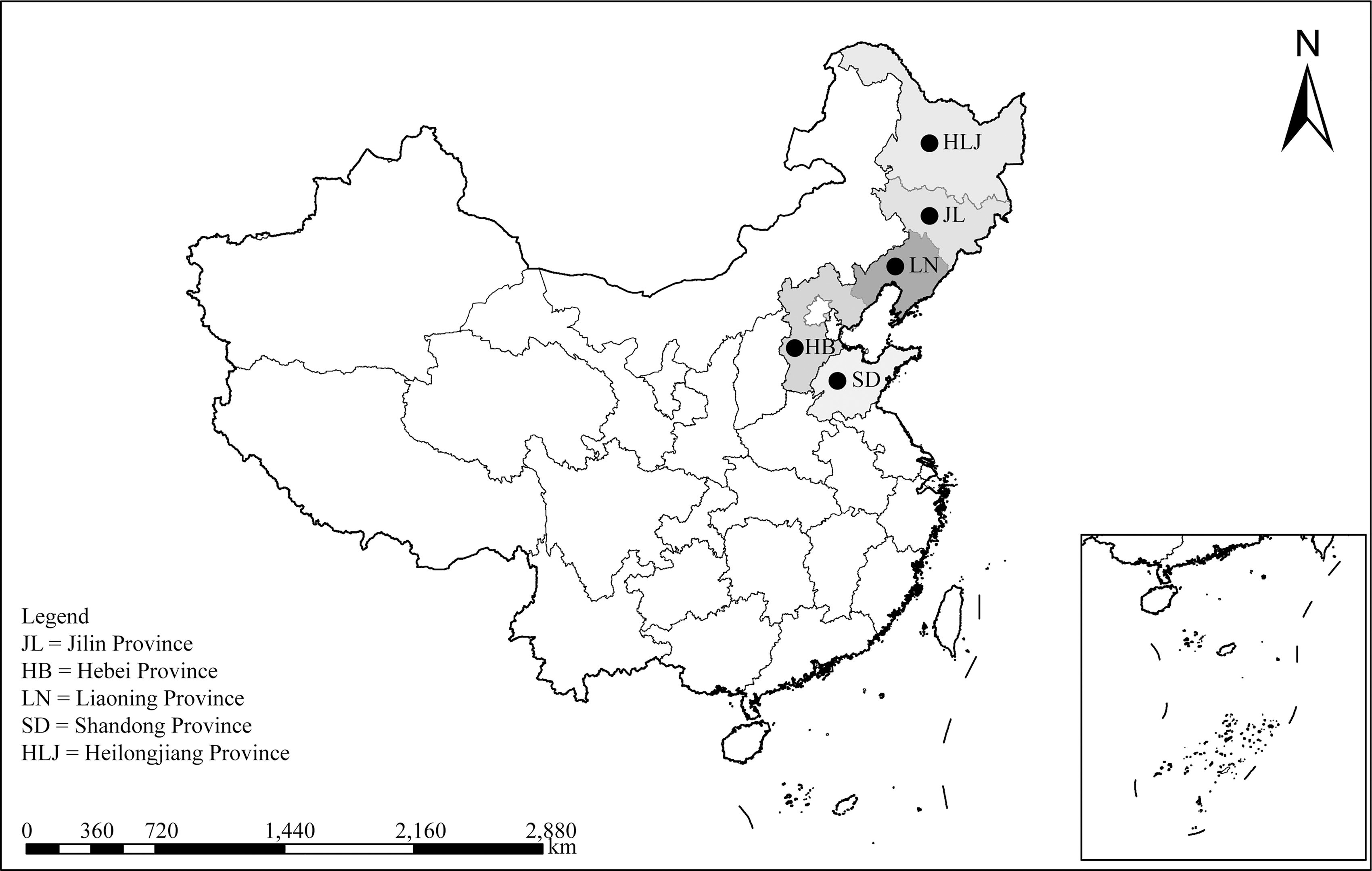
A map of PR China. The black dots represent the sampling position.
Prevalence of Pentatrichomonas hominis Infection in Mink and Raccoon Dogs by Various Factors
CI, confidence interval; OR, odds ratio.
PCR amplification
Nested PCR was used to detect the presence of P. hominis in the fecal samples. Initially, the trichomonad genus-specific gene was amplified using the forward primer FF (5′-GCGCCTGAGAGATAGCGACTA-3′) and the reverse primer RR (5′-GGACCTGTTATTGCTACCCTCTTC-3′). The second round of amplification targeted a P. hominis-specific fragment using the forward primer HF (5′-TGTAAACGATGCCGACAGAG-3′) and the reverse primer HR (5′-CAACACTGAAGCCAATGCGAGG-3′) (Wang et al., 2024). Both rounds of PCR were performed in a 30 μL reaction mixture containing 15 μL of 2× Master Mix Taq polymerase, 1 μL each of forward and reverse primer, 2 μL of template DNA, and 11 μL of deionized water. The PCR cycling conditions were as follows: initial denaturation at 95°C for 5 min; followed by 35 cycles of denaturation at 94°C for 60 s, annealing for 60 s (59°C for the first round and 61°C for the second round), and extension at 72°C for 60 s; with a final extension at 72°C for 7 min. Each round of PCR contained a negative and a positive control. The results were visualized via electrophoresis on a 2% agarose gel.
Sequencing and phylogenetic analysis
Sequencing of P. hominis-positive samples was performed by General Biol (Anhui, China). The assembled sequences were aligned with reference sequences in GenBank using BLAST (http://www.ncbi.nlm.nih.gov/blast/). Genetic distances were calculated using the Kimura-2 parameter model in MEGA11, and the reliability of the results was assessed with 1000 bootstrap replicates. A phylogenetic tree was constructed using the neighbor-joining method (Tamura et al., 2021).
Statistical analysis
Significant factors influencing P. hominis infection rates, such as region (x1), species (x2), gender (x3), age (x4), and health condition (x5), were evaluated using the Fisher scoring method in SAS (v9.0). Odds ratios (OR) and 95% confidence intervals (95% CIs) were calculated using SPSS (IBM Corp., Armonk, NY, USA). All tests were two-sided, and a p-value less than 0.05 was considered statistically significant.
Results
Prevalence of P. hominis
The overall infection rate of P. hominis in mink and raccoon dogs was 9.64% (48/498). Hebei Province had the highest infection rate at 15.69% (32/204, 95% CI 10.99–21.02), followed by Jilin Province (12.12%, 4/33, 95% CI 2.79–25.84), Heilongjiang Province (5.95%, 8/84, 95% CI 1.71–12.21), Liaoning Province (4.64%, 7/157, 95% CI 1.69–8.34) and no infections were detected in Shandong Province (0%, 0/20). A significant difference in infection rates was observed between mink and raccoon dogs (χ2 = 81.73, df = 1, p < 0.0001), with raccoon dogs showing a higher rate (21.17%, 47/222, 95% CI 16.03–26.81) than that in mink (0.36%, 1/276, 95% CI 0.00–1.55).
Among different gender groups, females (9.87%, 95% CI 7.35–12.73) had a higher infection rate compared with males (4.55%, 95% CI 0.00–18.49). Although adult animals (10.31%, 46/446) had a higher infection rate than juveniles (3.85%, 2/52), the differences in infection rates between mink and raccoon dogs were not statistically significant (χ2 = 2.30, df = 1, p = 0.1297). Additionally, no significant differences were observed in infection rates between healthy and diarrheal animals (Table 1).
Risk factors
Stepwise logistic regression analysis identified region and species as significant factors influencing P. hominis prevalence. The final model was described by the equation: y = −6.7512x1 + 0.8693x2 + 3.5501. Region was found to have a negative impact on P. hominis infection (χ2 = 18.00, df = 4, I2 = 77.0, p = 0.0012). The highest prevalence rates were observed in Hebei Province (15.69%, 32/204, OR = 3.99, 95% CI 1.71–9.30) and Jilin Province (12.12%, 4/33, OR = 2.96, 95% CI 0.81–10.75). Shandong Province (0%, 0/20) had no recorded infections, while Liaoning Province (4.46%, 7/157, OR = 4.46, 95% CI 1.69–8.34) and Heilongjiang Province (5.95%, 5/84, OR = 1.36, 95% CI 0.42–4.41) exhibited relatively lower prevalence rates. Species was positively associated with P. hominis infection (χ2 = 81.73, df = 1, I2 = 98.8, p < 0.0001). The infection rate in mink was significantly lower (0.36%, 1/276, 95% CI 0.00–1.55) compared with raccoon dogs (21.17%, 47/222, OR = 73.86, 95% CI 10.10–540.17) (Table 1).
Phylogenetic analysis and genotype distribution
A total of 48 P. hominis sequences were obtained, and three representative sequences (PQ285642–PQ285644) were identified through clustering analysis. Alignment with reference sequences in GenBank revealed that PQ285642 (raccoon dog) had 99% similarity with KC953860 (dog, Philippines) and OR033180 (dog, China). PQ285643 (raccoon dog) and PQ285644 (mink) showed 98% similarity with the same sequences.
Phylogenetic analysis revealed that PQ285643 and PQ285644 clustered in the same branch, forming a sister group with KC953860 and OR033180. PQ285642 formed a distinct branch. All sequences from this study, along with OM763804 (fox, genotype CC1), belonged to the same evolutionary clade, with a bootstrap value of 98% (Fig. 2). These findings indicate that all the sequences obtained in this study belong to the CC1 genotype of P. hominis.
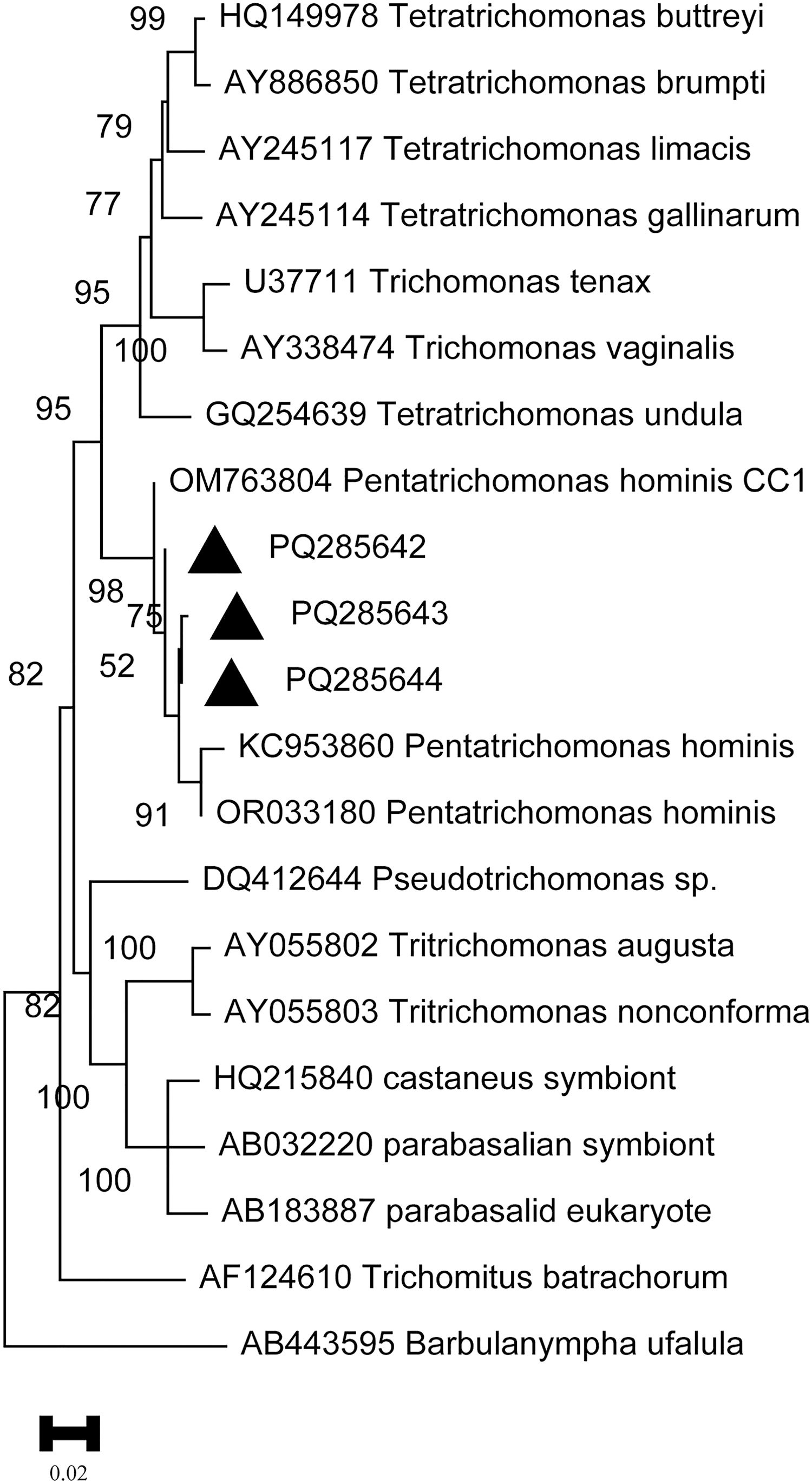
Phylogenetic tree using the neighbor-joining (NJ) method based on the 18S rRNA gene of P. hominis. The phylogenetic relationship between P. hominis obtained in this study and other known trichomonads was inferred using the NJ method based on the genetic distance calculated by the Kimura 2‐parameter model. Bootstrap values of more than 50% are shown. The triangle denotes isolates from the present study.
Discussion
The global concern over the public health threat posed by P. hominis is growing, with an increasing number of reports on this parasite. Studies from countries such as the United States, Japan, Hungary, and South Korea primarily focus on companion animals (Itoh et al., 2020; Kim et al., 2010; Romatowski, 2000; Tuska-Szalay et al., 2024). In China, investigations have extended to farm animals, including sika deer and foxes (Li et al., 2017). Previous research has shown a high infection rate of P. hominis in mink and raccoon dogs, though these studies are geographically limited (Zhang et al., 2022). To address this gap, the present study aimed to expand the epidemiological data by testing 498 samples from mink and raccoon dogs across five provinces in China.
The overall infection rate of P. hominis in mink and raccoon dogs was 9.64% (48/498). This prevalence is lower than the infection rate reported in Siberian tigers (31.3%), but higher than those recorded in sheep and goats (0.26%, 2/781) and pigs (0%, 0/362) in China (Li et al., 2018; Wang et al., 2024; Zhang et al., 2022). This variation suggests a potential link between P. hominis infection and meat consumption. In this study, geographical region emerged as a key risk factor affecting P. hominis prevalence. Hebei Province had the highest infection rate at 15.69% (32/204), followed by Jilin (12.12%, 4/33), Heilongjiang (5.95%, 5/84), and Liaoning (4.46%, 7/157), while no infections were observed in Shandong. Differences in infection rates across regions may reflect variations in breeding practices, disease control measures, or sample sizes. A previous epidemiological survey conducted in Jilin Province reported a much higher overall infection rate of 50.8% (61/120) for mink and raccoon dogs, suggesting that geographical factors, as well as differences in study periods, can influence parasitic infection rates (Li et al., 2017).
Species was another significant factor influencing P. hominis infection. Raccoon dogs (21.17%, 47/222) were found to be more susceptible than mink (0.36%, 1/276). This finding is consistent with the results of Li et al. (Mantini et al., 2009). The differences in infection rates may be related to the immune functions of the species, as well as differences in breeding and management practices. Epidemiological studies also indicate that female animals may be more susceptible to parasitic infections than males. A study in Brazil showed that female leaf litter anurans carried a higher worm burden than males, and research in Poland found that female raccoon dogs had a higher infection rate of Toxoplasma gondii compared with males (Martins et al., 2024; Osten-Sacken et al., 2024). Similarly, the present study found that female animals had a higher P. hominis infection rate (9.87%, 47/476) compared with males (4.55%, 1/22), further corroborating the association between gender and parasitic infections. This raises the need to investigate whether certain hormones or physiological traits in females contribute to increased susceptibility to P. hominis.
Age also influenced infection rates in this study. Adult animals exhibited a higher infection rate (10.31%, 46/446) compared with juveniles (3.85%, 2/52). This finding is consistent with previous research, including the work of Song et al. (2023) and a study on Angiostrongylus cantonensis infection in rats (Rivory et al., 2024). Understanding the mechanisms behind age-related differences in parasite susceptibility is crucial for developing effective control strategies. Although no significant difference was observed between the infection rates of diarrheic (10.52%, 2/19) and non-diarrheal animals (9.60%, 46/479), this potential connection should not be dismissed. It is likely that diarrhea may result from interactions between P. hominis and other gut microorganisms rather than from P. hominis infection alone. This conclusion is consistent with findings by Abdo et al. (2022), suggesting the need for further research on the interaction between P. hominis and gut microbiota.
Three genotypes of P. hominis are known: CC1, CC2, and CC3. Genotypes CC2 (KJ408931) and CC3 (KJ408928) are rare and have only been detected in dogs from Jilin Province, showing some degree of host specificity (Li et al., 2016). In contrast, the CC1 genotype has a broader host range, having been identified in raccoon dogs from Hebei Province (OM763803), Siberian tigers (MZ424463), dogs from Liaoning Province (KJ408863), non-human primates from Jilin Province (KJ408959), and even in humans (KJ408961). This indicates the zoonotic potential of the CC1 genotype. In this study, all 48 P. hominis sequences belonged to the CC1 genotype, with representative sequences clustering with P. hominis from other hosts, showing a 98% bootstrap value in phylogenetic analysis. This finding confirms that the CC1 genotype is the predominant strain of P. hominis in mink and raccoon dogs from the surveyed provinces and highlights the potential public health risks associated with these animals as reservoirs of infection.
However, this study has certain limitations that should be acknowledged. First, the sample size in some regions—particularly Shandong Province (n = 20)—was relatively small, which may have limited the detection of positive cases and affected regional comparisons. Moreover, the uneven distribution of samples across provinces and the small sample sizes in some subgroups may have reduced the representativeness and statistical power of the findings. Future studies with larger and more balanced sample collections are needed to confirm these results and provide a more comprehensive understanding of the prevalence and distribution of P. hominis.
Conclusion
This study expands the epidemiological understanding of P. hominis infection in mink and raccoon dogs across five provinces in China, identifying the widespread presence of the CC1 genotype and its zoonotic potential. The findings emphasize the importance of further research into factors such as hormonal and physiological characteristics that may influence infection rates, as well as the interactions between P. hominis and other gut microorganisms. Such insights will be critical in developing more effective strategies for controlling and preventing P. hominis infections in both animals and humans.
Footnotes
Authors’ Contributions
Conceptualization: N.L., J.J., and S.L. Investigation: H.-T.W., Q.-Y.H., and X.-M.L. Software: S.L. and X.Y. Methodology: H.-T.W. and S.L. Visualization: S.L. Resources: Y.Q. and J.J. Formal analysis: S.L. and H.-T.W. Writing—original draft: S.L. and N.L. Writing—review and editing: H.-T.W., Q.-Y.H., Y.Q., X.-M.L., X.Y., and J.J. All authors contributed to the article editing and approved the final article.
Ethics Approval and Consent to Participate
All procedures used in this study were approved by the Research Ethics Committee for the Care and Use of Laboratory Animals at Qingdao Agricultural University, China.
Data Availability
These representative sequences have been uploaded to the GenBank database under accession numbers: PQ285642–PQ285644.
Disclosure Statement
The authors have no conflicts of interest to declare.
Funding Information
No funding was received for this article.