







Abstract
Background:
Ticks are significant vectors of various pathogens affecting humans and livestock, necessitating effective control strategies. The widespread use of chemical acaricides has led to resistance development and environmental concerns, highlighting the need for sustainable alternatives. Entomopathogenic fungi (EPF), particularly Metarhizium anisopliae and Beauveria bassiana, have emerged as promising biocontrol agents due to their pathogenicity against arthropods. This study evaluates the efficacy of these fungi in controlling tick populations under laboratory and field conditions.
Methods:
Fungal isolates of M. anisopliae and B. bassiana were cultured and applied to adult and nymphal ticks using direct immersion and topical application methods. Tick mortality was monitored over 14 days, and lethal time 50% (LT50) and lethal concentration 50% (LC50) values were determined using probit analysis. Environmental stability assays assessed conidial viability under different temperature and ultraviolet (UV) exposure conditions. A field trial was conducted to evaluate fungal efficacy in reducing tick populations in a natural setting.
Results:
Both M. anisopliae and B. bassiana induced significant mortality in ticks, with M. anisopliae exhibiting slightly higher virulence. LT50 values were 5.8 ± 0.4 days for M. anisopliae and 6.9 ± 0.5 days for B. bassiana. Conidial viability declined under high temperatures and prolonged UV exposure, but fungal application in shaded areas improved efficacy. The field trial showed a 67.3% reduction in tick populations after fungal treatment (p < 0.001).
Discussion:
These findings demonstrate the potential of EPF as effective biocontrol agents for tick management. While environmental factors influence fungal persistence, protective formulations and targeted application strategies could enhance field performance. Integrating EPF with other control measures may provide a sustainable approach to tick population suppression.
Introduction
Ticks are significant ectoparasites that pose serious health risks to humans and animals by transmitting various pathogens, including bacteria, viruses, and protozoa. Conventional control methods, primarily reliant on chemical acaricides, have been widely used to mitigate tick infestations. However, excessive and prolonged use of these chemicals has led to several challenges, such as the development of acaricide resistance, environmental contamination, and adverse effects on nontarget organisms. Consequently, there is an urgent need for sustainable and environmentally friendly alternatives for tick management (Fernandes et al., 2012; Monisha et al., 2025).
Entomopathogenic fungi (EPF) have emerged as promising biological control agents due to their ability to infect and kill a wide range of arthropod pests, including ticks. Species such as Metarhizium anisopliae and Beauveria bassiana have demonstrated significant virulence against various tick species by penetrating the cuticle, proliferating inside the host, and ultimately causing mortality. Unlike chemical acaricides, EPF offer several advantages, including host specificity, environmental safety, and reduced risk of resistance development. Moreover, these fungi can be formulated and applied in different environmental settings, making them versatile tools for integrated tick management (ITM) strategies (Abbasi et al., 2024, 2025a; Abbasi and Daliri, 2024b;, 2024c; Rajput et al., 2024; Yamini et al., 2024).
Despite their potential, several factors influence the efficacy of EPF in tick biocontrol, including environmental conditions, fungal strain virulence, and tick species susceptibility. Understanding these interactions is crucial for optimizing the use of EPF in practical field applications. This study aims to explore the potential of EPF for tick population control by examining their mechanisms of infection, efficacy in laboratory and field settings, and challenges associated with their implementation. By integrating EPF into tick management programs, it may be possible to develop more sustainable and effective strategies for controlling tick populations while minimizing ecological and public health risks (Rajput et al., 2024, 2024).
Materials and Methods
Fungal isolates and culture conditions
Two entomopathogenic fungal isolates were used in this study, M. anisopliae (Isolate code: Ma-IRSUMS-01) and B. bassiana (Isolate code: Bb-IRSUMS-02). These isolates were obtained from the Fungal Culture Collection of the Research Center for Health Sciences, Shiraz University of Medical Sciences, Shiraz, Iran. Both isolates were identified based on morphological characteristics and sequencing of the internal transcribed spacer (ITS) region of rDNA. While GenBank accession numbers are not yet available, the deposition is currently in progress. The isolates were cultured on Sabouraud dextrose agar (SDA) and incubated at 25°C under a 12-hour light/dark cycle for conidia production. Given the recent taxonomic revisions in the genera Beauveria and Metarhizium, species identification of the isolates was confirmed through morphological examination and sequencing of the ITS region of rDNA. Recognizing the limitations of ITS in distinguishing closely related species, additional gene regions, including TEF1-α and RPB1, are being sequenced to provide higher taxonomic resolution. Results from these multilocus analyses will be submitted to GenBank and reported in a subsequent study. Conidial viability was determined using a germination assay on SDA. A 100-μL aliquot of the conidial suspension (1 × 10⁶ conidia/mL in 0.05% Tween-80) was spread evenly onto SDA plates and incubated at 25°C for 24 h. After incubation, a minimum of 300 conidia were examined under a light microscope (400× magnification), and conidia were considered viable if a visible germ tube at least twice the length of the conidium was observed. Only batches with viability ≥95% were used for laboratory and field bioassays. Each suspension was prepared fresh and assessed prior to application to ensure high-quality, infective material (Dal Bello et al., 2018; Zimmermann, 2007).
Tick collection and maintenance
A total of 360 ticks belonging to the species Rhipicephalus (Boophilus) microplus were collected from naturally infested cattle at a livestock farm in Marvdasht County, Fars Province, southern Iran (29.8747° N, 52.8028° E), during the spring season. The farm is situated in a semiarid region characterized by traditional open grazing practices. Ticks were manually detached from the neck, flank, and udder regions of the animals using fine-tipped sterile forceps and immediately placed into labeled, ventilated plastic containers. To maintain viability and minimize stress, samples were transported to the laboratory in insulated cool boxes. Species identification was confirmed using standard morphological taxonomic keys. Of the collected specimens, 180 were adults (90 males and 90 females) and 180 were nymphs. All ticks used were unfed, healthy, and active at the time of testing. They were randomly assigned to six experimental groups, each containing 60 ticks (30 adults and 30 nymphs): M. anisopliae (direct immersion), B. bassiana (direct immersion), M. anisopliae (topical application), B. bassiana (topical application), immersion control (Tween-80 only), and topical control (Tween-80 only). Each treatment was performed in triplicate, with 20 ticks per replicate. All ticks were sourced from the same location and host population to minimize biological variability across experimental conditions (George et al., 2004; Walker, 2003).
Fungal infection bioassay
The virulence of M. anisopliae and B. bassiana against R. (B.) microplus was evaluated using two application methods: direct immersion and topical application. In the immersion assay, ticks were submerged in conidial suspensions (1 × 10⁸ conidia/mL) for 10 s, while in the topical method, a 10-µL droplet of the same suspension was applied to the dorsal surface of each tick using a micropipette. Control groups received sterile 0.05% Tween-80 solution. All ticks were maintained in sterile Petri dishes lined with moist filter paper and incubated at 25°C and 85% relative humidity. Tick mortality was monitored daily for 14 days, and dead specimens were examined microscopically for fungal outgrowth to confirm infection. A total of 360 ticks were used in the experiments, including 180 adults (90 males and 90 females) and 180 nymphs. Adult ticks were sexed under a stereomicroscope based on morphological characteristics such as scutum size and shape. Ticks were randomly assigned to six treatment groups: M. anisopliae (direct immersion and topical application), B. bassiana (direct immersion and topical application), and two control groups (immersion and topical application with Tween-80 only). Each group consisted of three biological replicates, with 30 ticks per replicate (15 adults and 15 nymphs), resulting in 60 ticks per treatment. Although male and female adults were included in equal proportions (7–8 of each per replicate), sex-specific mortality patterns were not statistically analyzed in this study. Future research may investigate differential susceptibility between sexes to fungal infection. Each experimental treatment and control group consisted of three independent biological replicates (n = 3). Each replicate included 20 ticks (10 adults and 10 nymphs), resulting in 60 ticks per treatment group. Replicates were conducted in parallel under identical environmental conditions (25°C, 85% RH, 12:12 h light/dark). Tick mortality was monitored daily across all replicates (Joachim and von Samson-Himmelstjerna, 2001; Kaay and Hassan, 2000).
Data collection and statistical analysis
Mortality data from all three biological replicates were pooled for each treatment group. The proportion of dead ticks was used to calculate mortality rates, and these data were subjected to probit analysis to estimate the lethal time 50% (LT50) and lethal concentration 50% (LC50) values. Differences in mortality among treatment groups were statistically assessed using one-way ANOVA, followed by Tukey’s post hoc test for pairwise comparisons. All statistical analyses were conducted using SPSS software, with the level of significance set at p < 0.05 (Culver et al., 1925; Firko and Hayes, 1990).
Environmental stability and field evaluation
To evaluate the environmental stability of fungal conidia, laboratory simulations were conducted under varying temperature and humidity conditions, along with controlled ultraviolet (UV) exposure experiments to mimic field environments. Conidial viability was monitored at regular intervals to assess persistence under abiotic stress. A subsequent field trial was carried out over an 8-week period during the late spring season on a livestock farm in Marvdasht County, Fars Province, Iran—an area with high levels of tick infestation. Fungal formulations of M. anisopliae and B. bassiana were applied to natural tick habitats, including shaded zones under vegetation and livestock shelters, in order to optimize fungal survival. Tick population dynamics were monitored through systematic drag sampling and direct host examination across three designated treatment plots. Before treatment, baseline tick density was 37.2 ± 3.4 ticks per square meter. This number declined to 12.2 ± 2.7 ticks/m2 by week 4 and further to 7.6 ± 2.1 ticks/m2 by week 8, representing a 67.3% reduction in tick populations (p < 0.001). In contrast, concurrent control plots showed only a 12.8% reduction, suggesting minimal influence from natural mortality or environmental variation. Ambient climatic data were recorded throughout the study using a portable weather station, revealing an average daily temperature of 29.7°C (range: 26.4–34.1°C), relative humidity of 54% (range: 47%–62%), peak mid-day UV index of 8–10, no precipitation, and wind speeds ranging from 6 to 9 km/h. All fungal applications and tick sampling were conducted during early morning hours to reduce the detrimental impact of direct solar radiation on fungal conidia (Gindin et al., 2002; Song et al., 2008).
Results
Fungal virulence and tick mortality
The bioassay results demonstrated that both M. anisopliae and B. bassiana exhibited significant pathogenicity against the tested tick species. Mortality rates varied between fungal species and treatment methods, with M. anisopliae showing a slightly higher efficacy. By day 7 postinoculation, the mortality rate in the M. anisopliae treatment group reached 72.4% ± 4.1%, whereas B. bassiana induced a mortality rate of 65.7% ± 3.8%. By day 14, mortality exceeded 90% in both fungal-treated groups, while the control group exhibited only 5.6% ± 1.2% natural mortality (p < 0.001). Statistical analysis confirmed significant differences in mortality rates between fungal-treated and control groups across all time points (p < 0.05) (Abbasi, 2025a; Fernandes et al., 2012; Kaay and Hassan, 2000).
LT50 and LC50 estimates
Probit analysis revealed that M. anisopliae had a lower LT50 compared with B. bassiana, indicating a faster rate of tick mortality. The LT50 values for M. anisopliae and B. bassiana were 5.8 ± 0.4 days and 6.9 ± 0.5 days, respectively. LC50 estimates indicated that a lower conidial concentration of M. anisopliae (1.7 × 10⁷ conidia/mL) was required to achieve 50% mortality, whereas B. bassiana required a slightly higher concentration (2.2 × 10⁷ conidia/mL). These findings highlight the superior virulence of M. anisopliae in tick biocontrol applications (Bhoora et al., 2010; Quesada-Moraga et al., 2006).
Fungal outgrowth and infection confirmation
To confirm mycosis as the cause of mortality, all dead ticks were examined for fungal outgrowth. Over 85% of cadavers from both fungal-treated groups exhibited external fungal sporulation within 48 h postmortem, verifying successful infection. Microscopic examination revealed the presence of penetrating hyphae in tick cuticles, suggesting that fungal pathogenicity involved direct penetration rather than ingestion. No fungal outgrowth was observed in control group cadavers, further supporting the efficacy of the EPF (Abbasi, n.d.a; Abbasi, 2022; Dubey et al., 2008; Morán, 2025).
Environmental stability and field performance
The environmental stability assay demonstrated that conidial viability declined significantly at temperatures exceeding 35°C and under prolonged UV exposure, with a 50% reduction in germination after 6 h of direct sunlight. However, fungal conidia remained viable for over 14 days in shaded, high-humidity conditions, indicating that environmental factors play a critical role in fungal persistence.
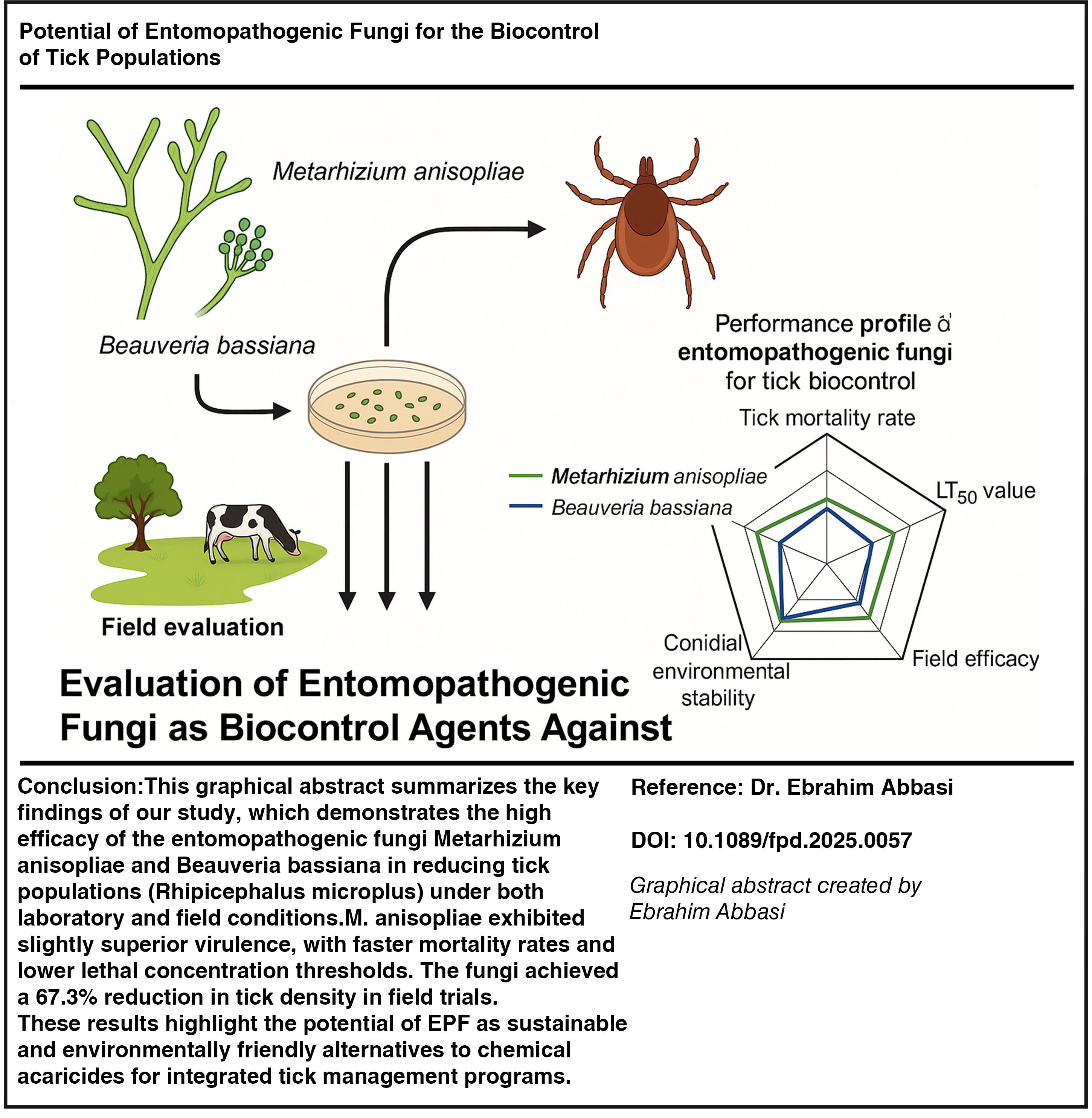
Field trials confirmed the efficacy of M. anisopliae and B. bassiana under natural conditions. Tick population density in treated plots declined by 67.3% ± 4.5% within 4 weeks of fungal application, whereas control plots exhibited only a 12.8% ± 2.1% reduction (p < 0.001). These findings suggest that EPF can effectively suppress tick populations in real-world settings, provided environmental conditions are favorable for fungal survival and infection, Reduction in tick population density following field application of EPF (Fig. 1). Mean tick density (ticks/m2) was measured at baseline, 4 weeks, and 8 weeks post-treatment across three treatment plots. Both M. anisopliae and B. bassiana significantly reduced tick populations over time compared with control plots (p < 0.001). Data are expressed as mean ± SD based on triplicate sampling per plot. Shaded error bars represent standard deviation. Decimal points have been used in accordance with English-language formatting conventions (das Neves et al., 2014; Ulrich and Boon, 2001).

Comprehensive performance profile of entomopathogenic fungi as biocontrol agents against ticks.
Discussion
The present study provides evidence supporting the efficacy of two EPF, M. anisopliae and B. bassiana, in controlling populations of R. (B.) microplus, a tick species of significant veterinary importance. Both fungi caused substantial mortality in adult and nymphal stages under laboratory conditions and achieved notable reductions in tick density under field settings. These findings not only confirm the pathogenic potential of these fungi but also highlight their relevance as viable alternatives to conventional chemical acaricides, particularly in light of increasing acaricide resistance, environmental contamination, and risks to nontarget species (Parveen et al., 2025; Vivekanandhan et al., 2024).
Among the two species tested, M. anisopliae demonstrated slightly higher virulence, as reflected by lower LT50 and LC50 values. This may be attributed to superior cuticle penetration ability and more efficient production of hydrolytic enzymes such as proteases and chitinases. Nonetheless, B. bassiana also exhibited considerable pathogenicity, suggesting its utility, particularly in integrated control programs where fungal diversity might provide resilience across variable ecological conditions. The inclusion of both fungi—whether applied alternately, sequentially, or in combination—could potentially increase biocontrol success, delay resistance development, and extend residual activity under diverse environmental pressures. Despite promising outcomes, the effectiveness of fungal agents in the field was significantly influenced by environmental variables, especially temperature and UV radiation. Conidial viability declined sharply under prolonged exposure to high temperatures and direct sunlight, conditions typical of open-field habitats. Such limitations underscore the importance of formulation improvements—such as the use of oil-based carriers, UV-protective additives, or encapsulation technologies—to enhance fungal persistence. Moreover, strategic targeting of shaded microhabitats and optimization of application timing can substantially improve fungal efficacy in natural environments (Rajput et al., 2024; Swathy et al., 2024).
One of the key advantages of EPF over chemical acaricides lies in their complex, multifactorial mode of action. Unlike chemicals that act on specific neural or metabolic targets, these fungi infect hosts via physical adhesion and enzymatic penetration, followed by internal proliferation and host death. This broad-spectrum biological mechanism reduces the likelihood of resistance evolution. Furthermore, due to their host specificity and natural occurrence, these fungi exert minimal negative effects on beneficial arthropods, pollinators, and soil microbiota, reinforcing their role in sustainable agriculture and animal health management. Nonetheless, several challenges must be addressed before these agents can be widely adopted in livestock systems. The production and stabilization of fungal conidia on a commercial scale remains a technical bottleneck. High production costs, variability in conidial quality, and limitations in shelf life pose operational challenges. Advances in fungal biotechnology, including strain selection, genetic improvement, and scalable fermentation techniques, are crucial for overcoming these barriers. Further, combining fungal biocontrol with complementary approaches—such as pheromone traps, biological competitors, antitick vaccines, and habitat management—will be critical to the success of ITM strategies (Alves et al., 2017; Swathy et al., 2024).
Climate change and environmental shifts have significantly influenced the ecology and distribution of tick populations, contributing to the resurgence and geographic expansion of tickborne diseases. Rising temperatures, altered precipitation patterns, and changes in land use may enhance tick survival and host contact rates, thereby increasing the risk of pathogen transmission. In this context, biological control methods such as EPF represent a sustainable and ecologically compatible alternative to chemical acaricides. By aligning fungal applications with favorable environmental conditions—such as shaded habitats and optimal humidity—these agents can be effectively integrated into adaptive tick management strategies. However, their success in diverse field conditions requires continued research into formulation technologies and long-term efficacy under climate-affected scenarios.
The global rise in arboviral diseases such as dengue, Zika, chikungunya, and yellow fever—primarily transmitted by mosquito vectors like Aedes aegypti—has posed serious public health challenges, particularly in tropical and subtropical regions. Concurrently, the widespread and often indiscriminate use of chemical insecticides has led to the emergence and spread of insecticide resistance among vector populations, significantly reducing the effectiveness of conventional control strategies. In this context, RNA interference (RNAi) emerges as a promising, highly specific, and environmentally friendly approach for mosquito control. By targeting essential genes involved in mosquito development, survival, or pathogen transmission, RNAi-based methods can serve as a powerful tool to suppress vector populations and mitigate the transmission of arboviral pathogens. This innovative strategy offers a sustainable and effective alternative to chemical control methods and holds considerable potential in addressing the growing challenges of arbovirus outbreaks and vector resistance (Abbasi, 2025g; Abbasi et al., 2025b; Abbasi and Daliri, 2024a; Abedi-Astaneh et al., 2025; Talbalaghi et al., 2024).
In light of the increasing burden of vectorborne diseases such as dengue, chikungunya, and Zika, which are predominantly transmitted by Aedes mosquitoes, there is an urgent need for integrated and innovative approaches to disease management. Traditional methods based on chemical insecticides have become less effective due to the widespread emergence of insecticide resistance among vector populations. The current article highlights the potential of RNAi as a cutting-edge, species-specific, and ecofriendly strategy for vector control. In parallel with such genetic and molecular technologies, advances in diagnostic tools, vaccine development, and antiviral therapies offer promising avenues for improving the treatment and prevention of these diseases. Combining RNAi-based interventions with novel therapeutics and precision public health strategies can enhance the overall effectiveness of vectorborne disease control programs and pave the way toward sustainable and long-term solutions to these escalating global health threats (Abbasi, n.d.b; Abbasi, n.d.c; Abbasi and Moemenbellah-Fard, 2024; Abbasi and Saeedi, 2022).
Climate change has profoundly influenced the ecology and distribution of vectorborne diseases, including those transmitted by ticks. Rising temperatures, altered precipitation patterns, and increased humidity create favorable microhabitats that support tick survival, reproduction, and geographic expansion. These environmental shifts not only extend the activity period of ticks but also enhance their interactions with animal hosts, thereby increasing the risk of pathogen transmission. As climate change continues to exacerbate the global burden of tickborne illnesses, there is an urgent need for sustainable control strategies that can adapt to shifting ecological dynamics. In this context, EPF such as M. anisopliae and B. bassiana present a viable biocontrol alternative to chemical acaricides. Their demonstrated efficacy under both laboratory and field conditions, particularly when applied strategically to environmentally stable zones, underscores their potential to mitigate the public and veterinary health impacts of climate-sensitive vectorborne diseases (Abbasi, 2025a, 2025b, 2025d, 2025e, 2025f).
The presence of virulence factors such as hemolysins, adhesins, and secretion systems identified in the genomic analysis of the strains under study highlights their potential role as foodborne pathogens. These genetic determinants have been widely implicated in the pathogenic mechanisms of several foodborne bacterial species, including Escherichia coli, Salmonella spp., and Listeria monocytogenes. The detection of antimicrobial resistance genes alongside virulence markers further raises concerns regarding their impact on public health, especially in the context of contaminated food products. This underscores the necessity of monitoring such strains in food sources to prevent potential outbreaks of foodborne diseases (Abbasi, 2025c; Alivand et al., 2024; de Noordhout et al., 2014; Kaper et al., 2004; Scallan et al., 2011).
Conclusions
This study provides compelling evidence that the EPF M. anisopliae and B. bassiana possess substantial biocontrol potential against R. (B.) microplus, one of the most economically significant tick species affecting livestock. Both fungal isolates demonstrated high levels of virulence in laboratory conditions and considerable efficacy in field trials, with M. anisopliae displaying slightly superior performance based on LT50 and LC50 values. Importantly, this research highlights that while EPF offer a promising alternative to chemical acaricides, their success in field applications depends heavily on environmental conditions. Factors such as high temperature, low humidity, and UV exposure were shown to reduce conidial viability, emphasizing the need for optimized formulations (e.g., oil-based or UV-protective carriers), strategic timing, and targeted application zones (e.g., shaded areas). From a sustainability and ecological perspective, the integration of these fungi into broader integrated pest management frameworks offers a viable pathway to reduce acaricide resistance, minimize environmental contamination, and protect nontarget species. As such, EPF could play a central role in future livestock health strategies, especially in regions where conventional control methods are no longer effective or environmentally acceptable. Future research should focus on (1) long-term monitoring of tick population dynamics following repeated fungal applications, (2) comparative genomics to identify high-virulence fungal strains with environmental resilience, (3) development of cost-effective mass production and formulation technologies, and (4) evaluation of synergistic interactions with other biological agents or vaccine-based controls. In conclusion, M. anisopliae and B. bassiana offer not only effective tick suppression but also align with the growing need for sustainable and ecologically sound vector management solutions. Their adoption in veterinary parasitology and vector control programs represents a step forward in the transition from chemical-intensive to biologically informed tick control systems.
Footnotes
Data Availability Statement
All data generated or analyzed during this study are included in this published article.
Author Disclosure Statement
The authors declare no competing interests.
Funding Information
This research received no specific grant from any funding agency in the public, commercial, or not-for-profit sectors.