







Abstract
Abstract
Objective:
Numerous serious games and health games exist, either as commercial products (typically with a focus on entertaining a broad user group) or smaller games and game prototypes, often resulting from research projects (typically tailored to a smaller user group with a specific health characteristic). A major drawback of existing health games is that they are not very well described and attributed with (machine-readable, quantitative, and qualitative) metadata such as the characterizing goal of the game, the target user group, or expected health effects well proven in scientific studies. This makes it difficult or even impossible for end users to find and select the most appropriate game for a specific situation (e.g., health needs). Therefore, the aim of this article was to motivate the need and potential/benefit of metadata for the description and retrieval of health games and to describe a descriptive model for the qualitative description of games for health. It was not the aim of the article to describe a stable, running system (portal) for health games. This will be addressed in future work.
Methods:
Building on previous work toward a metadata format for serious games, a descriptive model for the formal description of games for health is introduced. For the conceptualization of this model, classification schemata of different existing health game repositories are considered. The classification schema consists of three levels: a core set of mandatory descriptive fields relevant for all games for health application areas, a detailed level with more comprehensive, optional information about the games, and so-called extension as level three with specific descriptive elements relevant for dedicated health games application areas, for example, cardio training.
Conclusion:
A metadata format provides a technical framework to describe, find, and select appropriate health games matching the needs of the end user. Future steps to improve, apply, and promote the metadata format in the health games market are discussed.
Introduction
S
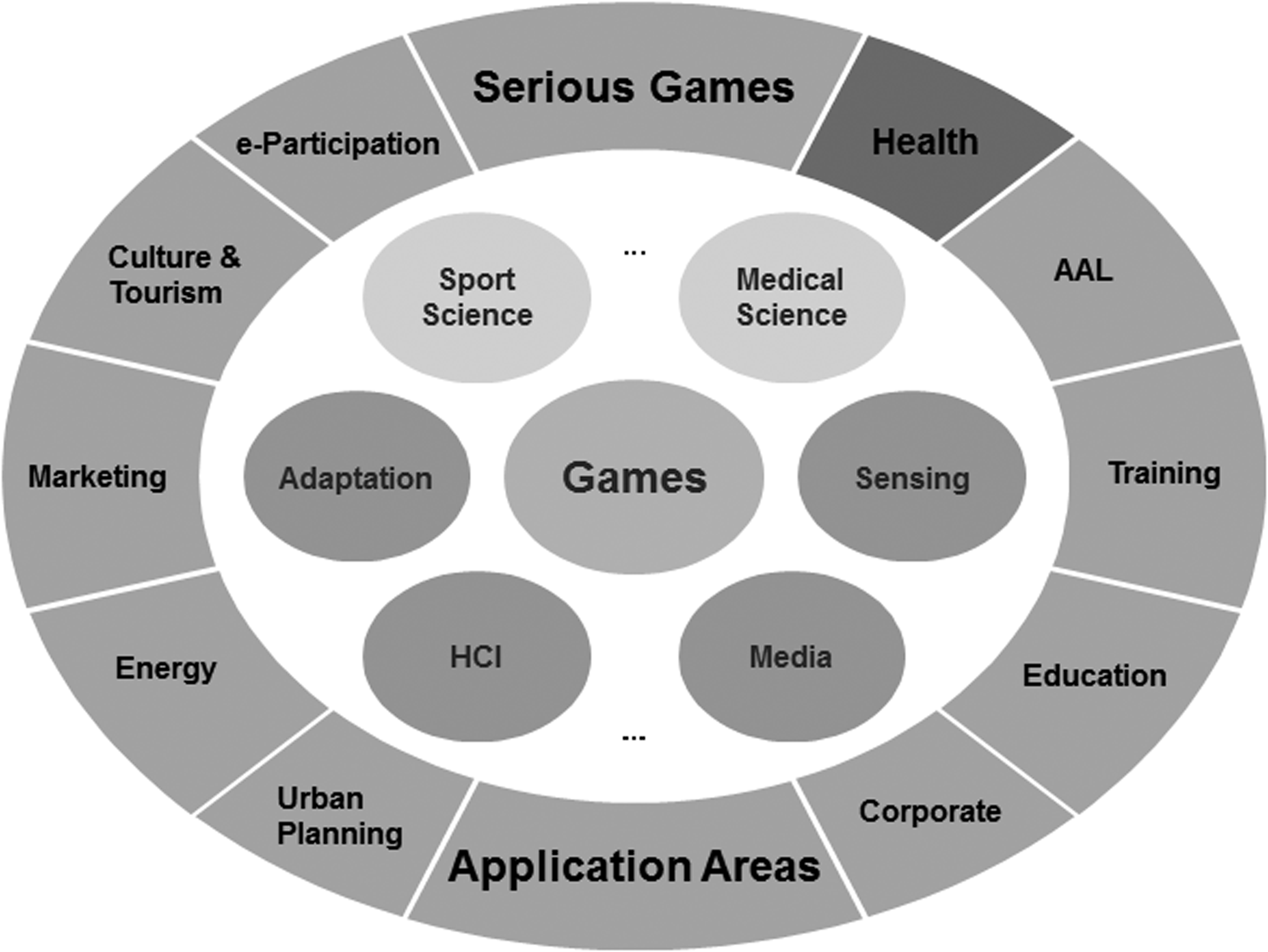
Conceptualization of serious games, applied in a broad spectrum of application areas.
Serious games have been investigated across a wide range of domains, including education2–6 and health with various health indicators 7 among others, behavior change in fruit and vegetable consumption, 8 obesity,9, 10 and rehabilitation. 11 Overall, research evidence has highlighted the potential of serious games for healthy lifestyle promotion. 12
While the application of advanced gaming concepts and game technology applied to nonleisure contexts (e.g., health) is a logical and promising approach (e.g., addressed by funding programs such as Advanced Gaming by the European Commission), acceptance by the gaming industry (game developers, publishers), intermediaries (doctors, therapists), and end users (individuals, patients) is low, resulting in a lack of market breakthrough. Potential reasons for this include (a) low development budgets resulting in low quality (content, graphics, story, gameplay, game experience) of existing serious games/health games, (b) the complexity and cost-intensive, multidisciplinary development of serious games matching the needs of individuals and groups, and (c) lack of empirical regarding the beneficial effects of serious games—as decision basis for potential customers to invest into games for nonleisure contexts. These statements are based on discussions with representatives of the German association of game developers, interviews with providers of best-practice examples for serious games, 13 and lessons learned from collaborative projects in the field of games for health with research partners, industry, intermediaries, and users (e.g., doctors, therapists, residential home for the elderly, youth people). a
Notwithstanding the potential of serious games, a drawback is that they are not very well described and attributed with (machine-readable, quantitative and qualitative) metadata such as the characterizing goal of the game, the target user group, and expected health effects well proven in studies. Therefore, it is difficult for end users (individuals, private persons) or intermediaries (doctors and therapists)—using search engines—to select the most appropriate game for a specific situation (user characteristic and needs). In this article, we outline a descriptive model for the formal description of serious games and health games. Subject matter experts (scientists, doctors, and therapists), game developers, and publishers, as well as organizations hosting game archives, are invited to contact the corresponding author and contribute to the introduced metadata format for serious games (MDF-SG) and health games.
Methods
Toward a descriptive model for the formal description of serious games and health games
To achieve a descriptive model (metadata format) for health games, a multistage approach was considered. In stage 1, the MDF-SG proposed by Göbel et al. 14 (described below) was used as the conceptual basis. Second (stage 2), different classification schemata of existing health game repositories were considered. Finally (stage 3), the resulting schema was checked and validated with the descriptive format for “videogames for health,” which has been provided by the editors of the Games for Health Journal for the description and analysis of health games. Each of these stages is described below.
Stage 1: Developing a metadata format
The term metadata originates from the discipline of librarians and libraries, and involved a structured mechanism to facilitate the description and retrieval of published books and articles. For example, author, publisher, date created and date modified, and number of pages or file size are examples of very basic document metadata in the library discipline. Having the ability to filter the metadata makes it easier for librarians and readers to locate a specific document. The concepts of metadata o has been adapted to different other application areas, for instance, geographic information—resulting in the ISO standard “19115 Geographic Information–Metadata,” b which provides a classification schema for the formalized description of geo-referenced information.15–17
Technically, metadata format follows common approaches for structuring data and metadata formats and models applied by the ISO standardization group for different application sectors. Hence, the format is structured in three levels (Fig. 2): A core level summarizing elementary, mandatory information relevant for all kinds of serious games (Level 1), a detailed level providing more comprehensive information with mandatory and optional description elements (Level 2), and so-called extensions or application profiles (Level 3) providing information relevant in a specific application domain, but not applicable for all domains of the broad spectrum of serious games application fields. Examples of application profiles include educational games with description elements about learning processes and learning goals and proposed learning effects or health games providing information about a desired health effect, underlying training programs, clinical studies proving the effects, and so on.
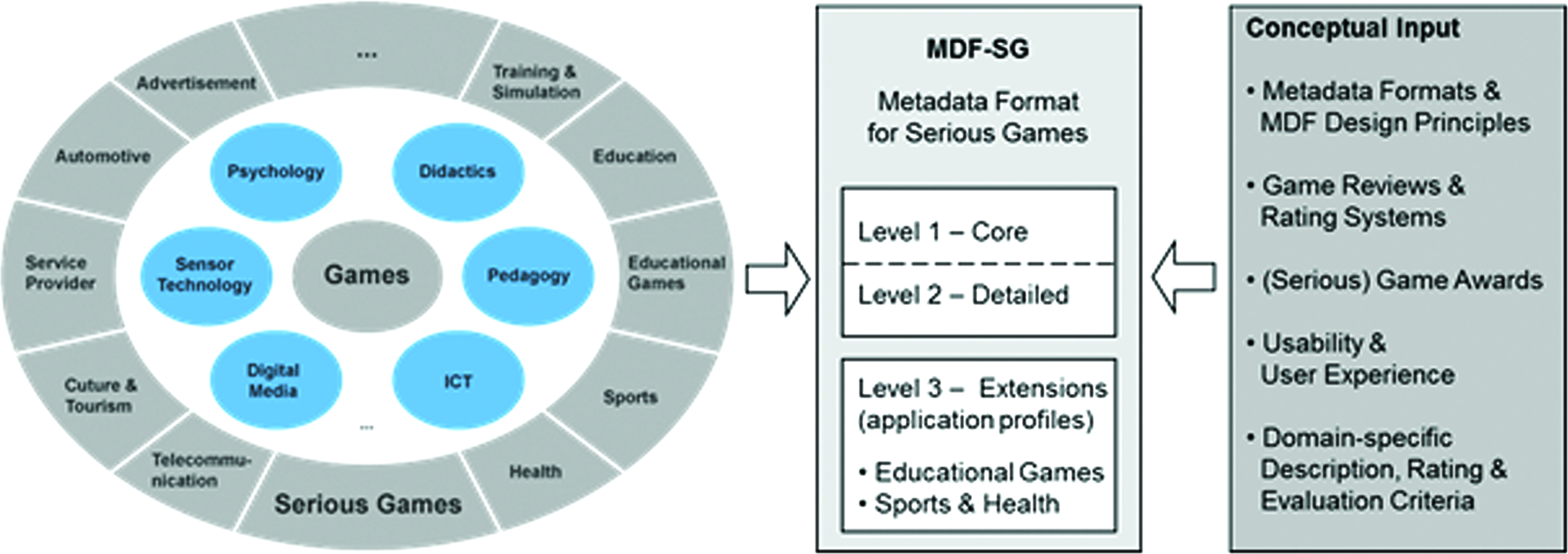
Level schema of a metadata format for serious games: “Core,” “Detailed,” and “Extensions.”
Level 1 is intended to provide a brief summary of a serious game, which will enable potential users and customers to get a rough idea about the quality, innovation, proposed effects, and use of a game and serving as selling item for game providers. The core set of elements include the “Title” and an “OVERALL_SCORE” (rating of the game by experts and/or users), “General Information” providing information about involved parties (in the game development process), recommendations (e.g., awards) and distribution information, information about the “Use” such as application fields, and a summary about (proposed, opt. proven) effects, a “Game Synopsis” summarizing the game idea, story, gameplay, and game genre, information about usability and user experience aspects, economic information such as the price (models), and “Other” information about system requirements, the stability, and robustness of a game or the level of support. Level 2 provides a more comprehensive description of the games—according to the same main categories of Level 1—and might also serve as instrument for editors (e.g., game magazines) or jury members to measure and score the quality of a game.
Stage 2: Validating the schema with health game repositories
Existing repositories for games, serious games, or health games differ not only in the amount of recorded games but also both in terms of (the size of) the covered application spectrum and the granularity of underlying classification schemata.
Probably the biggest and most elaborated database (especially dedicated) for health games is provided by the “Health Game Research” national program in the United States funded by the Robert Wood Johnson Foundation. The database contains (status: October 5, 2014) 432 games, 488 publications, 157 resources, 853 organizations, and 85 events. The games c are attributed by 37 categories/health topics from “Allergies” to “Visual Health.” Further attributes—also serving as search terms in the database—include information about the target population (target user group such as adults, children, or healthcare professionals) of a game, publication, or resource, the game platform (e.g., arcade, game console, PC, or Internet), the publication type (book, journal, etc.) and resource type corresponding to publications and resources (e.g., archive, game engine, or online community), the organization type (e.g., game development studio, publisher, sponsors of institutions such as museums where games are running) and the event type (e.g., conference, festival, or workshop) according to organizations and events, and information how to obtain games (download, free, purchase, subscription, etc.). More concrete, individual games—illustrated by the outdoor exergame “Active Life Outdoor Challenge” d —are described with the title of the game, an illustration, a set of keywords (“Adults,” “Children,” “Exergame,” “Nintendo Wii,” “Physical Activity,” “Racing,” “Sports,” and “Teens”), the name of the publisher and developer of the game, website(s) where to find the game, a short free text description of the game (“In this Nintendo Wii exergame, players move their upper and lower bodies by using the Wii remote and a game mat. This game involves more than a dozen fast-paced activities, such as log jumping, river rafting, and a minecart adventure.”), and further information about the topic (“Exercise and Fitness”), target population (“General Audience”), and game platform (“Game Console”).
The “Serious Game Classification System” e provided by the Ludoscience f group in France launched in 2006 18 is more generic and covers the broad spectrum of application domains for serious games in general (3076 serious games in total). Hereby, the research work and subsequently the structure of the underlying taxonomy for the serious games classification system (SGCS) are focused on the analysis and derived theoretical model of gameplay principles. The games are classified according to their overall category, their gameplay, their purposes, their markets, and target audience, alongside with user-contributed keywords. The category is deduced from the kind of gameplay and the market of a title/game, for example, “videogame,” “video toy,” “serious game,” “retro serious game,” indicating that the game was published before 2002 as well as subcategories such as “advergame,” “edugame,” or “exergame,” following the market and purpose of a game. The gameplay distinguishes two gameplay types: “Game based” for games with clear goals to reach in the game and “play based” for games without clearly stated goals and corresponding scoring mechanisms to evaluate the performance of a player. Whereas the game purpose(s) (e.g., educative message broadcasting, training, goods trading, or storytelling) and targeting market(s) (e.g., entertainment, state and government, military and defence, healthcare, education, corporate, religious, culture and art, ecology, politics, humanitarian and caritative, media, advertising, and scientific research) are closely coupled, the target audience is classified in age groups ranging from “0 to 3 years old” to “60 years+” as well as domain values such as “general public,” “professionals,” and “students.” A quick search provided by the classification system offers a text field for keyword search as well as checkboxes for direct playable or downloadable games. The advanced search mode offers radio buttons for searching a videogame, a video toy, or both. Furthermore, the classification system provides different (database) views to browse the system and search for a dedicated set of serious games: A “Thumbnail” view provides a preview image, the title, and year of a game. A “Details” view lists the title, year, supported platforms, the creator, editor, and country of a game, a “Taxonomy” view—as conceptual basis of the classification system—focuses on the gameplay, purpose, market, and audience, a dedicated “Gameplay” view separates games according to the (gameplay) goals and means, and finally a “Keywords” view focuses on keywords in addition to the title and year of a game. Individual games in the classification system are attributed with all the categories mentioned above plus a brief description of the game (including snapshots), a hyperlink, distribution information, and information about/links to related games with a similar characteristic.
The Serious Games Association also provides a serious games directory covering nine serious games application areas (e.g., “Corporate,” “Education,” and “Health Care/Medical” g ). In this study, basic information for the (19) health games listed in the archive include elementary information such as the title of the game, the game platform(s), the market, and a short description of the game. When selecting one particular game—as an example let us visit the cognitive brain training game “Braingymmer” h —narrower information includes the link to the website of the game, a snapshot of the game (here: game platform), comprehensive developer information (including the address and contact information), comprehensive publisher information (website, contact, available outlets, quantity order/pricing information, year developed, typical hours of play, awards/certifications/rankings, measuring performance/learning), and additional information such as a generic contact for any further questions.
Stage 3: Description format for health games by the Games for Health Journal
The description format provided by the editors of the Games for Health Journal to introduce and to evaluate videogames for health 19 referring to their effects (physical activity, behavior change, etc.) provides the following essential categories/description elements: “Health topics,” “targeted age groups” and “other targeted group characteristics,” a “short description of the game idea,” “target player(s)” (e.g., individuals, small groups, or massive multiplayer online environments), “guiding knowledge behavior change theory(ies), models, or conceptual frameworks,” “intended health behavior change(s),” “knowledge element(s) to be learned,” “behavior change procedure(s) or therapeutic procedure(s) employed,” whether clinical or parental support is needed, whether data are shared with parents or clinicians (opt.) information about an underlying story in the game (described with a story synopsis and how the story relates to the targeted behavior change), information about game components (game objectives/goals, rules, and game mechanics, and procedures to generalize or transfer what's learned in game to outside the game), the (virtual) game environment (description of the setting) and (opt.) avatar information (characteristics and abilities), “game platform(s) needed to play the game” (e.g., smartphone, tablet, computer, or game consoles), “sensors used” (for human computer interaction with a game and in terms of sensing and monitoring player behavior), as well as “estimated play time.”
Authors introducing new health games are invited to (optionally) provide further information—among others—concerning involved parties in the game creation/production process (ranging from game developers and publishers to subject matter experts), testing procedures, technical insights about the game development (e.g., which game engine has been used) and game platforms (where the games are running, including game interfaces), links to related games, the optimal setting to (successfully) play a game, what the game is trying to do (game purpose, goal, intended health effect), game design aspects (e.g., level concept and gameplay mechanisms), and distribution information (including the price of a game).
Results
The analysis of existing games and health game repositories resulted in considerable overlap of generic description elements such as the title, a short description, keywords, and (opt) a preview/thumbnail of the game, the target audience (users, players), supported platforms, distribution information (how to access the game), and information about the developer and publisher of a game. The main differences exist in the covered spectrum of games (serious games in general ranging from “Advergames” to “Edugames,” “Healthgames,” and “Exergames” contrary to health game repositories covering games related to health topics from “Allergies” to “Diabetes,” “Obesity,” or “Visual Health”) and varying perspectives for the establishment and use of game repositories. Whereas the serious games directory provided by the serious games association strives for a generic system, as broad and complete as possible, the SGCS provided by Ludoscience has a more IT-related approach (with a focus on the formal description and classification of gameplay principles) and the health game repository by the Robert Wood Johnson Foundation clearly focuses on a user-centered perspective (i.e., users such as institutions, doctors, therapists, and patients as stakeholders in the healthcare arena).
The analysis results (i.e., the derived structural information) of the (health) game repositories have been set in context with the original MDF-SG provided by Göbel et al. and the description format for videogames provided by the editors of the Games for Health Journal. This results in (a) an updated version of the MDF-SG—consolidating the different classification schemata of the health game repositories described above and (b) an application profile (of the MDF-SG) for health games—focusing on the application-oriented description elements of the health game repositories.
Updated MDF-SG
The updated version of the MDF-SG (comprehensive version, Level 2 “Detailed”) is presented in a Backus-Naur-like notation. Compared to the original work in 2011, the main changes included a harmonized naming of the main elements of the format (e.g., “gameInfo” and “useInfo” instead of “game” and “use”), the former “info” element has been resolved (i.e., the subelements such as “distributionInfo” and “involvedParty” have become top level elements), the former “contentInfo” has been subsumed in the “gameInfo” element, the former “UserExperience” element has been subsumed in the “useInfo” top element, the former element “Economy” has been deleted as main element (whereby “priceInfo” has been subsumed in the “distributionInfo”), and the former “Recommendation” element has been renamed and extended to a main element “qualityInfo.” Hence, the updated top level of the MDF-SG is composed by the following main elements.
Hereby, the following symbols are used in the Backus-Naur notation: A “+” indicates that an element (e.g., distributionInfo) needs to occur at least one time, but also can occur many times. For that, the cardinality of an element is [1…n]. Elements with a “*” have a cardinality of [0…n], which means that the preview also might be empty. The cardinality of elements with a “?” is [0 … 1], that is, for instance, the qualityInfo is optional and might be provided (exactly one time) or could be left empty. Elements without a following symbol are mandatory and do have a cardinality of 1, that is, there is, for instance, exactly one gameInfo element (which is composed by a set of subelements, which might have a higher cardinality again). The OVERALL_SCORE represents a (numeric) constant (typically in a range [0–10] similar to game ratings of entertainment titles).
Comments (command lines) are starting with “//.” Here, the elements and (IT-related) element types are explained. For instance, text fields are used for free text. Constants such as “CI_DATE” indicate that the MDF-SG uses some existing basic element types, which are already defined and provided by ISO for other (metadata) standards.
The keywordInfo exists of a number of keywords that might be selected from existing, well-defined keyword lists—providing well-established terminology. The use of such terminology increases the chance for successful information retrieval in a later stage.
Similar to keyword lists, the attributes for serious games application fields or targeted user groups should be based on well-established categories. Here, the (nine) categories for serious games application fields provided by the Serious Games Association or the categories and subcategories provided by the SGCS from Ludoscience are good examples of well-established lists and well-defined categories (domain values) for serious games application fields. Analogue, the classification schemata for the targeted user group(s) provided by SGCS or the health game repository from the Johnson Foundation, can be easily used for specifying the targeted user group(s).
Similar to different target user groups, a serious game or health game might be available for different platforms and might be distributed via different channels (e.g., retail or download). Here, as per distribution channel, price information is required (mandatory) and further description how to access a game might be provided (optionally).
Quality aspects might include awards for a game (providing a name, description, year, optionally a URL, etc.), quality certificates/labels, game studies or scientific evaluation studies (proving the benefit of a game in a specific environment, e.g., randomized clinical trials), as well as user ratings. Institutes/parties that provide quality label or process a game study/evaluation study might be referenced in the involvedParty element.
This kind of information becomes highly relevant when different game repositories are connected, for example, via a harvesting system collecting game information from different archives (see Discussion section).
Other information refers to additional content and features of serious games/health games, not covered by the elements listed above. For instance, further information about maintenance and technical support (if not already covered in the responsible party element), additional information about required technical prerequisites to run a game (if not covered by the platform element), or information and links to related similar games might be provided in this part. Also, production costs of a game could be (optional) specified here—whereby game developers typically are not keen (or are simply not allowed) to provide this information (according to the rules of a customer).
Analogous to the first version of the MDF-SG, a “core” set of elements (Level 1) has been extracted based on the mandatory elements of the updated metadata schema for the brief description, rating, and search/selection of serious games. Hence, core set elements include the title, abstract, keyword information, platform information, game type, application field(s) and targeted user group(s), possible age restrictions, distribution information (including price information), and information about involved parties (e.g., developer, publisher) of a game. Furthermore, the OVERALL_SCORE is kept to provide (exactly) one metric value to indicate the quality and user acceptance of a serious game.
Application profile for health games
Whereas MDF-SG Levels 1 and 2 are dedicated to describe any serious games, Level 3 is foreseen for extensions to tackle the characteristics of a specific application domain in a proper, adequate, narrower form. Based on the analysis described above, an application profile for health games has been elaborated as an extension for the MDF-SG in the healthcare domain. The conceptual basis for that profile (or “extension”) is built by the initial version of the description form(at) for videogames for health provided for health game studies in the Games for Health Journal. This original form(at) was further developed by the authors in the context of an health games/exergames expert panel in Houston, TX, in May 2014.
Table 1 presents the correlation among the essential fields of the form(at) for “Characteristics of a Video Games for Health” provided by the Games for Health Journal and the MDF-SG. Other description elements and categories used in the health games database provided by the Robert Wood Johnson Foundation can be fully mapped to Level 1 and Level 2 of the MDF-SG. Therefore, no additional changes toward an extension/application profile for health games were necessary.
cb, covered by an existing MDF-SG element (levels 1 and 2); new, additional element in the MDF (level 3).
As indicated in Table 1, application profiles—for example, a profile for health games—include both description elements of the core and detailed level for any serious games and a set of domain-specific (health related) description elements, which are only applicable for this dedicated application field. Hence, these metadata fields/description elements might be interpreted as conditional elements in the MDF-SG, only relevant for the healthcare domain.
Discussion
This article presents the development of a model for the formal description of serious games and health games. Three stages were followed to develop the descriptive model, and demonstration of the metadata format was provided. This process is in its infancy; and moving forward, both the updated MDF-SG and the application profile for health games need to be technically improved—for instance, the health games profile lacks classification into mandatory and optional fields, well-defined attribute lists/domain values for the elements, and information about the cardinality of individual description elements/metadata fields—and validated within real settings.
Within the course of the ALFRED project, a first prototypical implementation of a metadata information system has been established. Here, the MDF-SG is used as the underlying conceptual basis to describe the desired health games (with a focus on cognitive training and physical exercises in ALFRED) and build a search interface to retrieve (and run) the games. Hereby, the search engine could also serve as “harvester” (meta search engine) and directly connect to the health game repositories analyzed in this work. Further health game repositories and databases also might be connected, but here a (database) schema mapping among the underlying classification schemata and the MDF-SG will be necessary (for each repository).
Dissemination and standardization activities
Practically, apart from conceptual processes for the refinement of the metadata format (e.g., in the form of a Delphi panel among subject matter experts and game developers), dissemination strategies to promote the MDF-SG—as well as the application profile for health games—will be necessary as next steps. Similar to the analyzed existing repositories, the overall approach of this work can only be successful when a broad target audience applies the metadata format. To achieve this, a number of facilitators from the serious games community—ranging from commercial organizations such as the European and national game developer or publisher associations to networks such as the Serious Games Association, j the Serious Games Network, k and the Serious Games Society l or application-oriented communities (e.g., in the healthcare arena) and consumer associations such as the Entertainment Consumer Association m —as well as game magazines or media press will be contacted to promote the MDF-SG. Once a critical mass of users utilize the format (and see the benefit of serious games/health games), we anticipate an increase in the number of customers investigating serious/health games market, with a resulting increase in the quality of available games over time. This is the hope of the author's work, to contribute a little step forward toward the market breakthrough of serious games, finally for the benefit and health of users.
In the long-term perspective, the MDF-SG is intended to become an ISO/IEEE standard for serious games in general and health games in particular. A similar approach toward a standardized description and sharing information about educational games via a rating tool, aimed at teachers and parents, is ongoing in the field of game-based learning, where a first metadata format for (educational) serious games was introduced by Hendrix et al. 18 and updated by Elborij and Khaldi toward an IEEE LOM extension for (educational) serious games. 20
Conclusion
A metadata format for the formal description of serious games and health games is possible and feasible. Steps to achieve this were described.
Footnotes
Acknowledgments

Author Disclosure Statement
S.G. is head of the Serious Games group at TU Darmstadt and provided the conceptual draft of a metadata format for the description and evaluation of serious games. This group also participates in the EU-funded project ALFRED. R.M. declares no competing financial interests exist.