







Abstract
Objective:
To measure metabolic and physiological demand, subjective fatigue, and enjoyment during a signature 30-minute immersive virtual reality (IVR) adaptive cable resistance exergaming session.
Methods:
Fourteen healthy college-aged individuals (seven females) were initially acquainted with the IVR equipment and gameplay dynamics. Participants then underwent a 30-minute IVR exergaming session performing six different cable resistance exercises. A portable metabolic gas exchange analyzer concurrently assessed energy expenditure (EE) through indirect calorimetry while a chest-worn monitor captured heart rate (HR). Participants subsequently completed questionnaires, including the Borg scale for rating of perceived exertion (RPE), Physical Activity Enjoyment Scale (PACES), and Simulator Sickness Questionnaire (SSQ).
Results:
The mean EE, mean metabolic equivalent, and average total calories expended during the 30-minute session were 14.7 (standard deviation [SD] 2.8) kcal/minute, 12.9 (SD 0.5), and 440 (SD 84) kcals respectively. The mean HR was 176 (SD 3.1) beats per minute (bpm) with a mean max HR of 188 SD (SD 2.9) bpm. The combined training volume among all participants was 16,102 kg (SD 4137). Participants classified the IVR training session to be “somewhat hard-to-hard” with a RPE score of 14 (SD 1) while indicating the session to be “enjoyable” with a PACES score of 4.31 (SD 0.36). The participants did not report any cybersickness symptoms, demonstrating an average total SSQ score of 24.04 (SD 24.13).
Conclusions:
IVR exergaming incorporating cable resistance training elicits high EE and physiological demand with high enjoyment scores while attenuating perceived fatigue. The potential for IVR to elicit these acute training effects over long-term training periods warrants further investigation into its contribution to fitness and health.
Introduction
Video games that have merged the physical demands of exercise with the competition, diversion, and enjoyability of gameplay have been referred to as the portmanteau term “exergaming.”1,2 As a form of screen-based entertainment that links specific bodily movements to in-game actions and objectives, early exergaming systems such as Wii Fit and Xbox 360 Kinect3–6 had potential to increase daily physical exertion and enhance energy expenditure (EE) comparable with light and moderate-intensity exercise as defined by the American College of Sports Medicine.3,7–10 Notwithstanding, some of these popular exergaming systems fell well below the minimal threshold for meaningful intensity exercise and lack the fervor they once had for mitigating sedentary behavior. Very recently, exergaming has evolved to encompass even more engaging forms of exercise training by utilizing burgeoning immersive virtual reality (IVR) technology. 11
Compared with traditional exergaming, nascent IVR exergaming systems produce a three-dimensional space through wall-mounted and/or wearable body sensors with head-mounted displays (HMDs) entailing stereoscopic vision and a large field of view.12,13 This technology allows participants to enter virtual environments in real time and engage with the artificially created landscapes allowing the player to be fully immersed in the game world. The newest HMDs employ head-orientation tracking and create field-of-view's that extend 180° horizontally and 60° vertically, achieving user-perceived immersion levels not possible in nonimmersive displays.14,15 Although both IVR and traditional VR leverage gamification to increase exercise participation, early empirical evidence indicates that IVR may elicit even greater motivation2,16 and enjoyment.17,18 Moreover, studies showed that IVR studies paired with bicycling also induced greater physiological and metabolic demands as measured by heart rate (HR) and oxygen uptake without any reported differences in perceived exertion when compared with traditional nonimmersive biking.16–19 With full-body isometric resistance training, Bonetti et al. 1 demonstrated that VR-driven platforms helped modulate ratings of perceived exertion (RPE) and fatigue, and when compared with training controls without augmented reality, participants experienced greater caloric expenditure and oxygen consumption without notable differences in RPE.
Even so, the integration of IVR exergaming into resistance training remains largely unexplored. Considering the myriad of benefits resistance training has in concomitantly decreasing fat and increasing lean mass, increasing muscle strength and power, 20 EE, and resting metabolic rate, 21 a greater understanding of IVR resistance training has the potential to improve health and fitness. According to the latest Physical Activity Guidelines for Americans, participating in 150–300 minutes of moderate-intensity activity, or 75–150 minutes of vigorous-intensity activity per week achieves optimal health benefits.22,23 The guidelines also recommend muscle strengthening activities that activate all major muscle groups twice a week. IVR exergaming systems may offer a solution for promoting greater public engagement in exercise while concurrently reducing sedentary pastimes. Past applications of VR and IVR within the clinical realm has elucidated potential benefits as a supplement to conventional treatment and therapy for managing psychiatric, musculoskeletal, and neurological disorders.24–27 Robust scientific studies are needed to further understand these benefits and applicability in consumer-based exercise training.
The purpose of this study was to measure metabolic (i.e., EE) and physiological (i.e., HR) requirements during a single 30-minute session using a novel IVR-based cable resistance exergaming machine (Black Box VR®, Boise, ID). Since our cohort had roughly an equal number of men and women, our secondary objective compared study outcomes between sexes. Although our main goal was to assess the efficacy of this IVR exergame regimen, it was pertinent to acknowledge the potential effects of sex differences (i.e., body mass and aerobic capacity). Nevertheless, we hypothesize that integrating IVR exergaming with resistance exercise may elicit moderate to high levels of physiological and metabolic demand while optimizing enjoyment.
Methods
Recruitment
Fourteen volunteers (aged 19–28 years, seven females) were recruited from the University of California, Los Angeles (UCLA) campus and surrounding area. Sample size was calculated based on a pre-hoc power analysis using the EE reported in a previous study of similar design 28 assuming α = 0.05 and β = 0.2. Inclusion criteria maintained that participants be healthy and physically active, exercising a minimum of 30 minutes at least three times a week. This ensured that participants were physically able to perform the IVR sessions safely and effectively. Exclusion criteria included the presence of musculoskeletal, cardiovascular, pulmonary, metabolic, or other disorders that would preclude moderate-to-high intensity exercise participation and testing. All participants provided written informed consent at the beginning of the study. This research was approved by the UCLA Institutional Review Board and carried out fully in accordance with the ethical standards of the Helsinki Declaration.
Protocol
IVR exergaming system
The IVR exergaming system (Black Box VR) employs a servo-based electromagnetic adaptive resistance mechanism. The system also includes an HMD (HTC Vive Pro®, Taipei, Taiwan), automated support pad, and pair of resistance handles that adjust up and down on articulating carriages to automatically configure for all cable resistance exercises. The system's HMD and wrist-worn sensors process movement data to ensure proper syncing between the user's actions and the IVR gameplay.
Equipment
A portable lightweight (∼800 g) metabolic analysis system (PNOĒ®, Palo Alto, CA) was used to determine EE during the IVR exergaming session. This portable indirect calorimeter measured breath-by-breath ventilation and concentration of expired gases. The PNOĒ system, which has been previously validated 29 and successfully utilized in exercise research,30,31 was attached by a shoulder harness to the participants' upper back. Participants wore a standard facemask and head support (Hans Rudolph, Inc.®, Shawnee, KS) and breathed through a microelectromechanical hot film anemometer flow sensor that directed expired air to the gas analyzer for measures of oxygen consumption (VO2) and carbon dioxide production (VCO2). The gas analyzers were calibrated before each assessment per manufacturer instructions. Average calorimeter data were calculated for the entire session by analyzing 5-second epochs. The abbreviated Weir formula was used to determine average EE. 32 Standard resting EE values (3.5 mL/kg/min) were used to determine metabolic equivalents (METs). HR during the session was recorded in 5-second epochs through a chest strap (RS400; Polar Electro, Inc.®, Kempele, Finland) and simultaneously time-aligned with the portable indirect calorimeter.
Study phases
Familiarization and habituation
Participants first observed a 12-minute instructional video and were fitted with the VR-headset and wrist sensors. Thereafter, they completed nine 30-minute successive habituation sessions (no more than thrice weekly within 5 weeks) where they followed in-game training prompts and learned gameplay strategy. This controlled for the effects of exergaming expertise by enabling participants to practice the cable resistance exercises and acclimate to the virtual reality environment and intensity level of the IVR exergame sessions.
Testing
For the 10th session, participants were measured for standard anthropometric measurements, including height using a precision stadiometer (Seca®, Hanover, MD), body mass, and percentage body fat through a validated multifrequency multisegmental bioelectrical impedance device (270; InBody Co.®, Seoul, South Korea). 33
Measurement of a 30-minute IVR exergame session
The same researcher assisted all participants in donning their HMD, wrist sensors, portable metabolic analyzer, and HR monitor (Fig. 1). Since participants already underwent nine “habituation” sessions, no further instruction regarding the IVR exergame was provided. Once testing equipment were fitted, the researcher initiated the 30-minute testing session and began collecting HR and EE data. The exergame was similar to traditional tower defense where the user's goal was to protect their crystal by fending off enemy units while concurrently dealing damage to the opponent's crystal (Fig. 2). Six cable resistance exercises (i.e., lat pulldown, chest press, row, overhead press, stiff-leg deadlift, and squat) were linked to in-game attacks and each exercise corresponded to a unique attack move. The damage delivered was dependent on the cable resistance level. Per the manufacturer, the exergame system's proprietary software adjusted the resistance when 12–14 repetitions were completed per set at 60%–70% of the users automatically calculated one rep maximum. In addition, the attack moves were based on elemental categories such as fire, water, and air, and could be selected to counter enemy actions (i.e., a squat performed a water attack, which is best used against fire enemies). Thus, selection of individual exercises was in part determined by gameplay strategy, but the level of intensity and number of repetitions performed were entirely dependent on the user's ability.
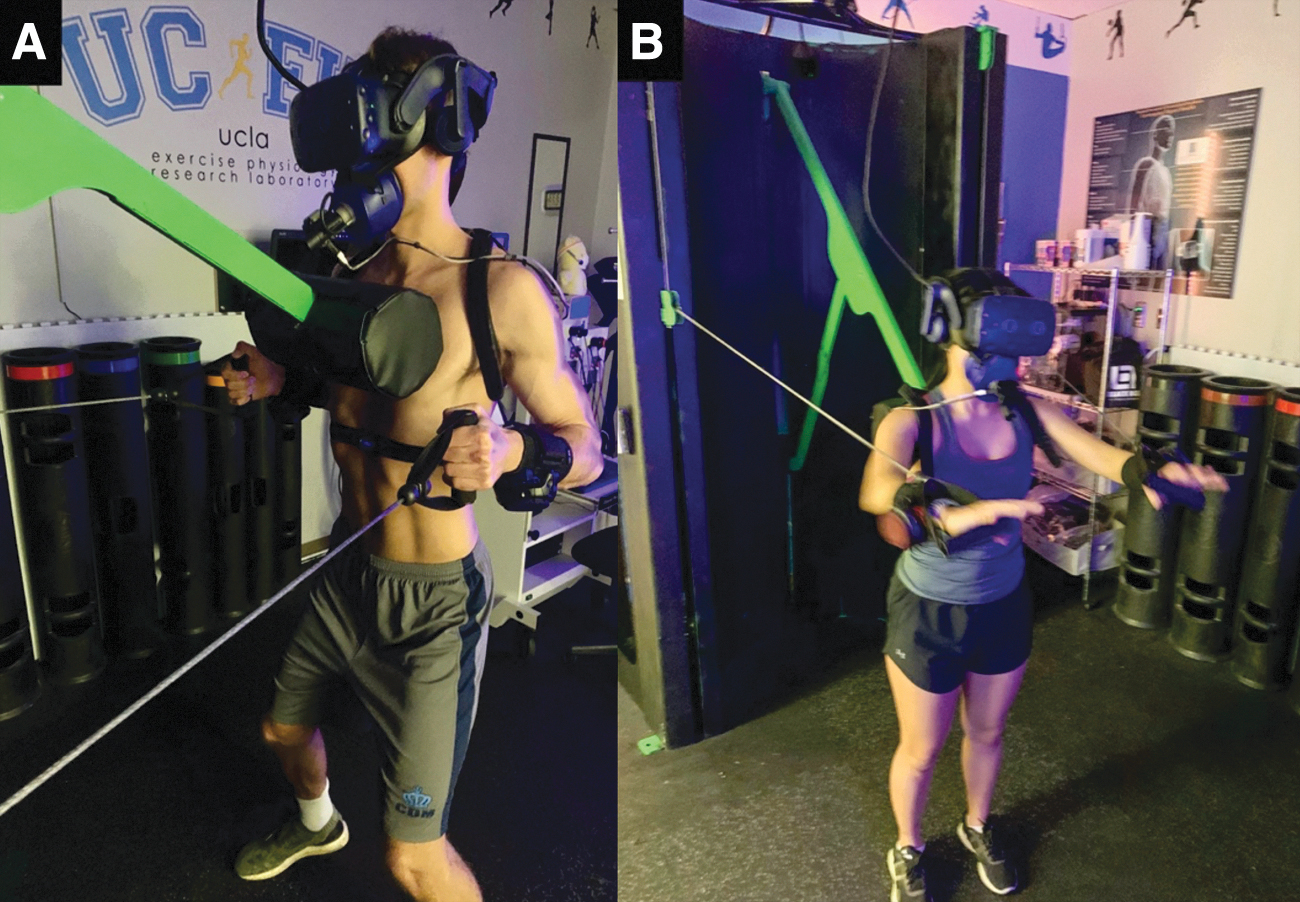
Participants donning the HMD and wrist-worn motion sensors during the IVR exergaming session while simultaneously being measured by a portable metabolic gas analyzer and heart rate chest strap monitor.

Screenshot of IVR gameplay (as seen through the head-mounted display); picture inset of Black Box VR System.
Post-IVR Session Questionnaires
Immediately after the testing session, participants completed the (1) Borg scale for RPE with perceived level of exertion on a scale from 6 (no exertion at all) to 20 (maximal exertion),34,35 (2) the Physical Activity Enjoyment Scale (PACES) with level of enjoyment on a scale from 1 (strongly disagree) to 5 (strongly agree), 36 and (3) the Simulator Sickness Questionnaire (SSQ) with perceived motion sickness and cybersickness symptoms on a 4-point scale (0–3) and categorized based on oculomotor discomfort, disorientation, and nausea.37,38
Statistical analysis
Descriptive statistics are presented as mean (standard deviation [SD]). We also compared data between sexes as differences in muscle mass and aerobic capacity may contribute to training volume, hence effecting metabolic and physiological outcomes. Statistical significance was determined based on α = 0.05, and all tests were two-tailed. Continuous variables were first assessed for normality through Shapiro–Wilk tests. Between-group comparisons were made by Welch's t-tests as all data did not significantly deviate from normality. A Holm–Bonferroni correction to control the familywise error rate was applied. Effect sizes were measured by Hedges' g. Analysis was performed in Excel (Microsoft Corporation®, Redmond, WA) and R (version 4.0.3; R Foundation for Statistical Computing®, Vienna, Austria).
Results
Demographics
Fourteen participants (n = 7 women) successfully completed the study. Mean age (SD) was 22.5 (2.8), 22.0 (2.4), and 23.0 (3.2) for all, males, and females, respectively. Mean height (cm), weight (kg), and body fat (%) for all was 173 (9), 68.0 (11.6), and 18.5 (6.8), respectively. Compared with females, the males were significantly taller [180.3 (6.6) vs. 165.5 (4.3) cm; P = 0.009 Hedges' g = 2.69], heavier [77.6 (7.9) vs. 58.4 (3.6) kg; P = 0.007 Hedges' g = 3.13] and possessed lower body fat [13.0 (3.9) vs. 24.0 (3.6) %; P = 0.003 Hedges' g = 2.93].
Metabolic demand and HR
Table 1 displays the total EE, METs, and HR observed during the 30-minute exergaming session. EE was greater in men for kcal/min (P = 0.001; g = 4.64), total kcal (P = 0.001, g = 4.66), and METs (P = 0.029, g = 2.00). Conversely, females demonstrated higher average HR (P = 0.020, g = 2.00) and HR as a percentage of HRmax (P = 0.018, g = 2.00).
Physiological and Metabolic Metrics During 30-Minute Immersive Virtual Reality Session
bpm, beats per minute; HR, heart rate; METs, metabolic equivalents of task; SD, standard deviation.
Resistance training volume
The combined mean training volume of all exercises (collected by IVR exergame application) among all participants was 16,102 kg (SD 4137), with men and women lifting 20,000 kg (SD 1161) and 12,203 kg (SD 512), respectively (Fig. 3). Men achieved greater volume on chest press (P = 0.005, g = 3.64), overhead press (P = 0.001, g = 3.69), stiff-leg deadlift (P = 0.002, g = 3.22), squat (P = 0.015, g = 2.67), and combined total (P < 0.001, g = 8.69). There were no significant differences between sexes in load achieved on the lat pulldown or row. There was also no significant difference between men and women for time spent on any individual exercise during the 30-minute training session.
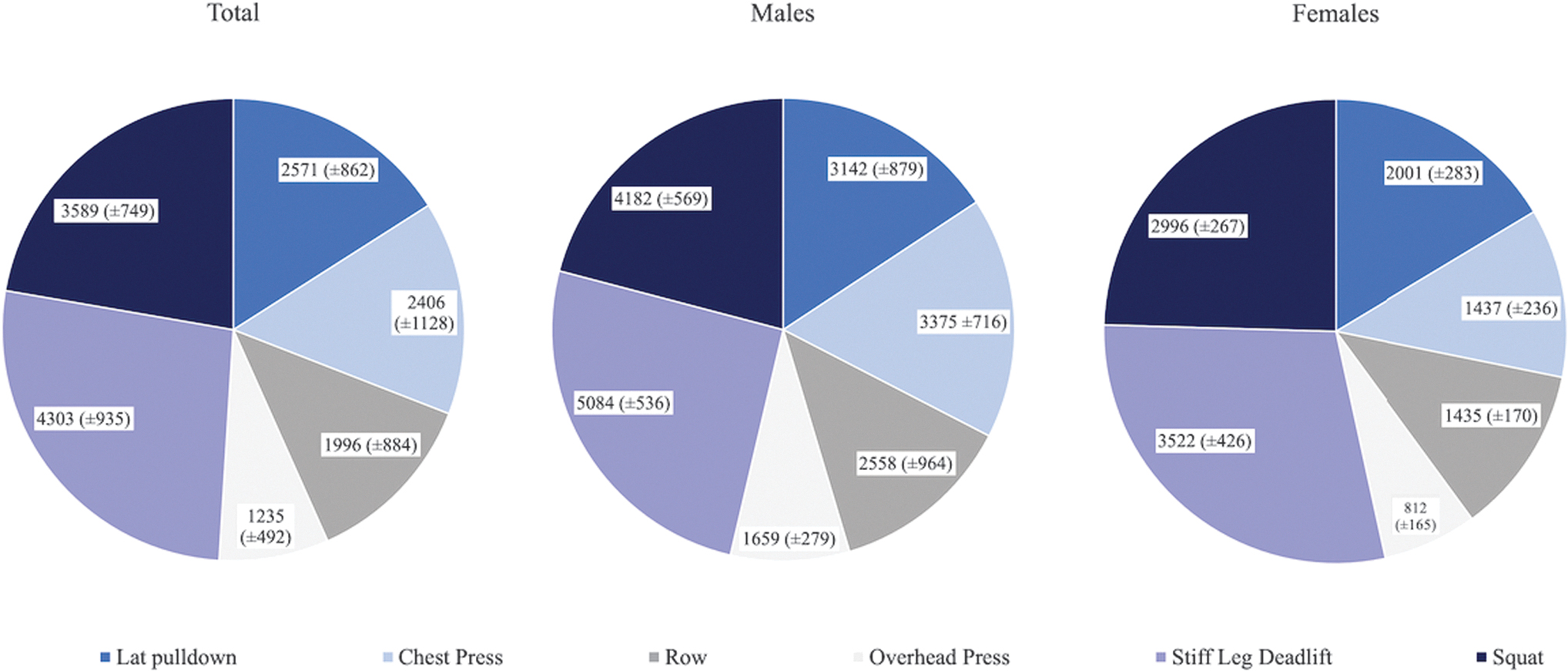
Training volume mean (SD) for each resistance cable-exercise during IVR exergaming session. SD, standard deviation.
Post-IVR Session Questionnaires
As a whole, participants classified the IVR training session to be “somewhat hard-to-hard” with a RPE score of 14 (SD 1) while indicating the session to be “enjoyable” with a PACES score of 4.31 (SD 0.36). The participants did not report any cybersickness symptoms, demonstrating an average total SSQ score of 24.04 (SD 24.13). There were no differences between men and women scores on all questionnaires.
Discussion
This study is one of the first to use indirect calorimetry to measure EE and HR during an IVR cable resistance exergaming session. The findings of this study show that 30 minutes of exercise generated a mean METs of 12.9 (SD 0.5), which the Compendium of Physical Activities classifies as a “vigorous-intensity” activity. 39 The compendium was developed for use in epidemiological studies to standardize the assignment of MET intensities and express EE among thousands of physical activities and exercises. Three items in the compendium describe the energy cost of resistance exercise—light effort weightlifting and conditioning (3.0 METs), vigorous effort powerlifting and bodybuilding (6.0 METs), and total-body circuit training (8.0 METs)—and the IVR exergame session exceeded the intensity level of all three (Fig. 4). It also surpassed the MET values and EE observed in studies examining traditional single-set resistance 40 and free-weight circuit training. 41 Owing to the nature of resistance training programming and the different possibilities of choosing and marshalling exercises, rest intervals, volume, movement velocity, and training load, comparing total EE values with other studies becomes impractical. Notwithstanding, the IVR exergame session did make use of multijoint compound resistance exercises, which are known to engage more musculature that would incur a significantly larger EE.
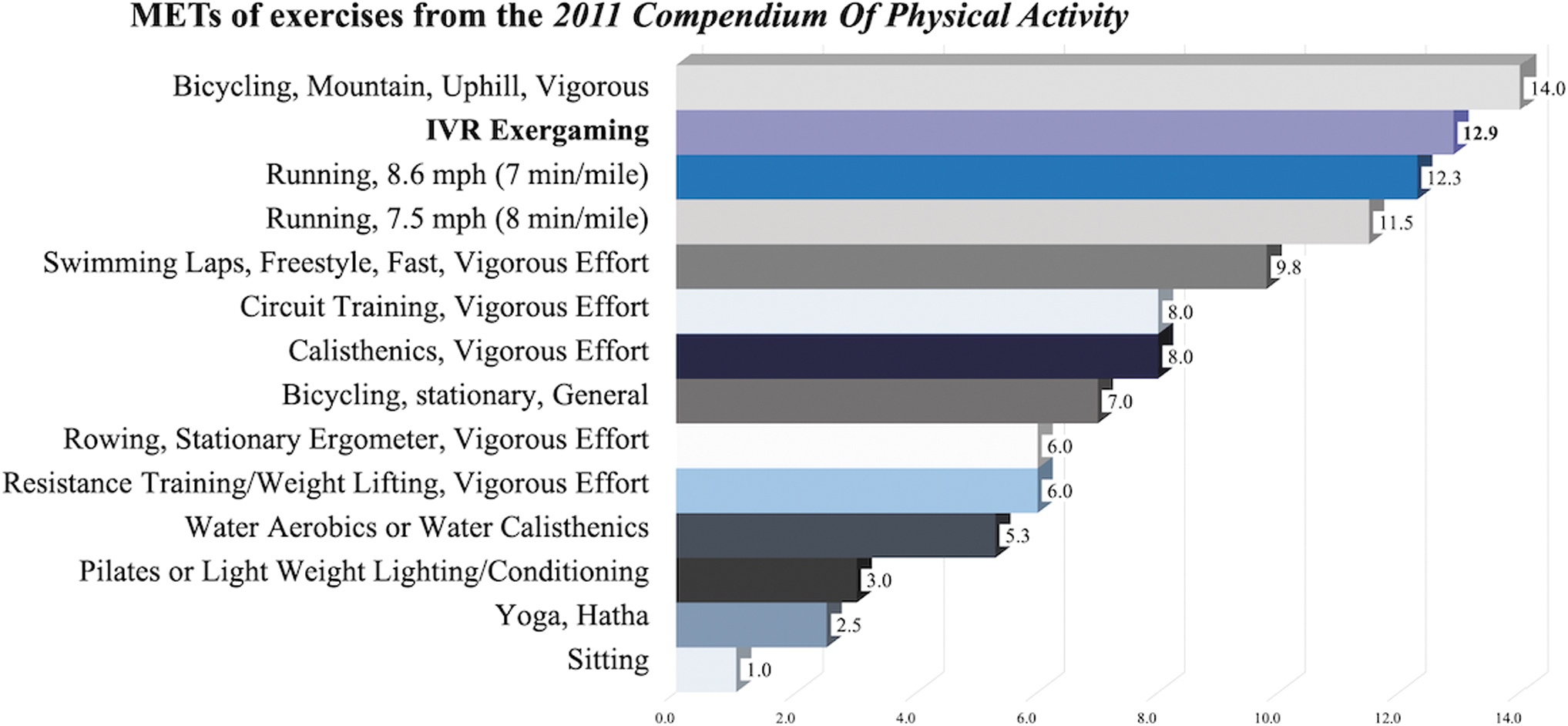
Comparing METs of IVR exergaming with other conditioning exercises listed in the 2011 Compendium of Physical Activity. METs, metabolic equivalents.
Throughout gameplay, the IVR platform's proprietary software adjusted the cable resistance based on the user's performance to push the user to, or near muscle failure. Training to such maximal levels of fatigue may elicit greater recruitment of larger motor units and explain the high levels of metabolic demand. Prior research has demonstrated 56% greater EE when training to such levels of fatigue. 42 Optimizing training with adaptable resistance intensities may also improve musculoskeletal performance and encourage greater muscle mass gains. Moreover, integration of in-game active rest intervals where users performed karate chops and air punches may further contribute to the energy cost. As depicted by the undulations of oxygen consumption throughout the 30-minute session in Figure 5, the peaks and troughs represent the consequences of resistance exercise and active rest energy needs, respectively. Differences in EE between sexes may be attributed to differences in body composition. Males also, on average, possess larger stroke volumes and higher hemoglobin levels 43 that in tandem, may allow for a greater transfer of oxygen transport and utilization when compared with females. 44 Overall training volume differences also explain EE discrepancy between sexes. Except for the lat pulldown and row, men achieved significantly greater loads for total volume of weight lifted (Fig. 4).
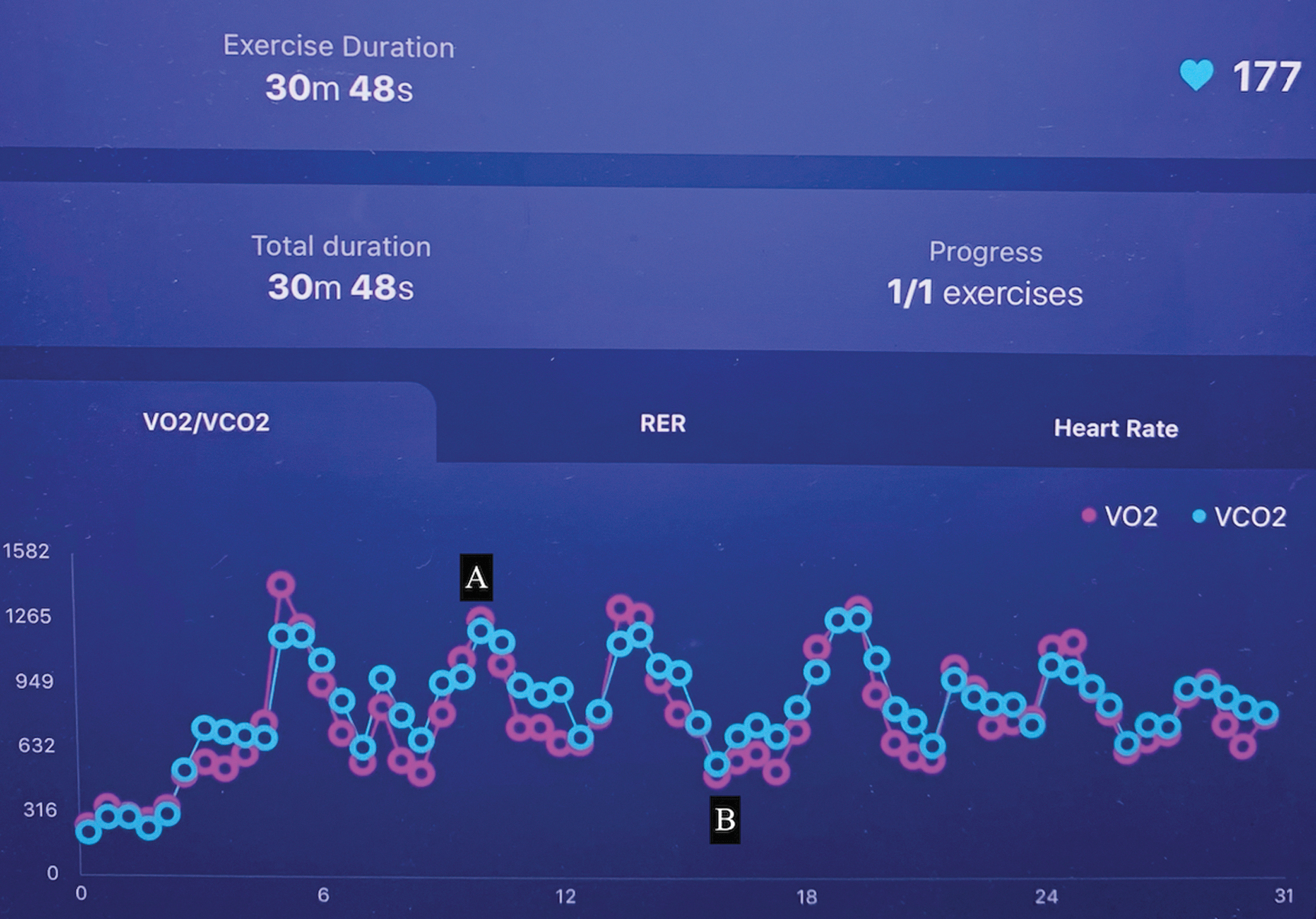
Screenshot from IPad app interface showing the portable metabolic gas analyzer's breath-by-breath measurements of VO2 and VCO2 undulation during the 30-minute IVR exergaming session.
Participants displayed high levels of EE with high corresponding mean HR of 176 (SD 3.1) and 84% (SD 1.5) of HRmax during the 30-minute session. Interestingly, despite this qualifying as a vigorous-intensity activity, the corresponding mean RPE scores of 14 (SD 1) only indicated a “somewhat hard” to “hard” user-perceived effort. This finding was unexpected, as existing literature demonstrates a strong correlation of RPE scores of 6–20 with HRs of 60–200.33,34,45 This gap between actual and perceived exertion could be accounted for by the IVR exergaming's multisensory stimuli that may have diverted the participants attention from the physiological and cognitive demands of exercise toward the in-game challenges instead. Similar effects on dissociative focus have been demonstrated with music and video media and we suspect the IVR system may act by a similar mechanism.46,47 Participants reported the IVR exergame as “enjoyable,” and although there was no control group, this finding was similar to Liu et al., 12 who found increased enjoyability and self-motivation in IVR compared with nonimmersive VR or traditional exercise. IVR exergaming appeals to psychosocial attributes such as motivation, fun, and distractive immersion, which may effectively push the user to redirect their attention from fatigue toward maximizing their effort during gameplay.
IVR exergaming may represent an innovative way to increase exercise adherence. 48 Studies involving interactive videogame-based exercise have demonstrated greater attendance relative to traditional training models in sedentary populations. 49 With exercise programs achieving only 50% retention rates after 6 months, discovering ways to improve exercise adherence is critical. 50 IVR exergaming alone, or as an adjunct to existing training regimens, may serve this purpose. Especially for populations that are new to exercise, IVR's ability to distract from fatigue and redirect attention toward gameplay objectives may be extremely beneficial. Furthermore, three IVR sessions per week would allow users to satisfy the recommendations from the Physical Activity Guidelines for Americans: 75–150 minutes of weekly vigorous exercise and strength training involving all major muscle groups twice a week. 25
Limitations and future study
We believe that these study results warrant further and larger investigations in the field of IVR exergaming. Additional participants would further substantiate these study findings and add statistical power. Participants in this study were all young, healthy, and already physically active at the time of recruitment, thus the generalizability of these outcomes may differ for older or less healthy individuals. In addition, our method of recruitment may have introduced sampling bias as all participants were volunteers. Despite the promising utility of IVR exergaming, cybersickness may be a limitation.37,51 This study's IVR platform, however, made use of the newest advancements in IVR and HMD technology, which reduced sensory discrepancies through improved positional tracking, enhanced resolution, and a faster refresh rate. 52 Consequently, study participants reported little to no associated symptoms of cybersickness during their sessions. Despite these limitations, this exploratory study's objective was not to provide a definitive answer to the efficacy of this novel form of exercise on EE, but instead shed light on a growing sector in the exercise/fitness industry. Future research should also consider the contribution of excess postexercise oxygen consumption toward EE and resting metabolic rate. Although this study only examined acute responses during a 30-minute IVR exergaming session, evidence suggests that postexercise oxygen consumption and fat oxidation may further increase total daily EE by being elevated for at least three, and up to 12 hours postresistance training.53–55
Conclusion
IVR exergaming is an emerging market, although few studies have measured its efficacy as a mode of physical activity. Our findings suggest that an IVR exergaming routine with adaptive resistance cable exercises exceeds a threshold of vigorous intensity exercise that requires high EE. Most importantly, this high-intensity routine is accompanied by a relatively low user perceived exertion with a high perceived enjoyment. Future study is warranted regarding the contribution of “gamified” exercise to longer term fitness habits, its appeal to a wider range of audiences (i.e., clinical populations), and overall benefit to weight loss, metabolic health, and musculoskeletal performance.
Footnotes
Acknowledgments
We are appreciative of the willingness of devoted participants to give so generously their time and effort to support this study. We also thank all the authors for their collective contributions to the study design, data collection, and writing of this article. Finally, we thank the reviewers from the Games for Health Journal for their thorough and careful review of our study.
Author Disclosure Statement
We declare no conflicts of interest for this study. Black Box VR had no role in the study design, data collection, analysis, interpretation, or writing of the article.
Funding Information
No funding was received for this article.