






Abstract
In what has been a run extending for nearly a full 12 months, U.S. sportsbooks continued getting the better of the public and fashioned the third monthly hold of 11% or higher to complete the fifth full year of state-by-state commercial sports wagering in the post-PASPA (Professional and Amateur Sports Protection Act) era.
Once again, sports bettors in most of the United States are asking: “The worm has to turn at some point, right?”
While overall year-over-year handle, revenue, and state tax revenue figures are skewing higher with the entrances of Ohio and Massachusetts, the top story of 2023 continues to be the domination of sportsbook operators against the betting public. May furthered the trend in staggering fashion as the nationwide hold reached double figures for just the sixth time in the post-PASPA era (please see Fig. 1) and was the third-highest overall.
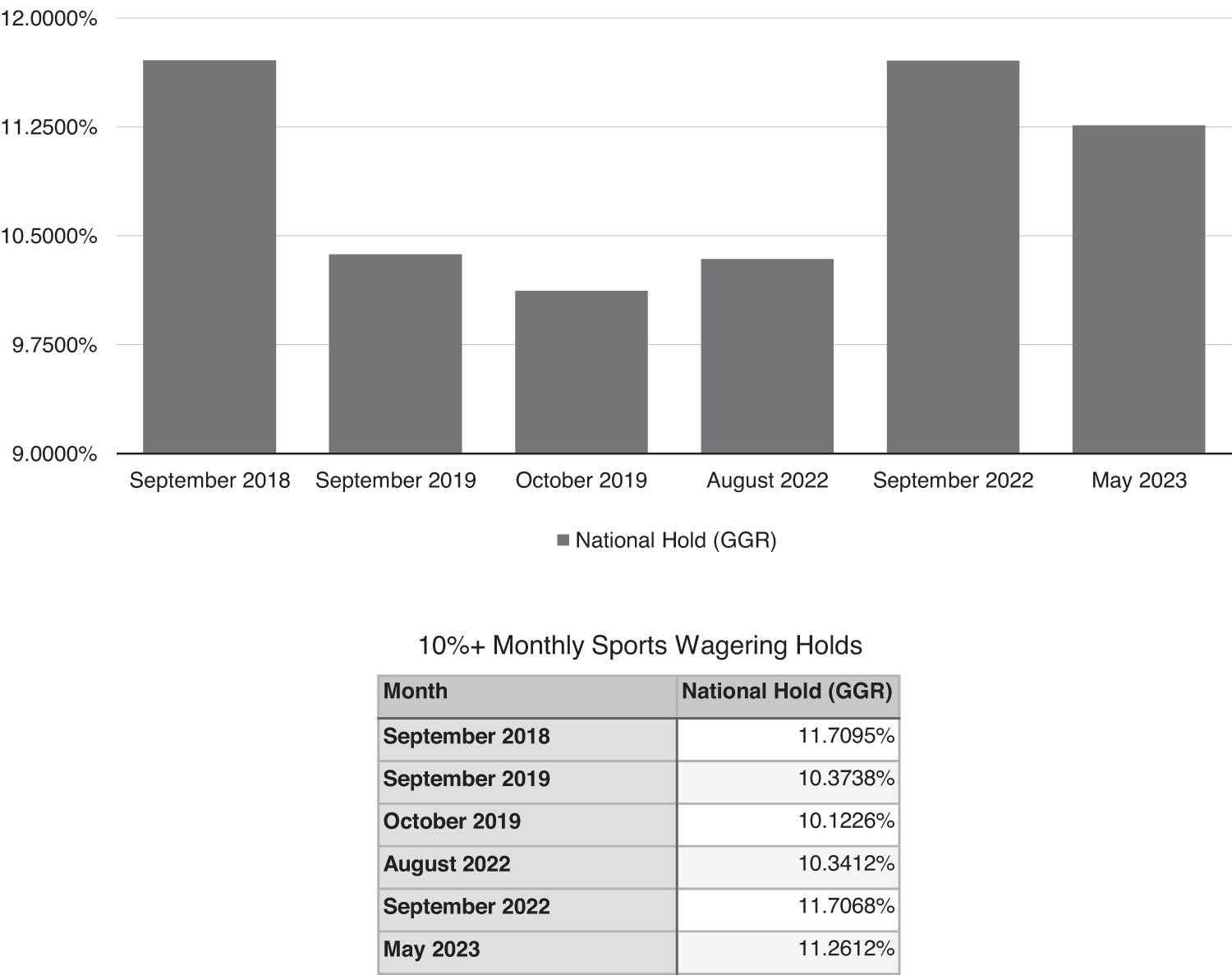
Months with a National Hold Above 10% for Gross Sports Wagering Revenue Post-PASPA
May marked the end of the fifth full year of state-by-state wagering following the U.S. Supreme Court striking down PASPA. As Figure 2 shows (please see Fig. 2), the expansion of sports wagering in a relatively short time frame has been widespread. When the first hold above 10% was recorded in September 2018, Nevada and New Jersey—both gambling meccas—headlined a group of five states offering commercial sports wagering. Fast forward to May 2023—which ended with a national hold above 11%—and 29 states are now in play, and there are more to come before the calendar year ends.
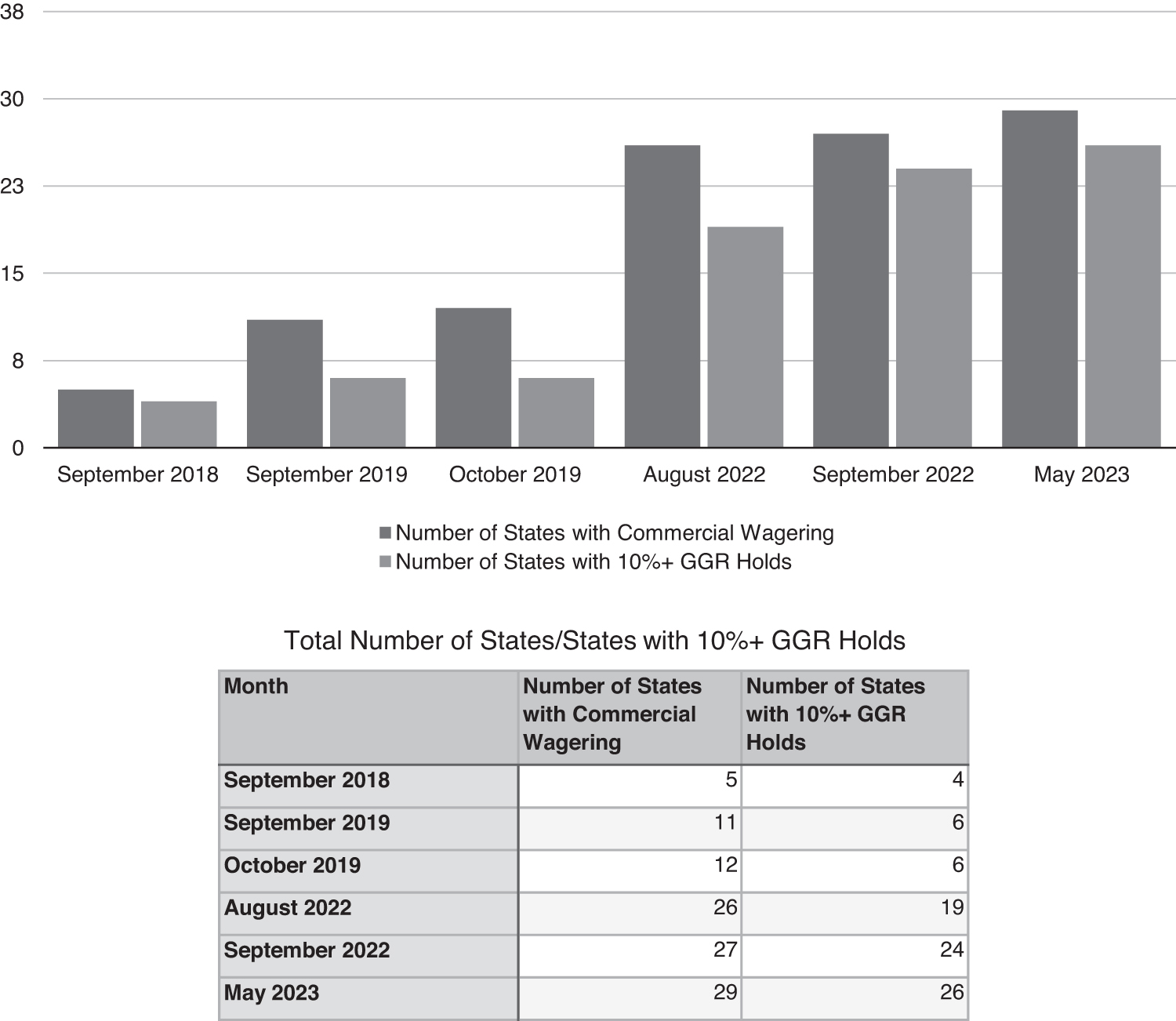
Number of States/Number of States with 10%+ Hold in Months with National 10%+ Hold
Accordingly, the handle and revenue in each of those six months with double-digit holds increased. As Figures 3 and 4 show (please see Figs. 3 and 4), the increase in both handle and gross revenue from the first occurrence in September 2018 to the most recent one in May is more than nine-fold. May's gross revenue total of more than $916.6 million ranks fifth all-time in the post-PASPA era despite the corresponding handle ranking 10th.
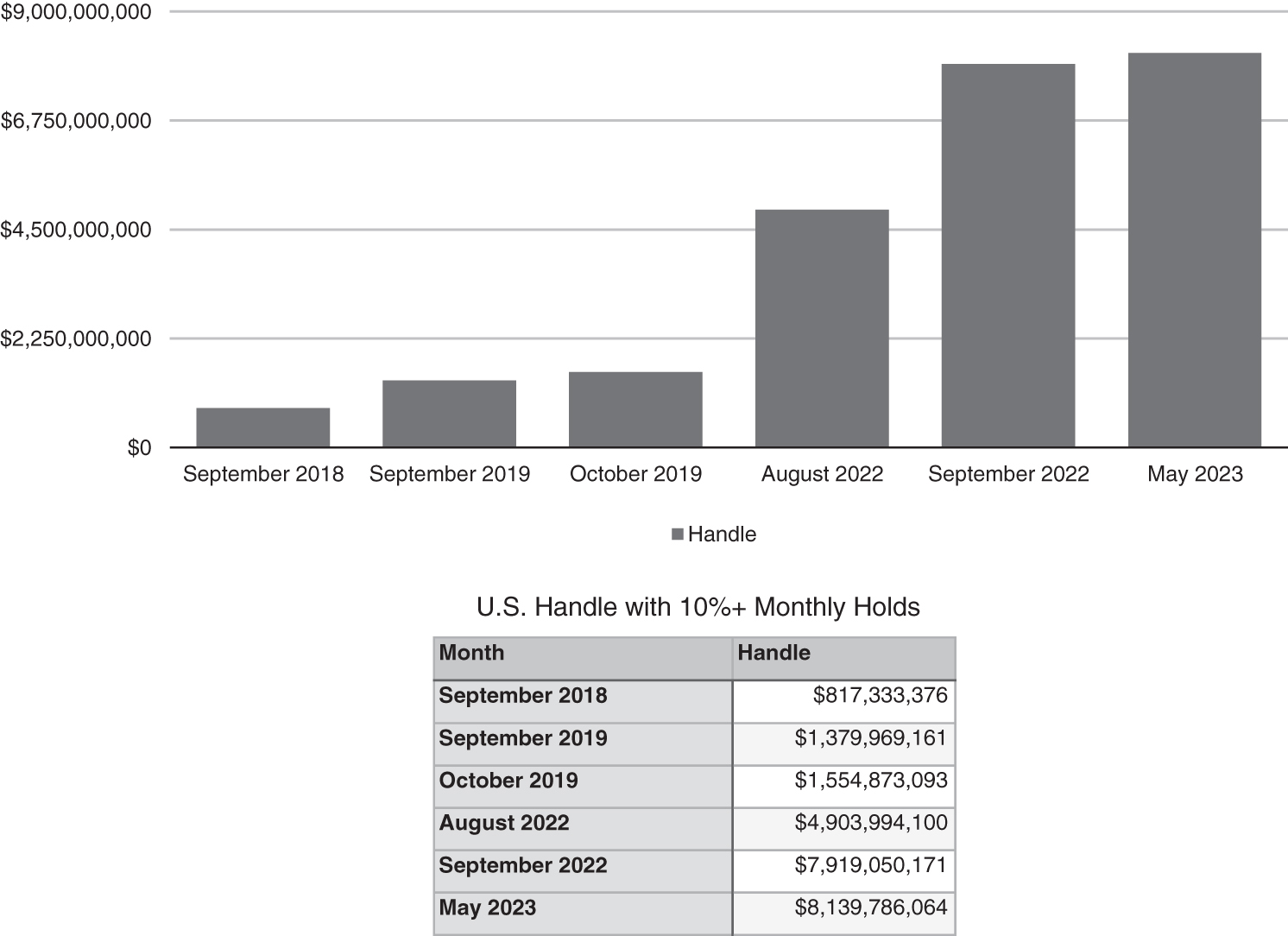
Sports Wagering Handle in Months with 10%+ National Hold
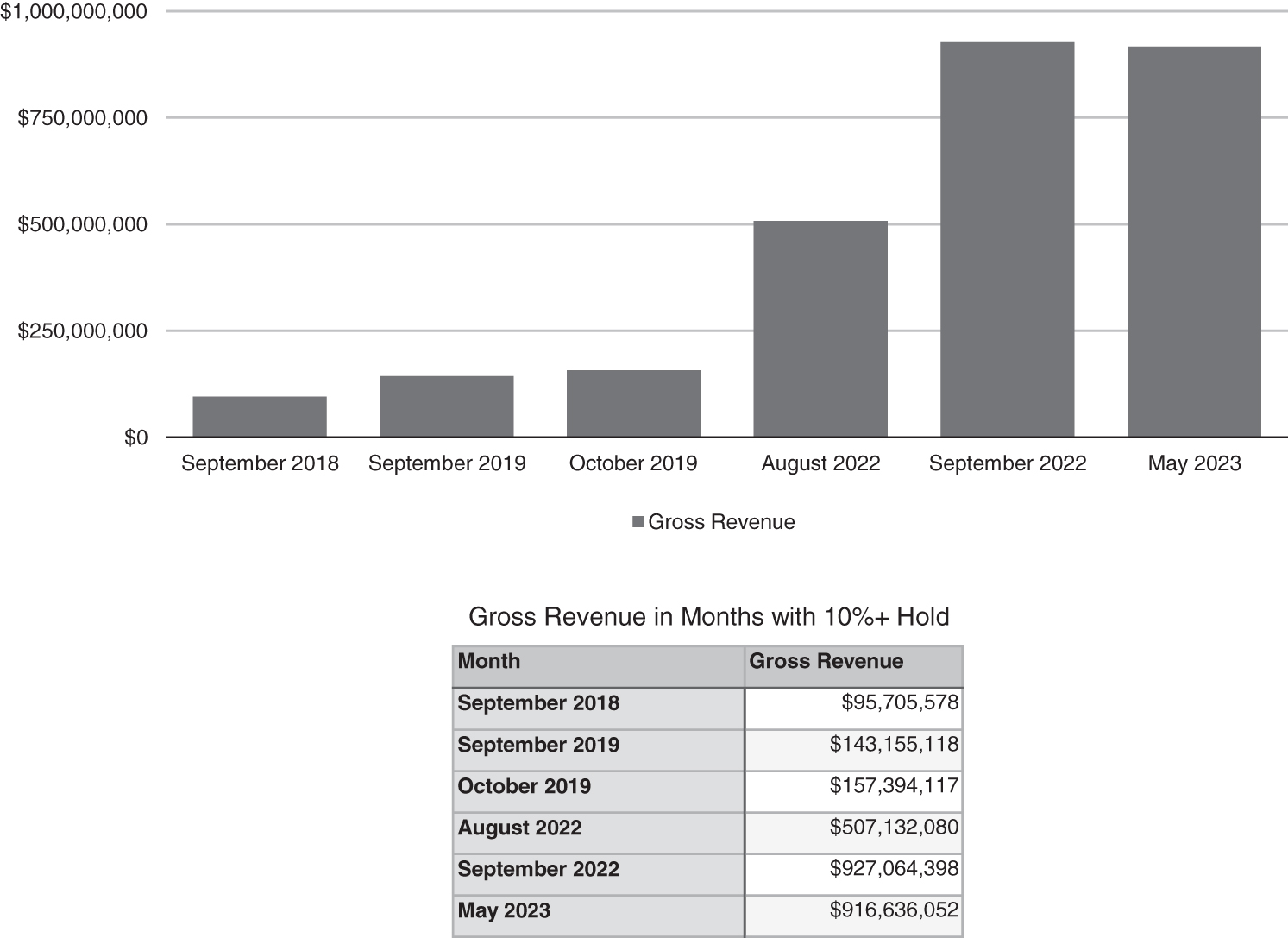
Sportsbook Operator Gross Revenue in Months with National 10%+ Hold
There are many factors that contributed to the house having a banner May. The time of year matters greatly as the NFL serves as a primary driver of sports wagering. As Figure 1 also shows, May marked the second time a 10% national hold did not occur during pro football season.
The ongoing popularity of parlay wagering also weighs into May's numbers, with the anecdotal opinion being that a sizable amount of handle among those parlays included the Milwaukee Bucks and Boston Celtics as NBA champions and/or the Boston Bruins, Carolina Hurricanes, or Colorado Avalanche as NHL champions. All five of those teams were worthy options to be included in such wagers: The Bucks and Celtics had the top two records in the league, but both were eliminated by the Miami Heat as the No. 7 seed made a stunning run to the NBA Finals.
The Bruins set single-season NHL records for wins (65) and points (135), only to be eliminated in the opening round by the Florida Panthers. The 2022 champion Avalanche, who amassed 111 points themselves and won the Central Division, joined the Bruins on the sidelines after one round, ousted by the second-year franchise Seattle Kraken. Carolina, winner of the Metropolitan Division, also fell to the Florida buzzsaw in the Eastern Conference finals.
The timing of those defeats could also have contributed to May's high hold. The Bruins and Avalanche were eliminated on April 30th, and depending on when a sportsbook graded the loss, some house parlay winnings may have been lumped in with April's numbers and some in May. It should be noted April's nationwide hold was 9.48%, slightly above the 9.45% hold generated by operators across the country from nearly $49.1 billion worth of wagers in the first five months of the year.
Parlay holds, at least from states that provide such figures, point to a high level of operator win. Among the six states that publish monthly parlay handle and revenue, five states had a hold of 17.5% or higher in May (please see Fig. 5). The lone outlier, Nevada, is well-established as a market not conducive to parlay wagering, which held true in May with a total handle of less than $85,000.
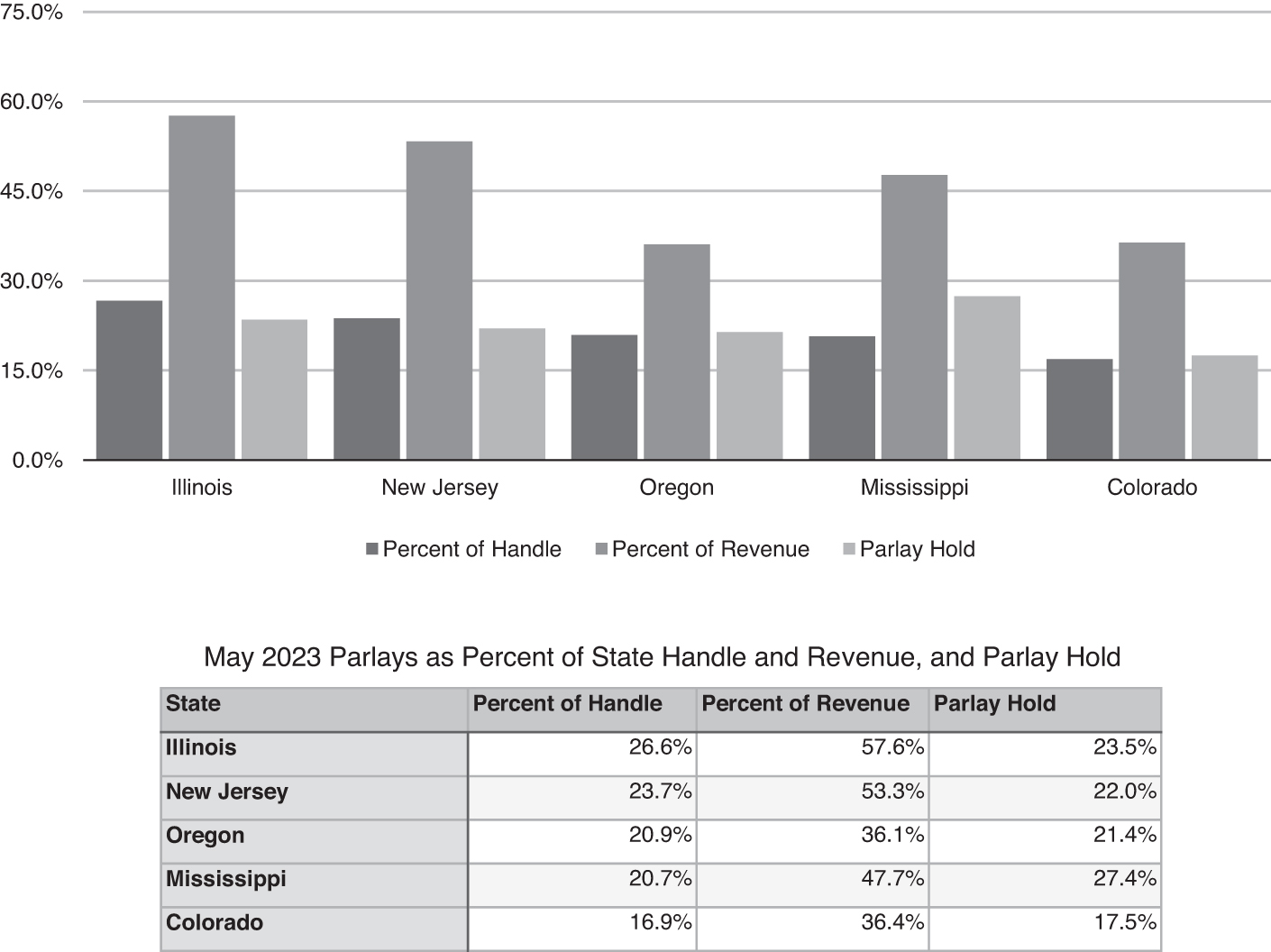
Percent of Parlay Handle and Revenue to Overall Handle and Win Rate, Select States
The other five states—Illinois, New Jersey, Colorado, Oregon, and Mississippi—reported a combined $484.6 million in parlay handle. That comes to nearly 6% of the total national handle for the month. The $110.4 million in gross revenue, however, resulted in a 22.78% hold for parlay wagers and accounted for just over 12% of the month's overall national gross revenue.
Another factor in high holds is where operators perform well. For example, an 11.41% hold on $2.76 million handle in Delaware—the 28th and second-smallest market by handle—is not going to weigh as heavily as a 10.84% hold on $821.7 million handle in Illinois, the No. 2 market.
As Figures 6 and 7 show (please see Fig. 6), six of the top 10 states in handle finished with a bottom-nine ranking for hold in May. All of those states, however, save Nevada, surpassed the 7% industry standard hold (please see Fig. 7), thus creating substantial revenue from the more than $6.1 billion handle from the top 10 markets.
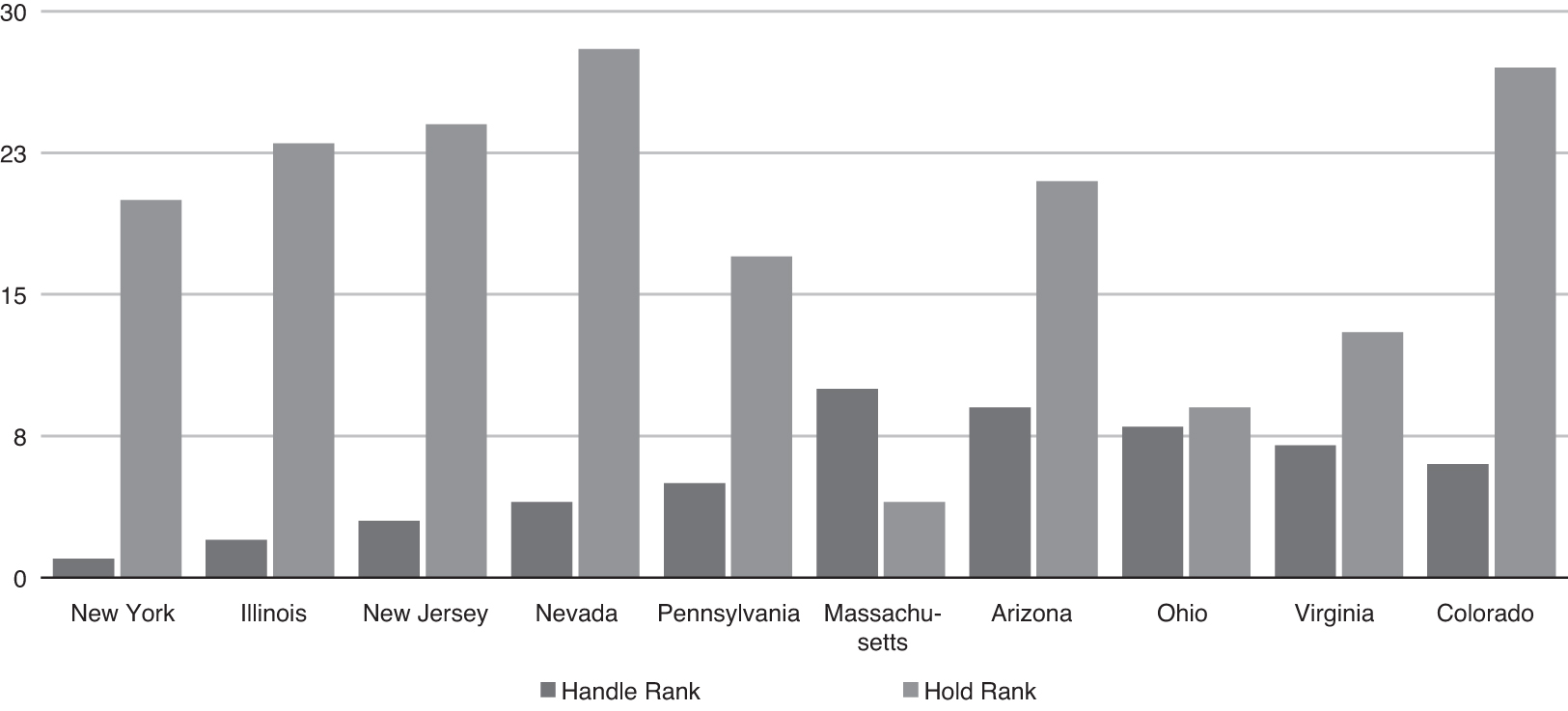
National Rank by State for Hold and Handle, May 2023
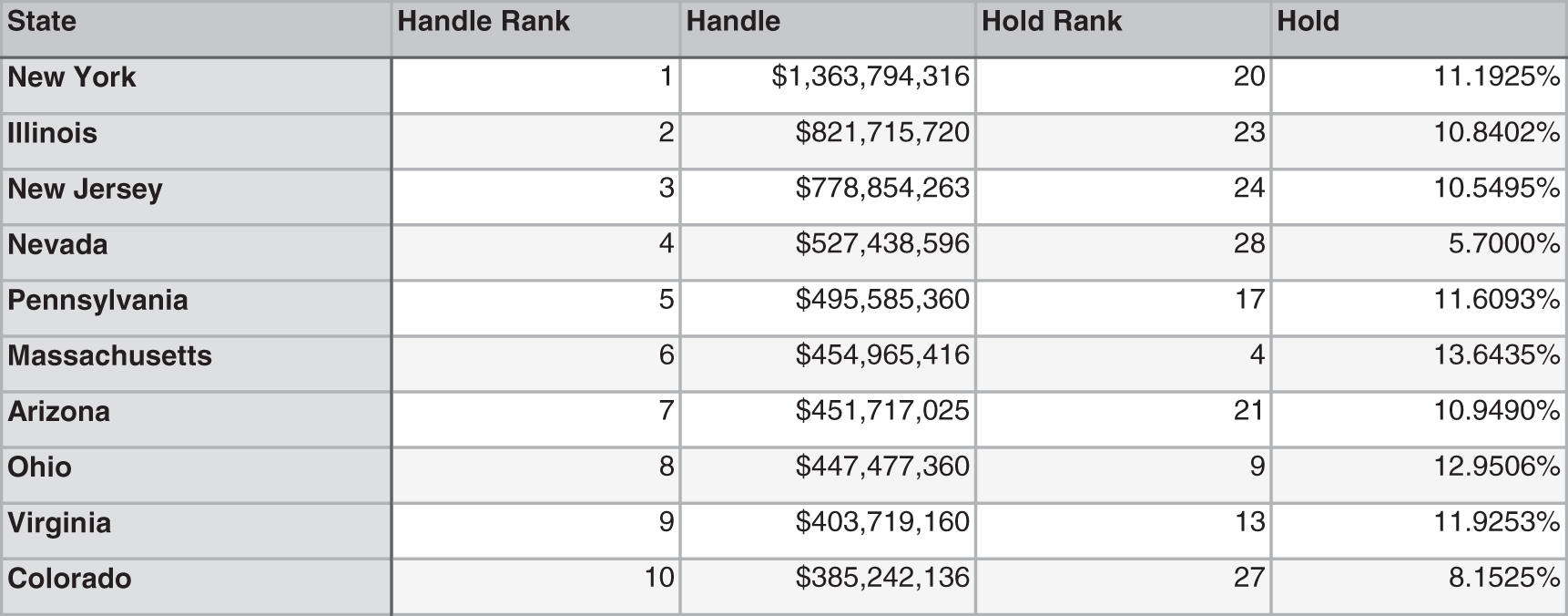
Handle Rank, Total Handle, Hold Rank, and Hold for Top 10 States by Handle in May 2023
As the upcoming NFL season draws near and renews the cycle of increased wagering activity, both in single-event markets as the most popular sport in the U.S., and in parlay-type wagers as an offshoot of fantasy football, little seems to be stopping operators from continuing to perform at an outsized level compared to—at a minimum—the 7% industry standard which continues to be rapidly hurtling towards being obsolete.
The question is whether those operator holds and revenue figures will approach the numbers starting with July 2023 when the house began a lucrative run versus the public that continues to this day.