







Abstract
Background: Studies investigating the association between vascular endothelial growth factor (VEGF) polymorphisms and colorectal cancer (CRC) risk report conflicting results. To clarify the effect of four VEGF (−460T/C, −634G/C, +936C/T, and −2578C/A) gene polymorphisms on the risk of developing CRC, we carried out a meta-analysis using published data to obtain more precise estimates of risk. Methods: Electronic searches of PubMed and EMBASE were conducted to select studies for this meta-analysis. The principal outcome measure was the odds ratio (OR) with 95% confidence interval (CI) for the risk of CRC associated with four VEGF (−460T/C, −634G/C, +936C/T, and −2578C/A) gene polymorphisms. Results: We identified 12 epidemiologic studies, which included 2770 CRC cases and 2568 controls. The combined results based on all studies showed that CRC cases had a significantly higher frequency of VEGF −634GG (OR=1.24, 95% CI=1.06, 1.44) and −2578AA (OR=1.37, 95% CI=1.12, 1.66) genotype and a lower frequency of −634CG (OR=0.82, 95% CI=0.71, 0.95) than controls. When stratifying for race, we found that patients with CRC had a significantly higher frequency of −460TC (OR=1.54, 95% CI=1.22, 1.94), −460CC (OR=2.00, 95% CI=1.50, 2.67), and −2578AA (OR=1.38, 95% CI=1.12, 1.69) and a lower frequency of −2578AA (OR=0.78, 95% CI=0.65, 0.93) genotypes of VEGF than controls, among Caucasians. We also found that patients with CRC had a significantly higher frequency of −634GG (OR=1.61, 95% CI=1.20, 2.15) and a lower frequency of −634CG (OR=0.60, 95% CI=0.46, 0.79) genotypes of VEGF than controls, among Asians. Conclusions: Our meta-analysis suggests that the VEGF −460T/C, −634G/C, and −2578C/A gene polymorphisms are associated with a risk of CRC.
Introduction
The VEGF gene is located on chromosome 6p21.3 and consists of eight exons exhibiting alternate splicing to form a family of proteins (Yang et al., 2011b). At least 30 single-nucleotide polymorphisms (SNP) have been described of the VEGF gene. Polymorphisms of the VEGF gene have been associated with susceptibility to several types of cancer (Ajaz et al., 2011; Bao et al., 2011; Zhou et al., 2011a). Some of these polymorphisms (−460T/C rs833061, −634G/C rs2010963, +936C/T rs3025039, and −2578C/A rs699947) have been related to protein expression of VEGF in CRC (Maltese et al., 2009; Antonacopoulou et al., 2011; Kang et al., 2011; Zhang et al., 2011).
Although there are some studies to investigate the association between VEGF polymorphism and risk of CRC, results have been inconsistent (Maltese et al., 2009; Wu et al., 2009; Antonacopoulou et al., 2011; Kang et al., 2011; Zhang et al., 2011; Zhou et al., 2011a). A recent meta-analysis of eight case-control studies found that only the VEGF −2578C/A polymorphism appeared to be associated with the risk of CRC (Zhou et al., 2011a). We conducted the meta-analysis to assess whether a relationship exists between the VEGF polymorphism and the risk of CRC.
Methodology
Literature search
We performed a systematic search of Medline (National Library of Medicine, Bethesda, MD) (1966 to January 2012), Embase (Elsevier B V., Amsterdam, the Netherlands) (January 1966 to January 2012), and Current Contents (Thomson Scientific, Philadelphia, PA) (1998 to January 2012) to identify published epidemiologic studies related to polymorphisms of the VEGF gene and CRC risk. Key words for the search were as follows: “vascular endothelial growth factor” or “VEGF”, “colorectal” or “colon” or “large bowel”, “carcinoma” or “cancer” or “tumor”. The reference lists of reviews and retrieved articles were hand searched at the same time. We did not consider abstracts or unpublished reports. No language restrictions were applied; all non-English articles were translated if necessary. When necessary, we contacted the authors of retrieved articles to require additional information. If two or more articles were published by the same author describing the same data, we selected the most detailed article.
Inclusion and exclusion criteria
Two independent researchers reviewed abstracts of all citations and retrieved studies. To be eligible for inclusion, studies had to be case-control that reported genotypic frequencies for both case and control populations and provided sufficient data to calculate an odds ratio (OR) and corresponding 95 percent confidence interval (CI). Studies based on pedigree data, overlapping cases or controls, interim analyses, and laboratory methods were excluded. Review and editorial articles were also excluded.
Statistical analysis
STATA 11.0 statistical software (StataCorp, College Station, TX) was used for all analyses. To determine whether to use the fixed- or random-effects model, we measured statistical heterogeneity between and within groups using the Q statistic, p<0.05 was considered statistically significant. If heterogeneity existed, we used the random effects model. Otherwise, the fixed effects model was used. Publication bias was investigated both visually by using a funnel plot and statistically via Begg funnel plots and the Egger's bias test, which measures the degree of funnel plot asymmetry. We calculated separate pooled estimates for different ethnic groups and geographic regions.
Results
Study characteristics
This meta-analysis identified 12 articles (Wu et al., 2006; Park et al., 2007; Bae et al., 2008; Cacev et al., 2008; Chae et al., 2008; Hofmann et al., 2008; Dassoulas et al., 2009; Maltese et al., 2009; Wu et al., 2009; Antonacopoulou et al., 2011; Kang et al., 2011; Zhang et al., 2011), which included 2770 CRC cases and 2568 controls, were found to conform to our inclusion criteria. These studies, including seven population-based case-control studies and five hospital-based case-control studies, were included in this meta-analysis. The genotyping method of these studies was polymerase chain reaction-restriction fragment length polymorphism. Studies were carried out in Italy, Croatia, Greece, Austria, Korea, and China. Characteristics of studies included in this meta-analysis are presented in Table 1.
HCC, hospital-based case-control; PCC, population-based case-control; DNR, data not reported; PCR, polymerase chain reaction; RFLP, restriction fragment length polymorphism.
Quantitative data synthesis
The combined results based on all studies showed that CRC cases had a significantly higher frequency of VEGF −634GG (OR=1.24, 95% CI=1.06, 1.44) and −2578AA (OR=1.37, 95% CI=1.12, 1.66) genotype and a lower frequency of −634CG (OR=0.82, 95% CI=0.71, 0.95) than controls (Table 2). When stratifying for race, we found that patients with CRC had a significantly higher frequency of −460TC (OR=1.54, 95% CI=1.22, 1.94), −460CC (OR=2.00, 95% CI=1.50, 2.67), and −2578AA (OR=1.38, 95% CI=1.12, 1.69) and a lower frequency of −2578AA (OR=0.78, 95% CI=0.65, 0.93) genotypes of VEGF than controls, among Caucasians (Table 2). We also found that patients with CRC had a significantly higher frequency of −634GG (OR=1.61, 95% CI=1.20, 2.15) and a lower frequency of −634CG (OR=0.60, 95% CI=0.46, 0.79) genotypes of VEGF than controls, among Asians (Table 2).
OR, odds ratio; CI, confidence interval; VEGF, vascular endothelial growth factor.
Publication bias and heterogeneity
We selected VEGF +936C/T polymorphisms to investigate the publication bias. No evidence of publication bias was found by the Begg rank correlation method (p=0.11) and the Egger weighted regression method (p=0.25). (Figs. 1 and 2) Heterogeneity of included studies of each polymorphism is presented in Table 2.
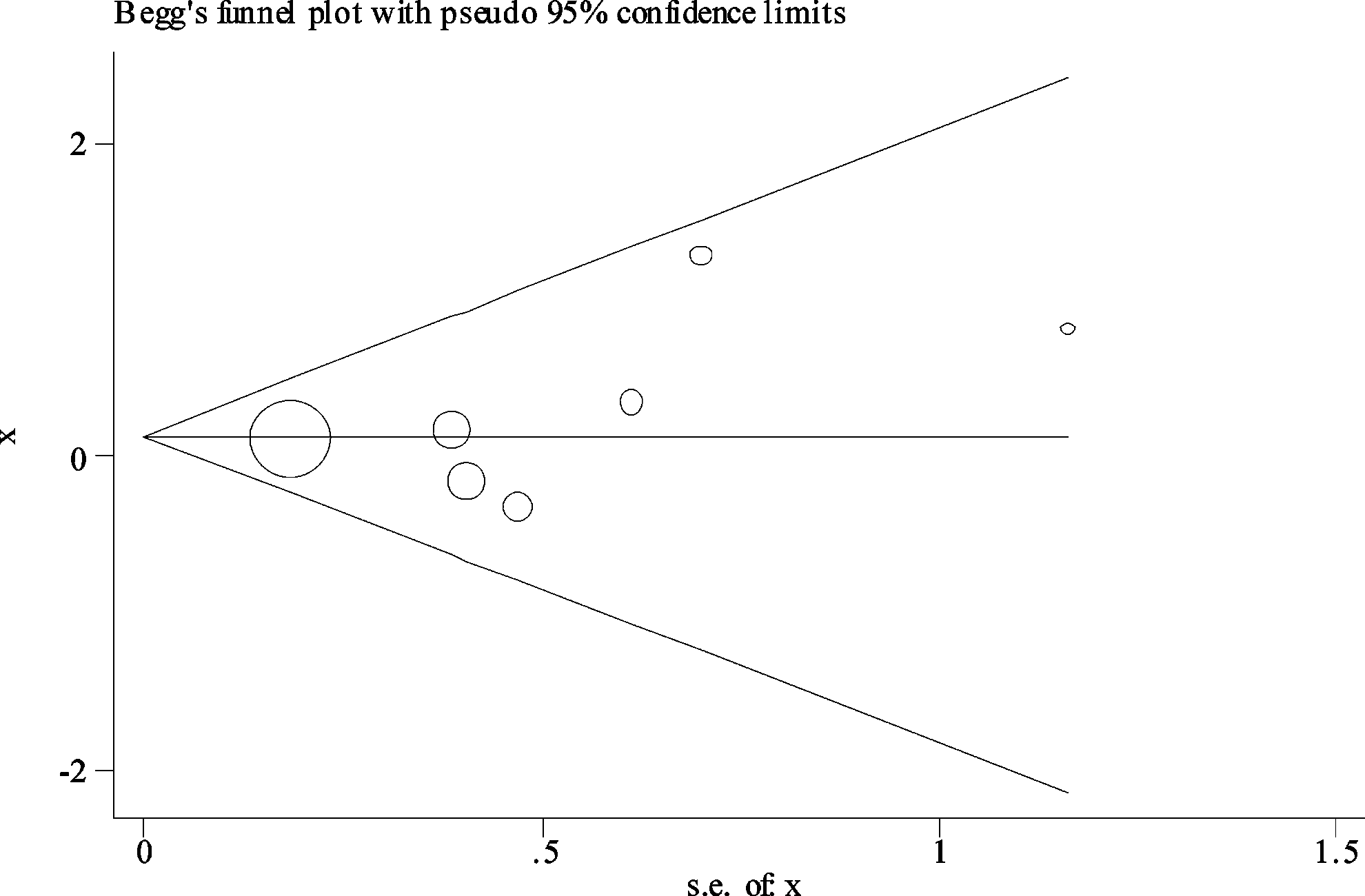
Begg's funnel plot of VEGF +936C/T gene polymorphisms and colorectal cancer (CRC) risk.
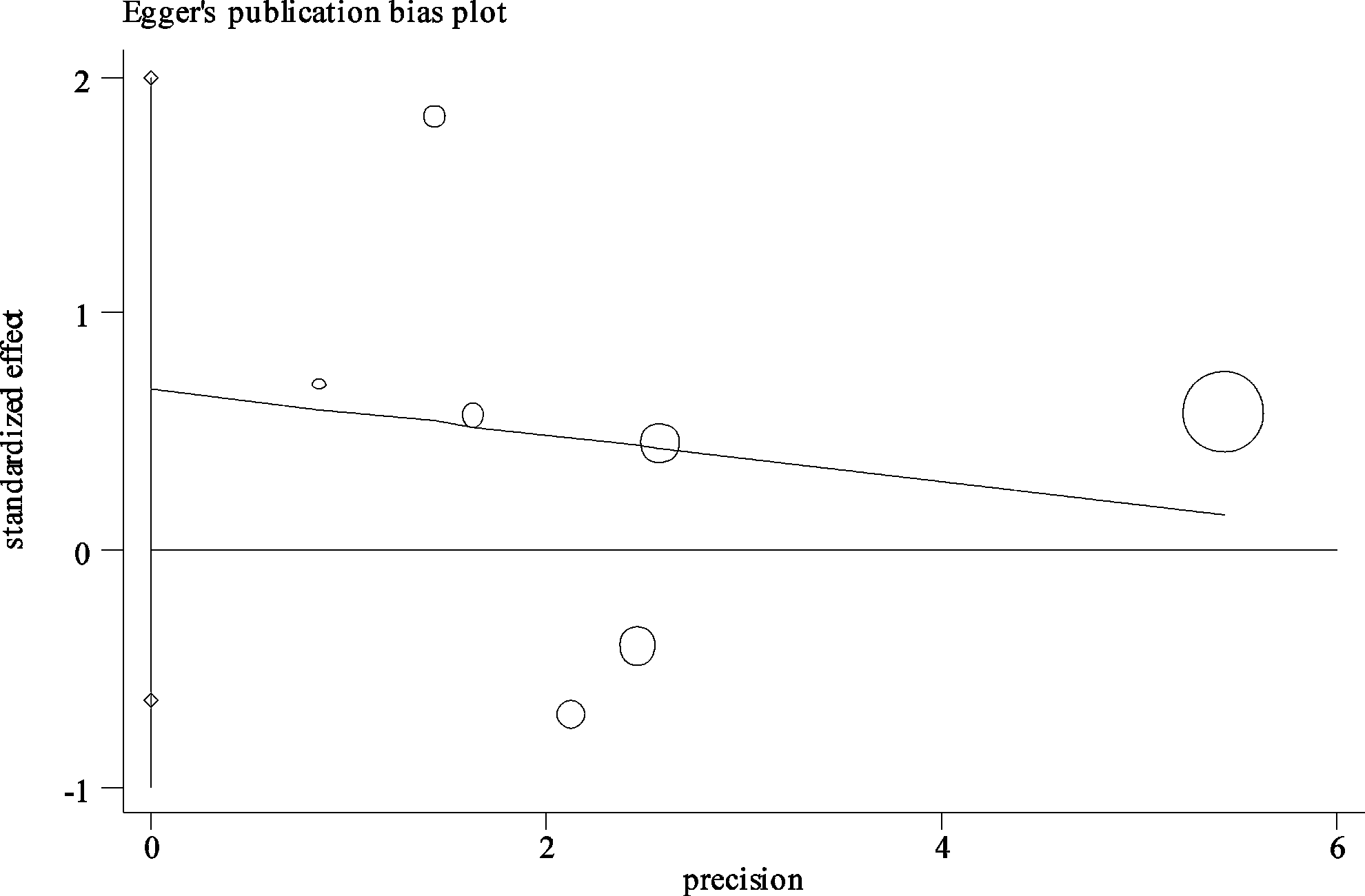
Egger's publication bias plot of VEGF +936C/T gene polymorphisms and CRC risk.
Discussion
Although there has been a meta-analysis to assess whether a relationship exists between the VEGF polymorphism and risk of CRC, it included eight case-control studies and found that only the VEGF −2578C/A polymorphism appeared to be associated with the risk of CRC (Zhou et al., 2011a). We identified 12 epidemiologic studies, which included 2770 CRC cases and 2568 controls. Our meta-analysis suggests that the VEGF −460T/C, −634G/C, and −2578C/A gene polymorphisms are associated with the risk of CRC.
Polymorphisms of the VEGF gene have been associated with susceptibility to several types of cancer. Krippl et al. (2003) found that carriers of a VEGF 936T-allele were at a decreased risk for breast cancer. However, recent meta-analysis suggests that the VEGF +936C/T, −1154A/G, −2578C/A, −634G/C, and −460T/C may be not associated with the risk of breast cancer (Gu and Wang, 2011; Qiu et al., 2011; Wang et al., 2011; Yang et al., 2011a). A case-control study suggested that the VEGF +1612 G/A gene polymorphism might be associated with gastric cancer in Chinese Han patients, and that the difference in genotype distribution might be associated with the location and Lauren's classification of gastric cancer (Zhou et al., 2011b). Another study suggested that VEGF −634CG genotypes may be associated with short-term survival in gastric cancer patients (Guan et al., 2009). A meta-analysis suggested that there was no association between VEGF +936 C/T polymorphisms and gastric cancer risk (Zhou et al., 2010). A case-control study indicated that the VEGF +936 C/T genotype was associated with a higher glioma risk in a Chinese Han population (Bao et al., 2011). A case-control study showed that the VEGF −2578 A-allele and A-carrier genotypes were associated with an increased risk of renal cell carcinoma (Ajaz et al., 2011).
Studies investigating the relationship between genetic polymorphisms and risk of CRC are being reported with a rapidly increasing frequency. A meta-analysis of 19,893 CRC and 22,106 controls found that the BMP4-rs4444235 polymorphism was probably associated with CRC risk (Li et al., 2012). A meta-analysis from 13 studies, including 5468 cases and 6492 controls suggested that CYP1A1 Ile (462) Val polymorphism was a low-penetrance susceptibility gene in CRC development (Zheng et al., 2012). A meta-analysis of 6765 CRC patients and 8496 unrelated controls suggested that the two polymorphisms of TGFBR1 may confer low-penetrance susceptibility of CRC risk (Zhang et al., 2012). A meta-analysis of 3347 CRC cases and 3102 controls from eight published case-control studies suggested that the MDM2 SNP309 polymorphism is a low-penetrance risk factor for the development of CRC, particularly, among Asians (Cao et al., 2012). A meta-analysis of 7954 CRC cases and 7369 controls from nine eligible studies suggested that the CDH1-C160A polymorphism provides a possible protection against CRC, which is especially evident in Caucasian and hospital populations (Geng et al., 2012).
Our study has a number of possible limitations. First, only published studies were included in the meta-analysis; therefore, publication bias may have occurred. Second, our meta-analysis combined the genetic association studies done from 2006 with the more current ones, most of these studies done before “Strengthening the reporting of genetic association studies (STREGA): an extension of the STROBE Statement” (Little et al., 2009). Third, this meta-analysis is based on unadjusted estimates, while a more precise analysis could be performed if individual data were available. Fourth, as in most meta-analyses, these results should be interpreted with caution because the statistical synthesis of gene disease association studies in the field of CRC pertains to many biases, although no evidence of publication bias was found by the Begg rank correlation method and the Egger weighted regression method. Finally, meta-analysis remains a retrospective research that is subject to the methodological deficiencies of the included studies. Sources of bias are not controlled by the method. As we all know, a good meta-analysis of badly designed studies will still result in bad statistics.
In conclusion, this meta-analysis suggests that the VEGF −460T/C, −634G/C, and −2578C/A gene polymorphisms are associated with the risk of CRC. More population-based case-control studies were needed.
Footnotes
Author Disclosure Statement
We declare that no conflict of interest exists for any of the authors.