






Abstract
Objective: Growing evidence has shown that vitamin D deficiency can cause lower bone mineral density (BMD) and an increased risk of osteoporosis. Vitamin D receptor (VDR) BsmI polymorphism (rs1544410) can affect BMD variation and circulating osteocalcin levels. To date, a wide range of epidemiological studies have been carried out to evaluate the association between VDR BsmI polymorphism and susceptibility to osteoporosis. Conflicting results, however, were obtained. The aim of this study was to evaluate the effect of VDR BsmI polymorphism on osteoporosis risk using a meta-analysis. Methods: Twenty-six publications were identified by searching PubMed and Embase databases. The association between VDR BsmI polymorphism and osteoporosis was estimated by calculating pooled odds ratios (ORs) with corresponding 95% confidence intervals (CIs). Results: The bb genotype was associated with a significantly decreased risk of osteoporosis in overall comparison (bb vs. BB: OR=0.61, 95% CI, 0.40-0.92; bb vs. BB/Bb: OR=0.70, 95% CI, 0.52-0.95, respectively). Subgroup analyses showed that the bb genotype had a decreased risk of developing osteoporosis in postmenopausal women (bb vs. BB/Bb: OR=0.68, 95% CI, 0.46-0.98) and Africans (Bb/bb vs. BB: OR=0.18, 95% CI, 0.09-0.37). Conclusion: The VDR BsmI polymorphism may have a protective role against the development of osteoporosis.
Introduction
O
To date, multiple candidate genes have been investigated to determine the relationship between these genes and susceptibility to osteoporosis. Among them, vitamin D receptor (VDR) is the first and most extensively studied. In 1992, Morrison et al. reported that VDR BsmI polymorphism (rs1544410) could affect BMD variation and circulating osteocalcin levels (Morrison et al., 1992, 1994). Subsequently, a large number of epidemiological studies have been carried out to evaluate the association between VDR BsmI polymorphism and individual susceptibility to osteoporosis. However, the results were inconclusive rather than conclusive. For example, Kanan and Mesmar (2008) reported that the VDR BsmI bb genotype was significantly more frequent in patients with osteoporosis than in controls in an Asian population. On the contrary, in the same Asian population, the bb genotype was reported to be significantly higher in controls than in osteoporotic patients (Mitra et al., 2006). The small sample sizes in single studies may be partly responsible for the conflicting results. Meta-analysis is a robust tool to cover the limitation of genetic association studies by pooling all the published data together, which increases the statistical power. We therefore performed a meta-analysis to determine whether the VDR BsmI polymorphism was related to the risk of osteoporosis.
Materials and Methods
Selection of published studies
We performed the meta-analysis according to the guidelines of the PRISMA group (Moher et al., 2009). The PubMed and Embase (1966-2011) databases were searched using the following algorithm: “(VDR or vitamin D receptor)” and “polymorphism” and “osteoporosis.” The last search was updated on May 31, 2012. Additional records were identified through manual searching.
Inclusion and exclusion criteria
The studies were included only if they met the following criteria: (1) case-control study; (2) the study assessed the association between VDR BsmI polymorphism (rs1544410) and risk of osteoporosis; (3) sufficient original data for calculating odds ratios (ORs) with corresponding 95% confidence intervals (95% CIs); (4) the full text was published in English.
If identical or overlapping data were published in different studies by the same research group, we excluded the articles with smaller sample size.
Data extraction
The following data were extracted from each study by two investigators (F.J. and R.F.) independently: the surname of the first author, year of publication, country of the corresponding author, ethnicity of study population, diagnosis of osteoporosis, matching variables, genotyping method, menopausal status, site of BMD measurement, age of cases and controls, the number of cases and controls, and genotype distribution of cases and controls. The Hardy-Weinberg equilibrium (HWE) and B allele frequency in controls were calculated based on the BsmI genotyping distribution in cases and controls.
Statistical analysis
The association between VDR BsmI polymorphism and osteoporosis was evaluated by calculating pooled ORs based on the individual ORs. Four comparisons were performed: Bb versus BB, bb versus BB, bb versus BB/Bb, and Bb/bb versus BB. The statistical heterogeneity between studies was tested using the Q-test and I2 statistics (Higgins and Thompson, 2002). When there is apparent heterogeneity between studies (p≤0.10), the pooled OR was estimated using the random-effects model (the DerSimonian and Laird method; DerSimonian and Laird, 1986); otherwise, the fixed-effects model (the Mantel-Haenszel method) was used (Mantel and Haenszel, 1959). Subgroup analyses were performed according to ethnicity, menopausal status, and HWE. If the heterogeneity between studies was detected, logistic meta-regression was carried out to explore the sources of heterogeneity. Publication bias was examined with Egger's test (Egger et al., 1997). Data were analyzed using STATA software, version 10.0 (STATA Corp., College Station, TX).
Results
Characteristics of studies
A total of 820 articles were identified though database and manual searching. After screening the title and abstract, 226 articles were excluded due to repetition. Then, 422 articles were excluded because they were not BsmI polymorphism or osteoporosis or human study, and review articles. The remaining 172 full-text articles were assessed in detail. One hundred forty four articles were excluded with reasons for not being BsmI polymorphism or osteoporosis or English studies or available data and reviews. Moreover, two studies were excluded because of overlapping data. Finally, 26 studies involving 2274 cases and 3150 controls were included in this meta-analysis (Supplementary Fig. 1; Supplementary Data are available online at www.liebertpub.com/gtmb).
The main characteristics of the studies are presented in Supplementary Table 1. In the study of Musumeci et al., (2009) the genotyping distribution was separately shown based on African and Caucasian populations. It was, therefore, separately considered in subgroup analysis according to ethnicity. There were 13 studies of Caucasian population, 5 studies of Asian population, 5 studies of Turkish population, 2 studies of African population, 1 study of Jewish population, and 1 study of Mexican population. All the studies used polymerase chain reaction-restriction fragment length polymorphism (RFLP) for genotyping. Twenty studies reported that the cases were postmenopausal women. Most of the studies (81%) used the WHO criteria for the diagnosis of osteoporosis. However, only 38% (10/26) of the studies reported frequency-matched controls to cases, mainly by age. About 35% (9/26) of studies were deviated from HWE in controls.
Meta-analysis
The evaluations of the association between VDR BsmI polymorphism and osteoporosis risk are summarized in Supplementary Table 2. The bb genotype was associated with a significantly decreased risk of osteoporosis when compared with BB, and BB/Bb genotypes (bb vs. BB: OR=0.61, 95% CI, 0.40-0.92; bb vs. BB/Bb: OR=0.70, 95% CI, 0.52-0.95, respectively) (Fig. 1). Similarly, the bb genotype had a 0.68-fold decreased risk of developing osteoporosis in postmenopausal women (bb vs. BB/Bb: OR=0.68, 95% CI, 0.46-0.98). After subgroup analysis according to ethnicity, significantly decreased risk was observed in an African population (Bb/bb vs. BB: OR=0.18, 95% CI, 0.09-0.37) but not in Asian, Caucasian, and Turkish populations. However, no significant association was detected both in HWE studies and in Hardy-Weinberg disequilibrium (HWD) studies.
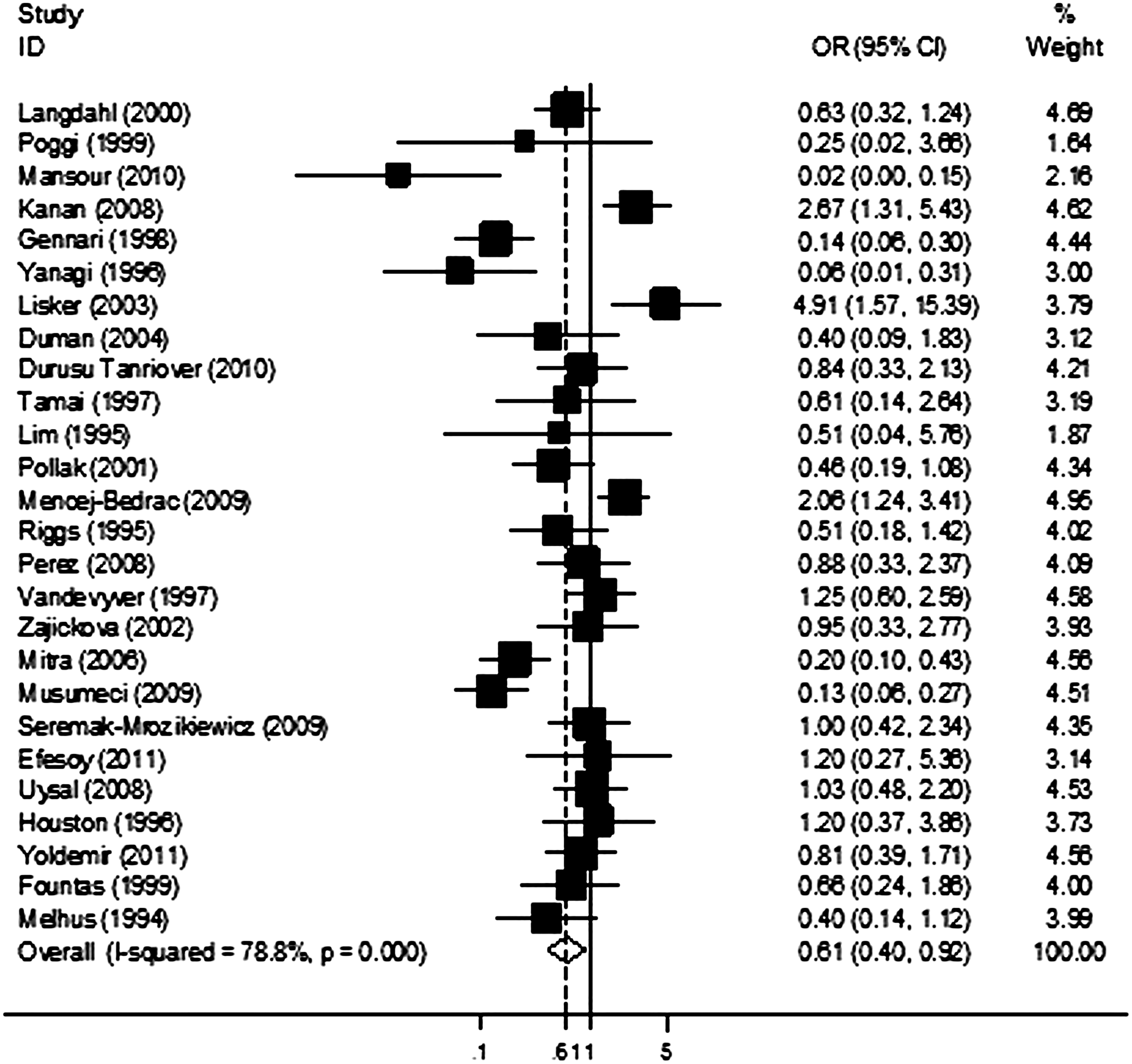
Forest plot of the meta-analysis (bb vs. BB). The random-effects model was used.
Heterogeneity analysis and publication bias
The obvious heterogeneity between studies was present in overall comparisons and subgroup analyses. To determine the sources of heterogeneity, some potential factors were taken into consideration: ethnicity, HWE, menopausal status, and sample size (≥200, and <200). However, none of the possible variables could contribute to the heterogeneity.
No evidence of publication bias for the VDR BsmI polymorphism was detected in all comparisons (p>0.05).
Discussion
1,25 Dihydroxyvitamin D3 (1,25-(OH)2D3), the active form of vitamin D, plays crucial roles in calcium and bone metabolism by binding to the VDR. Epidemiological evidence has shown that vitamin D deficiency can cause lower BMD and an increased risk of osteoporosis, especially in older adults (Nieves, 2005; Bell et al., 2010). Even though the exact mechanism is not fully known, several candidate genes have been identified to regulate genetic susceptibility to osteoporosis. A G/A variant (BsmI RFLP) in intron 8 of VDR has been detected to influence BMD variation. The presence of the polymorphism was associated with high BMD, while the absence of the polymorphism was associated with low BMD (Morrison et al., 1994).
Given the potential roles of VDR playing in the etiology of osteoporosis, varieties of studies have been conducted to identify whether the VDR BsmI polymorphism was the genetic determiner of osteoporosis. However, conflicting results have been obtained. We carried out a meta-analysis to clarify the debated issue. In this study, we found that the bb genotype was associated with a significantly decreased risk of osteoporosis in overall comparisons. Subgroup analyses showed that the bb genotype had a decreased risk of developing osteoporosis in postmenopausal women and Africans rather than in Asians and Caucasians. These findings suggest that VDR BsmI polymorphism may be involved in the pathogenesis of osteoporosis. Some of our results were in agreement with the findings reported by Zintzaras et al. (2006) who also found no relationship between the VDR BsmI polymorphism and susceptibility to osteoporosis. In contrast, some of our results were in disagreement with the findings reported by Zintzaras et al. (2006) who found that the bb genotype was a protective factor in East Asians. The main reason the contradictory results may be false positive was due to limited publications. Zintzaras et al. (2006) identified records by a search of PubMed database (last search: December 2005), and only two studies of East Asians were included. In this meta-analysis, Embase database was also searched besides searching PubMed, and the last search was performed up to May 31, 2012. Three additional studies, therefore, were included in this meta-analysis. Many more studies are needed to confirm the results by increasing the power of statistics.
After subgroup analysis according to ethnicity, we found that the bb genotype was associated with a decreased risk of developing osteoporosis in the African population but not in other populations. Although it is difficult to decipher the exact reason for the discrepancy, we could discuss some possibilities for elucidating the conflicting observations. Perhaps the different genetic backgrounds would be responsible for the inclusive results because the varied minor allele (B) distribution has been exhibited in diverse ethnicities, with the mean frequency of 16.5% in Africans (Musumeci et al., 2009; Mansour et al., 2010), 24.5% in Asians (Lim et al., 1995; Yanagi et al., 1996; Tamai et al., 1997; Mitra et al., 2006; Kanan and Mesmar, 2008), and 42.4% in Caucasians (Melhus et al., 1994; Riggs et al., 1995; Houston et al., 1996; Vandevyver et al., 1997; Gennari et al., 1998; Fountas et al., 1999; Poggi et al., 1999; Langdahl et al., 2000; Zajickova et al., 2002; Perez et al., 2008; Mencej-Bedrac et al., 2009; Musumeci et al., 2009; Seremak-Mrozikiewicz et al., 2009). Moreover, only two studies were included in this meta-analysis to investigate the relationship between the VDR BsmI polymorphism and susceptibility to osteoporosis in Africans (Musumeci et al., 2009; Mansour et al., 2010). There is a risk of the positive result occurring by chance due to insufficient statistical power. Further studies, therefore, are necessary to confirm this finding, especially in diverse ethnic groups.
It is well known that osteoporosis is a major public health problem in women after menopause. We therefore assessed the effect of VDR BsmI polymorphism on osteoporosis risk in postmenopausal women, and we found that the bb genotype had a 0.68-fold decreased risk of developing osteoporosis, indicating that the bb genotype may protect individuals against the development of osteoporosis in postmenopausal women.
HWE is absolutely essential for a sound case-control observational study. It is probable that studies of HWD in controls have selection bias and/or genotyping error, which may cause misleading results. In this meta-analysis, nine studies were deviated from HWE (Yanagi et al., 1996; Gennari et al., 1998; Poggi et al., 1999; Langdahl et al., 2000; Lisker et al., 2003; Duman et al., 2004, Kanan and Mesmar, 2008; Durusu Tanriover et al., 2010; Mansour et al., 2010). We evaluated whether the HWE studies could disturb the results using subgroup analysis. We failed to find any association both in HWE studies and HWD studies. Full-scale prospective cohort studies are warranted to verify the results.
The between-study heterogeneity is a major concern in a meta-analysis that may influence the results. In the current study, apparent heterogeneity existed in overall comparisons and also subgroup analyses. We used logistic meta-regression to test the origin of heterogeneity when considering the possible reasons, including ethnicity, HWE, menopausal status, and sample size. Nevertheless, none of the items could be attributed to the heterogeneity, suggesting that unknown factors may account for the pooled nonhomogeneous data. Additionally, only English-language publications were included in this meta-analysis, which may result in a possibility of missing some relevant studies, especially the negative results. Even though there are limitations, our study has some advantages. For example, no evidence for publishing selected data was examined. Such data are likely to reinforce our observations about the effect of VDR BsmI polymorphism on the risk of osteoporosis.
In conclusion, the meta-analysis provides evidence that bb genotype of the VDR BsmI polymorphism may protect individuals against osteoporosis. The obvious heterogeneity, however, was detected in overall analysis. Therefore, the results should be interpreted with caution. Moreover, osteoporosis is a complex disease that may be involved in several other risk factors besides the VDR BsmI polymorphism, such as tobacco smoking, medication use, and dietary intake. Further studies investigating gene-environment interaction are necessary to elucidate the role of genetic variations on the etiology of osteoporosis.
Footnotes
Author Disclosure Statement
The authors declare that they have no conflict of interest.
References
Supplementary Material
Please find the following supplemental material available below.
For Open Access articles published under a Creative Commons License, all supplemental material carries the same license as the article it is associated with.
For non-Open Access articles published, all supplemental material carries a non-exclusive license, and permission requests for re-use of supplemental material or any part of supplemental material shall be sent directly to the copyright owner as specified in the copyright notice associated with the article.
