







Abstract
Background:
Urinary microRNA (miRNA)-21 is a biomarker for acute kidney injury (AKI). We conducted this study to determine if a urinary exosomal analysis for this biomarker could serve as a novel diagnostic approach for detecting kidney disease.
Materials and Methods:
We investigated the clinical significance of urinary exosomal miRNA-21 levels for AKI in scrub typhus patients. We collected 138 urine samples from scrub typhus patients at the time of admission. Urinary exosomal miRNA-21 was assessed in 25 age- and sex-matched scrub typhus patients with and without AKI.
Results:
The total leukocyte count was higher in AKI patients than in non-AKI patients (10.40 × 10³/mL vs. 6.40 × 10³/mL, p < 0.01). Urinary exosomal miRNA-21 levels were higher in the AKI group than in the non-AKI group (20.1 ± 1.2 vs. 17.8 ± 1.8 ΔCt value of miRNA-21, p < 0.01). Additionally, the miRNA-21 levels correlated directly with the total leukocyte counts and inversely with the estimated glomerular filtration rate. A receiver operating characteristic curve analysis demonstrated good discriminative power for the diagnosis of scrub typhus-associated AKI, with an area under the curve value of 0.907.
Conclusion:
Urinary exosomal miRNA-21 could be a surrogate marker for scrub typhus-associated AKI diagnosis.
Introduction
Scrub typhus, caused by Orientia tsutsugamushi and transmitted by chigger bites, is an acute febrile illness that can involve the lungs, liver, kidneys, and central nervous system (Mahajan, 2005; Varghese et al., 2006). The reported incidence of acute kidney injury (AKI) in scrub typhus patients has ranged from 21% to 43% (Basu et al., 2011; Attur et al., 2013; Yang et al., 2020), with elderly persons, hypertension, and chronic kidney disease being linked with scrub typhus-associated AKI (Yang et al., 2020). Furthermore, biomarkers such as the serum neutrophil gelatinase-associated lipocalin (NGAL) have been reported to be helpful in predicting scrub typhus-associated AKI (Sun et al., 2017).
Exosomes are membrane-bound vesicles that are produced and released by cells that can contain a multitude of signaling molecules, including microRNAs (miRNAs) that can play roles in mediating intercellular communications (van der Pol et al., 2012; Krause et al., 2015). Such miRNAs are present in various bodily fluids, including urine, and are reported to be stable in tissues and biological fluids because of their binding to plasma components such as high-density lipoprotein cholesterol, which protect them from degradation (Valadi et al., 2007; Arroyo et al., 2011; Alvarez et al., 2012; Wang et al., 2014). Many miRNAs exhibit tissue-specific patterns of expression, with dysregulation being associated with various diseases (Sun and Lerman, 2019). Currently, >50 individual miRNAs have been reported to be associated with AKI, with miRNA-21 being the one most commonly reported (Li et al., 2013; Fan et al., 2016). However, no studies have elucidated the relationship between scrub typhus-associated AKI and urinary exosomal miRNA-21.
Therefore, we investigated the clinical significance of urinary exosomal miRNA-21 for AKI in patients with scrub typhus.
Materials and Methods
Study design and subjects
From January 2014 to December 2015, 145 patients were diagnosed with scrub typhus, using the IgM enzyme-linked immunosorbent assay (ELISA) for scrub typhus (InBios International, Inc., Seattle, WA). We excluded patients who were transferred to another hospital during treatment. In total, 138 patients were registered for this study; of those, 25 patients with AKI and 25 age- and sex-matched patients without AKI were enrolled randomly. This study was approved by the Institutional Review Board of the Presbyterian Medical Center, Jeonju, South Korea (Approval No. 2013-07-027). Written informed consent from participants was obtained before sample collection. This research adhered to the principles of the Declaration of Helsinki.
We gathered a detailed clinical history through interviews and the patients underwent physical examination and a standard set of investigations, as described previously (Sun et al., 2017). We defined AKI according to the RIFLE (Risk, Injury, Failure, Loss of kidney function, and End-stage kidney disease) criteria (Bellomo et al., 2004), and patients were classified into the R, I, or F category. The estimated glomerular filtration rate (eGFR) was calculated using the abbreviated Modification of Diet in Renal Disease (MDRD) equation (Levey et al., 2007). When the baseline renal function was not available, it was computed using the standard four-variable MDRD formula, assuming an eGFR of 75 mL/min/1.73 m2. We set the RIFLE criteria according to the worst among serum creatinine (Cr) levels, eGFRs, and urine output criteria during the treatment period.
Exosome isolation
We isolated exosomes from urine using the Total Exosome Isolation reagent (Invitrogen, Waltham, MA), as previously described (Sun et al., 2018). To eliminate cells and debris, we centrifuged the urine samples at 2000 g for 30 min at 4°C; then supernatants (800 μL) were mixed with one volume of the Total Exosome Isolation reagent. After a 1-h incubation at room temperature, samples were centrifuged at 10,000 g for 1 h at 4°C. Pelleted exosomes were resuspended in phosphate-buffered saline.
Measurement of miRNA-21
Total RNA was isolated from urinary exosomes using the mirVana PARIS total RNA isolation kit (Cat. #AM1556; Life Technologies) according to the manufacturer's protocol. Briefly, for the endogenous small RNA control, we added Cel-mir-39 (25 fmol, Cat. #4464066; Life Technologies) to each sample, as previously described (Park et al., 2015). Using the TaqMan MicroRNA Reverse Transcription kit (Cat. #4366596; Life Technologies), a fixed RNA content, 4.8 ng of RNA elute, was reverse transcribed. For quantitative real-time polymerase chain reactions (qRT-PCRs), 1.33 μL of the RT product was combined with 10 μL of TaqMan Universal Master Mix (Cat. #4440038; Life Technologies), 7.67 μL of H2O, and 1 μL of primers, including miR-21 (assay ID:000397, Cat. #4440887; Life Technologies), for a 20-μL final reaction volume. The qRT-PCR was carried out on an Applied Biosystems 7500 Real-Time PCR system at 50°C for 2 min, 95°C for 10 min, and 40 cycles at 95°C for 15 s and 60°C for 1 min (Mitchell et al., 2008; Lopes et al., 2018). The values of the threshold cycle were measured using SDS 1.4.1 software (Applied Biosystems). All qRT-PCRs were performed in triplicate. The average expression levels of miR-21 were normalized using cel-mir-39 (Applied Biosystems) and subsequently analyzed by 2(median cel-mir-39 Ct value-average Ct value of the given sample), as previously described (Mitchell et al., 2008; Lopes et al., 2018; Sole et al., 2019). All data were visualized using GraphPad Prism, version 5 (GraphPad Software, San Diego, CA). p-Values <0.05 were considered statistically significant.
Sandwich ELISA analysis of NGAL in serum and urine samples
We measured NGAL in urine and serum samples using previously described methods (Sun et al., 2017). Blood and urine samples were collected on admission, before antibiotic treatment. Peripheral venous blood was drawn into pyrogen-free vacuum blood collection tubes with EDTA as the anticoagulant and centrifuged within 30 min at 2000 g for 5 min to obtain platelet-poor plasma. The samples were then aliquoted and stored at −80°C until assayed. Plasma and urine NGAL levels were measured using the human NGAL ELISA kit (R&D Systems, Minneapolis, MN) based on the manufacturer's protocol. The urinary Cr concentration was used to normalize NGAL measurements and to calibrate the influence of urinary dilution on concentration. Urinary biomarker levels were expressed as the uNGAL/Cr ratio in nanograms per milligram creatinine (ng/mg Cr). Interassay and intra-assay coefficients of variation were 5% to 10% for batched samples analyzed on the same day.
Statistical analyses
All data are presented as mean ± standard deviation unless otherwise specified. The baseline characteristics of patients in the non-AKI and AKI groups were compared using t-tests, chi-square test, or Fisher's exact test, as appropriate. Clinically relevant parameters or variables, significantly associated with the presence of AKI in the univariate analysis, were included in the multivariate analysis. A p-value <0.05 was considered statistically significant. Statistical analyses were carried out using SPSS, version 22.0 (IBM Corp., Armonk, NY).
Results
Comparison of clinical characteristics between the non-AKI group and the AKI group
Compared with the non-AKI group, patients in the AKI group demonstrated an increased likelihood of comorbidities such as diabetes (50% vs. 5%, p < 0.01), hypertension (14% vs. 5%, p < 0.01), or chronic kidney disease (8% vs. 0%, p < 0.01) (Table 1). Patients with AKI had poorer renal function (30 ± 13 vs. 57 ± 21 mL/min/1.73 m2, p < 0.01) at admission. Total leukocyte counts were higher in patients with AKI than in those without (10.40 × 10³/mL vs. 6.40 × 10³/mL, p < 0.01), whereas plasma alanine aminotransferase concentrations and total bilirubin levels did not differ between the two groups. Serum NGAL (379 ± 254 ng/mL vs. 104 ± 51 ng/mL, p < 0.01) and uNGAL/Cr concentrations (380 ± 700 ng/mg vs. 37 ± 57 ng/mg, p < 0.01) were higher in the AKI group than in the non-AKI group. The levels of urinary exosomal miRNA-21 (20.1 ± 1.2 vs. 17.8 ± 1.8 ΔCt value of miRNA-21, p < 0.01) were higher in the AKI group than in the non-AKI group, while levels in the urinary supernatant did not differ between the two groups (Fig. 1).
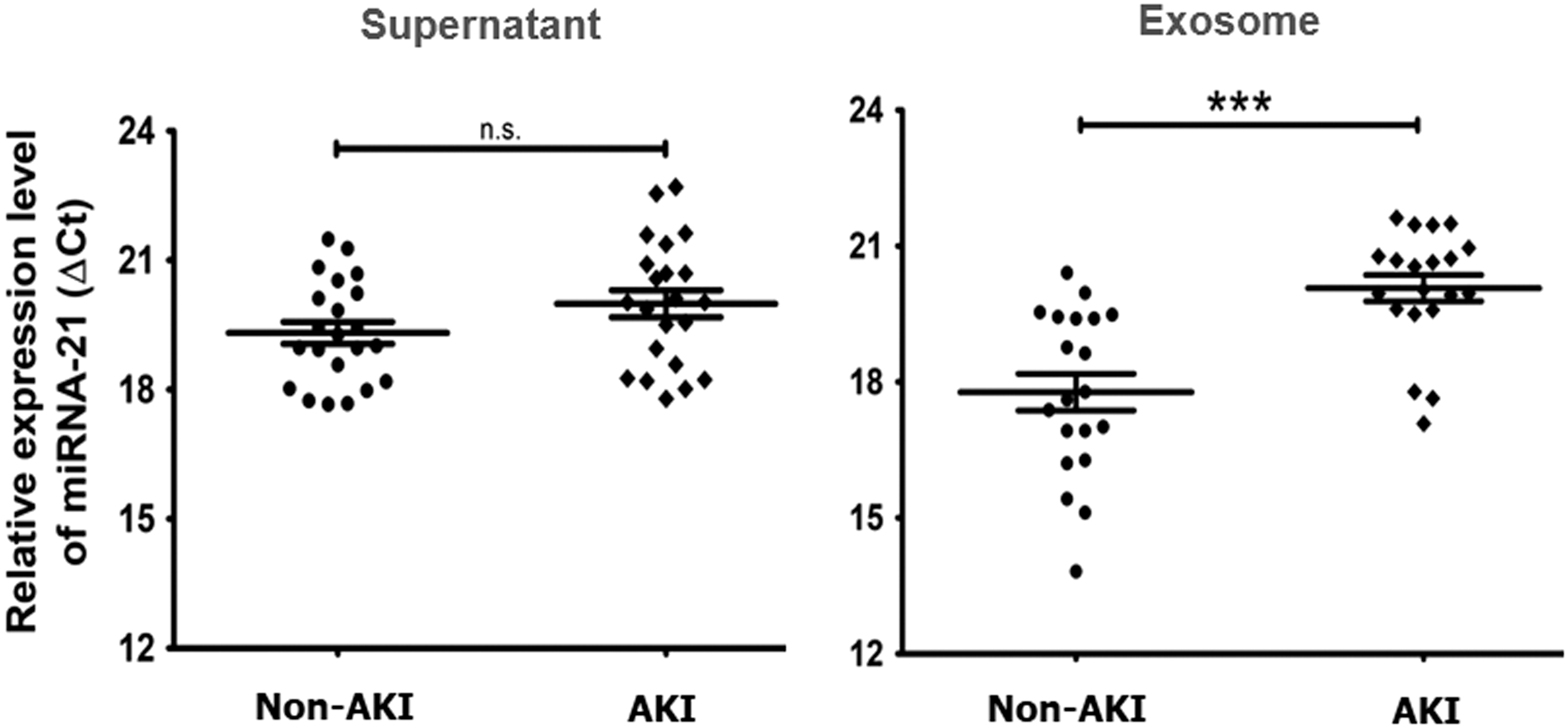
Urinary exosomal miRNA-21 is detected to be higher in the AKI group compared with the non-AKI group. Exosomes were isolated from patient's urine. RNA was isolated from the supernatant and exosome fraction and RT-PCR was performed for miRNA-21 using cell-mir-30 as a loading control. After reference gene normalization, the relative expression intensity (Ct) was not different between the two groups in urinary supernatant. However, the relative expression intensity in the urinary exosomal fraction was higher in the AKI group than in the non-AKI group. ***p < 0.01. AKI, acute kidney injury; miRNA, microRNA; RT-PCR, reverse transcription polymerase chain reaction.
Comparison of Baseline Characteristics Between Non-Acute Kidney Injury and Acute Kidney Injury Groups
Statistically significant results are indicated in bold.
t-test.
Chi-square test.
AKI, acute kidney injury; ALT, alanine aminotransferase; BP, blood pressure; CKD, chronic kidney disease; eGFR, estimated glomerular filtration rate; NGAL, neutrophil gelatinase-associated lipocalin.
Correlation between urinary exosomal miRNA-21 levels and other variables
Urinary exosomal miRNA-21 levels were directly correlated with serum NGAL (Pearson's correlation = 0.522, p = 0.001) and total leukocyte counts (Pearson's correlation = 0.43, p = 0.002). However, we observed a significant inverse correlation between urinary exosomal miRNA-21 levels and the eGFR (Pearson's correlation = −0.336, p = 0.034) (Fig. 2). The area under the receiver operating characteristic (ROC) curve was 0.907 for urinary exosomal miRNA-21 (Fig. 3).
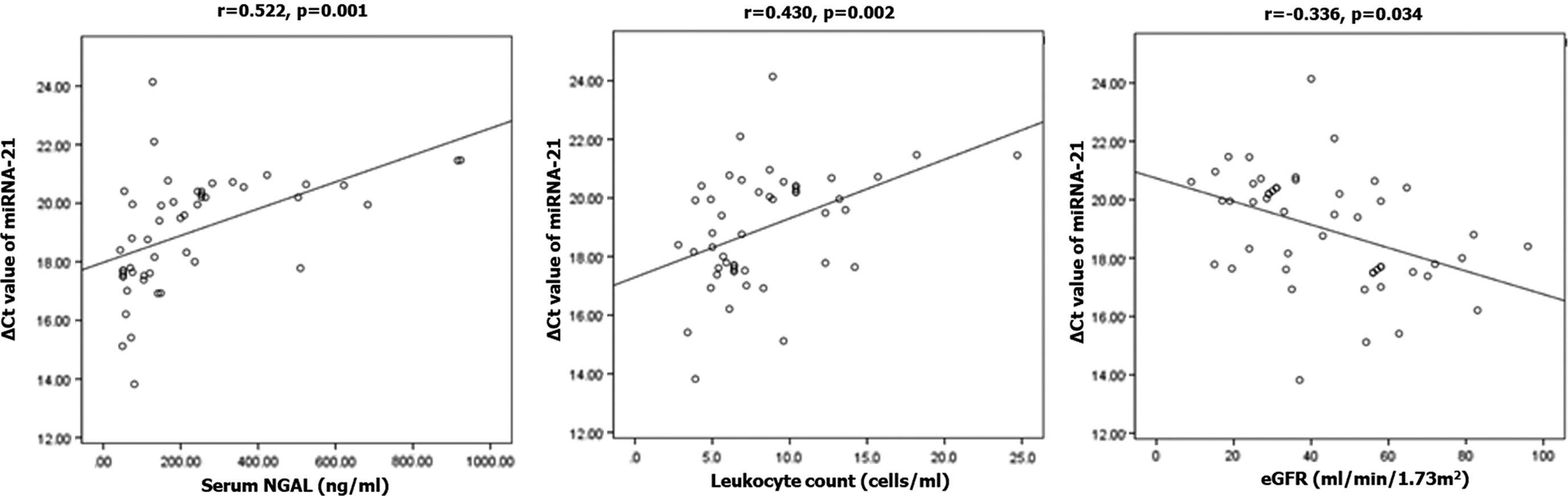
Correlation of urinary miRNA-21 with clinical parameters. Urinary exosomal miRNA-21 levels correlated directly with serum NGAL and total leukocyte count. However, they showed an inverse correlation with the eGFR. eGFR, estimated glomerular filtration rate; NGAL, neutrophil gelatinase-associated lipocalin.
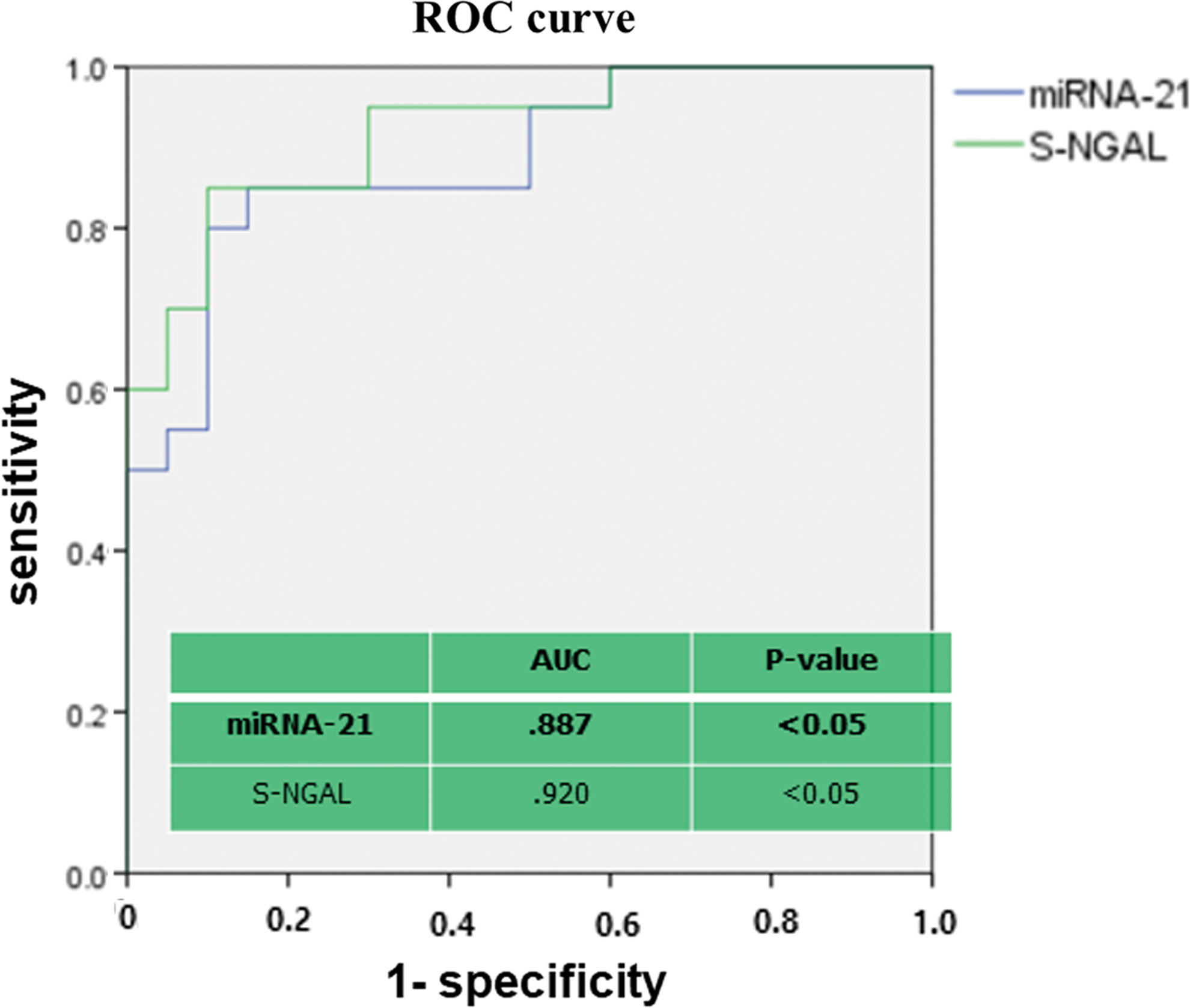
Receiver operating characteristic curve and performance characteristics for urinary exosomal miRNA-21 upon admission. The area under the receiver operating characteristic curve for the urinary exosomal miRNA-21 test is 88% (CI 0.818-0.997), with an area under the curve value of 0.907. CI, confidence interval. Color images are available online.
Discussion
Scrub typhus is characterized by focal and disseminated vasculitis that can involve several vital organs (Mahajan, 2005; Varghese et al., 2006). Patients may present with pneumonitis, acute respiratory distress syndrome, AKI, or even multiple organ failure (Hsu et al., 1993; Yen et al., 2003). Previously, we showed that serum NGAL might be helpful in predicting AKI in patients with scrub typhus (Sun et al., 2017). In this study, we demonstrated that urinary exosomal miRNA-21 levels were higher in patients with AKI than in those without AKI and that they were inversely correlated with the eGFR. In addition, the ROC curve analysis for urinary exosomal miRNA-21 showed good discriminative power for detecting scrub typhus-associated AKI. Thus, our findings provide a rationale for using urinary exosomal miRNA-21 as a diagnostic tool for detecting AKI in patients with scrub typhus. While several previous investigations have indicated the merits of exosomes as biomarkers for AKI (Salih et al., 2014), no data were available concerning exosomal miRNAs in scrub typhus-associated AKI before this study.
Several studies have suggested that miRNA-21 plays a role in protecting against injury by inhibiting inflammation and apoptosis, whereas miRNA-21 was also reported to be associated with amplifying injury responses and promoting fibrosis (Zhou et al., 2011; Chau et al., 2012; Xu et al., 2014). In this study, the levels of urinary exosomal miRNA-21 increased in the AKI group compared with the non-AKI group. Although the exact underlying pathomechanism of elevated urinary miRNA-21 levels in the AKI group was not fully understood in our study, we postulate that the upregulation of miRNA-21 in urine can be attributed to increased kidney tissue, as shown in a previous study (Saikumar et al., 2012). Du et al. reported that urine miRNA-21 levels are proportional to the severity of AKI (Du et al., 2013). However, the urinary miRNA-21 levels did not differ according to the Risk, Injury, and Failure group in our study (data not shown). To investigate the exact role of urinary exosomal miRNA-21 in scrub typhus-associated AKI, further studies are imperative.
Notably, urinary exosomal miRNA-21 levels were higher in the AKI group than in the non-AKI group, with comparable levels reported in the urinary supernatant in the two groups. We believe that such difference is due to the stability of exosomal miRNAs. miRNAs are reported to be more stable in tissue and biological fluid when contained within exosomes (Valadi et al., 2007; Alvarez et al., 2012; Sharkey et al., 2012).
Our study is not without its limitations. First, the number of enrolled subjects was relatively small. In the future, larger, prospective, randomized controlled trials are needed to confirm our observed results. Second, plasma and kidney tissues were unavailable, hence we failed to examine the miRNA-21 levels in various samples.
In conclusion, we observed elevated urinary exosomal miRNA-21 levels in scrub typhus patients with AKI compared with patients without AKI. Urinary exosomal miRNA-21 could be used as a biomarker for detecting scrub typhus-associated AKI. Future studies are crucial to evaluate its levels in other diseases and utility as a diagnostic or monitoring tool.
ICMJE Statement
All authors meet the ICMJE authorship criteria. Dr. Lee and Dr. Lim contributed to conceptualization and design of the study. Dr. Oh, Dr. Cho, and Dr. Yun contributed to data collection, drafting the manuscript, and performing the data analysis. Dr. Sun contributed to conceptualization and design of the study and supervised the study as the corresponding author.
Footnotes
Acknowledgment
The authors wish to acknowledge the financial support of the Christian Medical Research Center, Presbyterian Medical Center, Jeonju, Korea.
Author Disclosure Statement
No competing financial interests exist.
Funding Information
No funding was received for this article.