







Abstract
The rapid increase in the power of the life sciences has not been accompanied by a proportionate increase in the sophistication of biorisk management. Through conversations with thought leaders in biosafety and biosecurity, we have identified 19 concepts that are critical for biorisk management to continue to ensure the responsible and safe conduct of the life sciences in the future. Our work is not meant to be a comprehensive list, but rather a collection of topics that we hope will spark dialogue in the policy, research, and biorisk management communities.
Introduction
Over the past century, the study of pathogens has vastly improved the human condition, preventing millions of deaths by fostering hygienic improvements to mitigate the root causes of infection and through the advent of new treatments and prophylaxes for countless illnesses. Although highly beneficial, this work is not without risks. Because of the hazards posed by the pathogens studied, there have been several well-known cases of infections directly related to this laboratory work, most notably the SARS outbreaks occurring in Beijing, Singapore, and Taiwan in the mid-2000s, 1 and the 2007 foot-and-mouth disease outbreak in the United Kingdom that was thought to stem from faulty effluent pipes associated with an agricultural biosafety level 4 (ABSL-4) research laboratory in the Pirbright Institute (an animal research center). 2 Additionally, various accidents involving pathogens manipulated in high containment (BSL-3 and BSL-4) have occurred at the US Army Medical Research Institute of Infectious Diseases (USAMRIID), which has reported 7 potential biological exposures in BSL-3 laboratories and 1 in a BSL-4 laboratory space between 2017 and 2019. 3 Although a history of laboratory mishaps is beyond the scope of this article, several publications and databases provide information on the history and volume of laboratory accidents.4-6
Although our ability to characterize and manipulate life has increased, our approaches to managing risks arising from research on pathogens have stagnated. While advisory documents such as the US Centers for Disease Control and Prevention (CDC) Biosafety in Microbiological and Biomedical Laboratories 7 and the World Health Organization Laboratory Biosafety Manual 8 have provided essential information for the safe and responsible handling of biological agents, it is unclear how closely these guidelines have kept up with today's rapidly developing technologies. Readers of the first editions of these documents (published in 1984 and 1983) would likely find the latest versions (both published in 2020) largely familiar.9,10
Several researchers have made suggestions to improve upon existing biorisk management systems. In 2015, Palmer et al 11 discussed the lack of centralized biorisk guidance and oversight, stating that current oversight relies on few enforcement mechanisms, and that metrics and processes for monitoring the performance of biological and safety security regimes are underdeveloped. More recently in 2022, Ritterson et al 12 suggested the creation of a national agency for biorisk management to coordinate intragovernmental efforts and close gaps in biorisk oversight. Other researchers, including Farquhar et al, 13 have argued that laboratories performing potentially high-risk research should (1) establish clear liability in case of catastrophe and require grant holders to purchase liability insurances as part of the grant and (2) centrally commission absolute risk assessments to consider the price of externalities and require payment to a state or nonstate body to cover the expected cost. Furthermore, in 2020, Evans et al 14 highlighted the flaws in current biorisk management governance, stating that the White House Potential Pandemic Pathogen Care and Oversight policy 15 (tasked with considering ethical research conditions as it pertains to dual-use research) only performs reviews ad hoc, not systematically.
In 2 previous articles12,16 we discussed the need for social science research that addresses how to build a culture of biosafety research and the need for primary research in biosafety that fills critical data gaps to provide an evidence basis for biorisk management. Suggestions included the conduct of research on human reliability, physical factors driving laboratory accidents, life science research, and social science research (such as measures needed to foster a culture of biosafety). In addition to improvements in infrastructure, regulation, and policy, there is a need to understand how facility leadership skills can be used and developed to ensure safe and secure operations of biocontainment laboratories. In contrast to radiation safety, a topic in which many studies have been performed to gather and assess safety culture within the field,17-19 the literature on investigations of safety culture aspects in biocontainment laboratories is largely absent.
Given the prevalence of past laboratory mishaps and the feasibility that the COVID-19 pandemic could have resulted from a scientific accident, the idea of making vast changes in biosafety and biorisk management has begun to develop momentum within the scientific community. As a shining example, in 2022 the National Science and Technology Council (NSTC) released the Evidence-Based Laboratory Biorisk Management Science and Technology Roadmap, 20 which lays out several concepts to improve the evidence basis for biorisk management. The Roadmap elaborates a much needed program of research in the physical, life, management, and social sciences to underpin improvements in biosafety, emphasizing the need for government-wide coordination, biorisk management data-sharing, and a globally distributed research agenda. If implemented, the Roadmap would close important gaps in the evidence base that hamper effective biorisk management. 16 However, this research effort is just one of many needed improvements.
In an attempt to inject new energy into discussions of biorisk management and to build upon the momentum of the Roadmap, we present here 19 provocative concepts to help the field of biorisk management match the innovation observed in other life sciences. The concepts have resulted from our team's work in biorisk assessment and management for nearly 2 decades. We also held a series of 1-on-1 discussions with thought leaders in biorisk management to identify additional concepts.
The Concepts
In the sections that follow, we outline 19 concepts identified to bolster biorisk management, which are divided into 3 categories: research, workforce, and regulation, oversight, and guidance (Figure). These concepts address major gaps that exist in biorisk management research, workforce, and its regulatory framework.
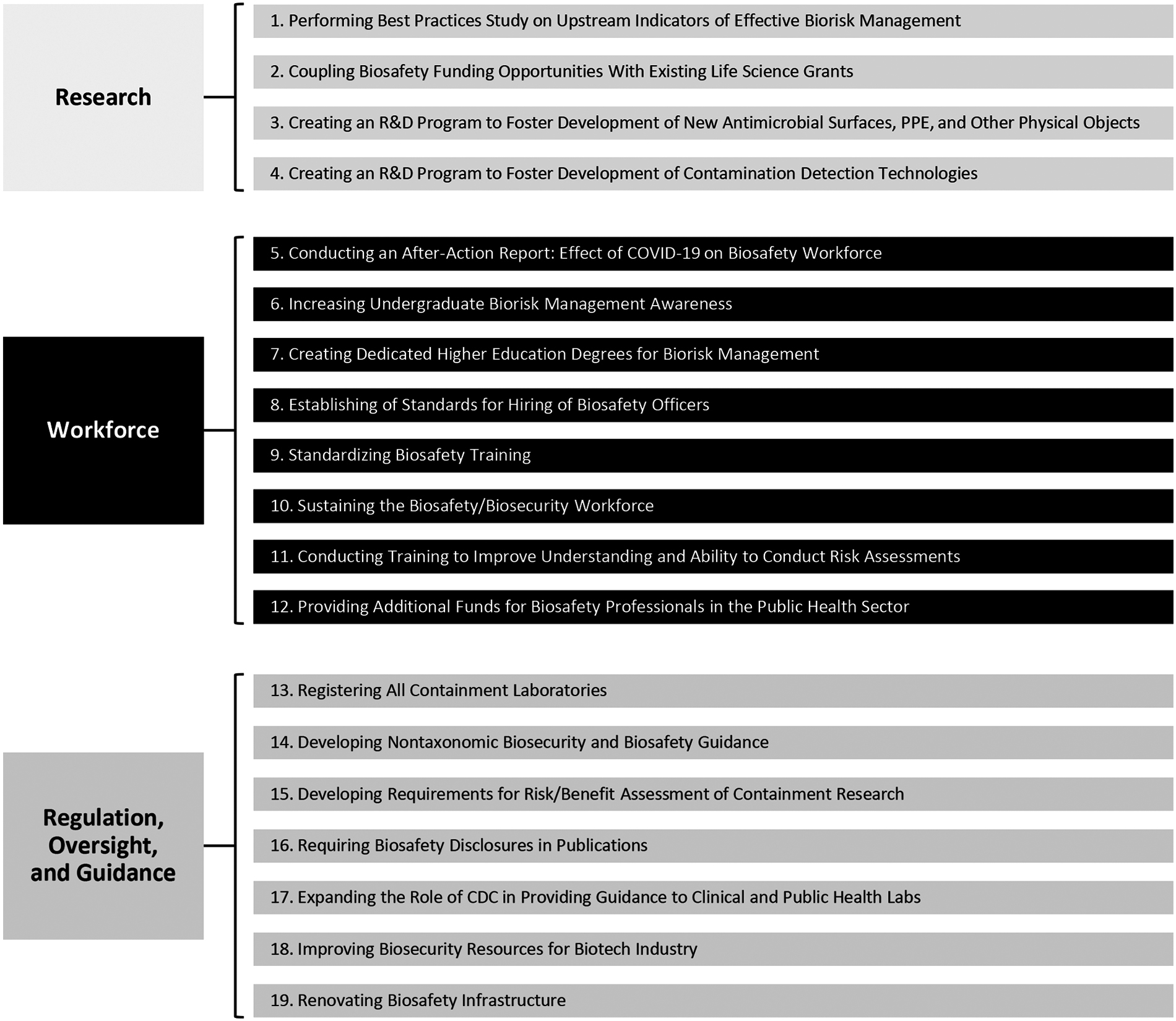
Visualization of 19 biosafety concepts pertaining to the 3 categories of gaps. Abbreviations: CDC, US Centers for Disease Control and Prevention; PPE, personal protective equipment; R&D, research and development.
Research: Concepts 1 to 4
The fields of biosafety and biorisk management suffer from a substantial lack of scholarship and data. 16 These missing data represent large gaps in our ability to characterize and hence mitigate risk. If the community does not understand how often humans make errors (eg, a plate is dropped or a protocol is ignored), how often a system fails (eg, broken heating, ventilation, and air conditioning systems), or how institutional factors (eg, limited budget allocations) impact incident rate, policies cannot reflect the true risk of the research being conducted. In this section, we outline the need to fill these research gaps via applied and fundamental biosafety research. Many of the concepts were described briefly in the NSTC Roadmap. 20
1. Understanding Upstream Indicators of Effective Biorisk Management
When a laboratory accident occurs, often it is not the result of one person's failure, but the failure of the larger structure or organization. 21 The performance indicators currently used in biorisk management systems, however, focus primarily on laboratory outcomes and do not evaluate the practices upstream from the laboratory itself. More multifarious indicators are needed to evaluate if the facility's biosafety practices are working holistically to reduce the risk of an accident occurring. Specifically, researchers at Sandia National Laboratories have noted the absence of performance indicators and metrics that allow measurement of success upstream; these indicators should include metrics that offer insight into the state of proactive interventions in addition to measuring the outcomes of the biorisk management system. 22 Additionally, because data on laboratory accidents are lacking in biosafety, additional metrics are needed to determine if a facility is operating safely.
A best practices study is needed to identify indicators for effective biorisk management that are upstream from laboratory outcomes. Such a study would evaluate how system factors (eg, management, oversight, budget allocations, review criteria) influence safety in a variety of industries with measurable outcomes related to safety (eg, number of environmental releases, workplace mishaps). Example metrics could include presence of committees, records of meeting minutes from committees, reports of violations, and frequency of proposal rejections. Results could then be developed into performance indicators to be used by facilities, auditors, and oversight groups to evaluate the effectiveness of a biorisk management system to reduce the likelihood of an accident. In addition to outcome-based measures, these alternative indicators could help holistically determine how a facility should devote their resources to best mitigate risk.
Furthermore, there is a need to build upon existing guidance pertaining to institutional biosafety committees, the first line of defense in making certain that work with pathogens is done safely. Ensuring that institutional biosafety committees are present and empowered at all facilities conducting potentially dangerous research and that minimum standards of review (by qualified reviewers) occur will help promote biosafety and biosecurity.
2. Coupling Biosafety Funding Opportunities With Existing Life Science Grants
As it stands, biosafety is not recognized as a quantitative field. Given this lack of recognition, there is a need not only to generate novel biosafety data through simple experiments (eg, drop tests), but to increase awareness that biosafety is moving in a quantitative direction.
Large federal and philanthropic organizations—such as the National Science Foundation, the National Institutes of Health (NIH), and the Bill & Melinda Gates Foundation—that provide grants to many life science research groups across the United States should encourage ancillary studies with relevance to biosafety when issuing grants for the study of pathogens. When laboratory groups are completing a grant application through the funding organization for their own research of interest, applicants should be given the option to also signal their interest in participating in simple, quantitative biosafety experiments. The groups that opt to participate in such experiments would also provide novel biosafety data (such as validated decontamination methods for the pathogen studied). Additionally, the existence of this option may help introduce the concept of biosafety research to undergraduate and graduate research students earlier in their career (discussed further in Concept 6).
3. Creating a Research and Development Program to Foster Development of New Antimicrobial Surfaces, Personal Protective Equipment, and Other Physical Objects
Risk of laboratory-acquired infections can occur through direct inoculation (inhaling or ingesting a pathogen) or indirect inoculation (touching one's hands or eyes with contaminated gloves). Although a researcher can contaminate their hands directly from spills, contamination through the handling of contaminated objects or surfaces may also be a major driver of risk. Surfaces in laboratories are generally not treated to prevent persistence of contaminating microbes. If the surfaces of laboratory and personal protective equipment were reengineered to be inherently hostile to contaminating microbes, a pathway for infection of laboratory workers (and subsequent exposure to the public) could be eliminated.
While some antimicrobial surfaces exist and several groups are conducting research in this area, the development of antimicrobial surfaces for laboratory work is less well funded and less understood. Of the few studies that have been performed, Selvamani et al 23 (2020) achieved success in engineering an antimicrobial copper surface with enhanced activity against Pseudomonas aeruginosa and methicillin-resistant Staphylococcus aureus. An additional study investigated antimicrobial, copper-based self-sanitizing surfaces for use in inpatient clinical areas and laboratories 24 while another tested the antimicrobial ability of copper-coated polypropylene filter face masks. 25 The gaps in our knowledge of antimicrobial surfaces could be addressed via the establishment of a dedicated research and development program that funds new methods to develop and deploy antimicrobial surfaces for wide use in laboratories, which could reduce the risk of laboratory-acquired infections. Requirements must be set to help guide research targets.
4. Creating a Research and Development Program to Foster Development of Contamination Detection Technologies
Perhaps the most dangerous type of incident in a laboratory is one in which a pathogen contaminates the body or clothing of a worker without their knowledge. If a worker is aware of contamination, they can take many actions to reduce risk. Contaminated items can be carefully removed, workers can wash themselves thoroughly, workers could monitor for early signs of illness (called “fever watch”), or they could preemptively isolate themselves. None of these actions are possible if contamination occurs without a worker's knowledge.
To greatly reduce the risk of unnoticed incidents in a laboratory, research is needed to develop technologies that can warn a worker that contamination occurred. This research could include “reactive” personal protective equipment that indicates when it becomes wet, laboratory coatings that change color when contamination occurs, or holographic systems that can identify or track tiny splashes or spills. Requirements must be set to help guide research targets.
Workforce: Concepts 5 to 12
Without a workforce dedicated to the sustained and continual improvement of biosafety and biorisk management, neither research nor efforts to improve the practice of biosafety can be implemented. There is an urgent need to increase interest in the field of biosafety and foster a cadre of well-trained, early-career workers. Unfortunately, many seasoned biosafety officers are reaching retirement age, and most biosafety and biosecurity offices are understaffed and underfunded. In this section, we discuss policies aimed at expanding our current biosafety workforce.
5. Conducting an After-Action Report: Effect of COVID-19 on Biosafety Workforce
COVID-19 placed an unprecedented burden on the biosafety workforce. Guidance was needed to facilitate the pivot of many laboratories toward SARS-CoV-2 research and expertise was required to operate occupational settings in the presence of an environmental infectious disease risk. A lack of flexibility in this workforce hampered the scientific response, particularly at the local level. 26 Understanding the gaps, lessons learned, networks formed, and best practices established is essential to ensuring that this workforce can more ably pivot to address any emerging infectious disease threat. Research should be conducted while the data are still new, or the information may be lost. In November 2021, useful information pertaining to this concept was collected via a survey of biosafety officers in the United States and internationally, with a focus on how their jobs changed in response to COVID-19. 27
Additional studies are needed that engage with biosafety officers in various academic, private, and public settings about the challenges faced and measures taken to accommodate a surge in biosafety expertise to confront COVID-19. These studies should elucidate the demands on the biosafety workforce, shortages in expertise or workforce, points of failure, and measures that enabled a successful response. A workshop should be conducted to validate the broad applicability and relevancy of solutions to improve the ability of the biosafety workforce to surge for future infectious disease events.
6. Increasing Undergraduate Biorisk Management Awareness
Biorisk management is not introduced as a concept until late in the education of life scientists. As a result, students working within a laboratory may exhibit poor awareness of standard laboratory biosafety and biosecurity regulations and practices.28,29 In some fields, concepts of biological risk management are not properly introduced (eg, risks to field biologists from environmental hazards and risks that field biologists pose to the ecosystems they study). Failures in biorisk management are observed in many life science fields (eg, scientists infecting their subjects, field biologists killed by wild animals or infections contracted from them). A report published by Lawrence Livermore Laboratories investigated the biosecurity course offerings at 8 top US universities: only 2 of these offered a single course focused on biosecurity to undergraduates. 30 In a study published by Mancini et al 31 in 2008, out of 57 universities in 29 countries, only 3 universities offered some form of specific biosecurity module for students in life science courses, and in all cases, it was optional.
Incorporating the principles of biorisk management into undergraduate curricula would help build a culture of biosafety. Early introduction and reinforcement of the concepts of biorisk management also benefit those with a life science background who go on to careers in medicine, agronomy, animal health, and so on, as all of these professionals face various forms of biorisk in their workplaces. This curriculum could introduce students to the concept of risk management in each life science class (eg, the risks from hazards in the environment, environmental risks from imported species, risks from the spread of bred or engineered strains, risks of misuse of biotechnology, risks of the scientist to a pristine environment or subjects, infection control in medicine and animal health, risks of theft of intellectual property) and also could be the subject of a dedicated course for those who wish to obtain a deeper understanding.
7. Creating Dedicated Higher Education Degrees for Biorisk Management
Biosafety professionals receive training in life sciences or workplace safety, but they must learn the fundamentals of biorisk management “on the job” because no preprofessional degree programs or certificates are available. Credentials are offered to practicing professionals, but these credentials require years of experience. Moreover, the United States is facing a workforce cliff as seasoned biosafety officers retire or change fields. 32
Research institutions can examine their own workforce challenges to understand when they may be unable to adequately oversee biological research and, in response, they can fund internal training programs to proactively address this gap before it occurs. Providing training grants for institutions to develop biosafety majors, certificates, and degrees within their institutions would also help address this gap. Research would be needed to determine whether these programs would be best offered as a few classes added on to an existing program or as a standalone program, and whether they would be best offered at the bachelors, masters, or professional level and/or at community colleges and technical schools for students hoping to gain certificates or associate degrees. The largest hurdle to implementing such a program is likely the lack of funding and inertia; some may see the current system as working and thus envision no need for major changes.
8. Establishing of Standards for Hiring Biosafety Officers
There are no guidelines as to when a facility must hire a biosafety officer and how many are needed; for NIH-funded entities, at least 1 biosafety officer is required if any work is performed at BSL-3 or higher and a biosafety officer is required for select agent registration, but no other guidelines exist. In some facilities, biosafety responsibility lies with a consultant, while in other facilities it resides with someone who has many other roles. 32 Clearly, there should be a standard that dictates when a dedicated, professional biosafety officer should be available. Moreover, large facilities need guidance on how many biosafety officers are needed to properly oversee the work done.
Guidelines must be developed to address the number of biosafety professionals needed to adequately serve facilities of various types and sizes, and indeed should indicate when a dedicated biosafety professional is needed at all. Guidelines should be flexible to accommodate the realities of research and the workforce worldwide. Such guidelines could be widely shared to inform the conduct of research internationally.
9. Standardizing Biosafety Training
Biosafety training is developed independently by each research entity, and therefore biosafety training in some facilities is more rigorous and more evidence-based than in others (eg, only some BSL-3 facilities have a 2-hour biosafety cabinet training). Moreover, some biosafety training courses contain idiosyncrasies inherited by the program that are not aligned with current thought in biosafety (eg, prohibiting use of sanitizer on gloves). Lastly, the independent development of the same basic training program in many institutions is a wasted duplication of effort.
Creating a standardized biosafety training curriculum that sets requirements and content for biosafety nationwide would help reduce duplication and ensure that all participants learn at least the same fundamental concepts in their training. Such a curriculum could include drop-in modules that are easily adapted by each institution. The curriculum should incorporate universal design principles and concepts of adult learning to facilitate retention (currently, most biosafety trainings are lecture based). Each institution could add material to this basic training to adapt it to their programs and policies. The initial version of the training should build upon a best practices study of current training. The training curriculum would be reviewed and updated to match current biosafety science on a regular (5-year) basis.
This type of training is distinct from the credentialing programs run by biosafety organization such as the ABSA International 33 and the International Federation of Biosafety Associations (IFBA), 34 because it would focus on conducting research safely in the laboratory rather than the skills and knowledge needed to become a biosafety professional.
10. Sustaining the Biosafety and Biosecurity Workforce
Two major challenges are related to the biosafety and biosecurity workforce: (1) many seasoned biosafety officers are reaching retirement age and (2) the majority of biosafety and biosecurity offices are understaffed and underfunded, leading to burnout and staff turnover. 35 Many public health laboratories have had difficulty identifying qualified biosafety officer candidates. 32 Furthermore, COVID-19 has exacerbated this issue by increasing the demands on biosafety staff, yet providing no more resources.
To address the current and looming crisis in the biosafety workforce, several steps must be taken. In the long term, the integration of biorisk management principles into undergraduate curricula and the development of graduate curricula in biosafety would create the next-generation workforce (described in Concept 9). To address this gap in the short term, grants should be given to support recruitment and training of a biosafety workforce to organizations such as ABSA International, Eagleson Institute, and IFBA. Such grants should support the full-time training (ie, stipend and tuition) of workers who already have a biology background in the fundamentals of biosafety and biosecurity that are already being taught as part of the continuing education component of these organizations. To recruit scientists into biosafety, existing biosafety organizations should be funded to recruit for scientists at conferences and in career talks at universities.
11. Conducting Training to Improve Understanding and Ability to Conduct Risk Assessments
Most contemporary biosafety guidance focuses on the concept of a risk-based approach to biosafety, with an increasing shift toward protocol-driven risk assessments in each subsequent revision of guidance. This risk-based approach, when implemented well, results in stronger and more thorough biorisk management programs than 1-size-fits-all prescriptive standards; however, many within the field of biosafety feel that the resources and training necessary to understand how to conduct risk assessments well is lacking, which leaves biosafety officers and other safety personnel adrift. While a strong risk assessment is better than a prescriptive requirement, a weak risk assessment may be worse. Current biosafety guidance (in particular, the Biosafety in Microbiological and Biomedical Laboratories 7 ) emphasizes risk-based approaches, tacitly supporting improvements in risk assessment skills. Given the widespread recognition for training in this area, the largest hurdle to implementation is a lack of funding.
Developing freely available training materials on how to conduct risk assessments, which personnel and laboratories can use as a starting point, would help address this gap. This training material can dovetail with other concepts proposed here—for example, a simplified version could be created as part of the proposal for more substantive biorisk training for life science undergraduates, while an in-depth course could be developed for future biosafety professionals. An expanded version of this concept could include funding to support training delivery. The training materials should be based on best practices and research that evaluates the effectiveness of various approaches, which also has yet to be conducted. Conducting this research is essential to ensure that the training is effective.
12. Providing Additional Funds for Biosafety Professionals in the Public Health Sector
Most public health laboratories lack a dedicated biosafety professional; those that do have them frequently place the responsibility on a person who already has many roles. 27 This gap stems from a lack of funding to support biosafety personnel and training in the public health sector. Some limited efforts have been undertaken previously and demonstrated success; for example, small grants were made available in the wake of the 2014-2016 West Africa Ebola outbreak amidst concerns that the outbreak could spread to the United States. 26 The current lack of biosafety professionals in the public health sector stems primarily from a lack of funding, but potentially also from a lack of recognition by some public health laboratories regarding the value of biosafety professionals.
Increasing funding under existing lines of authority to explicitly cover the cost of hiring and retaining a biosafety officer and a biosafety outreach officer at public health laboratories would help address this gap. The US federal government, often through the CDC, already provides a substantial proportion of public health funding and could expand the scope of funding available to cover biosafety. In initial years, the program could be “opt-in,” in which only those laboratories most interested in hiring professionals could participate. Subsequently, the CDC could gather data on implementation to improve the program. Later, when the program is optimized, both “carrots” and “sticks” could be used to incentivize the rest of the community to participate. Clearly, the hiring of biosafety officers at many public health laboratories would exacerbate the workforce shortage in biosafety, so this concept should be supported only when other measures are also taken to bolster the overall workforce.
Regulation, Oversight, and Guidance: Concepts 13 to 19
In this section, we focus on the creation of systems that will universally improve biosafety via regulation and guidance. Many of these concepts could fit well under the oversight of a centralized national authority for biorisk management. Existing entities, including ABSA International's laboratory accreditation program, whose goal is to ensure BSL-3 laboratories, “have the necessary practices, procedures, personnel, and equipment in place to protect people, animals, plants, and the environment and minimize the potential of laboratory-associated infections and laboratory accidents” may be expanded to incorporate of such concepts. 36 However, these entities lack the power to enforce regulations, which may be necessary to ensure that critical gaps in oversight do not occur. Although many of these concepts have been discussed by other authors and even partially implemented by other nations, they are largely absent in the United States and represent an important gap in our ability to conduct research with pathogens safely and securely.11,37 The proposal to establish a National Agency for Biorisk Management would partially address this gap in the United States. 5
13. Registering All Containment Laboratories
No one knows how many facilities in the United States are working on pathogens because there is no requirement to register these containment laboratories. This lack of knowledge complicates our understanding of biorisk and undermines biosecurity (a laboratory cannot be protected if its existence is unknown). Moreover, without an understanding of the containment space in the United States, the US government cannot make decisions regarding the adequacy of the life science enterprise to perform critical research on pathogens, which is necessary to respond to the next pandemic. The Government Accountability Office (GAO) has highlighted this gap in reports over the last decade.38,39 Going further, the GAO suggested to the White House that a biosafety oversight authority be created to manage laboratory registration, but this concept was rejected by the Obama administration as not in the interest of US national security. 40 No additional commentary was provided to the GAO, but concerns may have arisen related to the registration of laboratories working on critical national-security functions. This concern appears unwarranted, however, as select agent laboratories are already registered and the US government has several information protection schemata at its disposal to protect this information, similar to how the US Department of Agriculture protects the location of certain farm producers in the National Survey of Agriculture, 41 for example.
We suggest requiring the registration of any facility that wishes to work with Risk Group 2 agents and above. This registry could be used to disseminate biosafety and biosecurity information and guidance, help secure laboratories, and facilitate distinguishing licit and illicit biological activities. Other countries, such as Canada, have similar registration requirements. 42
14. Developing Nontaxonomic Biosecurity and Biosafety Guidance
Almost all biosecurity and biosafety guidance—such as the US government select agent rules, 43 NIH recombinant DNA guidance, 44 Bureau of Industry and Security export administration regulations, 45 and the US government dual use research of concern policy 46 —applies if, and only if, the activity in question is conducted with a pathogen that matches a species or strain from a list. This approach leaves substantial biosafety and biosecurity gaps, for many reasons. First, the system is inflexible, taking years to account for the emergence of new strains or the development of attenuated strains. Second, the system is being outmoded by the power of modern biology, within which chimeric synthetic and highly modified pathogens do not fall neatly. In 2010, Casadevall and Relman 47 noted many of these deficiencies, stating that the taxonomic basis for select agent designation ignores the natural diversity and variation in virulence and behavior within a given taxonomic group, and also devalues the contribution of the host in conferring transmission. Third, the system is inconsistent in that some pathogens are listed for historical reasons (or because risk was analyzed) and others are not. For example, Rickettsia prowazekeii is a select agent, yet many transmissible, pathogenic respiratory viruses would more readily cause more global deaths in an outbreak. This problem has been noted in the biosecurity field for a while, but most efforts to address this shortcoming merely restated the difficulties with fixing it.
Universal concepts for biosafety and biosecurity should be developed that are risk based and not taxonomic. Casadevall and Relman 47 specifically suggests considering the pathogen's genome sequence and host properties, such as immune response. These concepts would lead to a revision of nearly all biosafety and biosecurity guidance to better handle emerging pathogens and modern biology. These concepts would necessitate measures to predict risk (or risk range) of pathogens that cannot be tested empirically due to resource or practical constraints (eg, modified pathogens that infect only humans). Such a study should start with a risk assessment that captures the risk posed by pathogens controlled under various regimes, and then compare that to the risk of pathogens outside control to determine if current controls are capturing (and excluding) all known agents that should be captured. The risk assessment would be based on data already published and requires no new experiments to be conducted. Another early step is a study that gathers requirements from key stakeholders regarding what level and types of risks current regimes are designed to mitigate. For example, should the select agent rules prevent access to any pathogens that could be misused by an unsophisticated actor to infect, harm, or kill an established threshold volume of humans? These data would be used to create straw-person approaches to a phenotype-based system, which would then be extensively reviewed by stakeholders in industry, academe, and government (particularly law enforcement). A key criterion is that a controlled strain should be unambiguously identified as being controlled, regardless of the resources or perspective of the person doing the assessment.
15. Developing Requirements for Risk–Benefit Assessment of Containment Research
Work with pathogens in any containment level is always associated with some residual risk that cannot be mitigated practically. Numerous authors suggest a need to rethink how we approach research with high-containment pathogens.13,48,49 Although pathogen research may yield advances in diagnosis, treatment, and prophylaxes for dangerous diseases, the decision to conduct this work requires careful consideration of the risks and benefits of such research. Currently, when the biosafety systems of a grant proposal are reviewed at all, they are reviewed to simply assess if they are “appropriate” for the experiments proposed; there is no attempt to estimate how much risk remains after the implementation of all controls. Moreover, the “benefit” of the research is usually judged on its intellectual merit, not the practical benefits of the research to reduce risk of global pandemics. Therefore, current risk–benefit approaches are not rigorous and usually result in a lopsided apples-to-oranges comparison that favors the conduct of research over safety.
To address these gaps, requirements for when rigorous risk–benefit assessments should be conducted must be established. Additionally, standards for the methodologies that must be applied when conducting risk–benefit assessments for work with dangerous pathogens must be developed. Standards for the methodology should not be prescriptive, but should describe a minimal set of activities, data, and methods that must be used for the risk–benefit assessment to have enough rigor and transparency to guide critical actions (eg, approval or denial of the research or additional mitigations that must be employed first). Such methodology estimates the residual risk given the proposed biosafety measures and weights these against the benefits conferred to global health and medicine. These risk–benefit assessments should be conducted by an assessor outside the funding organization. Other publications, including Inglesby and Lipsitch 48 (2020), suggest requiring a high-level official, such as the NIH director or US Department of Health and Human Services secretary, to approve enhanced public–private partnership research, and their determination could be greatly informed by such a risk–benefit assessment.
16. Requiring Biosafety Disclosures in Publications
Information on biosafety measures employed when conducting research is currently excluded from academic publications, which complicates the sharing of best practices and analysis of biosafety measures employed. Lack of awareness and communication of best practices in biosafety have limited the implementation of effective practices to the institution itself. As a result, institutions are stuck in an endless cycle of reinventing the wheel, effectively spending more resources on less-proven biosafety practices.
As a requirement when receiving federal funding, information about biosafety measures should be included in any resulting publication. Alternatively, editors of journals that focus on infectious disease research could also be separately encouraged to suggest that the authors include this information (or require it). Although not required by law, existing frameworks such as the Materials Design Analysis Reporting have aimed to increase transparency about biosafety practices and materials (eg, requirement of step-by-step protocols and dual-use disclosures) used in life science research and are currently implemented by more than 1,000 journals and publishers. 50 This information would help build a culture of biosafety, fostering the establishment of standards for additional biosafety measures, and enable laboratories to build on the mitigation practices used by other laboratories. To be successful, this concept should be preceded by a study to establish what should be reported and the best way to foster the inclusion into publications.
17. Expanding the Role of the CDC to Provide Guidance to Clinical and Public Health Laboratories
Clinical and public health laboratories lack a strong coordinating entity that provides biosafety guidance and helps laboratories implement biosafety standards. Even for those public health laboratories that do emphasize biosafety, available guidance (eg, Biosafety in Microbiological and Biomedical Laboratories 7 ) is tailored toward research and production facilities and not clinical laboratories. Given the current partial coverage of this role by CDC, the US government has tacitly supported an oversight role of the CDC for these facilities, and the biggest hurdle to implementation is likely a lack of funding to do so.
Explicitly creating a federal mission within the CDC to provide an oversight role on biosafety guidance for clinical and public health laboratories would help address the current lack of guidance. CDC is highly regarded and trusted by the clinical and public health laboratory sectors and would be a natural home for this role, as they already offer guidance to public health laboratories in many other areas. Specifically, CDC is viewed as having a deep understanding of those sectors and offering translated, tailored advice to them. As conceived, CDC would offer guidance to public health laboratories, who in turn can offer guidance to clinical laboratories within their jurisdictions.
18. Improving Biosecurity Resources for the Biotechnology Industry
As biotechnologies continue to advance, a host of outsourcing and automation companies have sprung to life, including fully automated laboratories available remotely to researchers seeking to use their capacities, gene synthesis companies, protein production companies, and many more. Despite the risk of these companies being misused by malicious actors to facilitate acquisition of a harmful agent, there is no federal guidance, advocacy organization, or commercial enterprise focused on improving biosecurity within these industries. Yet industry recognizes the value of improving biosecurity and has asked for help with 2 specific biosecurity efforts: (1) a training program to introduce concepts of biosecurity 51 and (2) a clearinghouse that could provide on-demand and rapid response biosecurity advice when harrowing situations arise. 52 Currently, concerns can be reported to the US Federal Bureau of Investigation, but it can neither provide advice nor comment on whether any given incident that was reported should have been considered suspicious. This concept was recently echoed in the NSTC Roadmap, 20 which suggested the creation of “real time problem-solving platforms between practitioners, or narrow biorisk interventions, for immediate adoption.” Although an attempt to provide an on-demand resource for biosafety inquiries was established by the Woodrow Wilson Center's “Ask a Biosafety Expert” service, Trejo et al 53 state that no model has yet been implemented in a systematic or sustained manner; therefore the efficacy and usefulness of the few existing programs are unknown.
Improvements in industry biosecurity should incorporate a 3-pronged effort. The first is to extend the core concept of the US Department of Health and Human Services synthetic DNA guidance 54 —being aware of what product is being made and who is receiving it—to the breadth of the biotechnology automation/outsourcing industries. The second is to provide funding to develop a standard biosecurity training program and begin to deploy it to companies. The last is to provide funding to kickstart a biosecurity advice hotline, which would likely be housed within the private sector.
19. Renovating Biosafety Infrastructure
Many laboratories in the United States are located in older buildings or outfitted with biosafety equipment that has reached (or is nearing) the end of its life. Some of this equipment was purchased with funds for pathogen research available after the 2001 anthrax attack, and this equipment has a design-life of only 15 years. Although funding for certain activities (eg, updating heating, ventilation, and air conditioning, plumbing, and building automation systems) has recently been available for select BSL-3 and BSL-4 laboratories engaged in RNA viruses of pandemic potential via the US National Institute of Allergy and Infectious Diseases, 55 additional funding is needed to replace outdated equipment to improve safety. In some institutions, such as teaching laboratories for clinical laboratory staff, funding to meet current biosafety guidance is lacking.
First, there is a need to assess the current state of containment laboratories in the United States, including their equipment and physical plant. Second, funding (either in the form of matching funds or block grants) should be provided to facilities to replace or refurbish their physical plant and equipment or to reach compliance with existing guidelines. Much of the equipment that would be purchased is made in the United States and therefore would also be a boost to US manufacturing.
Conclusion
Each of the concepts discussed in this article addresses longstanding and critical gaps in biorisk management. Together, implementing these concepts could bolster the oversight of biorisks, the data underpinning evidence-based risk mitigation, and the workforce needed to guide and oversee biorisk management. These concepts are self-reinforcing. Solid data on what drives or mitigates biorisks arising from a robust research program could help foster more efficient regulation, while an educated and properly staffed safety office is needed to ensure current thinking in the field is implemented in the laboratory.
Most of the concepts are relatively cost-effective and each could be implemented for a few million dollars or less, based on preliminary studies and laboratory experiments our group has conducted. Together, these concepts would sum to less than 1% of the budget currently spent by the NIH to investigate pathogens. Still, the lack of a US government entity with the mission to improve biorisk management across the research and public health enterprise as a whole remains an issue. While a newly created national authority for biorisk management 12 would be a natural home for these policies, piecemeal implementation of individual concepts within various departments and agencies would still dramatically increase our ability to perform meaningful pathogen research safely and economically.
Footnotes
Acknowledgments
We would like to thank Open Philanthropy for providing funding for this research. Additionally, we thank Adam Fleming, Kelly Kim, Greg Koblentz, Barbara Johnson, Rebecca Moritz, Richard Ebright, Joe Kanabrocki, Sherry Supernavage Bohn, Kathleen Vogel, Gigi Kwik Gronvall, and David Gillum for providing their inputs for this study.