







Abstract
Rhamnolipids are well-studied glycolipids secreted by Pseudomonas aeruginosa that have been found to have excellent surface activity. Already used in various application areas, including environmental, health, food, cosmetic, and oil industries, rhamnolipids are attractive candidates to replace chemically synthesized surfactants because they are derived from a natural source at high purities and have low toxicity levels. Production of rhamnolipids depends on several environmental and nutritional factors, and the highest yield is estimated to be 6 g/L; recent advances in recovery methods have resulted in 99.9% pure rhamnolipids. Rhamnolipids have several beneficial characteristics: they are easily degradable, nontoxic, nonmutagenic, and have the highest surface-tension-reduction index of any surface-tension reducing agent currently in use. They have broad potential applicability across industries. They can also be used in oil-spill management, environmental management, biodegradation and remediation, the uptake of heavy metals and environmental pollutants, and the production of skin-compatible biochemicals for use in cosmetics. Rhamnolipids have applicability as antimicrobial, antifungal, antiviral, anti-algal, and anti-protist agents. In this review, we summarize the production parameters, properties, and industrial potential of rhamnolipids, as the next generation of biosurfactants.
Introduction
Rhamnolipids are extracellular glycolipids composed of L-rhamnose and 3-hydroxyalkanoic acid that are produced by Pseudomonas spp. Much of the research that has been conducted on rhamnolipids to date has focused on determining potential applications. Jarvis and Johnson first isolated and described rhamnolipids from Pseudomonas aeruginosa in 1949. 1
Rhamnolipids are synthesized when one or two rhamnose sugar molecules fuse with one or two β-hydroxy 3-hydroxy fatty acids. 2 There are four types of rhamnolipids: mono-rhamnolipids (Rh1), which contain one rhamnose sugar attached to two molecules of β-hydroxydecanoic acid; di-rhamnolipids (Rh2), which contain two rhamnose sugars attached to two molecules of β-hydroxydecanoic acid; tri-rhamnolipids (Rh3), which contain one rhamnose sugar attached to one molecule of β-hydroxydecanoic acid; and tetra-rhamnolipids (Rh4), which contain two rhamnose sugars attached to one molecule of β-hydroxydecanoic acid. 3 The length of the carbon chains found on the β-hydroxyacyl portion of the rhamnolipids can vary significantly. However, rhamnolipids produced by Pseudomonas aeruginosa predominantly contain a 10-C molecular chain. 4 Glycolipids in which one or two rhamnose molecules are linked to one or two molecules of β-hydroxydecanoic acid have been the most studied. The OH− group of one of the acids forms a glycosidic bond with the reducing end of the rhamnose disaccharide, while the OH− group of the second acid is involved in ester formation. 5 The Rh1 L-rhamnosyl-L-rhamnosyl-β-hydroxydecanoyl-β-hydroxydecanoate, and L-rhamnosyl-β-hydrodecanoyl-β-hydroxydecanoate, an Rh2, (Fig. 1) are the principal glycolipids produced by P. aeruginosa. 6
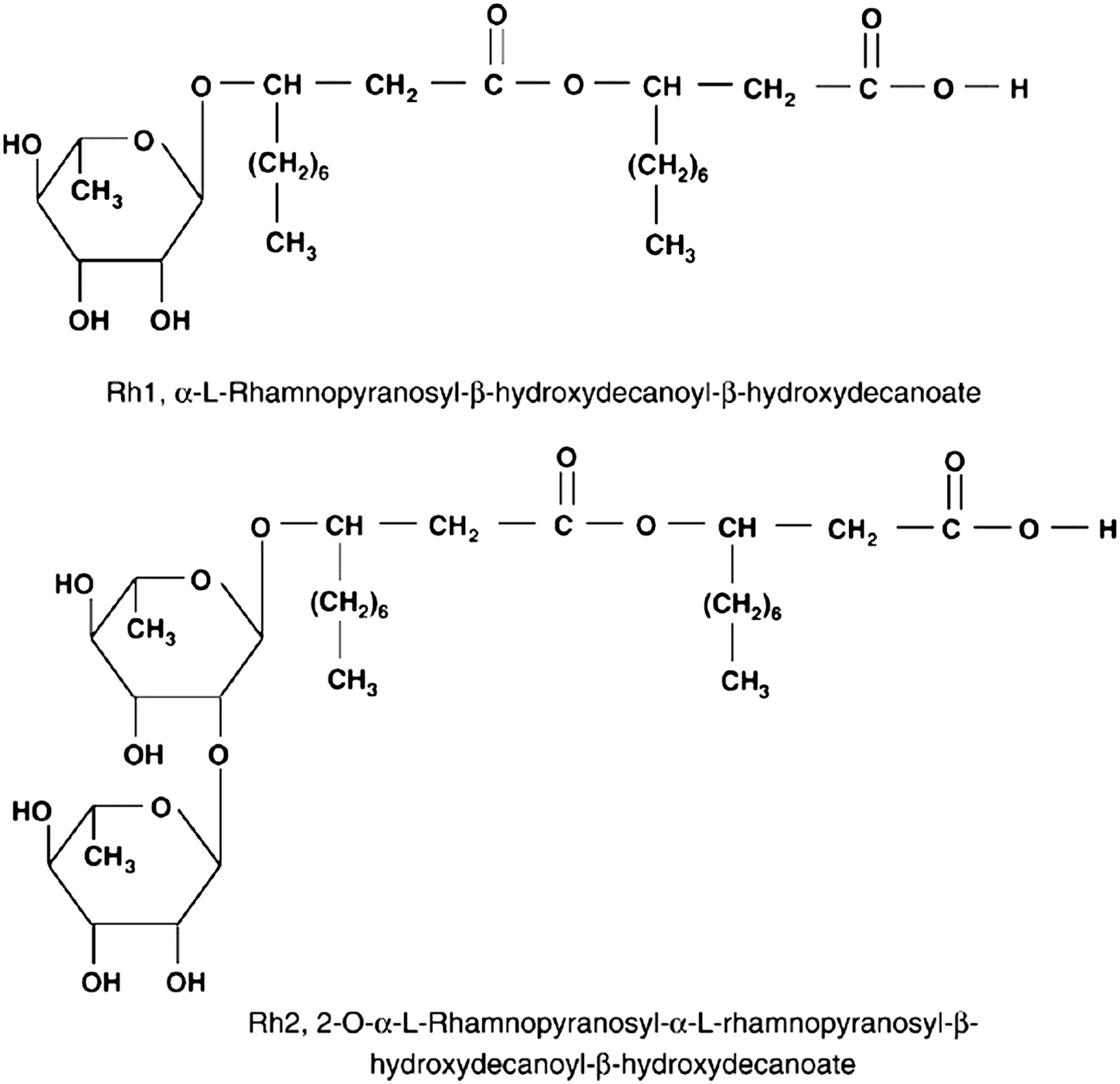
Chemical structures of rhamnolipid 1 (Rh1) and rhamnolipid 2 (Rh2).
Pseudomonas species are the main sources of rhamnolipids, with P. aeruginosa the primary species to produce rhamnolipids. Sim et al. reported in 1997 that Pseudomonas pyocyanea could produce rhamnolipids when grown on glucose. 7,8 Norman-Shaw summarized the known sources and structures of bacterial glycolipids in 1970. 9 P. aeruginosa is capable of growing and producing rhamnolipids by metabolizing a range of different carbon sources; however, the highest level of rhamnolipids production results from using vegetable-based oils, including soybean oil and olive oil. 2,10 –12 However, many isolates from other bacterial species of varying distance in their taxonomical classification were reported to be rhamnolipid producers. 13,14
Rhamnolipid biosurfactants can be produced from inexpensive raw materials that are available in large quantities, such as industrial wastes and byproducts. 15 The carbon source, which may come from hydrocarbons, carbohydrates, or lipids, is the most important factor in rhamnolipids production. 16 However, rhamnolipids production also depends on several other environmental and nutritional factors, including nitrogen, multivalent ions, agitation rate, temperature, pH, phosphates, and metals. The highest achievable rhamnolipids yield has been estimated to be 6 g/L with optimized parameters. 17 Olive oil waste has been considered an excellent carbon source for rhamnolipid production, with a maximum yield of 3.0 g/L at 10% olive oil concentration. Glycerol and ammonium nitrate also resulted in high rhamnolipid production, at 3.9 g/L. 18 Optimized parameters for rhamnolipid production have been shown to be an agitation rate of 50–200 rpm, temperature of 25–30°C, and pH of 6.0–6.8. 19,20 Mutations of the P. aeruginosa strain to enhance rhamnolipid production have resulted in a 10-fold increase over the parental strain (grown at an agitation rate of 200 rpm and temperature of 37°C). 21 Adding 35 μM of iron to the medium resulted in a 3-fold increase in rhamnolipid production, illustrating the dramatic effect iron concentration has on rhamnolipid production. 20 In previous work, adding 0.008 g/L of iron sulfate to media containing manitol as the carbon source produced 3.81 g/L rhamnolipid. 22
Innovative approaches are being applied to enhance the production of rhamnolipids. 23,24 In this review, we describe the ideal properties of rhamnolipids and their potential in various industrial sectors. We also discuss the potential for applying fully characterized rhamnolipids as next-generation biosurfactants across industries.
Properties of Rhamnolipids
Rhamnolipids are of increasing interest for commercial use because of their biological compatibility. Rhamnolipids used as biosurfactants and derived from natural sources have many advantages compared to their chemically synthesized counterparts. They can be obtained from different microbes, including those originating from industrial and environmental wastes. 25,26
Rhamnolipids have several beneficial properties. These include the ability to reduce surface tension. Rhamnolipids from P. aeruginosa can decrease the surface tension of water from roughly 72 millinewtons (mN)/m to 25–30 mN/m, and the interfacial tension of water/hexadecane to <1mN/m. 4,27 Their stability is another inherent benefit. Some rhamnolipid biosurfactants are stable at extreme temperatures, even after being autoclaved at 121°C for 20 min and at −18°C for more than 6 months. Their surface activity also remains unchanged even with a pH change from 5 to 11. 28
Rhamnolipids are easily degradable and particularly suited for environmental applications such as bioremediation and dispersion of oil spills. 10,29 When compared in assays with the widely used synthetic surfactant Marlon-A-350 (Sasol, Johannesburg, South Africa), rhamnolipid biosurfactants have been shown to be nontoxic and non-mutagenic, compared to the toxicity and mutagencity associated with chemically derived surfactants. 30 Another advantage of rhamnolipids is their ability to form stable emulsions with lifespans of months to years. It has been observed that high molecular mass biosurfactants are in general better emulsifiers than low molecular mass biosurfactants. 31 Rhamnolipids also exhibit excellent emulsification properties and have the highest emulsification index against toluene (86.4%). 18 The chemical diversity of naturally produced rhamnolipids also offers a wide selection of surface-active agents with properties closely related to specific applications. Rhamnolipids are of particular interest in the detoxification of environmental pollutants and de-emulsification of industrial emulsions, in addition to their existing applications in the cosmetics, pharmaceuticals, and food industries. 2
Applications of Rhamnolipids
The chemical surfactant industry is one of the most rapidly growing industries in the world. The total quantity of surfactants produced during 1989–1990 in the United States was 7.6×10
Food Industry
Rhamnolipids can be used in the food industry as food additives. They can agglutinate fat globules, stabilize aerated systems, improve texture and shelf-life of starch-containing products, modify rheological properties of wheat dough, and improve the consistency and texture of fat-based products. 37 In ice cream and bakery formulations, rhamnolipids can be used to control consistency, retard staling, solubilize flavor oils, stabilize fats, and reduce spattering. 38,39 Rhamnolipids can also be used to improve properties of butter cream, croissants, and frozen confectionery products. L-rhamnose has considerable potential as a precursor for flavorings; it is being used as a precursor for high-quality flavor components like Furaneol (Firmenich SA, Geneva, Switzerland), which is produced by hydrolyzing rhamnolipids. 40
Oil Industry
Rhamnolipids have potential applications in the oil industry, using whole-cell broth with minimum purity specifications. 41 These rhamnolipids are very selective, required in small quantities, and are effective under a broad range of oil and reservoir conditions. 42 Specific properties of rhamnolipids–anaerobic, halotolerant, and thermotolerant–make them potential agents for in situ and ex situ microbially enhanced oil recovery. 15,43 In 1995, Banat successfully applied rhamnolipids to desludge a crude oil storage tank for Kuwait Oil Co and achieved 90% recovery of the oil trapped in the sludge. 44
Rhamnolipids can also be used in the microbial remediation of hydrocarbon and crude-oil-contaminated soils. 45 Biodegradation of hydrocarbons by native microbial populations is the primary mechanism by which hydrocarbon contamination can be removed from the environment. 34 Rhamnolipids have been used in contaminated Alaskan gravel to remove substantial quantities of oil from the Exxon Valdez oil spill. 46 Bragg et al. validated the effectiveness of in situ bioremediation of the Exxon Valdex oil spill using rhamnolipids in a large-scale test in 1994. 47 In another experiment, Shabtai and Gutnick demonstrated a 25–70% and 40–80% increase in the recovery of hydrocarbons from contaminated sandy-loam and silt-loam soil, respectively. 48 In another report, 56% and 73% of the aliphatic and aromatic hydrocarbons, respectively, were recovered from contaminated sandy-loam soil when treated with rhamnolipids. 49 The ability of rhamnolipid biosurfactants to emulsify hydrocarbon-water mixtures, degrade hydrocarbons in oil spill management, and remediate metal-contaminated soil has been well documented. 46,50 –52
Cosmetics Industry
A large number of compounds for cosmetics applications are prepared by enzymatic conversions of hydrophobic molecules using various lipases and whole cells. 53 Monoglyceride, one of the most widely used surfactants in the cosmetic industry, has been produced from glycerol-tallow (1.5:2) with a 90% yield using Pseudomonas fluorescens lipase treatments. 54 Surfactants in cosmetics applications are required to have a shelf life of more than 3 years, and saturated Acyl groups are preferred over unsaturated compounds.
Sophorolipids are used commercially by Kao Co. Ltd. (Tokyo, Japan) as humectants for brands such as Safina. The company has developed a fermentation process for sophorolipids, following a two-step esterification process; the product is used in lipstick and as a moisturizer for skin and hair products. 55 In 1987, Yamane considered sophorolipids suitable as biosurfactants for cosmetic applications and demonstrated that 1 mole of sophorolipids biosurfactants and 12 mole of propylene glycol can be used commercially as an ideal biocompatible skin moisturizer. 56 Kanebo Cosmetics Global Corporation (Tokyo) recently unveiled rhamnolipids biosurfactants-based products, and new research has pointed to rhamnolipids as the only biocompatible and ideal biosurfactants for use in cosmetics. 57
Environmental Protection
Because rhamnolipids are readily biodegradable and have lower toxicity than chemical surfactants, they are a potential candidate to overcome damage caused by synthetic chemicals in the industrial sector. 58 The US Environmental Protection Agency (EPA) recommended rhamnolipids as environmentally compatible compounds and registered Jeneil Biosurfactant Company's biofungicide (Saukville, WI) ZONIX. Rhamnolipids help to degrade polycyclic aromatic hydrocarbons, which are environmental pollutants. Rhamnolipids also have antagonistic effects on economically important zoosporic plant pathogens, ensuring their use as biocontrol agents. 59 Deziel et al. demonstrated the potential of rhamnolipids in bioremediation of sites contaminated with toxic heavy metals like uranium, cadmium, and lead. 60
The degradation of hexadecane and octadecane by different Pseudomonas strains has also been studied. 52 Microbial bioremediation technology depends mainly on aerobic microorganisms. 61 In 1995, Ghosh et al. used a mixture of hydrocarbon-degrading microbes for bio-augmentation of soil contaminated with slop oil from the petrochemical industry. 62 Because of their anionic nature, rhamnolipids can be used to remove heavy metal ions, i.e., cadmium, lead, and zinc. 52,63 –65 Along with their potential in removing heavy metals, their addition to the hydrophobic substrates helps microorganisms with uptake and assimilation of insoluble hydrocarbons—such as linear alkanes, which are very insoluble in water but are good nutrient sources for P. aeruginosa. 66 Rhamnolipids also play an important role in the dispersion of biofilm when added to freshly inoculated substrates. 67,68
Health Care Industry
The use of biosurfactants in the health care industry was first reviewed in 1993 by Kosaric. 69 Rhamnolipids have been characterized as novel antiviral, antifungal, and antibacterial agents. Rhamnolipids have been found to inhibit the growth of human immunodeficiency virus (HIV) in leukocytes. 70 Rhamnolipids have also shown excellent antifungal properties against Aspergillus niger (16 μg/mL), Gliocadium virens (16 μg/mL), Chaetosphaeridium globosum, Penicillium chrysogenum (32 μg/mL), and Aureobasidium pullulans (32 μg/mL), whereas growth of the phytopathogenic fungi Botrytis cinerea and Rhizoctonia solani was inhibited at 18 μg/mL. 71 Rhamnolipids are also very effective in controlling Pythium spp., a downy mildew fungus affecting cucurbits, grapes, and potatoes, and can be used to prevent adhesion of microbes to roots and reduce bacterial biofilm formation. 72 Various cell-associated and secreted antigens of P. aeruginosa have been used for vaccine development. Among Pseudomonas antigens, the mucoid substance, which is an extracellular slime consisting predominantly of alginate, has been found to be heterogeneous in terms of size and immunogenicity. 73 Wang et al. showed that the optimum rhamnolipids concentration for inhibiting Heterosigma akashivo and Protocentrum dentatum growth is 0.4–10.0 mg/L. 74 The optimum concentration for inhibiting Escherichia coli, Micrococcus luteus, and Alcaligenes faecalis has been determined to be 32 mg/mL; for Serratia marcescens and Mycobacterium phlei, 16 mg/mL; for Staphylococcus epidermidis, 8 mg/ mL; for Aspergillus niger, 16 mg/mL; for Chaetonium globosum, Penicillium crysogenum, and Aureobasidium pullulans 32 mg/mL; and 18 mg/mL for the phytopathogenic B. cinerea and Rhizoctonia solani. 71 Mycelial growth of Phytophthora sp. and Pythium sp. was 80% inhibited by 200 mg/L of rhamnolipids. 75
Rhamnolipids have also been found effective against several gram-positive and gram-negative bacteria. 76 Growth of Rhodococcus erythropolis, Bacillus cereus, Staphylococcus, Mycobacterium, Bacillus, Serratia marcescens, Enterobacter aerogenes, and Klebsiella pneumonia was inhibited when they were cultured at variable concentrations of rhamnolipids. 72,77 Antibacterial effects of rhamnolipids against almost all of the gram-positive bacteria and a few gram-negative species have been tested and found effective. Haba et al., in 2003, defined the antimicrobial activity of rhamnolipids as the minimum inhibitory concentration and determined them to be excellent antimicrobial, antiphytoviral, and anti-protozoan agents. 12,59,72,78,79 The antimicrobial mechanism of rhamnolipids was proposed in 2008 to be the intercalation into the biological membrane, with rhamnolipids' permeability causing cell destruction. 80
Rhamnolipids have been applied in medical sciences to treat several diseases and infections. Because of their low irritancy and biocompatibility, rhamnolipids have been recommended for external use. 81 Bergstrom first reported the effective application of rhamnolipids against tuberculosis infections. 8 Rhamnolipids have also been used to treat psoriasis and promote cutaneous wound healing. 82,83 Recently, rhamnolipids have been found to be effective anti-tumor agents. 84 Rhamnolipids cause the formation of dramatically aberrant cytoplasmic extensions and affect the cytoskeletal architecture of cells, membrane recycling, or interactions between the membrane and cytoskeletal. 85 Rhamnolipids also affect cellular immunosuppression, keratinocytes, and fibroblasts, and have been described as biological endotoxins. 86 –88
The amount of rhamnolipids being applied in the health sector is, however, a sensitive issue, since elevated levels of rhamnolipids can cause serious complications. In 1987, Kownatzki et al. examined the sputum samples obtained from P. aeruginosa-colonized patients with cystic fibrosis and found the presence of rhamnolipids. He proposed that there is a correlation between elevated levels of rhamnolipids and worsened clinical status. 89 It was also observed that rhamnolipids have specific hemolytic activity. 90 The Rh2 Rha-Rha-C14-C14 from Burkholderia pseudomallei was found to be hemolytic and cytotoxic for various erythrocyte species. 91 Rhamnolipids cause ciliostasis, resulting in damage of cell membranes. They inhibit epithelial ion transport and perturb mucociliary clearance. When applied to animal tracheal mucosa, rhamnolipids reduce tracheal mucus velocity—causing cessation without recovery. Ciliary beat frequency of tracheal rings showed cessation of ciliary beating following treatement with rhamnolipids. 92 In addition, rhamnolipids damage the bronchial epithelium by inhibiting ciliary functions. They alter respiratory epithelial ion transport by reducing sodium absorption, causing unidirectional chloride fluxes across human bronchial epithelium and inhibiting transcellular ion transport. 93,94 Rhamnolipids also interfere with the normal tracheal ciliary function of inhibiting the phagocytic response of macrophages and act as heat-stable extracellular haemolysins because of their hemolytic activity. 92,95,96 Rhamnolipids develop a protective biofilm for P. aeruginosa, which is both useful and problematic in humans. 97 It also has been observed that rhamnolipids affect neutrophil recruitment. Pre-incubation of monocytes with rhamnolipids enhanced the oxidative burst response of these cells. 98 Rhamnolipids, especially Rh2s, are cytolytic for human monocyte-derived macrophages as Rh2s (L-rhamnosyl-L-rhamnosyl-3-hydroxydecanoyl-3-hydroxydecanoate) serve as self-generated surface-specific stimuli that promote swarming motility in P. aeruginosa. 85,99,100 They can also inhibit the phagocytic response of macrophages at lower concentrations. 95
When applied to cells, rhamnolipids can cause different behaviors because of their amphipathic nature. They induce several cellular responses, e.g., histamine release from mast cells, release of the inflammatory mediators serotonin and 12-hydroxyeicosatetraenoic acid from human platelets, and, release of copious amounts of interleukin (IL)-8, granulocyte-macrophage colony-stimulating factor (GM-CSF), and IL-6 from nasal epithelial cells at non-cytotoxic levels. 101 –103 Rhamnolipids stimulate both chemotaxis and chemokinesis of polymorphonuclear leukocytes at subtoxic levels and lyse the polymorphonuclear leukocytes. 104,105 They also stimulate the release of mucus glycoconjugates from feline trachea and human bronchial mucosa. 106 Rhamnolipids solubilize the phospholipids of cell membranes and alter their structural properties. 95,107,108 The alignment of the hydrocarbon chains of Rh2s with the phospholipids' acyl chains can disrupt phospholipid packing, reduce the cooperative nature of the transition, and shift the phase-transition temperature to lower values. 108 This behavior has also been observed for some other hydrophobic molecules, like toxicant abietic acid. 109 Rhamnolipids remove the dynein arms from the microtubules of ciliary axonemes and cause the direct breakdown of interactions between microtubules and granules. 110 The ability of rhamnolipids to self-assemble into soft microtubules, and the presence of rhamnose sugar moieties at their surface, make it possible to load gold particles and produce composite rhamnolipid gold nanoparticle microtubules, which may have interesting applications in catalysis, biosensing, and electronics. 111 Rhamnolipids increase the inter-lamellar repeat distance of phosphatidylcholines and reduce the long-range order of multilamellar systems. The phospholipid hydrocarbon chain conformational disorder is increased, and the packing of the phospholipid molecules is perturbed in the presence of rhamnolipids. 108 Rhamnolipids also inhibit the calcium ATPase activity in the assay medium of ATP hydrolysis. 112
Rhamnolipids' diverse impacts can be both problematic and beneficial in the health sector. The problems associated with the use of rhamnolipids in health care could be resolved with treatment under optimum concentrations, since the quantity of rhamnolipids is highly significant. The US Food and Drug Administration has not yet made any recommendations for the use of rhamnolipids as a medicinal biosurfactant, but in the near future, this could be achieved after the development of specific and optimized formulations of rhamnolipids.
Conclusions
Research on rhamnolipids to date shows that these glycolipids have the potential to replace a range of synthetic chemical surfactants due to their broad application area and importance. 113 This review presents the well-characterized properties of rhamnolipids and their applications in different fields. In summary, these biosurfactants can work in extreme conditions, are nontoxic, and are biodegradable. They can be used in oil-spill management and to treat diseases such as skin disorders, immune diseases, and respiratory disorders. They can also be applied in the cosmetics industry, food industry, and in environmental protection. The global surfactant industry can be replaced by rhamnolipids, and the spread of diseases can be reduced, as these inexpensive molecules and their role in controlling viral infections have already made them highly preferred among biomolecules. 114 By using biocompatible compounds like rhamnolipids, the world's population can face and solve the present threats of HIV, heavy metals in soil, and maximization of oil production.
Footnotes
Acknowledgments
The authors thank the administration of ParsTechRokh Biopharmaceutical Co. (Mashhad, Iran) for their technical assistance in completing this review.
Author Disclosure Statement
No competing financial interests exist.