







Abstract
Thermomyces lanuginosus lipase, in both its free form as well as immobilized in sol-gel matrices produced using the precursor tetraethoxysilane (TEOS) and dried using the xerogel technique, was used in transesterification reactions between 2-phenylethyl alcohol and vinyl acetate. The free lipase was first characterized in terms of its transesterification activity at 37°C, with a value of 1,233 U/g obtained and lower temperatures providing higher activity. The influence of humidity on the enzyme immobilized with TEOS was evaluated using a 22 factorial design (varying the conditions of humidity and temperature). The results indicate that higher humidity (30%) and lower temperature (40°C) provided the best transesterification activity, and that these two factors and their interaction had a significant influence on activity (at the 95% confidence level). Under these conditions, the biocatalyst presented a surface area of 502 m2/g, a pore volume of 0.643 cm3/g, and an average pore diameter of 51.2 Å. These results reflect its effectiveness in this type of reaction. Differences between the support alone and the immobilized biocatalyst were observed using scanning electron microscopy.
Introduction
There is considerable interest in the use of enzymes as biocatalysts due to their potential for application in many reactions used in scientific research, pharmacology, and industry. Lipases are widely used in diverse reactions involving triglycerides, including hydrolysis, esterification, transesterification, interesterification, and others. Lipases are also used in the manufacture of a variety of commercial products, in which they help to produce high yields selectively with high degrees of purity and low levels of contamination. However, the high costs associated with the use of lipases remain a challenge. Immobilization techniques that enable reuse of the enzyme have been used to help bring down costs and make lipase use economically viable at industrial scale.
Immobilization is a generic term employed to describe the retention of a biologically active catalyst within the interior of a reactor or analytical system. A biocatalyst generally consists of an enzyme or a mixture of enzymes found in cells that are retained in the interior of the pores or on the surface of a material used as a support. The enzyme-support complex retains the physical characteristics of the support while providing the biological activity of the enzyme in a soluble form. This system can be used in continuous reactors, with easy separation of the catalyst and product and greater process efficiency. 1
The sol-gel immobilization process involves the synthesis of an inorganic matrix through the formation of a sol and its transformation into a humid gel. Removal of the liquid results in the formation of a dry porous gel in the form of a dense amorphous solid. 2 Chemical agents are added to the sol in order to control the drying and reduce the processing time, as well as to avoid the appearance of cracks in the membranes during the drying step. There are three main stages of the procedure: complexation (hydrolysis and polycondensation), solidification by cooling (gelation), and drying. In the first two stages, different components are uniformly incorporated together in a colloidal polymer contained in a solvent. In the final stage, a three-dimensional coagulate is produced from the two-dimensional polymer. In these polymerizations, the compositional homogeneity of the liquid state is maintained in the gel and is ultimately reflected in the catalyst. The coagulate obtained has a small quantity of unreacted water, large quantities of diol/monoalcohols that are physically adsorbed and absorbed by the three-dimensional structure, and some unhydrolyzed organic residues that remain unchanged after the drying process. 3 The xerogel composites normally show high porosity as well as high concentrations of metal oxides. The nature and degree of the dispersion of oxide particles captured within the pores of the matrix are important factors influencing the characteristics of the xerogel. 4
The enzyme chosen in this work was a Thermomyces lanuginosus lipase (lipolase) produced during submerged fermentation using a genetically modified strain of Aspergillus oryzae. The commercial enzyme is available in granular or liquid forms with declared activities of 100,000 U/g. This lipase is 1,3-specific and acts to break the 1,3 bonds of the triacylglycerol ester.
The enzyme, either free or immobilized in a sol-gel matrix produced using a silica precursor (tetraethoxysilane, TEOS), was employed in the transesterification reaction between 2-phenylethyl alcohol and vinyl acetate, producing 2-phenylethyl acetate. The effects of biocatalyst humidity and reaction temperature were evaluated, and morphological analysis of the biocatalyst was performed using the Brunauer-Emmett-Teller (BET) technique and scanning electron microscopy (SEM).
Materials and Methods
Materials
T. lanuginosus lipase (Lipolase) and TEOS were obtained from Sigma-Aldrich (St. Louis, MO). The following analytical-grade reagents were used: olive oil, anhydrous ethanol, 2-phenylethyl alcohol, vinyl acetate, ethanolamine, ethanol, hydrochloric acid, ammonium hydroxide, heptane, acetone, powdered gum arabic, and polyethylene glycol (PEG-1500; Synth, Campinas, Brazil).
Determination of Protein Content
The protein content of the free lipase enzyme was determined by the colorimetric method employing Coomassie Brilliant Blue reagent and standard bovine serum albumin, as described by Bradford. 5
Determination of Transesterification Activity by Production of 2-Phenylethyl Acetate
The transesterification activity of the enzyme in its free and immobilized forms was measured using the reaction of 2-phenylethyl alcohol with vinyl acetate, forming 2-phenylethyl acetate. The reaction product was measured using high-performance liquid chromatography (HPLC), with an octadecylsilane column and an ultraviolet detector operated at 254 nm. The mobile phase was a mixture of acetonitrile and water, at a flow rate of 1.0 mL/min. The reaction mixture was prepared using 0.6 mL of 2-phenylethyl alcohol, 2.4 mL of vinyl acetate, and 20 mg of free or immobilized enzyme, followed by agitation for 20 min at the desired temperature. Subsequently, 0.1 mL of the mixture was removed using a pipette and added to 0.6 mL of isopropyl ether, followed by 1:10 dilution in the acetonitrile/water mobile phase. The products were then quantified by HPLC. One unit of enzymatic activity was defined as the quantity of enzyme that produced 1 μmol of 2-phenylethyl acetate per min, at a given temperature. The activities of free and immobilized enzyme were measured in triplicate and expressed in U/g (activity units per gram of enzyme).
Immobilization Procedure Using Teos
The sol-gel solution was prepared according to the methodology described in Patent PI0306829-3. 6 TEOS was diluted in absolute ethanol under a nitrogen atmosphere. A pre-hydrolysis solution of 0.22 mL of HCl dissolved in 5.0 mL of ultrapure water was then added, at 35°C, and the mixture was maintained under agitation for 90 min. The enzyme (2.7 g) dissolved in deionized water was added, together with an additive (16 mL of a solution prepared with 0.8 g of PEG-1450 in 20 mL of deionized water). Gelation of the silica was achieved by adding ammonium hydroxide (concentration 28–30%) dissolved in ethanol (hydrolysis solution). After 24 h, the material was filtered under vacuum, using hexane and acetone to remove the excess water. For preparation of the support alone (control), the enzyme solution was substituted by water. After preparation, the biocatalysts were dried by evaporation in a desiccator, with humidity controlled by the Karl Fischer technique.
Physical Characterization (Surface Area, Pore Diameter, and Pore Volume)
Sample analysis was performed using a NOVA 1200 instrument (Quantachrome; Boynton Beach, FL). The surface area, average pore size, and average pore volume were determined via the BET method using N2 adsorption at 77 K. Before analysis, samples were submitted to a thermal treatment at 60°C, under vacuum, to eliminate any water existing within the pores of the solids.
SEM
SEM analyses were performed using a Leica Model LEO 440i (Leica Microsystems; Wetzlar, Germany). Portions of the enzymatic preparations were attached to the sample holders using carbon tape and coated with a layer of carbon under vacuum.
Results and Discussion
Characterization of the Free T. Lanuginosus Lipase
The average protein concentration of the commercial T. lanuginosus lipase preparation, in units of mass of protein per volume of solution, was 27.3 mg/mL.
Measurements of the transesterification activity of the free enzyme were performed at different temperatures (Table 1) and showed that the highest activity was achieved at the lowest temperature. Temperature has a major influence on the activity, selectivity, and stability of a biocatalyst, as well as on the reaction equilibrium; this reaction was used to characterize the enzyme because it is employed during the production of biodiesel.
Transesterification Activity of the Free Enzyme at Different Temperatures
specific activity.
The T. lanuginosus lipase is highly stable in aqueous media and maintains its activity between pH 7 and 11, which is a broad range for an enzyme. The lipase also remains reasonably active at temperatures of 55–60°C, even though recommended temperatures are between 30–40°C, as observed previously. 7
Influence of the Humidity of the Immobilized Enzyme on the Transesterification Reaction
An evaluation of the influence of the humidity of the immobilized enzyme on the transesterification reaction involving 2-phenylethyl alcohol and vinyl acetate was then performed. The conditions of temperature and humidity were varied using a 22 experimental design (Table 2) in order to identify the conditions that provided the greatest transesterification activity.
Transesterification Activities Obtained Using a 22 Experimental Design
The results showed that the enzyme was most active under conditions of lower temperature (as also found for free lipase) and higher humidity, achieving 1,814 U/g at 40°C and 30% humidity. In transesterification reactions, the presence of small quantities of water generally helps to improve reaction yield, as the presence of water within the pores sustains the activity of the lipase and facilitates catalyst reuse. According to Ahn et al., adding 1.0 mL of water per 0.33 g of biocatalyst resulted in high selectivity towards unsaturated methyl fatty acids produced during methanolysis of soya oil using lipase immobilized on mesoporous silica and increased the stability of the immobilized lipase considerably. 8 Other studies have also demonstrated the need to add water in processes involving lipases, such as the transesterification of palm oil with ethanol and methanol, where Candida rugosa lipase immobilized on activated carbon was used at a ratio of 0.5 mg of enzyme to 1.0 mL of water. 9
The Pareto estimated effects diagram (Fig. 1) revealed that all the parameters influenced transesterification activity, with the greatest effect being due to the interaction, followed by temperature and humidity. These findings were in agreement with the analysis of variance, with p-values <0.05 for the interaction. An R2 value of 0.9643 was obtained for the regression model.
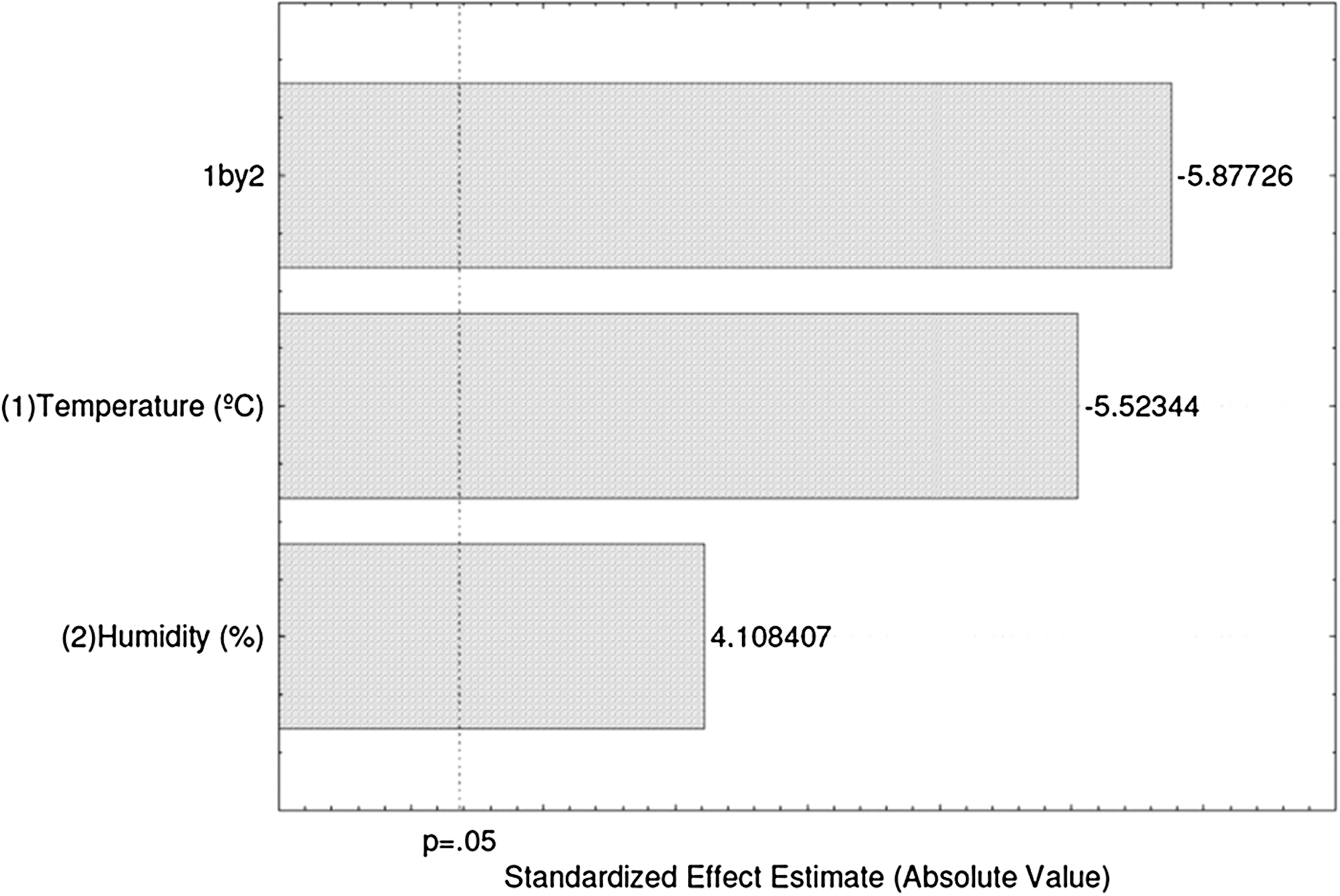
Pareto diagram of estimated standardized effects on the transesterification activity of immobilized T. lanuginosus lipase.
The regression model describing the transesterification activity of T. lanuginosus lipase immobilized on TEOS, as a function of reaction temperature and humidity, could be described by:
A normality graph (Fig. 2) was constructed in order to confirm that the conditions of normality required by the model were satisfied, with the errors obtained in the analysis of variance being independent and normally distributed. Fig. 2 shows that one point is slightly removed from the regression line for the experimental data. However, despite this feature, there was no significant departure from normality.
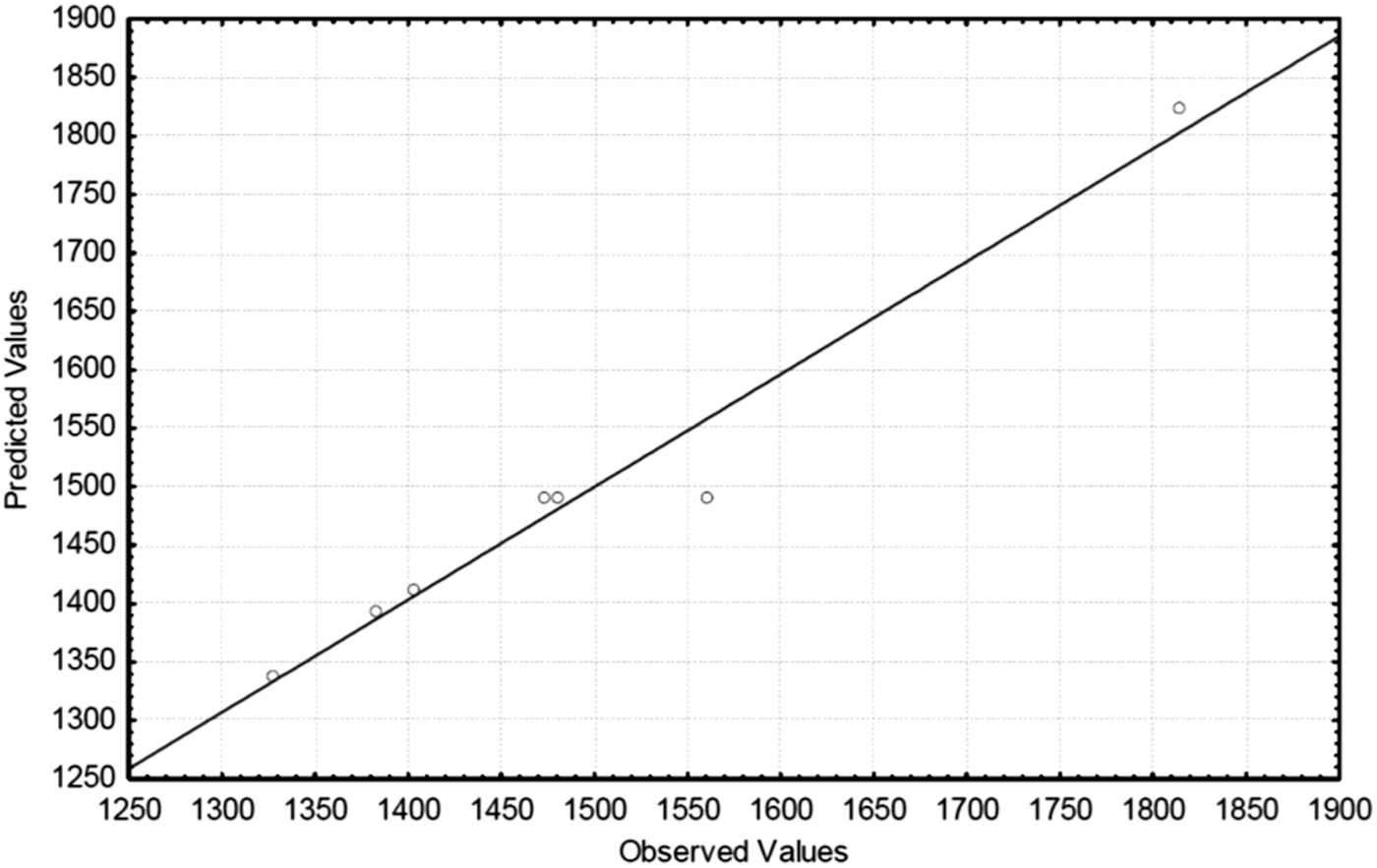
Normality graph of observed values as a function of the values predicted by the regression model for the transesterification activity of immobilized T. lanuginosus lipase.
The results are summarized in the response surface graph shown in Fig. 3, from which it is clear that the greatest transesterification activity was obtained at lower temperature and higher humidity.
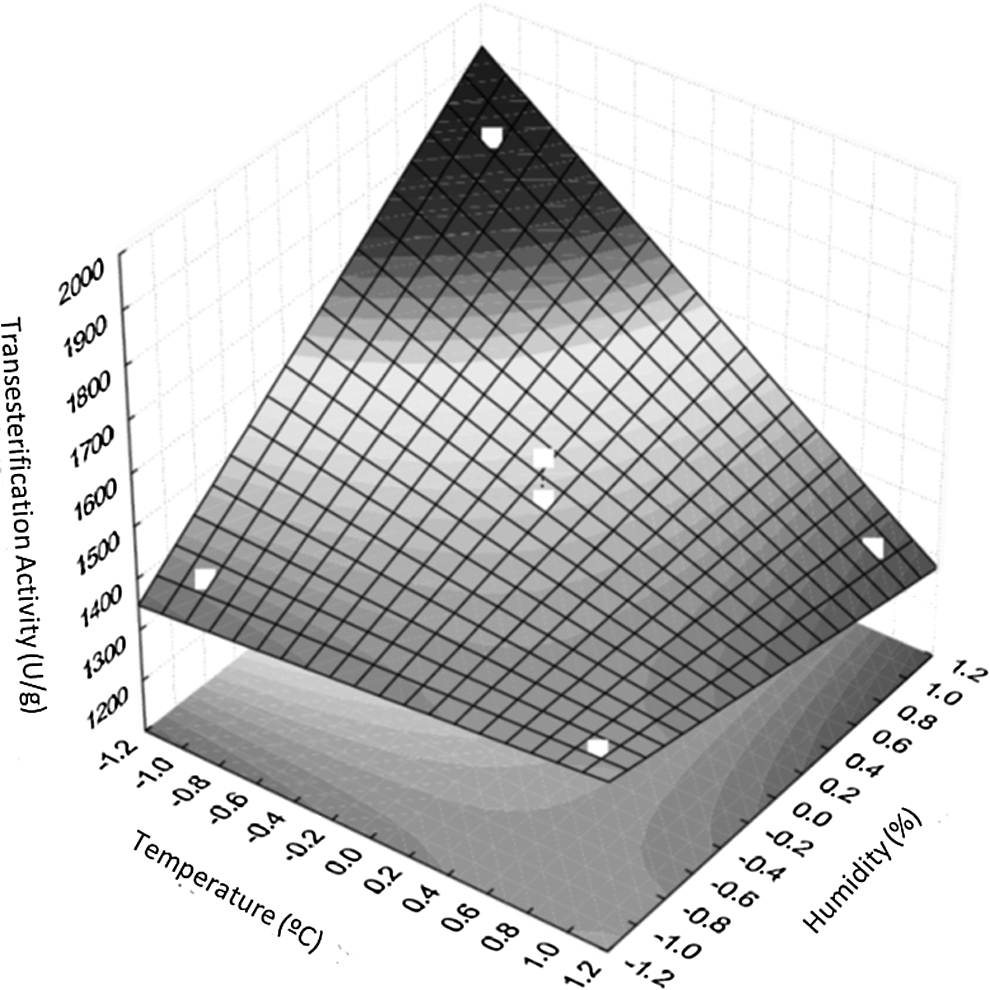
Response surface for the transesterification activity of immobilized T. lanuginosus lipase as a function of temperature and humidity.
Textural Characterization of the Immobilized Enzyme
The BET technique was used to determine the surface area, pore size, and pore volume of the biocatalyst at 30% humidity, and images were obtained using SEM. The values obtained were 502±0.36 m2/g (surface area), 0.643±0.006 cm3/g (pore volume), and 5.1±0.03 nm (average pore diameter). Characterization of the porosity of biocatalysts can aid interpretation of the enzyme activity results. The values obtained here showed that the biocatalyst possessed a high surface area that provided substantial contact with the substrate. The immobilization process was assisted by the presence of mesopores; release of the enzyme from pores of this size is much slower than from macropores, while contact with the substrate is not restricted to the extent found for micropores. These physical characteristics indicate that the biocatalyst could be used in a wide range of applications. Similar findings have been reported for lipase immobilized on mesoporous silica (obtained using sodium silicate and a biodegradable gelatin) in the hydrolysis reaction of triacetin, where the values obtained were 518.8 m2/g (surface area), 3.6 nm (pore size), and 1.34 cm3/g (pore volume). The preparation showed good thermal stability and retained 45% of its initial activity after six consecutive usages. 10
The SEM micrographs of the support, either pure or containing the enzyme (Fig. 4), revealed the roughness of the materials, especially in the case of the biocatalyst, where the presence of large quantities of material deposited on the surface acted to increase the measured porosity.
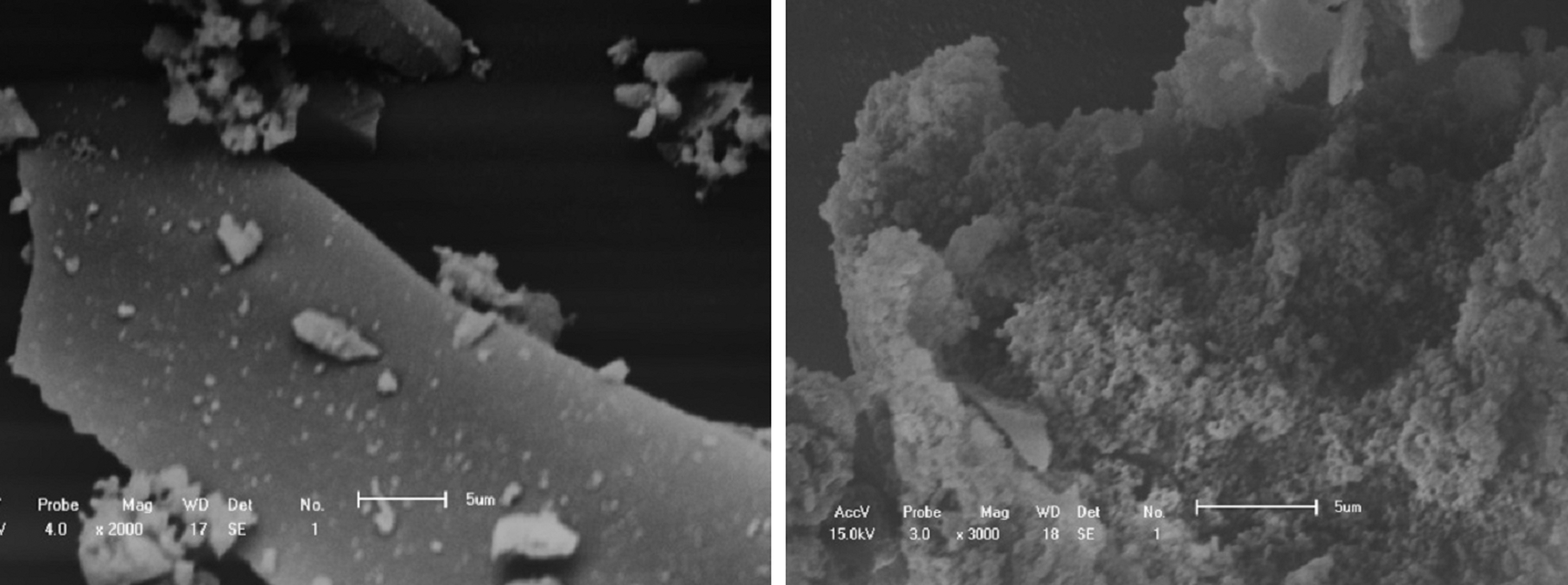
Micrographs of the pure support
The images revealed that the enzymatic preparations possessed irregular surface morphology, suggesting that there was incomplete homogenization during the biocatalyst preparation process, as expected for the sol-gel technique based on previous work. 11
Conclusions
The lipase derived from T. lanuginosus was shown to be effective in transesterification reactions. Despite the fact that the enzyme was derived from a thermoresistant microorganism, its activity in the transesterification reaction was greater at lower temperature. When the lipase was immobilized in a silica matrix (xerogel) produced using TEOS as a precursor, factorial design experiments demonstrated that the transesterification activity was significantly influenced by temperature, humidity, and the interaction between these two parameters. Higher enzyme activity was achieved at higher humidity and lower temperature (within the ranges tested). The structure of the biocatalyst, investigated using BET and SEM analyses, revealed the existence of a mesoporous structure with a high surface area, which contributed to the effectiveness of the biocatalyst.
Footnotes
Acknowledgments
The authors thank the Chemical Engineering Department of State University of Maringá for the support and CAPES for funding the Pró-engenharias project (process 23038-028317/2008-44).
Author Disclosure Statement
No competing financial interests exist.