







Abstract
Profitability of biofuel production from microalgae is difficult to achieve but co-locating production with wastewater treatment plants is a possible avenue help to reduce costs. A microalgae culturing project was conducted using wastewater from an industrial park to obtain valuable metabolites from the biomass to eventually use them locally. Different growth conditions were tested with a mixture of wastewater as the culture medium and a native microalgae-bacteria consortium isolated locally. The results showed that this consortium grows well in wastewater and that different fatty acids profiles are produced under the different growth conditions. The optimal culture conditions to produce biomass and extracted lipids are in mixotrophic mode under an irradiance of 200 μmol m−2 s−1 with an injection of 1% of CO2. High amounts of other fatty acids were also produced and could potentially be used to make other co-products. In addition to reducing wastewater treatment costs, the manufacture of biosurfactants could bring additional income to the overall microalgae production process.
Introduction
There is strong interest in using microalgae for biomass production due to their growth characteristics and the multiple functions they can fulfill during growth. Microalgae have relatively high growth rates and only a few requirements for growth. 1 They can grow in a wide range of aquatic environments from fresh to saltwater including extreme environments such as municipal and industrial wastewater. 2,3 Since light is required for their photosynthesis, its availability and quantity affect the physiology and growth of microalgae. 3 –5 In addition to carbon dioxide (CO2) as a source of carbon, microalgae also require nutrients to grow. Nitrogen and phosphorus are required in relatively large quantities for the synthesis of proteins, nucleic acids and phospholipids 6 –8 while trace elements (e.g. Na, Mg, Ca, Mn, Cu, Fe and Mo) and vitamins are required in smaller amounts.
Microalgae are currently considered as a potential source of renewable material. They contain, among others, lipids, starch, cellulose and proteins that can be used for the production of renewable fuels such as biodiesel and bioethanol. 1,9 –13 Microalgae have more efficient solar energy conversion and nutrient acquisition strategies than traditional agricultural culture and do not require agricultural land for their cultivation. 1,12 Finally, various value-added co-products (e.g. feed additives, therapeutic products) can be obtained from residual algal biomass that may contain carbon compounds, pigments, bioactive compounds and antioxidants. 14 –16
Despite the many benefits that microalgae provide, there are some economic disadvantages, such as the cost of producing and processing biomass for biofuel production, making some algae technologies non-viable. 1,12,17,18 However, alternatives have been proposed to counter these disadvantages. The cost of producing biomass can be reduced if wastewater is used as a source of nutrients. 7 The use of municipal or industrial wastewater to cultivate microalgae is an interesting option because: 1) there is no extra need for freshwater; 2) the cost of nutrient addition is reduced or eliminated depending on their presence in the wastewater; and 3) some wastewater treatment is carried out at the same time as the production of biomass. 19
The use of microalgae is also limited by the fact that a single strain can be inefficient or die when conditions change. The use of algal strains with particular characteristics (e.g. predominant chemical composition for high value-added products) may be an approach to reduce the cost of exploiting biomass. 20 The use of a consortium (multiple strains usually including bacteria) also helps to counter this limitation. It gives organism robustness against environmental fluctuations, allows stability of the species present, sharing of metabolites, and preventing invasion of unwanted species. 21 The consortium has been shown to increase nutrient removal efficiency in wastewater while generating microalgae biomass for use in co-product production. 2,19,22,23
Finally, microalgae production colocated with an industrial CO2 emitter could represent a profitable and potential strategy for producing large quantities of algal biomass and recycling CO2. 12 Microalgae production co-located with industrial plants can benefit from waste nutrient (present in wastewater) and energy (e.g. excess heat in colder climates). Furthermore, for industries producing CO2, it can be recycled by injection in the media and captured through algal photosynthesis. 12 Therefore, in addition to promoting growth and lipid productivity, a reduction of the industrial greenhouse gas emissions can theoretically be achieved. 6,8,12
Although there are still very few operational wastewater treatment systems with microalgae, a few cities around the world, including the city of Vancouver in Canada, are working to integrate microalgae production in their sewage treatment plant. This is also the case of the city of Victoriaville (Quebec, Canada) and its local companies that wish to benefit from the production of microalgae in their wastewater to treat them while obtaining biobased products from the biomass produced. A case study was conducted to integrate microalgae cultivation in the Victoriaville industrial park to obtain biobased products for local use. In this project, wastewaters from three industries located in the industrial park were used as the culture medium for microalgae: a dairy product manufacturer; a pharmaceutical company; a manufacturer of cleaning products (Sani Marc Group). In addition, leachate from a municipal waste management company was also used. Various applications could be targeted, such as the production of biodiesel to support the fleet of heavy vehicles in the city of Victoriaville, or obtaining biosurfactants or other biobased ingredients for the manufacturer of cleaning products. The project partners agreed to focus for this study on the production of the primary molecules required in their production process for biosurfactant manufacturing while considering the possibility of reducing the wastewater management costs.
Sani Marc Group is a leading manufacturer of cleaning products for domestic and industrial use in Canada. To manufacture its cleaning products, the company uses petrochemical surfactants obtained from non-renewable resources. To reduce their environmental footprint, this manufacturer is looking for bio-sourced ingredients. The molecules required for the manufacture of their surfactants are the lauric (C12:0) and myristic (C14:0) fatty acids that must subsequently be converted into amine-oxides and added in the cleaning product formulations. These two fatty acids can be found in natural oils produced by microalgae. Sani Marc Group therefore wishes to use the fatty acids derived from the biomass generated by the microalgae grown in their wastewater mixed with those of the other companies involved in this project.
The main objective of this study was to use wastewater from companies in the Victoriaville industrial park and its surroundings to produce an algal biomass rich in lipids, and more particularly, large quantities of lauric and myristic fatty acids (C12:0 and C14:0). To do this, different growth conditions (e.g. light intensity, CO2 injection, glucose addition) were tested in order to find the best conditions to obtain the highest productivities in terms of biomass and lipids. A native algae-bacteria consortium was used.
Materials and Methods
Culture Medium and Consortium
The wastewater was collected at the Victoriaville industrial park (Quebec, Canada) in addition to leachate at a nearby site. They were stored in plastic containers at 4°C until they were used for the experiments within two days. The proportion of wastewater and leachate used in the mixture (as described in Bélanger-Lépine et al. 24 ) was determined based on preliminary experiments and the relative volume available for each company. The mixture contains a high proportion of nitrogen and carbon compared to natural water.
According to preliminary metagenomic results, the native consortium used in this work (as described in Bélanger-Lépine et al. 24 ) consisted mainly of green algae belonging to the genus Chlorella and Trebouxiophyceae and bacteria belonging to the phylum Proteobacteria and Verrucomicrobia. The consortium was maintained in Erlenmeyer flasks containing a mixture of the three wastewaters and leachates collected and supplemented with nutrients as described in Bélanger-Lépine et al. 24 The algae-bacteria consortium was maintained in an orbital shaker set at 110 rpm at 25°C, under a photosynthetically available irradiance of 20 μmol m−2 s−1 (32 W cool-white fluorescents tubes) on a 12h/12h light/dark cycle until the algal cell concentration reached 1 x 10⁸ cell mL−1 for further experiments.
Erlenmeyer Flask Experiments
In order to determine which growth conditions lead to the highest biomass (g L−1), cell densities (cell L−1) and extracted lipids (w/w), nine experiments, corresponding to the rows in Table 1, were carried out. Each experiment was performed over a period of five days. For all treatments, 25% (v/v) of inoculum, containing the algae-bacteria consortium, was cultured in a one-liter flask containing five hundred milliliters of the same wastewater mixture used for maintenance on an orbital shaker set at 110 rpm, at 25°C. The growth conditions for each experiment differed by the combination of CO2 concentration, light intensity and glucose addition (Table 1). CO2 was supplied as a mixture with N2 and O2, for autotrophic and mixotrophic modes, at rate of 0.42 L min−1 through a porous sparing stone. The concentration of CO2 in the gas was adjusted to 1%, 2% or 5% with 21% O2 and nitrogen as the remaining portion. It was bubbled in the culture media for 15 min every hour during the light phase only. Otherwise, atmospheric air was injected into the media. A 200 W compact fluorescent light provided 30, 200 or 550 μmol m−2 s−1, except for the heterotrophic condition where darkness was achieved by wrapping the cultures in aluminum foil.
Trophic Modes and Other Conditions Tested (Irradiance, CO2, Glucose) in Shake Flask Experiments
Glucose (0.5 g L−1 d−1) was added the first four days as the organic carbon source to supply microalgae under heterotrophic and mixotrophic modes. These experiments are referred by a four-letter system (Table 1). The second and fourth letters refer to light intensity (L) and CO2 (C) concentration. The first and third letters refer to Low (L), Medium (M) or high (H) conditions for light and CO2. For example, the 550 μmol m−2 s−1 and 1% CO2 experimentation is referred as HL-LC. In addition, for each experiment, three trophic modes (autotrophic, mixotrophic and heterotrophic) were compared in triplicate, giving a total of nine flasks per experiment (Table 1). It should be noted that autotrophic mode is used as a term to refer to the growing conditions of light and CO2. However, it is not a strict autotrophic mode, because the culture medium contains carbon from the wastewater that may be available for growth.
Analysis
Biological and physicochemical parameters
Biomass, cell density and pH monitoring were performed daily. Biomass (dry weight per liter) culture was followed by filtering, using a Buchner funnel and vacuum, 10 ml of the medium on Whatman™ 934 AH™ glass microfiber filters (effective pore size of 1.5 μm). The biomass productivity was determined according to the formula:
Biomass productivity:
where xf and xi are the biomass (g L−1) on day 5 (tf ) and 1 (ti ) of the experiments.
Ten μL samples were taken and observed daily and counted, to follow the growth of algae and bacteria present in the consortium, with a Neubauer chamber using a phase-contrast microscope (Axio Scope A1 from ZEISS, Toronto, Canada).
Lipid extraction and fatty acid methyl esters (FAME) profile
Lipids were quantified as described in Bélanger-Lépine et al., 24 based on the Bligh and Dyer 25 method. Briefly, vacuum dried algae were extracted using methanol and chloroform and weighted after evaporation. Fatty acids were analyzed by GC-MS after the transesterification of extracted lipids as described in Bélanger-Lépine et al. 24 according to the method of Li et al. 26
Statistical analysis
Analysis of variance (ANOVA) was used to compare the treatments for each data set using the JMP Pro 11 Software. We considered the p value smaller than 0.05 to be statistically significant.
Results and Discussion
Biomass Production
Culture conditions can significantly affect algal biomass production. 10,27 Each species of microalgae has an optimal light intensity allowing it to reach maximum growth. 3 It has been reported 28 –35 that some species, like Chlorella, can develop under a wide range of light intensities, ranging from 25 to 600 μmol m−2 s−1. However, beyond a certain irradiance (generally around 200 μmol m−2 s−1), photosynthesis and growth reach a maximum and do not increase beyond those levels. Photoinhibition is possible leading to a reduced growth rate. 36 Therefore the cultures were subjected to the two minimum and maximum irradiance endpoints identified (30 and 550 μmol m−2 s−1) and to 200 μmol m−2 s−1 while varying the concentration of CO2 injected to measure the impact on microalgae growth.
Under low light intensities (30 μmol m−2 s−1), the biomass production (g L−1 d−1) in cultures under autotrophic mode was generally low and even negative, regardless of the concentration of CO2 injected (Table 2). This irradiance thus seems limiting for growth. Under high irradiance (550 μmol m−2 s−1) and low CO2 concentration (HL-LC), the biomass production was also negative (Table 2). This was likely caused by photoinhibition of growth. However, under this same irradiance but with medium CO2 concentration (HL-MC), a good amount of biomass was produced (Table 2). The autotrophic cultures with the highest CO2 concentration injected (HL-HC) did not grow. Mixotrophic conditions always showed higher or equal growth to those under autotrophic conditions.
Biomass Productivity (g L−1 d−1), Percentage of Other Organisms (such as Protozoa and Rotifers) and Bacterial Abundance under Autotrophic, Mixotrophic and Heterotrophic Conditions After Five Days of Cultivation
This category excludes Chlorella and Trebouxiophyceae-like algae and bacteria; 2.Bacterial abundance was qualitatively assessed using a letter system that refers to the amount observed in the microscope: low (L), medium (M), and high (H).
The highest biomass productivities (0.38 g L−1 d−1) were obtained at 200 μmol m−2 s−1 in autotrophic and mixotrophic conditions (Table 2). The results are in agreement with those obtained in other studies. The light intensity allowing the consortium of algae-bacteria to reach higher productivities in terms of biomass is 200 μmol m−2 s−1. Regarding the injection of CO2 under this light intensity, the most effective seems to be 1 and 2% (Table 2). Cheng et al. 37 showed that the maximum growth rate of Chlorella vulgaris was achieved with a CO2 injection at a concentration of 1%. In a study by Lam and Lee, 38 the highest growth was obtained at a CO2 concentration of 5%. Carbon dioxide has low solubility in water, 38 so even if a higher concentration is injected, the algae will not necessarily have access to all of it. In addition, since the wastewater contains carbon available for growth, CO2 injection at high concentration may not be required to maximize growth. In this project, a CO2 injection at a concentration of 1% combined with a light intensity of 200 μmol m−2 s−1 led to the highest biomass production.
Of the nine experiments, mixotrophic and heterotrophic cultures achieved the highest biomass productivities compared to autotrophic. These results were expected and are consistent with other studies. 39 –42 The presence of glucose in the mixotrophic and heterotrophic cultures has generally led to the higher biomass compared to autotrophic cultures. Glucose is a source of organic carbon that is metabolized rapidly and provides instantaneous energy to the cell. 42 It can be used directly by the cell, unlike other carbon sources that must be converted to glucose before they can be used by microalgae. 42 In this study, the main objective was to determine the conditions for achieving the highest productivities in terms of biomass and lipids. It is for this reason that glucose has been added in some cultures.
Under heterotrophic growth conditions, unwanted organisms or bacteria can become a significant portion of the consortium at the expense of microalgae. The results of our study showed that heterotrophic cultures generally have a higher percentage of other organisms compared to autotrophic and mixotrophic conditions (Table 2). Among these other organisms, protozoa and rotifers are observed. Protozoa can feed on microalgae and rotifers on bacteria, which can affect the balance of the algae-bacteria consortium used in this project. In addition, a higher amount of bacteria was observed in three of the nine experiments in heterotrophic cultures (Table 2). This demonstrates once again that under these conditions, the consortium is affected. In light of these results, the mixotrophic mode appears to be optimal for the growth of the consortium in the industrial wastewater mixture used.
Lipids Production
The highest extracted lipids (20.3 ± 1.3% and 19.6 ± 3.4%, relative to dry weight) were obtained in autotrophic and mixotrophic conditions respectively, at an irradiance of 200 μmol m−2 s−1 and 1% CO2 (ML-LC, Table 3). In the low light treatment, all modes produced similar extracted lipids by dry weight, independently of the carbon addition (Table 3). Under high light conditions, the different modes were not significantly different except under the low carbon conditions where the mixotrophic showed higher extracted lipids. In the heterotrophic mode (which is not influenced by the light level for a treatment), differences of a few percent were observed but these were generally not significantly different from another treatment. The mixotrophic conditions, under a light intensity of 200 μmol m−2 s−1 and an injection of 1% of CO2, seem optimal not only for growth but also for the production of extracted lipids.
Extracted Lipids (% of Dry Weight) Under Autotrophic, Mixotrophic and Heterotrophic Conditions, After Five Days of Cultivation
Extracted lipid values in the microalgae biomass were relatively good under all three growing conditions after five days of cultivation, ranging from approximately 13–20% (Table 3). The conditions tested were established foremost to obtain optimal growth conditions and secondarily to see if these conditions also influenced the production of lipids. It has been reported that under optimal growth conditions, high biomass but low lipid contents of 5 to 20% of their dry weight are achieved. 13 The results are consistent with what was reported. High levels of biomasses have been obtained, but the highest lipid content does not significantly exceed 20%. Overall, no strong pattern emerged from the light and trophic modes with respect to fractional biomass in lipids with a similar percentage in all treatments.
Fatty Acid Production
The fractional concentration (% weight of total FAME) of the various fatty methyl esters (FAMEs) spans almost 4 orders of magnitude ( Fig. 1 ) with the longer chain fraction generally more abundant (C16 and longer) with percentages in the tens of percent. The others (C12 to C15 and C17) are around 1% or below of the total fatty acids mass or slightly higher (up to 4.3%) for C14:0. Although the amount of lipids produced is important, as mentioned above in the potential for the production of lauric (C12:0) and myristic (C14:0) fatty acids. Therefore, their concentration relative to total fatty acids (w/w) is also of interest. The fatty acid profiles also show some significant changes between the conditions evaluated.
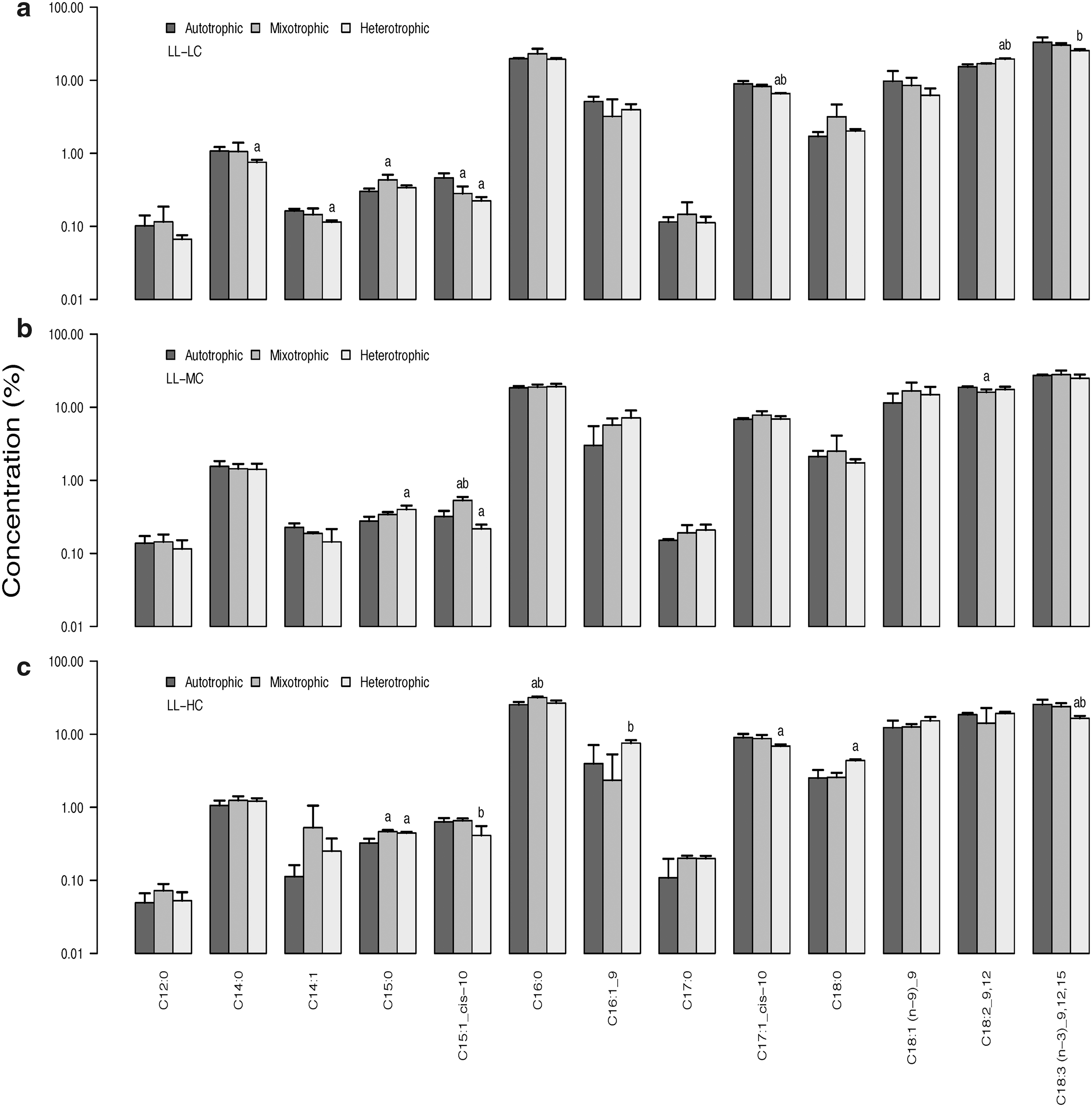
Fatty acid profiles for the nine experiments subjected to various trophic modes: (
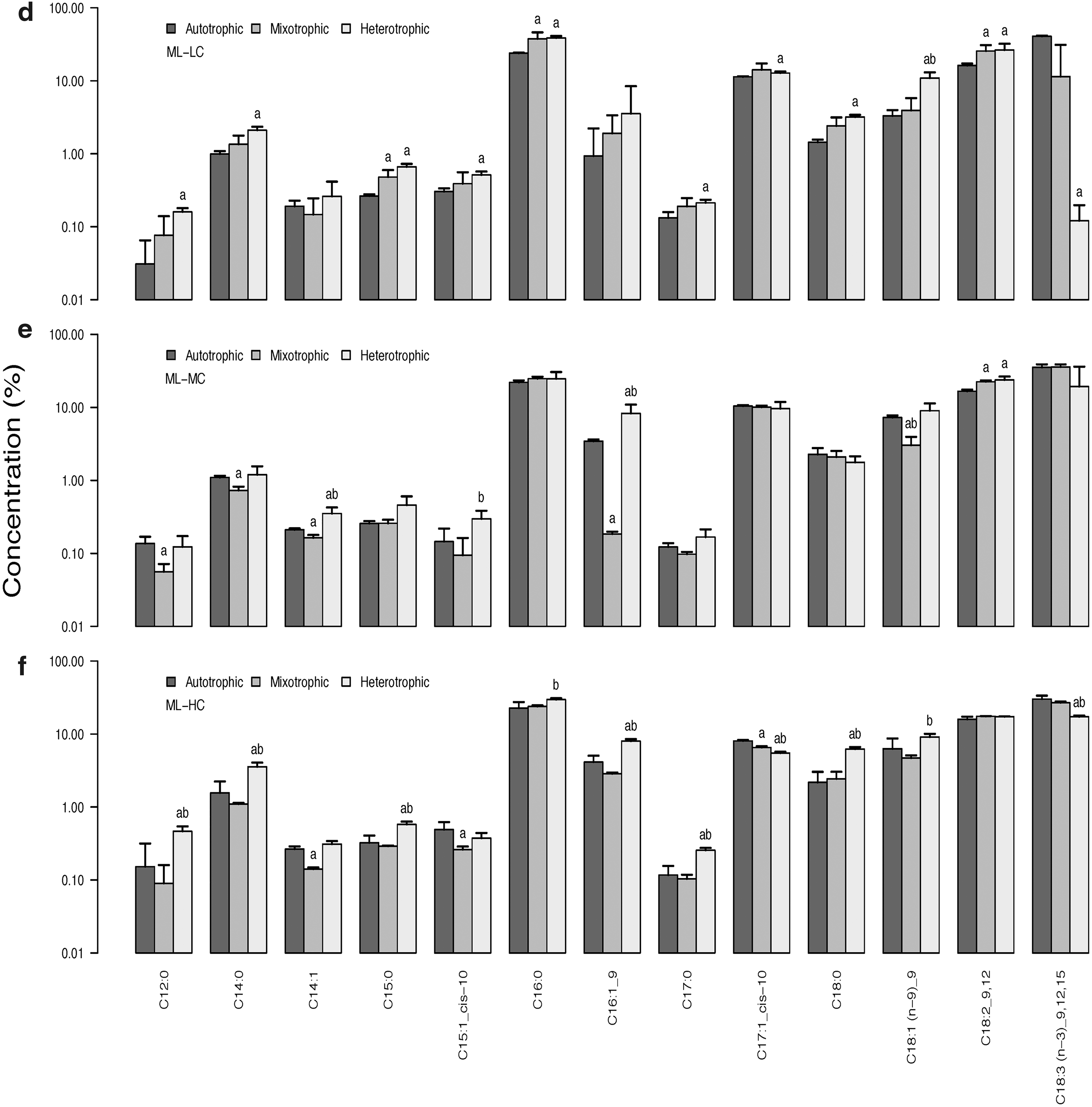
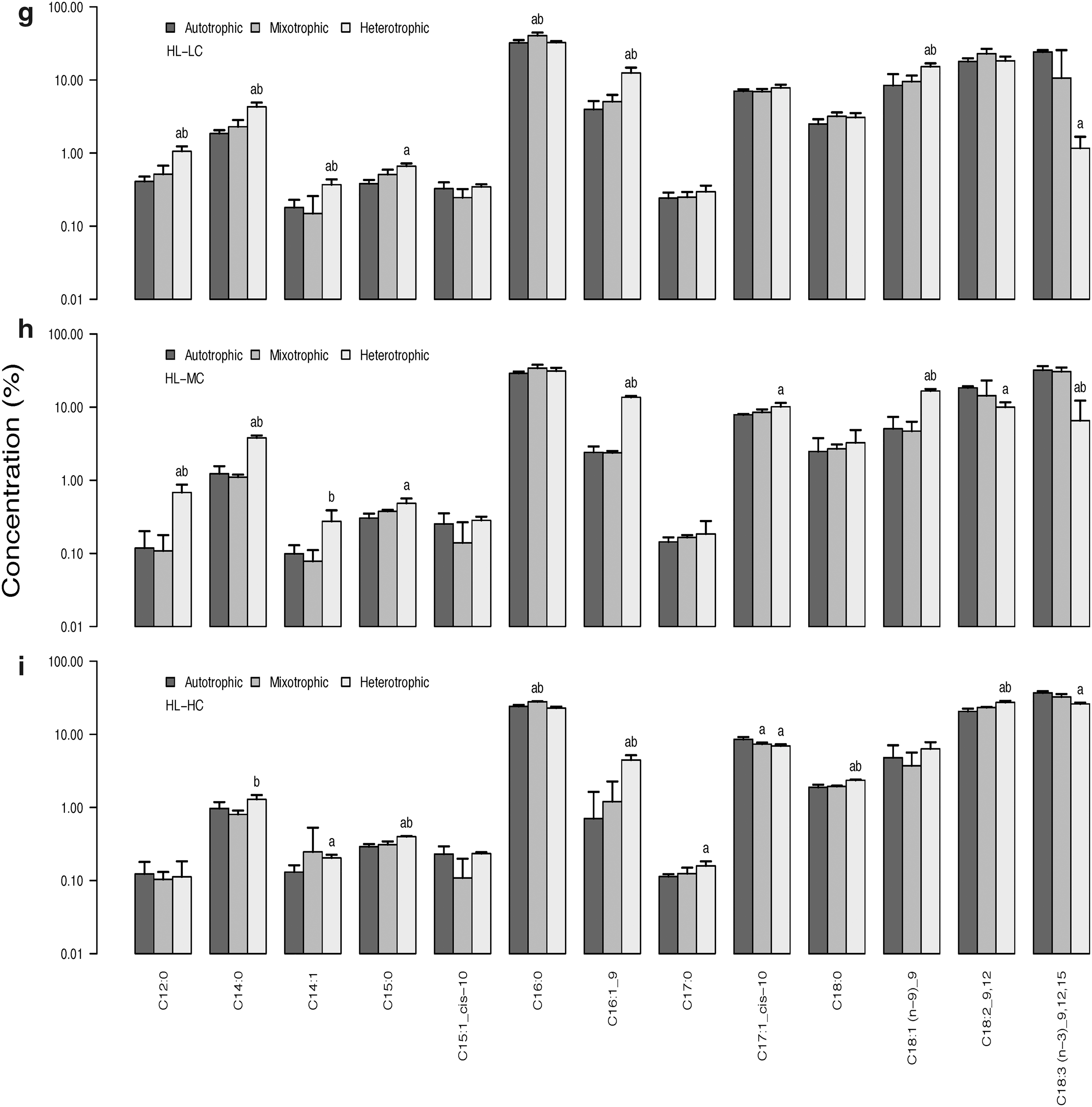
Under the low light condition treatment, all modes produced similar amounts of C12:0 and C14:0. Except in the low carbon conditions, the heterotrophic mode led to lower C14:0 ( Fig. 1a-c ). In the medium light treatment, the low and high carbon conditions produce higher amounts of the two desired fatty acids in the heterotrophic mode ( Fig. 1d-f ). Under the low carbon conditions, the production of C12: 0 (0.16 ± 0.02%) and C14: 0 (2.1 ± 0.2%) in heterotrophic mode is significantly higher than in the autotrophic mode (0.03 ± 0.03% and 0.99 ± 0.09%, respectively, Fig. 1d ). In this same light treatment, in high carbon conditions, the heterotrophic mode produces a significantly higher amount of C12:0 (0.46 ± 0.08%) and C14:0 (3.6 ± 0.5%) than autotrophic (0.2 ± 0.2% and 1.6 ± 0.7%, respectively) and mixotrophic (0.09 ± 0.07% and 1.10 ± 0.04%) modes ( Fig. 1f ). In the medium carbon conditions, it is the mixotrophic cultures that produced a smaller amount of the two desired fatty acids ( Fig. 1e ). Finally, in the high light condition treatment, the highest amounts of C12:0 and C14:0 were obtained in the heterotrophic mode ( Fig. 1g-i ) in most carbon conditions. In this light treatment, under low and medium carbon conditions, the amounts of lauric and myristic acids are significantly higher in heterotrophic cultures compared to those in autotrophic and mixotrophic modes ( Fig. 1g-h ). Under the high carbon conditions, there is only C14:0 production in heterotrophic mode that is significantly higher than in mixotrophic mode ( Fig. 1i ). The highest values of the two desired fatty acids were obtained in low carbon conditions. In fact, the amount of C12: 0 (1.1. ± 0.2%) produced in heterotrophic mode is about 2 times higher than in mixotrophic (0.5 ± 0.2%) and autotrophic (0.41 ± 0.07%) modes ( Fig. 1g ) and the amount of C14:0 (4.3 ± 0.6%) produced in heterotrophic mode is about 2 times higher than in mixotrophic (2.3 ± 0.5%) and autotrophic (1.8 ± 0.2%) modes ( Fig. 1g ).
Some polyunsaturated fatty acids produced by microalgae are important because they play a role in tissue integrity and can confer beneficial effects on health 3 . This is particularly the case of omega-3 and omega-6 fatty acids that are essential for humans who cannot synthesize these molecules. 3 The results showed that, in addition to the two sought fatty acids (C12:0 and C14:0) for the manufacture of biosurfactants, microalgae produced other interesting molecules. In fact, linolenate (C18:3 (3) cis-9,12,15) fatty acid, an omega-3 polyunsaturated fatty acid, were produced in large quantities in most experiments performed and regardless of the trophic mode used ( Fig. 1 ). Additional income could come from producing this omega-3 polyunsaturated fatty acid, making the co-location of a microalgae culture on the site of an industrial park even more profitable.
Utilization of a consortium can lead to more variability in results as the composition is invariably changing with time. This is clearly observed in the heterotrophic mode where all treatments for the same carbon concentration should be identical irrespective of the light level of that treatment (since light is not provided to the heterotrophic mode). However, large variations are observed (e.g. compare 0.75% with 4.3% for C14:0 production). Therefore, a key result from this study is that while the consortium is more resistant to environmental changes, 21,43 the consistency in the production of a given fatty acid will likely vary with time as the inoculum is invariably changing even if production conditions remain the same (as in this experiment). This may not be amenable for a production strategy for industries where constant production of a given fatty acids is required. However, the sturdiness to environmental changes will be a desirable feature to industries where the overall biomass or energy content of the consortium is more important.
Finally, although it was not the main objective of this study, the profile of lipids produced by a consortium was measured which is important in the context of biodiesel production. The quality of biodiesel is determined by the amounts of each fatty acid present. 44 It has been reported that lipids composed of fatty acids with 16 to 18 carbons atoms would have good properties for biodiesel. 45 On the other hand, a greater amount of saturated and monounsaturated fatty acids would provide adequate biodiesel properties, such as improved stability. 27,44 In most of the experiments, the lipid profile analysis showed that an interesting amount of saturated and monounsaturated fatty acids is produced compared to polyunsaturated fatty acids. It suggests that oils produced by microalgae grown in industrial wastewater could be used as a biofuel source.
Conclusion
The objective of this study was to cultivate a microalgae-bacteria consortium in a mixture of industrial wastewater to generate a biomass containing two fatty acids (C12:0-C14:0) sought by one of the companies involved. The results showed that the consortium develops well in wastewater and that the microalgae produced small amounts of the two desired fatty acids in addition to high amount of other lipids that could potentially be used to make other co-products. The possibility to cultivate microalgae in wastewater while generating value-added products has been demonstrated. Future work will explore other interesting bio-molecules for local uses.
Footnotes
Acknowledgments
The authors wish to express thanks to the staff of the Industrial Research Chair on Environment and Biotechnology of Université du Québec à Trois-Rivières (Canada) and the Cégep de Trois-Rivières (Quebec, Canada) for their technical support.
Author Disclosure Statement
No competing financial interests exist.
Funding Information
This work was funded by MITACS (Grant #IT04228), City of Victoriaville and its local companies (Quebec, Canada) and the Consortium de recherche et d'innovation en bioprocédés industriels (CRIBIQ) (Grant #2013-017-PR-C10).