







Abstract
Background:
Bacillus Calmette–Guérin (BCG) is a vaccine used to protect against tuberculosis primarily in infants to stop early infection in areas of the world where the disease is endemic. Normally administered as a percutaneous injection, BCG is a live significantly attenuated bacteria that is now being investigated for its potential within an inhalable vaccine formulation. This study investigates the feasibility and performance of two jet and two vibrating mesh nebulizers aerosolizing BCG and the resulting particle characteristics and residual viability of the bacteria postaerosolization.
Methods:
A jet nebulizer (Collison), outfitted either with a 3- or 6-jet head, was compared with two clinical nebulizers, the vibrating mesh Omron MicroAir and Aerogen Solo devices. Particle characteristics, including aerodynamic particle sizing, was performed on all devices within a common aerosol chamber configuration and comparable BCG innocula concentrations. Integrated aerosol samples were collected for each generator and assayed for bacterial viability using conventional microbiological technique.
Results:
A batch lot of BCG (Danish) was grown to titer and used in all generator assessments. Aerosol particles within the respirable range were generated from all nebulizers at four different concentrations of BCG. The jet nebulizers produced a uniformly smaller particle size than the vibrating mesh devices, although particle concentrations by mass were similar across all devices tested with the exception of the Aerogen Solo, which resulted in a low concentration of BCG aerosols.
Conclusions:
The resulting measured viable BCG aerosol concentration fraction produced by each device approximated one another; however, a measurable decrease of efficiency and overall viability reduction in the jet nebulizer was observed in higher BCG inoculum starting concentrations, whereas the vibrating mesh nebulizer returned a remarkably stable viable aerosol fraction irrespective of inoculum concentration.
Introduction
Tuberculosis (TB) is a worldwide endemic pulmonary disease that infects one-third of mankind and is the causative disease agent of more than two million deaths yearly.(1,2) Tubercular disease in humans can be attributed to respiratory exposure to and ensuing infection from Mycobacterium tuberculosis, an environmentally hardy pathogenic mycobacteria that has caused human disease for several thousand years.(3) A prophylactic vaccine that protects people of all ages against infection has been a goal of medical science for several decades. Many types of TB vaccines have since been developed,(1,4) which include live attenuated, whole cell killed, virally vectored, and subunit variants. One of the earliest attempts at vaccine development yielded a live highly attenuated multipassage variant of Mycobacterium bovis referred to as Bacillus Calmette–Guérin (BCG), accrediting the creation to its French originators. BCG remains the only licensed vaccine for prevention of tubercular infection and is still in use today.(5–7) BCG has been widely utilized for several decades primarily in pediatric populations in countries where TB is considered endemic. BCG is currently administered as a subcutaneous injection and has proven to be effective in the prevention of childhood pulmonary TB when administered to infants. The vaccine is considered to result in minimal efficacy, however, when administered to adults and has not proven to be effective in the generation of an immune response that is consistent with protection against pulmonary TB.(5)
Several years ago, it was proposed that the apparent lack of stimulating the appropriate immune response in the adult that would provide protection against tubercular disease may be associated with the route of vaccination rather than the biological components and composition of the vaccine being used.(8–10) The strategy of delivering BCG as an aerosol or mucosally to stimulate preferential immune response has been performed in animals and clinically for a number of years.(9,11–13) M. tuberculosis is an exceedingly complex micro-organism that has adapted to the rare ontological niche of being a successful human pathogen for thousands of years. It stands to reason that a successful vaccine to TB would by necessity contain the majority of the biological complexities associated with the disease agent, and maintain the structural and biological capacity for replication, which are many of the characteristics of BCG.(7,14,15) In addition, TB is an obligate respiratory pathogen—the primary (and required) route of infection for M. tuberculosis is through inhalation of infectious aerosols sourced from an infected host and/or fomite re-aerosolization.(16–21) An aerosolized form of BCG, therefore, would maintain the requirement for a “whole” vaccine product thought to be one of the necessities for adult protection, while delivering to the respiratory system, eliciting an immune response both humoral and locally in lung mucosa, which would provide dual protection against disease. Immune response of mucosally delivered BCG has been investigated for the past several years(9,12,22) with some success when used as a comparator to conventional immunization strategies. It is clear that aerosol vaccination with BCG is a promising option for delivery of the vaccine and could be performed with a wide array of nebulizers. Accordingly, the purpose of this study was to determine the performance of the most common clinical device (Omron) with other nebulizers in the context of aerosolized BCG delivery.
Aerosol generation of a biologically active replication-competent micro-organism such as BCG necessitates characterization of the device provisioning the aerosol to define physical composition and immunizing “dose.” Investigation of the physical and biological characteristics of the aerosols produced and the resulting effects of the corresponding mycobacterial payload within the particles is essential to this process. Accordingly, in this study we assess the effects of aerosolization upon BCG when using various aerosol generators. Initially, particle size dynamics of BCG was assessed at four starting concentrations, hereafter referenced to notationally as Cs (at 105, 106, 107, 108 CFU/mL) when using either jet or vibrating mesh nebulizers. These concentrations were selected as previous study with inhalation delivery of BCG utilized concentrations in this range. All BCG aerosol events were performed using the same growth lot. Particle size characteristics were assessed using a singular method, aerodynamic time of flight measurements by an aerodynamic particle sizer (Thermo Systems, Inc., [TSI], St. Paul, MN). Two primary parameters, including the mass median aerodynamic diameter (MMAD) and count median aerodynamic diameter (CMAD) and corresponding aerosol concentration by mass and number, were determined from measurements performed using the APS at available dilutions and bacterial growth lot. Thereafter, integrated sampling for the purposes of quantifying aerosolized culturable bacteria was performed using liquid impingement. The results of the impingement provided calculated aerosol concentrations of culturable BCG from each nebulizer for each starting concentration used in the study. Collectively, the physical characterization and particle sizing profile paired with the culturable mycobacterial aerosols provides a physical and biological basis from which to determine dose as a function of inhalation of generated aerosol.
Materials and Methods
Nebulizers
The nebulizers chosen for this testing were selected based on multiple factors, including previous use with aerosol generation of BCG in clinical studies, with the potential for utilization in future clinical studies. The jet nebulizers that were used in this characterization are either 3- or 6-jet Collison nebulizers (CH Technologies, Westwood, NJ). This style nonclinical nebulizer provides input feed through Bernoulli effect capillary uptake from a liquid reservoir and entrains the liquid into a provided airstream that functions at critical flow [2 liters per minute (LPM)/jet] under pressure; a minimal 18 psig is required to run the complementary airstreams to achieve optimal particle size.(23) The 3-jet Collison nebulizer operates at 6 lpm; the 6-jet at 12 LPM. The mesh nebulizers used for comparison with the jet nebulizers are the Omron Microair and Aerogen Solo. Both versions are employed in clinical settings for the delivery of aerosolized medication. The generator platform, rather than using jet airflow, utilizes a mesh (palladium) perforated with conical holes that act as a micropump when vibrated.(24) There is no integrative airflow with either of the vibrating mesh generators, rather in clinical use patient inspiration provides flow to facilitate inhalation and aerosol delivery.
Propagation and quantifying BCG
The vaccine BCG (Danish) was commercially acquired through ATCC (Manassas, VA). The stock vial, which was held at −80°C, was thawed at RT and 100 μL added to 10 mL of Middlebrook 7H9 media (Fisher Scientific, Hanover Park, IL), warmed to 37°C, then agitated on an incubated shaker for ∼3 days. Subcultures were grown at a 1:10 ratio of subculture aliquot to Middlebrook 7H9 media (Fisher Scientific, Hanover Park, IL) until an OD of ∼0.5 was attained. The initial subculture was derived from a stock culture, and all subsequent subcultures thereafter were propagated from a previous subculture. The stock culture and all subcultures were held at 4°C until aerosolization. Bacterial concentration was confirmed by plating 100 μL of the final subculture used for aerosolization, on prepared 7H11 agar (Fisher Scientific, Florence, KY) media plates. The stock culture was held at 4°C until subculture for the purposes of experimental use.
Measurement with aerodynamic particle sizer
Particle characteristics were determined using an aerodynamic particle sizer (APS Model 3321; TSI, Inc.). The APS measures the aerodynamic size of particles from 0.5 to 20 μm and uses time-of-flight analysis based upon velocity and relative density of interrogated particle stream to determine particle behavior while airborne. Aerosol is drawn into the APS at a total flow of 5 LPM; 20% of the total flow is dedicated to inlet into the analyzer; 80% is sheath flow. The APS spectrometer uses a double-crest dual laser system and nozzle configuration that reduces the advent of false (e.g., doublet) background counts. Analysis of data from the APS was collected and device software (Aerosol Instrument Manager Version 5.3; TSI, Inc.) was used for initial review of data. Statistical analysis and graphing was performed using GraphPad (Prism V.7; GraphPad, La Jolla, CA, USA). The APS device operated on a continual basis once aerosol generation was initiated, and logged data for the duration of each aerosol event.
Experimental configuration
Use of standard aerosol characterization standard methodology (e.g., USP 601) was not feasible to our experimental approach as BCG aerosolization required additional engineering controls, including housing our configuration within Class III biological Safety cabinet, for added safety during these studies because of the biologically active nature of BCG. Therefore, all BCG aerosol generation took place inside a 16-L polycarbonate chamber outfitted with dilution and exhaust tubing and a sampling orifice. The chamber was connected to an automated system (Biaera Technologies, Hagerstown, MD) that controlled dilution, exhaust, sampling, and generator air flows when applicable, and also recorded temperature, relative humidity, and pressure readings. The automated system maintained equal rates of total air flow in and out of the chamber to retain equilibrium. Figure 1 illustrates the experimental configuration of the chamber utilizing one of five possible nebulizers/nebulizer orientations and one of two sampling strategies implemented. The jet nebulizer (Fig. 1A) used was either the 3-jet (3JC) or 6-jet (6JC) Collison, which requires an outside air supply source, provided by the automated system in this instance. The handheld vibrating mesh nebulizers, however, are electronically operated and do not require outside air supply. They were placed inside the chamber and clamped to a shelf to achieve the proper height for proximity to the sampler tubing within the chamber (Fig. 1B). The mesh nebulizers used in this study were the (B) Omron Microair held horizontally (OM), the (C) Omron Microair tilted 30° from horizontal (OM.t), and the (D) Aerogen Solo (AeS). Samples from the chamber were collected using either the (E) APS for particle characterization or the (F) All Glass Impinger (AGI-4) sampler for bacterial viability. Total air flow in and out of the system was kept at 16 LPM, with adjustments to the dilution and exhaust flows as needed for differing generator and sampling requirements.
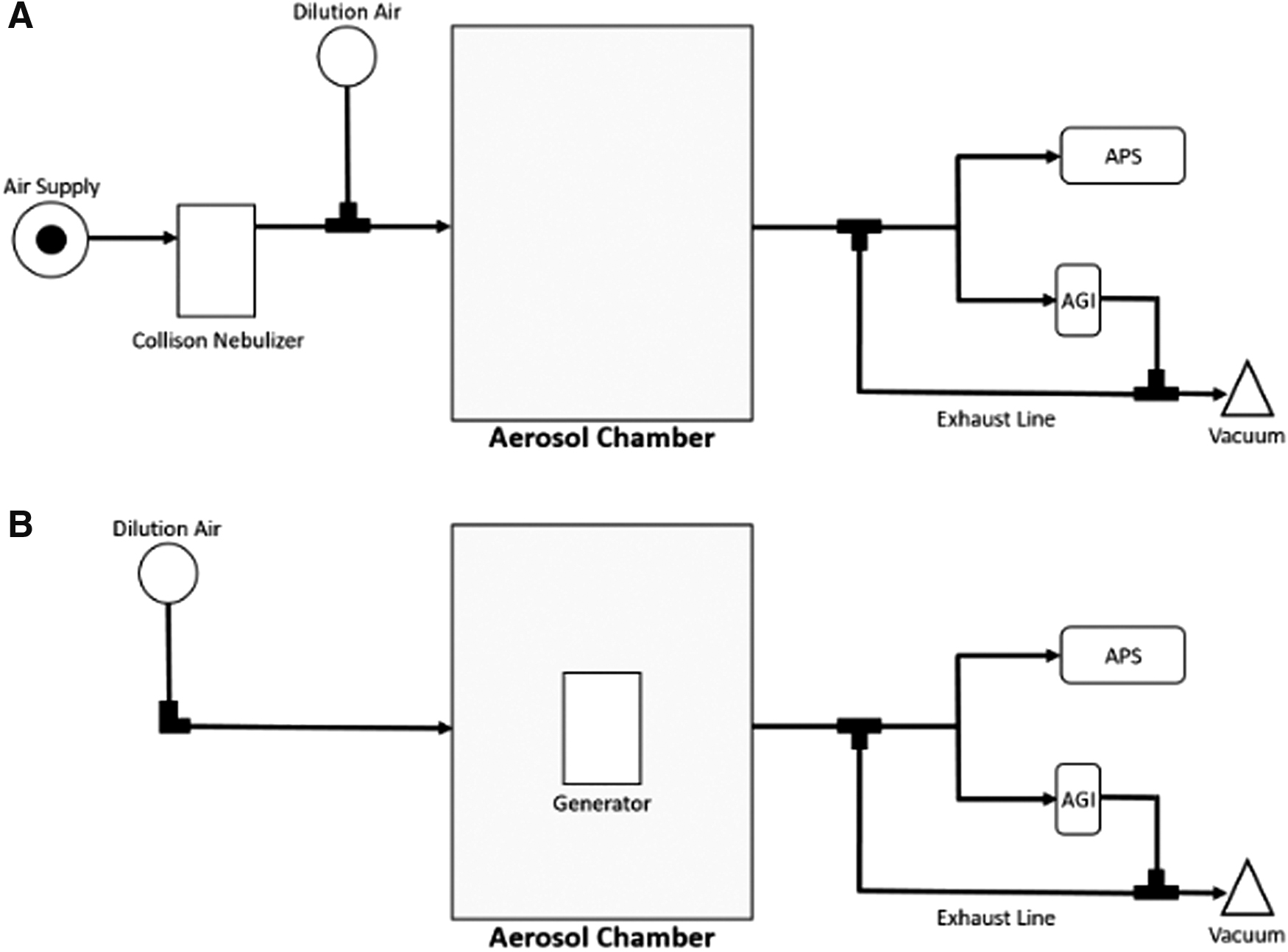
Experimental setup and corresponding sampling strategy used for the evaluation of nebulizers. BCG was aerosolized using a 3-jet or 6-jet Collison nebulizer
Experimental procedure
Individual aliquots of a liquid volume (5 mL) of BCG and corresponding dilutions were prepared for each nebulizer device. Upon performance for each device, a liquid aliquot was directly expressed into the precious fluid reservoir for the Collison nebulizers, the medication port for the Omron MicroAir device, and the reservoir basin for the Aerogen Solo. Each device was then actuated, and allowed to continuously run for analysis. The experimental configuration was harmonized among devices, and shared similar design and internal volume (Fig. 1). Flow rates for the configured system varied according to the device being used to accommodate for the relatively high flow rates generated by the Collison nebulizers (6 and 12 LPM for the 3-jet and 6-jet versions, respectively) compared with the devices the vibrating mesh nebulizers with no intrinsic air flow (Omron MicroAir and Aerogen Solo), which relies upon patient inspiratory flow to facilitate aerosol delivery. Therefore, input flow for the Omron and Aerogen devices in this configuration was augmented with an external pump that provided equivalent input flow into the chamber at a rate approximating the 3-jet Collison (6 LPM). Two aerosol sampling instruments with differing flows were used in each aerosol generation event. For the experiments involving PSD, the aerodynamic particle sizer (TSI Model 3321) was used, which houses an internal exhaust flow of 5 LPM. Residual exhaust flow was provided through an external pump at 2 LPM. BCG aerosols were also collected in separate aerosol generation events for the purposes of biological viability determination of the BCG aerosols. An all glass impinger (AGI-4, SKC, Eighty-four, PA) was used to collect aerosol sample from the chamber and was actuated upon initiation of each run of the aerosol system. The AGI-4 sampler requires 6 LPM exhaust flow for operation. The residual exhaust flow from the chamber was adjusted according to either sampling requirement and the necessity to maintain neutral pressure (0′′ H20), which was actively monitored throughout all aerosol generation events. The dynamic flows as described through the evaluation chamber were operated continuously for every evaluation for each device. Temperature and humidity were monitored continuously. The prevailing temperature was 21.6°C ± 2.6°C and relative humidity 51.5% ± 8.3% across all evaluations.
Spray factor
Aerosol efficiencies, expressed as spray factor (Fs) were calculated as a result of this evaluation. Calculation of Fs is a unitless quotient used to understand the dilution and relative effect of aerosol generator action upon viability of the particular biological agent under study and has been a useful metric in past similar studies.(23,25–27)
Results and Discussion
PSD of BCG aerosols
The CMAD, MMAD, and geometric standard deviation (GSD) for each measurement, shown in Table 1, represent the overall mean and corresponding standard deviations across all starting concentrations of BCG (105–108 CFU/mL) performed with each aerosol generator. Close examination of individual starting concentrations indicated little variation in particle size characteristics, and statistical comparison resulted in no significant differences (p > 0.05) between BCG starting concentrations in particle characteristics when using the same aerosol generator.
Particle Sizing Dynamics, Mass Median Diameter, Count Median Diameter, and Corresponding Geometric Standard Deviations for Each Nebulizer Evaluated
The results of particle sizing of aerosols by number and mass for each nebulizer evaluated. Data are presented as the mean ± standard deviation of at least three 30-second cumulative measurements by the APS.
CMAD, count median aerodynamic diameter; GSD, geometric standard deviation; MMAD, mass median aerodynamic diameter.
The CMAD across all aerosol generators was remarkably similar, and ranged from 1.13 to 1.98 μm and was not affected by starting concentration used in the aerosol generation events as evidenced by low heterodispersity GSD (range 1.48–1.61). Similarly, the MMAD for all generators were collectively <4 μm (range 2.69–3.66) with little variation in the corresponding GSD (range 1.47–1.71), indicating minimal effect on the density solute of the aerosols generated when using higher concentrations of BCG. The majority of the particles represented in the corresponding distributions were <5 μm and are considered the fine particle fraction (FPF) of aerosols when collectively describing the characteristics of the distribution. Accordingly, the percentage of FPF represented as a part of the whole distribution was >90% for all generators evaluated using BCG.
There were differences in the number and mass of particles, measured as an airborne concentration, from each generator evaluated. The total number of particles, expressed as particles/cm3 of aerosol, and as a measure of mass generated, expressed as mg/m3, is shown in Table 2. Theoretical “dose” of BCG, calculated based upon a series of inhalation presumptions, only considering viable fraction of BCG postaerosolization, is shown in Table 2. Doses are shown stratified by the initial BCG concentration (in CFU/mL) and according to the nebulizer under evaluation. Three of the five nebulizers/nebulizer orientations (3JC, 6JC, and OM) produced remarkably similar number and mass of particles generated, with the OM.t (Omron tilted in a 30° orientation) producing noticeably more particles by mass than any other generator tested. The Aerogen Solo (AeS) produced the lowest number of particles by number and mass, returning a logarithmically lower (∼0.327 mg/m3) mass concentration. Accordingly, the results of the theoretical calculated dose shown in Table 2 is apropos as demonstration that only a small portion (<1% in many cases) of the postaerosol culturable BCG is available for inhalation when considering the initial BCG (CFU/mL) concentration used in each nebulizer.
Aerosol Concentration as a Function of Particles and Mass and Resulting Dosage of Viable Bacillus Calmette–Guérin Based Upon Predicted Inhalation Constants
The results of concentration of aerosols by number for each nebulizer evaluated. Data are presented as the mean ± standard deviation of at least three 30-second cumulative measurements by the APS.
Estimated dosage as viable BCG (total CFU inhaled) delivered calculated using respiratory parameters that would be consistent of predictive inhalation using a clinical aerosol generator for an adult (5 LPM for 5 minutes); logarithmic headers refer to the BCG starting concentration titer (in CFU/mL) used for each aerosol generation.
BCG, Bacillus Calmette–Guérin.
Comparison of nebulizer performance, when assessed purely as an efficiency of total aerosol particles generated by a nebulizer, can be informative to overall contribution of the “viable fraction” as a percentage of total number of particles generated. Figure 2 details the percentage of BCG aerosol particles as a function of prevailing Cs in use and total particles generated by each nebulizer under evaluation. All nebulizers were remarkably uniform in total number of particles generated (∼5E+07 particles/liter of aerosol) with exception of the Aerogen Solo (∼1E+07 particles/liter of aerosol) across all Cs performed, stratified logarithmically. The relative percentage contribution of the viable BCG as a component of the total particles generated, which was calculated post hoc to analysis and functionally as Ca, demonstrates significant differences between nebulizers assessed. For example, at a Cs of 1E+07 CFU/mL, the relative percentage contribution of viable BCG as a component of total particles generated for the 3-jet Collison nebulizer was ∼1E-04% compared with the Omron MicroAir, which showed the was ∼2E-02%, showing a 2-log difference in viability contribution at the same starting concentration. Differentials in viability and the overall performance of the relative efficiency of nebulizers can be summarized as OM.t>OM>AeS >6JC >3JC at the highest Cs (1E+08 CFU/mL).
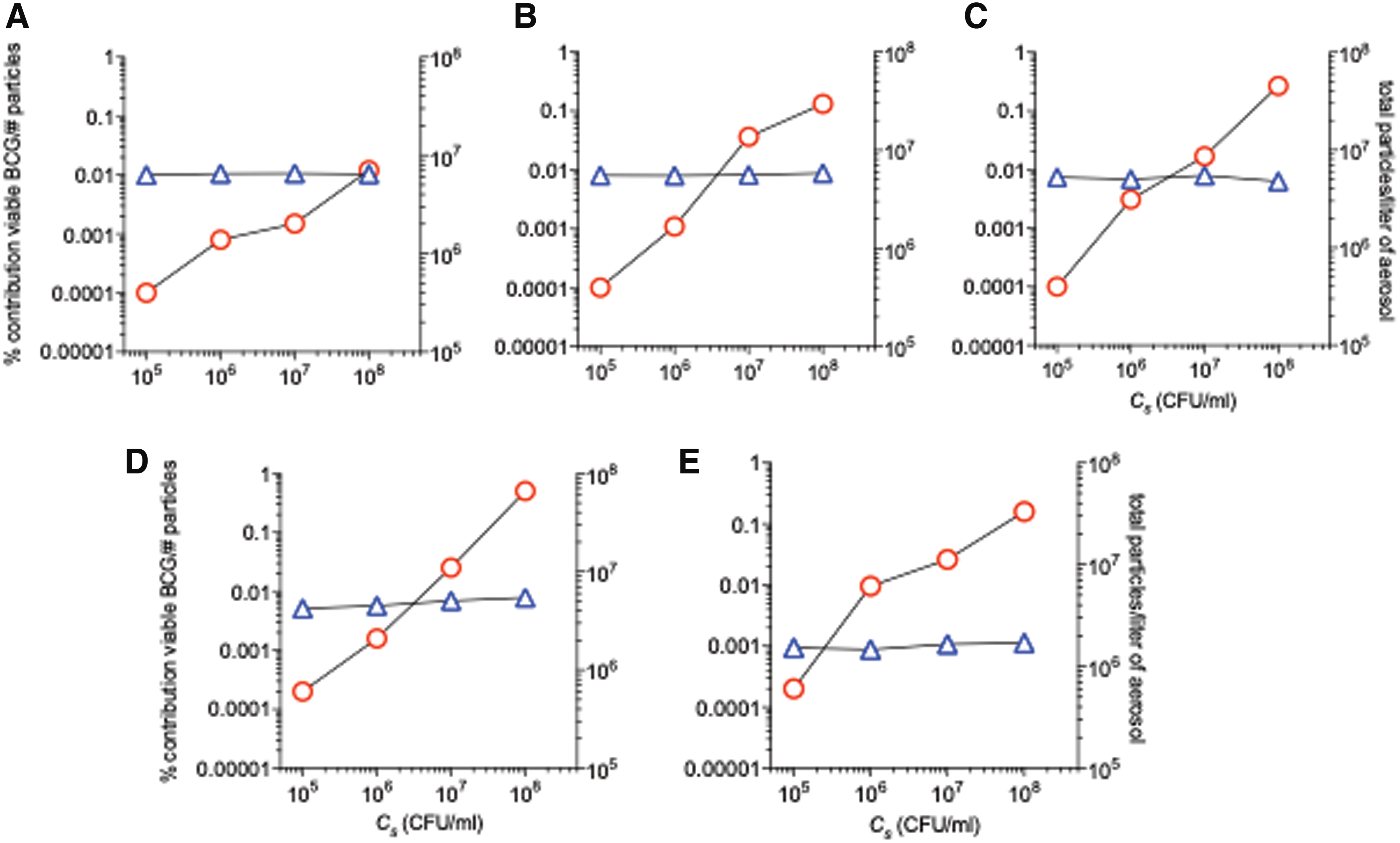
Comparison of nebulizer performance as a function of total particles per liter of aerosol generated, blue triangles (right ordinate axis), percentage contribution of viable BCG as a function of total aerosol particles generated, red circles (left ordinate axis) based upon BCG starting concentration (Cs) used for each aerosol generation event (abscissa axis). Each panel represents
Spray factor of BCG
The spray factor (Fs) is a unitless ratio, as detailed earlier, is a useful quotient used to understand the dilution and relative effect of aerosol generator action upon viability of the particular biological agent under study. The results of the Fs for BCG in each nebulizer evaluated, and stratified according to prevailing logarithmic Cs, are shown in Figure 3. There are clear differences in Fs among the nebulizers under evaluation. The experimental determinations resulting from 3JC nebulizer demonstrated that initial Fs at 1E+05 Cs (3.1E-07) significantly worsened by nearly one log as BCG Cs logarithmically increased to 1E+08 (1.3E-08). A similar trend was observed in the 6JC evaluation, with a 0.5log worsening of the Fs between the lowest (1E+05) and highest (1E+08) Cs performed. In contrast, the Fs for OM, OM.t, and AeS is relatively stable as a function of BCG Cs used in each evaluation.
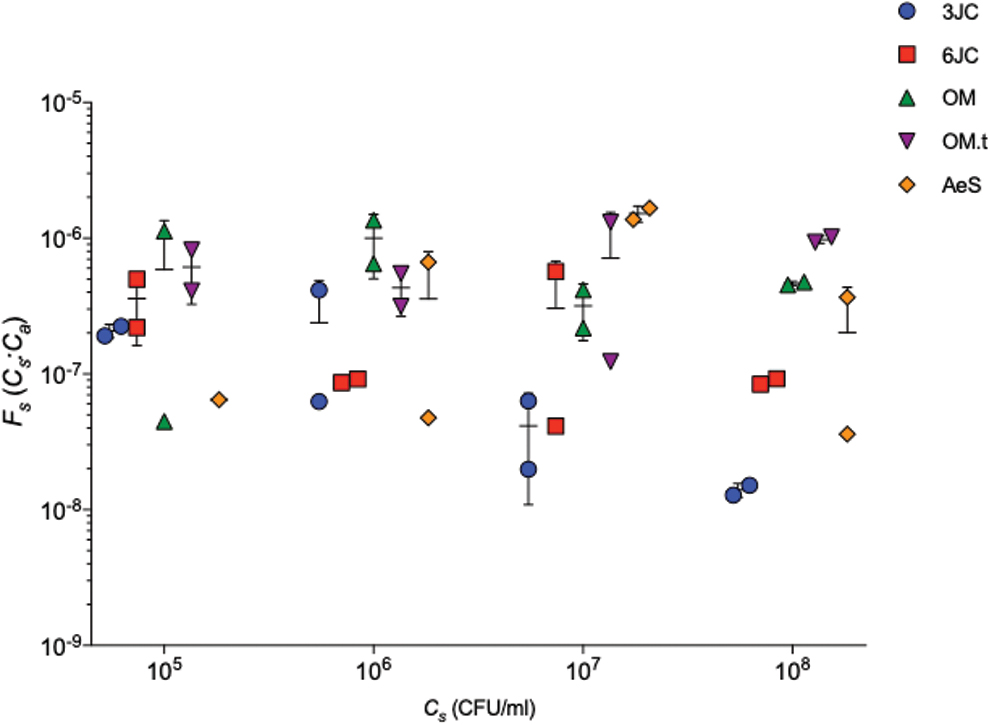
Spray factors (Fs) for BCG. Markers, circle (3JC), square (6JC), triangle (OM), inverted triangle (OM.t), and diamond (Aes), represent iterative result in Fs calculation for each aerosol run for each nebulizer at each Cs. Corresponding error bars show corresponding standard deviation set at the median of each set of generator and Sc parameters. Color images are available online.
Effect of aerosolization on BCG
The mechanism by which each style nebulizer generates the aerosol affects the resulting viability of the BCG. The Collison nebulizer employs a multitude (either 3 or 6 jets) of fluid nozzle jets under pressure that produces a high-velocity stream impacting the wall of the reservoir containing the BCG inoculum. The satellite aerosols from this action are swept up into the subsequent flow out of reservoir and outlet with a total flow of either ∼6 LPM (3JC) or ∼12 LPM (6JC). The mechanical shear developed during this process of nebulization undoubtedly imparts stress onto the mycobacterial innocula, and may limit culturability. The Omron Microair (OM) and Aerogen (AeS) devices, in contrast, utilize a piezoelectric actuated mesh to generate an aerosol. The distinction between the Collison (C) and OM/AeS nebulizers as it relates to the worsening Fs as BCG Cs increases (Fig. 3) may be a result of the coarse treatment of the contents of the innocula in the former compared with the relatively gentle single-pass generation method used by the OM and AeS nebulizers.
Collectively, these data suggest that previous study with BCG aerosol vaccination (typically performed with the OM device) resulted in inhaled doses that were generally three logs less than the starting concentrations loaded into each device. The performance of the OM device was comparable with standard nebulizers utilized in bioaerosol studies (3JC and 6JC). Interestingly, the AeS resulted in a lower aerosol concentration in this series of testing. The vibrating mesh nebulizers were superior to jet nebulizers with respect to resulting higher viability of generated aerosols. Also, it should be noted that OM device had higher output than AeS device and, therefore, is a good choice for aerosol delivery of this particular biological.
Footnotes
Acknowledgments
Special thanks to the Aerosol and Mucosal Vaccination Community standing membership of the Bill and Melinda Gates Foundation (BMGF)-based Collaboration for Tuberculosis Vaccine Discovery for outstanding discussions and critical analysis of the subject matter of this study. The authors also acknowledge the Infectious Disease Aerobiology Core located at the Tulane National Primate Research Center, Tulane University, for logistical and scientific coordination and use of its aerobiology resources essential to this study.
Author Disclosure Statement
The authors declare they have no conflicting financial interests.
Funding Information
This study was funded by the BMGF Grant No. OPP1126491 to C.J.R., the Aeras Foundation Innovation Fund/MISC041 to C.J.R. and P.J.K. and supported in part by Grant No. OD011104 to CJR from the Office of Research Infrastructure Programs (ORIP), Office of the Director, National Institutes of Health.
Reviewed by:
Charles Scangaca
Ronald Wolff