






Abstract
The Rosalind Franklin Society (RFS), in partnership with Mary Ann Liebert, Inc., publishers, enthusiastically congratulate our distinguished recipient of the 2022 annual
Rachel K. Redmann, et al., “Particle Dynamics and Bioaerosol Viability of Aerosolized Bacillus Calmette–Guérin Vaccine Using Jet and Vibrating Mesh Clinical Nebulizers,” Journal of Aerosol Medicine and Pulmonary Drug Delivery 35, no. 1 (February 2022): 50–56, http://doi.org/10.1089/jamp.2021.0030.
Abstract
Bacillus Calmette–Guérin (BCG) is a vaccine used to protect against tuberculosis primarily in infants to stop early infection in areas of the world where the disease is endemic. This study investigates the feasibility and performance of the jet nebulizer and two vibrating mesh nebulizers aerosolizing BCG and the resulting particle characteristics and residual viability post-aerosolization. Particle characterization, including aerodynamic particle sizing, was performed on all devices within a common aerosol chamber configuration and comparable BCG concentrations. Aerosol particles within the respirable range were generated from all nebulizers at different concentrations of BCG. The jet nebulizer produced a uniformly smaller particle size than the vibrating mesh devices, though particle concentrations by mass were similar across almost all devices. A measurable decrease of efficiency and overall viability reduction in the jet nebulizer was observed in higher BCG inoculum starting concentrations, whereas the vibrating mesh nebulizer returned a remarkably stable viable aerosol fraction irrespective of inoculum concentration.

Biosketch
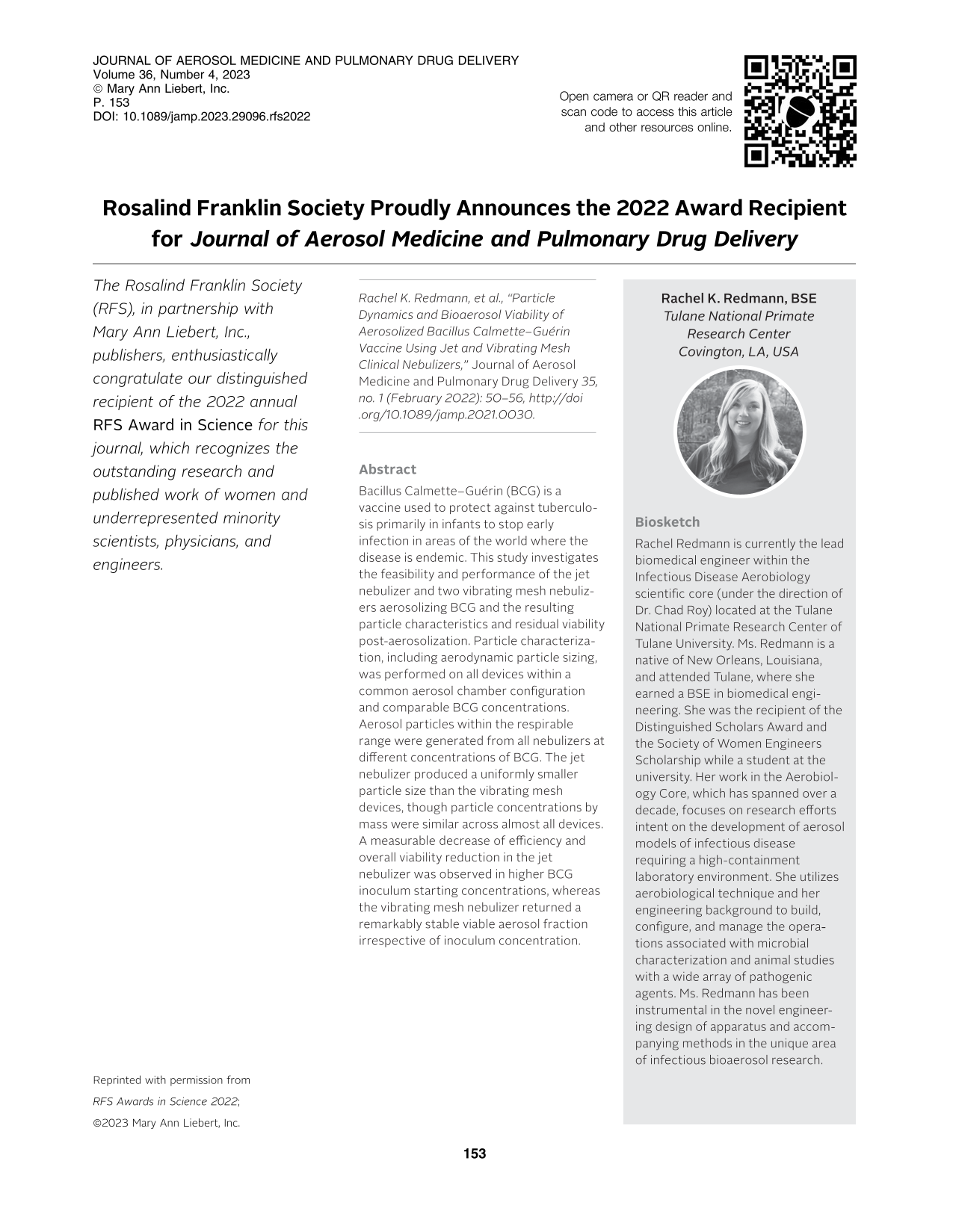
Rachel Redmann is currently the lead biomedical engineer within the Infectious Disease Aerobiology scientific core (under the direction of Dr. Chad Roy) located at the Tulane National Primate Research Center of Tulane University. Ms. Redmann is a native of New Orleans, Louisiana, and attended Tulane, where she earned a BSE in biomedical engineering. She was the recipient of the Distinguished Scholars Award and the Society of Women Engineers Scholarship while a student at the university. Her work in the Aerobiology Core, which has spanned over a decade, focuses on research efforts intent on the development of aerosol models of infectious disease requiring a high-containment laboratory environment. She utilizes aerobiological technique and her engineering background to build, configure, and manage the operations associated with microbial characterization and animal studies with a wide array of pathogenic agents. Ms. Redmann has been instrumental in the novel engineering design of apparatus and accompanying methods in the unique area of infectious bioaerosol research.