







Abstract
Purpose:
The concept of liminality has been applied to both the experience of adolescence and to the experience of a cancer diagnosis. The aim of this study was to explore how the concept of liminality can be applied to a cohort of patients experiencing both adolescence and cancer concurrently.
Methods:
Thematic analysis was applied to data from interviews with 17 participants who had been treated for cancer between the ages of 15 and 24 in an adult hospital. As the analysis developed, it became apparent that liminality was a useful conceptual framework to be applied to the data.
Results:
Participants experienced the liminality of both adolescence and cancer. Four subthemes revealed the interaction of these two liminal states: an oscillation between childhood and adulthood; a disassociation from noncancer peers; a strong connection with other adolescents and young adults (AYAs) with cancer; and a lack of connection with older cancer peers.
Conclusion:
A model of dual liminality provides a unique conceptualization of the AYA cancer experience. Cancer in the AYA years is depicted as a navigation of two compounding transitional periods. Adolescence and cancer exacerbate one another and impede the AYA's ability to progress through either. It is this compounding of two transitional periods that makes the model of dual liminality valuable to an understanding of AYAs with cancer.
Introduction
Although cancer amongst adolescents and young adults (AYAs) is rare and represents <1% of all diagnoses, 1 the impact on this age group is often life-changing. 2 As well as coping with a life-threatening condition, AYAs with cancer have to simultaneously navigate a developmental life-stage. 3 The changes typically associated with adolescence, such as achieving independence, making life decisions about career, and engaging in romantic relationships can be permanently affected by cancer.4,5 The challenge for professionals working with this cohort is developing an understanding of AYAs with cancer, so that young people can be appropriately supported through this difficult experience. 6 However, health professionals' perception of the needs of AYAs with cancer can differ greatly from the perception of patients. 7 The aim of this study was therefore to explore whether the concept of liminality, which has previously been applied to adolescence and cancer separately, can provide a greater understanding of those patients experiencing adolescence and cancer concurrently.
Liminality
The concept of liminality derives from anthropology, in particular the work of van Gennep, 8 who argued that life in any society or culture is a series of “rites of passage” from one stage to another, such as adolescence, marriage, and bereavement. In order to transition between stages, an individual must leave one stage, enter into an ambiguous and uncertain “liminal” stage, before entering a new social position. 9 A person in the liminal period is considered to be “betwixt and between,” in a transitory, threshold stage outside of classification. 10 In common with the concept of the sick role, 11 individuals in the liminal period are ascribed a temporarily suspended status, are exempt from normal duties and activities, and are excused from contributing to society. 12 The liminal period is an important period of transformation that enables reentry into society at a higher social status. 13 People within the liminal stage experience “communicative alienation,” a feeling of disassociation from others and an inability to relate to anyone not in the liminal stage. 14 This is counterbalanced by “communitas,” an ability to spontaneously empathize with others within the same liminal stage. 15
Liminality and adolescence
The notion of a transitional period between childhood and adulthood has pervaded theories of adolescence.16–21 Adolescence is often depicted as a period when key developmental tasks, such as separation from parents or forming a clear identity, must be completed on the journey from childhood to adulthood.22–25 Being in a liminal period outside of classification, AYAs are not expected to contribute to society. 26 Influenced by the anthropological concept of liminality, adolescent theories depict the AYA years as a turbulent, transitional period that must be navigated to achieve adulthood.
Liminality and cancer
The liminal notion of a transitional stage has also been used to explain the experience of cancer.14,27,28 The diagnosis of cancer creates uncertainty, turmoil, and a sense of distance from other people.12,29 Cancer forces someone into a liminal stage of illness, setting them apart from others and producing communicative alienation. 14 Being among other cancer patients enables communitas to occur, and through their shared experience patients can support one another to negotiate the liminal period. 27 Achieving wellness is not always achievable, and an individual can become trapped within the uncertainty of the liminal state.12,30 For those who are able to achieve wellness, they may be permanently changed by the cancer diagnosis.13,28–30
Previous studies have conceptualized adolescence and cancer as separate liminal states, but there has been no consideration of how the two may interact. The aim of this study was therefore to explore how the concept of liminality can be applied to a cohort of patients experiencing both adolescence and cancer concurrently.
Methods
Thematic analysis was applied to data collected in a study of the experience of AYAs treated for cancer in an adult setting. 31 As the analysis developed, it became apparent that liminality was a useful concept to be applied to the data and became the study's conceptual framework. Seventeen participants were recruited via cancer charities and social media, all of whom had been treated for cancer between the ages of 15 and 24 (the age range for AYAs commonly employed in the UK1,32). Based upon clinical experience and the findings of a literature review, 33 an interview schedule was developed, which was subsequently adapted into a more flexible topic guide following a pilot interview. Telephone interviews were conducted with the participants, audiorecorded, and transcribed. Analysis was based upon the approach developed by Braun and Clarke 34 and described in Appendix A. Approval was granted by Lancaster University's Research Ethics Committee (FHMREC 13016).
Results
The data revealed the liminal experience of both adolescence and cancer, which are presented as main themes. Four subthemes displayed the interaction of these two liminal states: an oscillation between childhood and adulthood; a disassociation from noncancer peers; a strong connection with other AYAs with cancer; and a lack of connection with older cancer peers. These themes are explored using direct quotes to illustrate each theme. All but one of the participants requested that their own name be used in any publication and their age at diagnosis is provided.
Theme 1: the liminality of adolescence
Participants articulated being in a transitional period between childhood and adulthood and used terms such as in-betweener and middle-grounders to describe themselves. This terminology depicts a liminal, intermediate period and was described as fragile:
You don't quite have your identity sorted and it's still a big period of change … because I didn't really have that much of a settled life before [cancer] because I'm only young it just sort of messed my head up even more (Steph, 19).
This uncertainty can be a feature of the liminal state. Participants argued that as an AYA's identity is not firmly established, it is therefore more vulnerable:
Teenage and young adults it's a time of their life of great change and also when a lot of their future behaviours are laid down so if you're going to smoke when you are an old person you probably started as a teenager for example … I'd just left home I'd just gone to University I was just becoming independent - finding my own feet and then I get cancer - you can become very vulnerable
(Tom, 18).
The AYA years were depicted as a liminal period of transformation when the direction of a person's life is molded, rendering it more susceptible to damage from cancer.
Theme 2: the liminality of cancer
The sense of being within a liminal state due to their cancer diagnosis was also evident in the data. Participants perceived of themselves as weird and freaks, displaying how their self-perception could be negatively impacted by cancer. The liminal sense of isolation was also revealed:
I'm now on my own in the wilderness - what do I do now?
(Tom, 18).
Some participants appeared to be struggling within the sustained liminality of cancer and were unable to see a way forward:
I tend to compare myself to pre-cancer me because I was so active and so social and I achieved so much … I'm not that person anymore so maybe my path has changed - so I'm kind of grieving for my former self as well as trying to find out who I am now
(Karen, 22).
Cancer was often described as life-changing and those participants able to transition through this liminal stage considered themselves permanently transformed by the experience.
Subtheme 1: oscillation between childhood and adulthood
Being within the liminal stages of both cancer and adolescence appeared to cause an oscillation between childhood and adulthood. Participants had to regress to a more child-like and dependent state, while simultaneously having to cope with a life-threatening illness, for which they felt ill-prepared:
There's this weird thing when you're at that age bracket 15 to 24 - you're trying to be independent from your parents to a point and do things on your own and be an adult so society sort of tries to treat you like that to a point but then it also thinks oh no - I'm not going to be sensitive to the fact that this person hasn't got this much life experience yet
(Tabitha, 20).
The degree of independence achieved before diagnosis could be precarious, and cancer often forced the young person back into dependency on their parents:
I had been to University for a year so I'd just got all that independence and then to have it just taken away again straight away and being completely dependent on my parents that was a really weird thing
(Steph, 19).
Cancer could cause conflicting emotions in participants: there could be a desire for increased parental support, while at the same time needing to resist losing any independence already achieved. The threshold liminal state of adolescence appeared to have been disrupted by cancer, leaving participants oscillating between childhood and adulthood.
Subtheme 2: disassociation from noncancer peers
Participants reported a sense of disassociation from their peers when diagnosed with cancer. The shared liminal experience of adolescence appeared to have been negated by cancer and participants described a communicative alienation from peers:
Some friends kind of get really scared off by it and freaked out by it and disappear
(Tabitha, 20).
As their peers are also going through the liminality of adolescence, they lacked the life experience to support someone with cancer. The culture of young people may not be supportive to a peer who cannot partake in typical activities:
I don't have any of the friends that I used to have before they all got bored that Karen can't go out drinking anymore and moved on
(Karen, 22).
As peers were also within the adolescent liminal state and had not achieved adult maturity, they could not be relied upon to be supportive toward a peer with cancer. Participants could therefore feel discordant from their peers, as their adolescent priorities had been shifted by their experience of cancer.
Subtheme 3: strong connection with other AYAs with cancer
In contrast to the disconnection with noncancer peers, participants described a strong connection with other AYAs with cancer. This is the communitas experienced by people in the same liminal state:
If you talk to another young person who's been through the same thing you just automatically have quite a large degree of understanding with each other which I think's crucial to make you realise that you're not on your own that there are other people going through a similar thing that other people understand
(Tom, 18).
Being among peers with cancer reduced the liminal sense of isolation and reduced feelings of abnormality:
Being with other people my age who got cancer was pretty uplifting and it got me out of hospital quicker … you can talk about normal things not just the illnesses
(Andrew, 15).
Although communitas did not transcend the shared liminality of adolescence with noncancer peers, there appeared to be a strong connection between AYAs with cancer.
Subtheme 4: lack of connection with older cancer peers
Despite a shared diagnosis and treatment, participants did not find any connection with older people with the same cancer:
Even though we were all cancer patients or we were all in the same boat - it felt very different and their needs were completely different to mine and that was the main problem
(Jessica, 24).
Age appeared to be a barrier to communitas, as despite a shared cancer and treatment experience, participants did not find any commonality with older patients. The liminal sense of communitas only seemed to occur with other AYAs with cancer.
Discussion
Based upon the findings and by integrating other research in the field, a model of dual liminality is presented as a framework for conceptualizing the experience of AYAs with cancer. This model depicts cancer in the AYA years as a navigation of two compounding liminal periods. Two studies have discussed similar notions of a “dual crisis” 35 and an “AYA paradox,” 36 however, neither presents a developed conceptual framework. This study makes a unique contribution by using dual liminality as a conceptual model for the intersection of adolescence and cancer.
The experience of being within two liminal states was apparent in the interviews. Participants articulated being within an in-between phase at diagnosis and described the liminality of adolescence: they were in the transitional adolescent phase of becoming independent, leaving home and going to university. 21 Adolescence was depicted as fragile and easily disrupted by cancer, mirroring the findings of other studies.6,37,38 Cancer immediately set participants apart from their peers, which is also supported by the literature.39,40 Participants continued to be in a liminal adolescent period, but an alternative liminality to their noncancer peers.
Participants experienced a second liminality due to their cancer diagnosis and displayed a sense of having been forced into an uncertain liminal state outside of wellness. Previous studies argue that people with cancer have a shared liminal experience.12,14,29 However, this was not the case when the other patients were older. Age was a barrier to communitas, which only occurred with other AYAs with cancer, and this was the strong connection displayed in other studies.6,38 The notion of a shared liminal experience of cancer appears to be correct, but only when both parties are experiencing adolescence and cancer concurrently. The model of dual liminality describes this compounding of two liminal states. The AYA with cancer has to negotiate the competing demands of two liminal states simultaneously and navigate entry into both adulthood and wellness. This experience of dual liminality is represented visually in Figure 1.
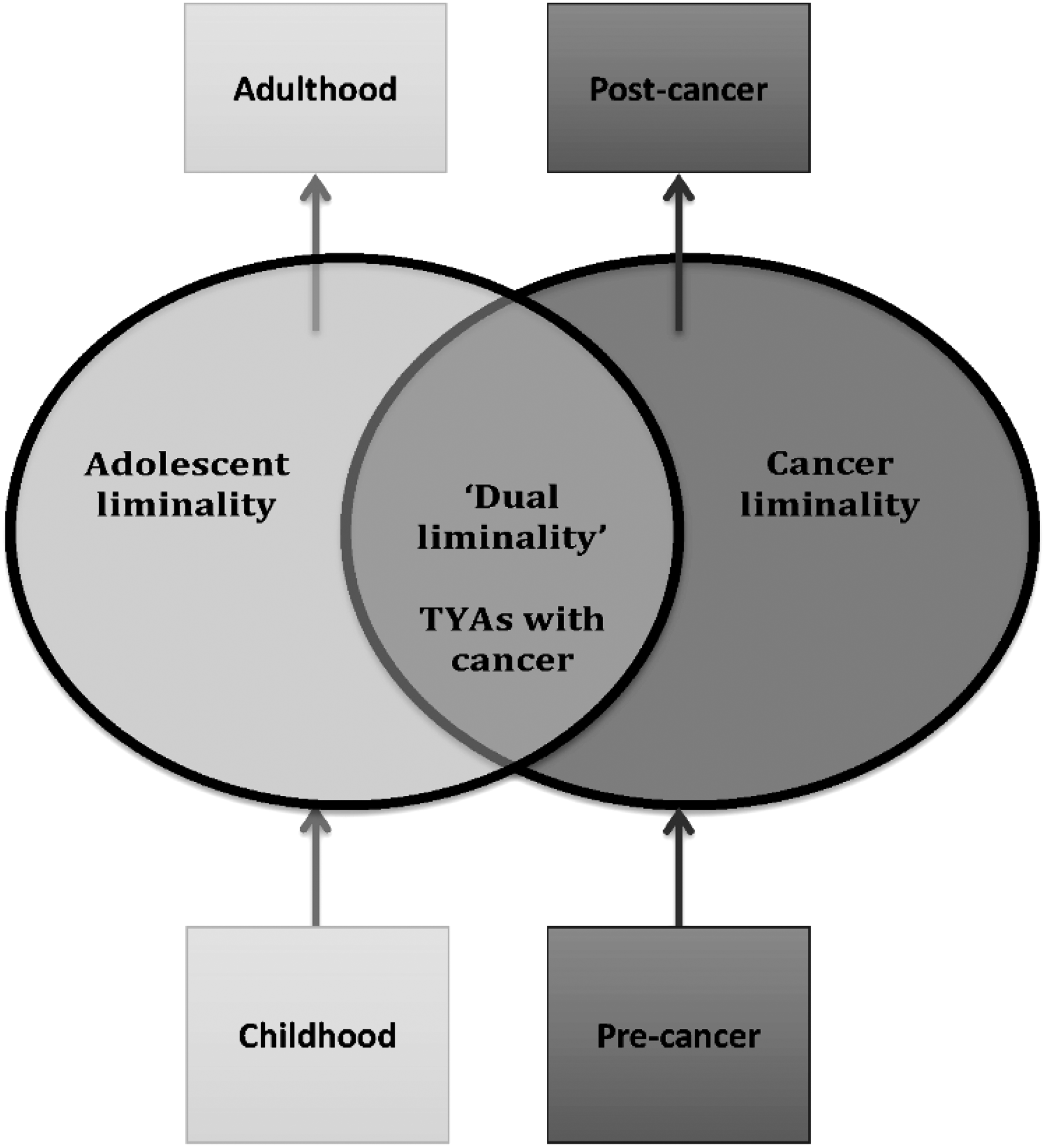
The model of dual liminality.
Demonstrating this dual liminal experience, participants described how adolescence and cancer conflicted with one another. Cancer impeded the transition from child to adult: some participants had to relinquish their newly acquired independence. A return to childlike dependence was seen as a backward step and contrary to “normal” adolescent development. 23 Participants often resisted and tried to maintain as much independence as possible. Conversely, participants also craved the support of their parents. This return to a more childlike nurturing was both welcomed and resented during this difficult period and has been displayed previously. 37 While curtailing the transition into adulthood, cancer necessitated an AYA having to be prematurely adult and make life-changing decisions about treatment. The oscillation between a regression to childlike dependence and a forced advancement to adult maturity is described in other studies40,41 and displays how AYAs with cancer are precariously positioned within the competing demands of two liminal states.
Participants attributed fundamental life changes to their cancer diagnosis, as well as describing the negative impact that cancer could have upon their ambitions. Reminiscent of Frank's concept of the “remission society,” 42 the AYAs in this research described having to adapt to a permanently changed identity after the experience of cancer. Cancer appeared to have moved the end point of the adolescent transitional period, so that participants achieved a different adulthood at a different time. Participants also described feeling trapped in a liminal state and unable to progress into wellness or adulthood. This is suggestive of sustained liminality, 14 whereby the individual remains permanently changed and unable to transition out of the liminal state. As an adolescent with cancer, some participants were therefore constrained within two liminal states simultaneously.
A cancer diagnosis complicates the transition to adulthood, but being an adolescent, it can also make recovery from cancer more difficult. Congruent with the literature,39,40,43 participants described feeling unprepared for cancer due to their lack of life experience. The sense of being altered by cancer and of having transferred into a different liminal state to other young people is evident throughout the data. Cancer changed participants' priorities and distanced them from “normal” AYA concerns. For the AYA with cancer, the experience of having transitioned into a liminal state because of their diagnosis happens within the context of already being within the liminality of adolescence. The liminal states of cancer and adolescence appeared to exacerbate one another and in doing so inhibited the ability of a young person to progress through either. The AYA with cancer is in a unique position where two liminal states interact and impede one another. It is more difficult to recover from cancer due to the pressures of adolescent liminality; it is also more difficult to progress into adulthood due to the impact of cancer. This framework of dual liminality provides a unique conceptualization of the AYA cancer experience.
Limitations
Despite the different aims of the study that generated the data, the liminality of both adolescence and cancer was evident in the interviews. Participants were exclusively UK-based. Due to the methods of data collection, the background of the participants was unknown, making it impossible to incorporate any variables into the analysis. Many of the participants were interviewed several years after their diagnosis, although this enabled them to have a reflective perspective. The richness of the data obtained around the dual liminal experience outweighs the limitations.
Conclusion
Dual liminality has been shown to be a useful framework to explore the experience of AYAs with cancer and can be used as a conceptual framework in future studies. The model of dual liminality depicts cancer in the AYA years as a navigation of two compounding transitional periods. The diagnosis of cancer forces the AYA, already in the liminal period between childhood and adulthood, to enter a second overlapping liminal state of illness. Cancer and adolescence exacerbate one another and impede the young person's ability to progress through either. The pressures of adolescent liminality make it more difficult to recover from cancer; it is also more difficult to progress into adulthood due to the impact of cancer. Conceptualizing AYAs with cancer as their age and disease intertwined helps to understand the uniqueness of their perspective and of their experience. It is this interconnection and compounding of adolescence and cancer that make the model of dual liminality useful to an understanding of the AYA cancer experience.
Footnotes
Acknowledgments
The authors thank the participants for sharing their experiences and the charities for helping with recruitment.
Author Disclosure Statement
No competing financial interests exist.