







Abstract
Rheumatoid arthritis (RA) is a type of arthritis autoimmune disease characterized by systemic chronic inflammation. C-C Chemokine ligand 20 (CCL20) is the same as most chemokines with immunomodulatory and inflammatory processes. The correlation of CCL20 in RA remains unclear. This study aimed to explore the association among levels of CCL20, T helper cell (TH) subset (Th1/Th2/Th17)-related cytokine levels, and clinical indices of RA disease activity. Serum CCL20 levels were quantified by enzyme-linked immunosorbent assay, and a flow-fluorescence technique was used to assess Th1/Th2/Th17-related cytokine levels. The serum CCL20 levels in patients were significantly higher than those in healthy controls and positively associated with C-reactive protein levels, erythrocyte sedimentation rate, and disease activity score-28 (DAS28). Patients with RA were categorized into 4 major groups, including remission, low, moderate, and high disease activity, with related DAS28 scores for each group. CCL20 levels of the disease moderate/high activity group were moderately positively correlated with IL-6 levels, but not with the other Th1/Th2/Th17-related cytokines. Serum CCL20 levels correlate strongly with RA disease activity and clinical inflammation and were significantly elevated in patients compared to healthy individuals. CCL20 plays a key role in the immune response of patients with RA and is, therefore, a potential biomarker of disease activity.
Introduction
Rheumatoid arthritis (RA) is a systemic autoimmune disease featuring synovial joint inflammation leading to cartilage destruction and resorption (Weyand and Goronzy, 2021). Throughout the chronic synovitis progression, a large number of inflammatory cells migrate from the peripheral blood to the synovial tissue of the joint (Kondo et al., 2021; Micheroli et al., 2022). Here, inflammatory cells produce various inflammatory mediators, including cytokines and matrix-degrading enzymes, destroying synovial tissue (Firestein and Mcinnes, 2017; Wright et al., 2020). However, the mechanism remains unclear.
Chemokines are a class of cytokines capable of inducing chemotaxis, which plays an important role in inflammatory cell migration and infiltration (Elemam et al., 2020; Kraemer et al., 2022). In RA, chemokines are mainly produced by macrophages of the synovial membrane, prompting chemotaxis among the neutrophils, lymphocytes, and monocytes (Shah et al., 2022; Szekanecz et al., 2009). Chemokines promote the release of inflammatory mediators and cytokines, perpetuating a vicious cycle of inflammation (Nanki, 2016; Szekanecz et al., 2009). Regarding collagen-induced arthritis (CIA), chemokine receptors antagonists have been shown to mitigate joint inflammation in a CIA model (Ahmad et al., 2023; Ansari et al., 2021), suggesting that chemokine receptors antagonists may be a potential RA treatment.
C-C chemokine ligand 20 (CCL20) is primarily produced by inflamed synovial cells and can recruit immature dendritic cells, T cells, B cells, and monocytes to the joints of individuals with RA (Kaneko et al., 2018; Lisignoli et al., 2007). Presently, the primary role of chemokines, such as CCL20, in the pathogenesis of RA is not completely understood. To elucidate the role of chemokines in the initiation of RA, this study aimed to determine the effects of CCL20 on clinical indices of disease activity and T helper cell (TH) subset (Th1/Th2/Th17)-related cytokine levels by assessing serum levels of CCL20 among patients with RA and healthy individuals.
Methods
Patients
Overall, 90 patients with early never-treated RA and 90 healthy volunteers were enrolled randomly from the Department of Rheumatology and Immunology, Affiliated Jinhua Hospital, Zhejiang University School of Medicine, seeking a comparable sex distribution in the 2 groups. The 2010 American College of Rheumatology/European Alliance of Associations for Rheumatology criteria were used for RA classification and diagnosis (Aletaha et al., 2010). The exclusion criteria were as follows: a history of other types of rheumatic disease, tumors, chronic liver or kidney problems, heart disease, or if their age was outside the range of 18 to 80 years.
In addition, individuals with a history of treatment with glucocorticoids, conventional synthetic disease-modifying antirheumatic drugs (csDMARDs), and biological/targeted synthetic DMARDs were also excluded. This study was conducted in compliance with the Declaration of Helsinki and approved by the ethics committee of our hospital, and each participant signed an informed consent form. All methods were carried out in accordance with relevant guidelines and regulations.
Clinical and laboratory data
The following clinical and laboratory data were collected: sex, age, swollen joint count (SJC), tender joint count (TJC), visual analog scale score, disease activity score-28 (DAS28) score (≤2.6, clinical remission; 2.6 < DAS28 ≤ 3.2, disease activity is low; 3.2 < DAS28 ≤ 5.1, activity is moderate; and DAS28 > 5.1, high disease activity), platelet count (PLT), erythrocyte sedimentation rate (ESR), C-reactive protein (CRP) level, rheumatoid factor (RF) level, and anticyclic citrullinated peptide (anti-CCP) level. The laboratory data were obtained from the laboratory of our hospital.
Measurement of peripheral serum levels of CCL20
Peripheral serum samples were collected from participants. A human CCL20 enzyme-linked immunosorbent assay kit (Multi Sciences, Hangzhou, China) was used to determine the serum CCL20 level.
Measurement of Th1/Th2/Th17-related cytokine levels
Peripheral blood serum from participants was collected. Th1/Th2/Th17-related cytokines, including interleukin (IL)-2, interferon-gamma (IFN-γ), tumor necrosis factor- alpha (TNF-α), IL-4, IL-6, IL-10, and IL-17 were detected using multiple microsphere flow-fluorescence technique according to the Th1/Th2/Th17 cytokine kit manufacturer protocol (RaiseCare, Qingdao, China), and detected by a BD FACS Canto II flow cytometer (BD Biosciences, California).
Briefly, 25 μL of capture beads was added to each test tube, and 25 μL of diluted standards was added to the standard tube. Furthermore, 25 μL of the sample to be tested was added to the sample tube and then incubated at room temperature in the dark for 2 h. Also, 25 μL of phycoerythrin detection reagent was added to all test tubes and incubated at room temperature in the dark for 0.5 h. Subsequently, 1 mL of wash buffer and centrifuge at 300g for 5 min were added. The supernatant was discarded and the beads were resuspended in 300 μL of wash buffer. The samples were prepared ready for analysis using a flow cytometer.
Statistical analysis
SPSS 22.0 (IBM Corp., Armonk, New York) and GraphPad Prism 8 (GraphPad Software, San Diego, CA) were used to perform statistical analyses and create charts. Data are shown as mean ± standard deviation or interquartile range. For normally distributed data, means were compared through independent sample t-tests; otherwise, the nonparametric Mann–Whitney U tests were performed. Categorical data were compared using the chi-square test. A correlation analysis was performed using Spearman's method. Values of P < 0.05 (two tailed) were considered statistically significant.
Results
Clinical and laboratory data of patients with RA and healthy volunteers
The clinical and laboratory data of 90 patients with RA and 90 healthy volunteers are shown in Table 1. There were no statistically significant differences in age, sex, or body mass index between the 2 groups.
Clinical and Laboratory Data of Study Participants
Anti-CCP, anticyclic citrullinated peptide; BMI, body mass index; CRP, C-reactive protein; DAS, disease activity score; ESR, erythrocyte sedimentation rate; HC, healthy control; NA, not available; PLT, platelet count; RA, rheumatoid arthritis; RF, rheumatoid factor.
Elevated serum CCL20 levels of RA patients
As shown in Fig. 1, the mean serum CCL20 levels of patients with RA were significantly higher than those of healthy volunteers (111.2 ± 74.94 versus 74.29 ± 28.99 pg/mL, respectively; P = 0.0086).
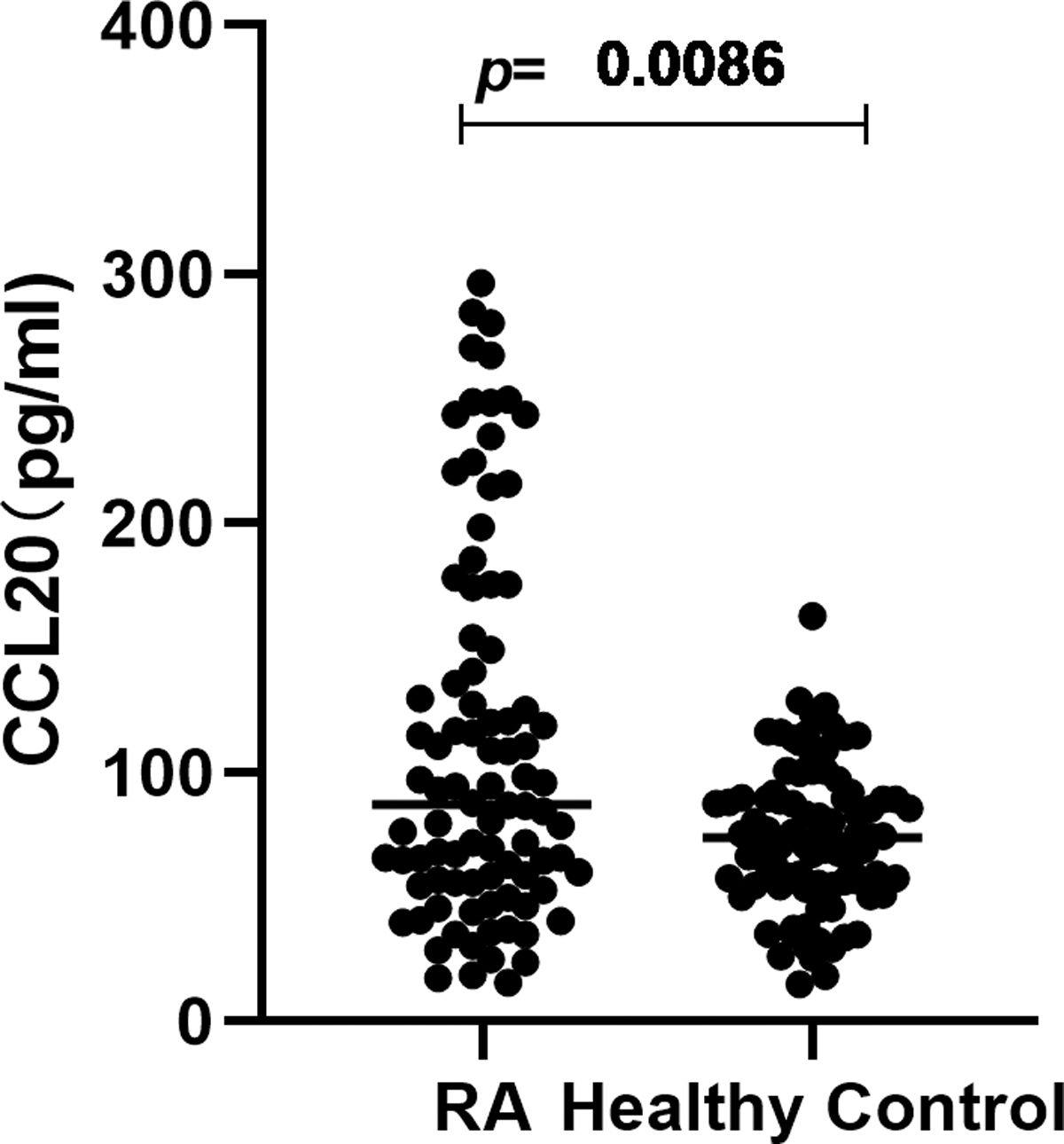
Serum levels of chemokine ligand 20 (CCL20) are shown. Levels of CCL20 in the sera of patients with RA were significantly higher than those of healthy individuals. RA, rheumatoid arthritis;
Associations between serum CCL20 levels and indices of disease activity in RA patients
Serum CCL20 levels were moderately positively associated with CRP (r = 0.3235, p = 0.0019), ESR (r = 0.3051, P = 0.0035), and DAS28 (r = 0.3091, P = 0.0030) in patients with RA. CCL20 levels were not associated with SJC (r = 0.08056, P = 0.4504), TJC (r = 0.08084, P = 0.4488), or PLT (r = 0.09705, P = 0.3629) (Fig. 2). We then divided 4 groups according to DAS28 and analyzed the levels of CCL20 in each group.
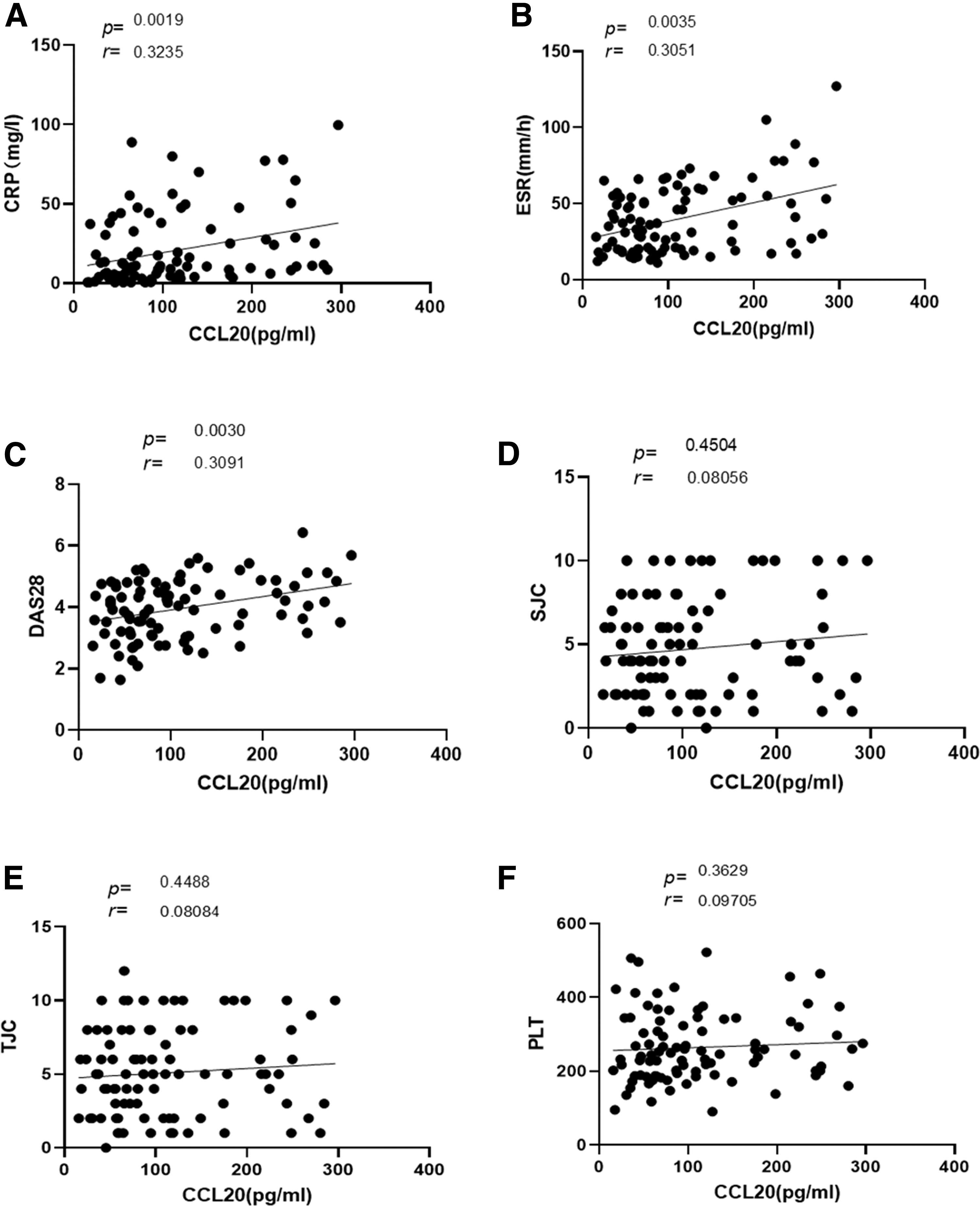
Association between serum CCL20 levels and indices of disease activity in RA patients. Serum chemokine ligand 20 (CCL20) levels of patients with RA are moderately positively associated with
The results showed that the level of CCL20 in the moderate disease activity group (n = 51) and the high disease activity group (n = 13) was significantly higher than that in the remission group (n = 10) (113.1 ± 77.40 versus 62.41 ± 37.82 pg/mL and 163.5 ± 80.15 versus 62.41 ± 37.82 pg/mL, respectively P = 0.0447 and P = 0.0003); however, no statistical difference was observed between the low disease activity group (n = 16) and the remission group (93.44 ± 55.30 versus 62.41 ± 37.82 pg/mL; P = 0.1350) (Fig. 3). We also observed that the CCL20 levels were not correlated with RF and anti-CCP level (r = 0.01839, P = 0.8781; and r = 0.02301, P = 0.8478, respectively) (Fig. 4).
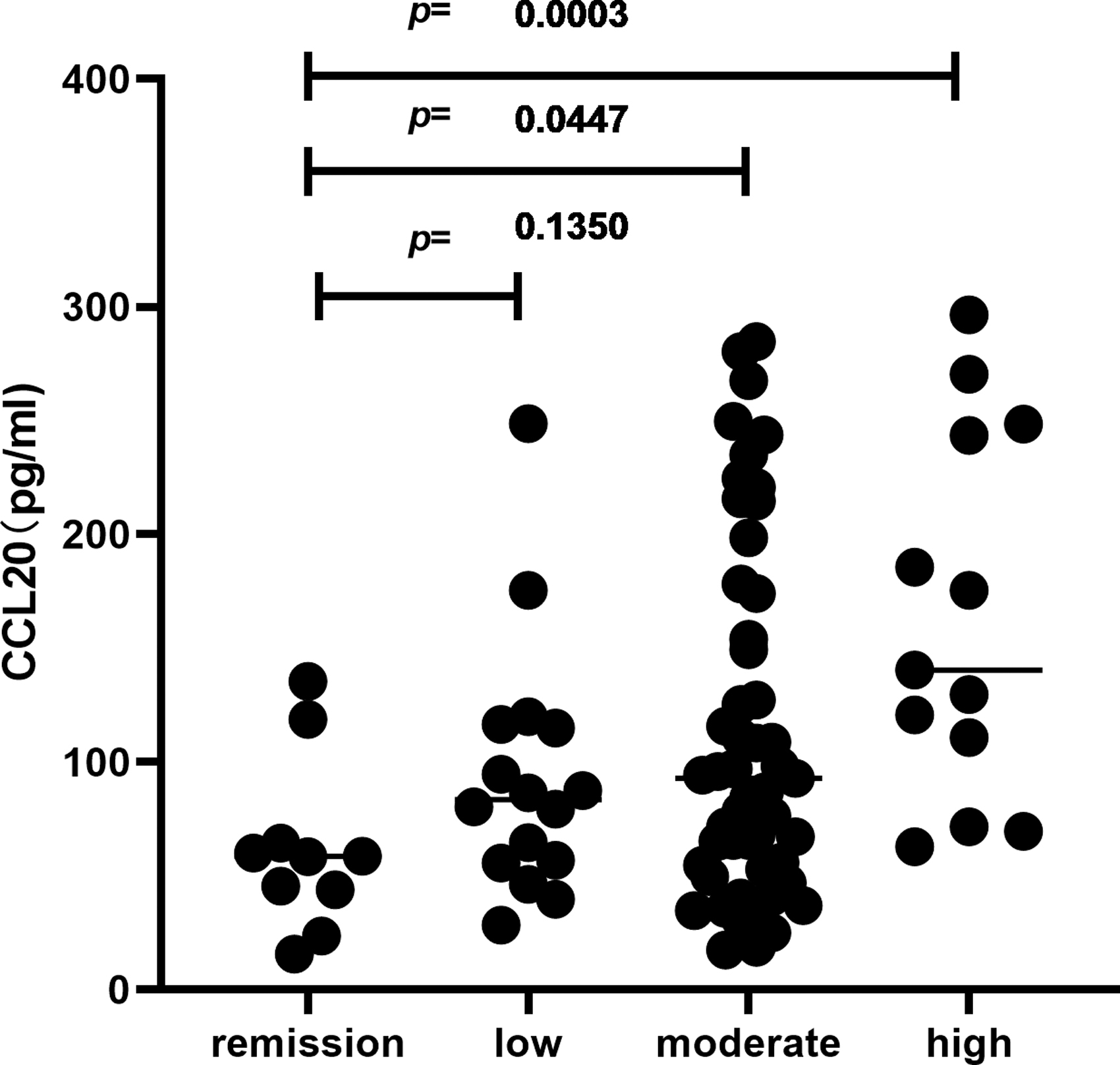
Association between serum CCL20 levels and 4 groups according to DAS28 score in RA patients. The results showed that the level of CCL20 in the moderate disease group (n = 51) and the high disease activity group (n = 13) based on DAS28 score was significantly higher than that in the remission group (n = 10).
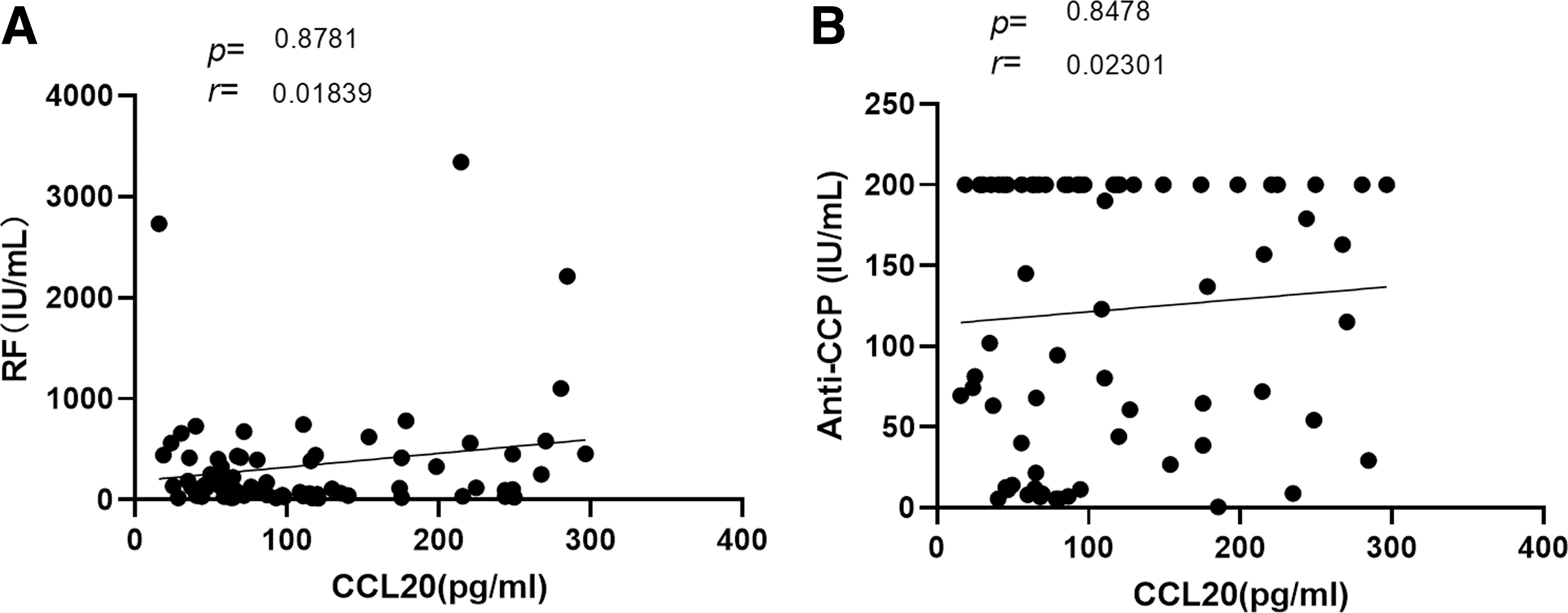
Comparison of CCL20 with RF and CCP. We observed that the CCL20 levels were not correlated with RF
Associations between levels of serum CCL20 and Th1/Th2/Th17-related cytokines in RA patients
The Th1/Th2/Th17-related cytokine levels were evaluated in 59 patients. The typical 2-dimensional scatter diagrams of the frequency of Th1/Th2/Th17-related cytokines in patients with RA are shown in (Supplementary Fig. S1). Thereafter, the patients were divided into the following 2 groups based on the DAS28: disease moderate/high activity group (DAS28 score >3.2) (n = 46) and disease remission/low activity group (DAS28 score ≤3.2) (n = 13). In the disease moderate/high activity group, serum CCL20 levels were moderately positively associated with levels of IL-6; however, no significant association was identified in patients of the remission/low activity group. In addition, no distinct association with other Th1/Th2/Th17-related cytokines (IL-2, IFN-γ, TNF-α, IL-4, IL-10, or IL-17) were observed in either group (Table 2 and Supplementary Fig. S2).
Spearman Correlations Between Levels of Serum CCL20 and Th1/Th2/Th17-Related Cytokines in the Rheumatoid Arthritis Disease Moderate/High Activity Group
Statistical significance (P < 0.05).
CCL20, chemokine ligand 20; IFN, interferon; IL, interleukin; TNF, tumor necrosis factor.
Discussion
Chemokines play a crucial role in regulating immunomodulatory and inflammatory processes. CXC chemokine receptor antagonist exhibits potent antiarthritic effects and inhibits glucocorticoid-induced TNF receptor-related protein and inflammation in the CIA model (Bakheet et al., 2020a; Bakheet et al., 2020b). In addition, these selective C-C chemokine receptor type 6 (CCR6) inhibitors have favorable pharmacokinetic properties. They can inhibit the chemotactic effects mediated by CCL20 and have demonstrated good efficacy in the treatment of RA in mice, suggesting that the CCR6/CCL20 axis is a critical regulator of humoral immune responses (Shi et al., 2021).
However, research on CCL20 in Chinese patients with RA is still relatively limited, and more studies need to be conducted to provide a more comprehensive understanding. To further clarify the role of CCL20 in the pathogenesis of RA, this study compared the serum CCL20 levels of patients with RA and healthy volunteers, exploring the association between CCL20 level and levels of Th1/Th2/Th17-related cytokines and indices of disease activity based on the DAS28.
In this study, the serum CCL20 levels in patients were significantly higher than in healthy controls. This is consistent with the findings of Kaneko et al. (2018), who reported that CCL20 levels are increased in synovial tissues of patients with RA, and Kawashiri et al. (2009), who revealed that CCL20 levels of patients with RA were higher than those of healthy control subjects.
Furthermore, CCL20 levels in both the synovial fluid and serum of patients with RA and psoriatic arthritis were higher than those of patients with osteoarthritis (Mrabet et al., 2013). Generally, CCL20 levels tend to increase in joints both locally and systemically; thus, CCL20 functions as a potential predictor of joint inflammation. Recent research has shown that the administration of infliximab and etanercept may significantly reduce serum CCL20 levels in RA patients, an outcome that is likely achieved by limiting TNF-α levels (Kawashiri et al., 2009). This finding indicates that CCL20 could be an effective therapeutic approach for treating RA.
This study also noted that the serum CCL20 levels of patients with RA were positively associated with inflammatory indices (CRP and ESR) and moderately positively correlated with the DAS28, a disease activity index. These results imply that inflammation and disease severity might be directly linked to serum CCL20 levels in RA; therefore, CCL20 may function as a biomarker of disease activity. Similarly, a recent study showed that plasma levels of CCL20 were associated with clinical and laboratory parameters, especially ESR, DAS28, RF, and anti-CCP (Pournazari et al., 2022).
Contrastingly, we found no correlation between the autoantibodies RF and anti-CCP, which may be due to the different population and sample sizes. Notably, few studies have been conducted on the association between the Chinese population and CCL20. Du et al. (2021) demonstrated that CCL20 is associated with CRP, DAS28, and CCL20 is associated with radiological progression in RA to assess the progression of joint destruction. However, the correlation between RF and CCP has not been studied.
Immunologically, T and B cells manifest significant ectopic activity and form a germinal center-like structure in RA synovial tissues. Among T cells, Th1/Th2/Th17 subgroups are mainly responsible for inducing inflammation and tissue damage (Ye et al., 2021). We explored the relationship between CCL20 and Th1/Th2/Th17-related cytokines using a flow-fluorescence technique and observed a moderately positive relationship between serum CCL20 and IL-6 levels.
A previous study reported that CCL20 can induce or modulate synovial cell production of IL-6. Furthermore, CCL20 enhanced IL-17-induced IL-6 production at lower concentrations (Kaneko et al., 2018). Prior research revealed that IL-6 signaling is involved in TNF-α-induced CCL20 production (Shinjo et al., 2016). These findings demonstrated that CCL20 may be linked to the proinflammatory cytokine network by stimulating the production of IL-6. A previous study showed that CCL20 promotes osteoclast synthesis by regulating IL-6 expression in early osteoblasts (Pathak et al., 2015), thereby playing a role in joint destruction in RA.
Our study, while providing valuable insights, also faces certain limitations that merit acknowledgment: First, the relatively small sample, combined with the limited number of RA patients who were able to get their Th1/Th2/Th17-related cytokine levels evaluated, could introduce potential statistical bias. Moreover, our reliance solely on serum samples underscores the need for a more expansive dataset. Validating the correlations, we observed demands of subsequent clinical studies that incorporate not only larger cohorts but also synovial fluid samples from RA patients. Second, the study did not simultaneously measure CCR6 expression as an indicator. Consequently, the intricate relationship between CCL20 and CCR6 cannot be observed remains unexplored in our findings.
Confirming these correlations and addressing these limitations in future research are essential to fortify and validate the correlations postulated in this study.
Conclusions
In conclusion, serum CCL20 levels of patients with RA were distinctly higher than those of healthy individuals. Furthermore, CCL20 was closely associated with disease activity in patients with RA. Our study also revealed a moderate positive association between serum CCL20 levels and IL-6 levels in RA patients with moderate/high activity disease, while no significant association was observed in the remission/low activity group. In addition, no notable association was found between serum CCL20 levels and other Th1/Th2/Th17-related cytokines (IL-2, IFN-γ, TNF-α, IL-4, IL-10, or IL-17) in either group. These findings provide insights into the complex immune responses involved in the pathogenesis of RA and suggest that CCL20 and IL-6 may have potential therapeutic implications. Further research with larger sample sizes, diverse patient populations, and experimental studies is necessary to confirm these associations and elucidate the underlying mechanisms.
Footnotes
Acknowledgments
We would like to thank Editage for English language editing. We gratefully acknowledge all study participants.
Authors' Contributions
Writing-original draft: L.W. Writing-review and editing: H.D. Data curation: L.W. and X.H. Formal analysis: L.W. and X.H. Supervision: H.D. All authors read and approved the final article.
Author Disclosure Statement
No competing financial interests exist.
Funding Information
This study was supported by grants from the Medical Science and Technology Project of Zhejiang Province (2020ky1013), Jinhua Science and Technology Bureau (2019-4-018; 2020-3-052), and the Jinhua Municipal Central Hospital project (JY2019-1-05).
Supplementary Material
Supplementary Figure S1
Supplementary Figure S2