







Abstract
A plant-based diet reduces the risk for the development of several chronic diseases, such as ischemic heart disease or cancer due to natural compounds found in plants. Numerous cereals, berries, fruits, and vegetables, including sour cherry (Prunus cerasus), which is a favored fruit worldwide, contain biological active components. The antioxidant components of the sour cherry seed kernel have not been investigated until now. The aim of our study was to isolate and analyze the bioactive constituents of sour cherry seed kernel. We separated the oil fraction of the kernel; then the remaining solid fraction was dried, and the oil-free kernel extract was further analyzed. Our results show that sour cherry seed kernel oil contains vegetable oils including unsaturated fatty acids, oleic acids, α-tocopherol, tocotrienols, and tocopherol-like components. The components of the solid fraction include various bioactive structures such as polyphenols, flavonoids, vegetable acids, and pro- and anthocyanidins, which could have useful therapeutic effects in the prevention of various vascular diseases.
Introduction
B
Based on the results found in the many studies mentioned above and additional studies, we hypothesized that the seed kernel of the sour cherry could contain different bioactive constituents. The aim of our study was to isolate and analyze of the bioactive constituents of sour cherry seed kernel originating from the northeastern region of Hungary. In earlier works we studied the effects of the sour cherry seed kernel extract on ischemia/reperfusion-induced damage in isolated “working” rat heart and retina models. 15,16 In these studies we found that pretreatment of the animals with the extract, in the concentrations used, significantly reduced the infarct size and myocardial apoptosis and improved postischemic recovery, which was reflected in the reduced incidence of ischemia/reperfusion-induced ventricular arrhythmias. Furthermore, pretreatment of the animals with the extract prevented the ischemia/reperfusion-induced damages in rat retina. 15,16 Thus, in rats treated with sour cherry seed kernel extract, retinal ischemia/reperfusion-induced Na+ and Ca2+ accumulation and K+ loss were significantly reduced in comparison with the drug-free control group. 16 In the present investigation we isolated and characterized the bioactive constituents of the sour cherry seed kernel with the objective of gaining insight into molecular mechanisms underlying the therapeutic effects observed in the aforementioned animal studies. Knowing the composition of the seed kernel also provides a basis for designing (presently undefined) uses for the large quantity of sour cherry seeds generated by the processing industry—thereby offering a possible new source of national revenue for Hungary and other nations that produce large quantities of sour cherry.
Materials and Methods
Materials
The sour cherry seeds were collected by Jonaco Ltd. (Nyírtass, Hungary) after harvesting and processing the fruit. All chemicals were analytical grade or higher and were purchased from Sigma-Aldrich Kft. (Budapest, Hungary).
Extraction procedure
The extraction procedure was carried out as described earlier. 15 In brief, sour cherry stones were dried, and the wall was removed. The kernel was then ground and extracted with n-hexane by a Soxhlet apparatus. The solvent was evaporated under vacuum using a rotary evaporator at a maximum temperature of 40°C, resulting in the oil fraction (fraction I) of the kernel (32–36%). The remainder (64–68%) defatted solid fraction (fraction II) was dried and further extracted.
Extraction of the solid fraction (fraction II)
The dried solid oil-free kernel extract was divided in two parts: the first portion was Soxhlet-extracted with water-methanol (70%), yielding a yellow-brown viscous material; the other portion was extracted using methanol and hydrochloric acid (9:1, vol/vol), producing a red-brown powder. The remaining solvents were removed using a rotary evaporator.
Spectrophotometric measurements
Infrared (IR) analysis of the extracts was accomplished with a Spectrum 100-FT-IR spectrophotometer (Perkin-Elmer Inc., Boston, MA, USA) using a KBr pellet or a liquid film in a KBr cuvette. Ultraviolet-visible (UV-VIS) detections were done on a Heλios-α double beam spectrophotometer (Thermo Fisher Scientific, Waltham, MA, USA).
Gas chromatography (GC)-mass spectrometry (MS) analysis
The sour cherry seed kernel oil was analyzed by GC-MS (GCMS-QP2010 gas chromatograph mass spectrometer; Shimadzu Co., Kyoto, Japan). The gas chromatograph was equipped with an SLB-5ms capillary column (Supelco, Bellefonte, PA, USA) (30 m × 0.25 mm i.d.; film thickness, 0.25 μm). Operating conditions were as follows: carrier gas, helium at a flow rate of 30 cm/second; column temperature program, 3 minutes at 40°C, 40–280°C at 5°C/minute, and finally 60 minutes at 280°C. The temperatures of the injection port and the interface were 250°C and 280°C, respectively. One microliter of the oil in chloroform was injected into the GC-MS apparatus using an AOC-20i auto sampler; the split ratio was 1:100. The mass spectrometer operating conditions were as follows: ionization energy, 70 eV; ion source temperature, 200°C; solvent cut time, 2.5 minutes; mass range, 40–700 atomic mass units.
Peak identification was accomplished by comparison of mass spectra found in the spectrum libraries (Wiley229 and NIST19 and 21) supplied with the GC-MS apparatus.
Liquid chromatography (LC)-MS analysis
LC-MS measurements were done on a Micromass LCT instrument (Waters Co., Milford, MA, USA) equipped with an ESI LockSpray™ ion source with syringe pump injection. The mass spectrometer was operated at 2.5 kV capillary voltage and 20 V cone voltage. The ion source temperature was set at 140°C, and the desolvation temperature was 250°C.
Measurement of total phenolic constituents
Total soluble phenolic constituents of the extract were determined by using methods involving Folin-Ciocalteu reagent and the gallic acid as standard. 17 One hundred microliters of the extract solution, containing 1,000 μg of extract, was taken up in a volumetric flask, 46 mL of distilled water and 1 mL of Folin-Ciocalteu reagent were added, and the flask was thoroughly shaken. After 3 minutes, 3 mL of Na2CO3 solution (2%, wt/vol) was added, and the mixture was allowed to stand for 2 hours with intermittent shaking. Absorbance was measured at 760 nm. The same procedure was repeated with all standard gallic acid solutions.
Galvinoxyl radical scavenging assay
The radical scavenging activity of the fractions against galvinoxyl radical was assessed using the method of Shi et al. 18 Galvinoxyl (100 mM) was mixed with the extract solution (0.2 g/10 mL) in ethanol, and the reaction was carried out at 25°C. Scavenging of galvinoxyl radical was measured as changes in the absorbance at 428 nm.
Results
In Figure 1, the total ion chromatogram of the sour cherry seed kernel oil can be seen in comparison with that of sunflower oil. The total ion chromatogram shows that the former consists of seven main components (Table 1), which constitute about 98% of the oil and the proportion of these compounds above 1%. We further identified six minor components (Table 1) constituting approximately 0.1–0.5% in the oil fraction. We identified some other aldehydes, for example, decadienal, benzaldehyde, and butanal. These aldehydes and the further identified ergost-5-en-3-ol were observed to be present in proportions >0.1%. The largest fraction, which is separated at about 41 minutes, contains two components: 9,12-octadecadienoic acid (Z,Z) (35–38%) and 9-octadecenoic acid (E) (50–53%). Furthermore, the sour cherry seed kernel oil contains β-tocopherol at >1% (1.2–1.6%), relatively large amounts of γ-sitosterol (4.3–4.7%), and squalene (1.0–1.1%). N-Hexadecanoic acid was present in the oil fraction at approximately 3%. The sour cherry seed kernel oil was compared to sunflower oil. The former, beside the main components, contains many minor components in comparison with the analysis of sunflower oil (Fig. 1). However, it should be noted that the vitamin E content of the sour cherry seed kernel oil is less than that of sunflower oil, but vitamin E can be identified in the former as well, and it has to be mentioned among the components of the sour cherry seed kernel oil; however, its proportion is about 0.2%.
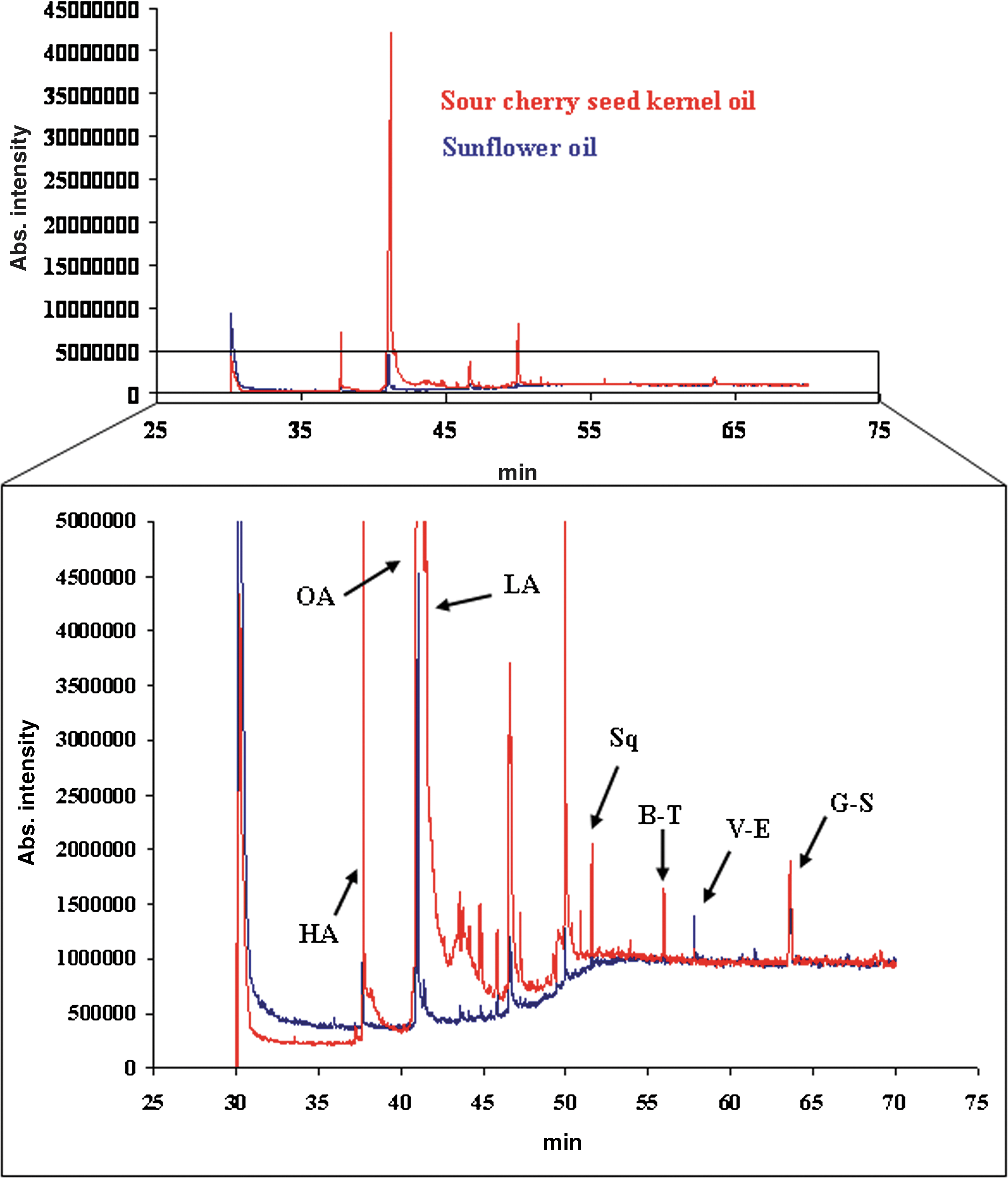
Total ion chromatograms of sour cherry seed kernel oil and sunflower oil. The sour cherry seed kernel oil was compared with sunflower oil. The sour cherry seed kernel oil, beside the main components, contains many minor components in comparison with the analysis of sunflower oil. Abs., absolute; BT, β-tocopherol; GS, γ-sitosterol; HA, n-hexadecanoic acid; LA, linoleic acid; OA, oleic acid; Sq, squalene; VE, vitamin E.
The analysis of the IR spectrum of the oil supported the results of the GC-MS measurements. The band at 3,010 cm−1 indicates a huge degree of unsaturation. The characteristic bands of long-chain alkyl groups can be found between 3,000 cm−1 and 2,800 cm−1 (2,922 cm−1 and 2,852 cm−1) and between 1,460 cm−1 and 720 cm−1. At 1,710 cm−1 the νC = O band indicates the presence of compounds with carbonyl groups. The spectrum of sour cherry seed kernel oil was compared to that of sunflower oil, and many similarities were found. Thus, the major difference is the content of free fatty acids. Free fatty acids cannot be found (or in a very little amount) in sunflower oil; however, the oil fraction of the sour cherry kernel seed contains relatively high levels of these compounds.
Fraction II was divided in two parts (fraction IIa and fraction IIb) according to the extraction procedure found in Materials and Methods. Analysis of the IR spectra of fractions IIa and IIb showed that fraction IIa contains ester components, indicated by the peak at 1,666 cm−1 (carbonyl group). The peaks of the IR spectra at 3,400 and 1,050 cm−1 indicate the substantial presence of compounds bearing hydroxyl groups. Fraction IIb does not contain ester structures, and this is the so-called flavonoid fraction and was proven by the UV-VIS spectra, showing peaks at 330 nm and 275 nm, respectively. The UV-VIS absorbance spectrum of fraction IIb showing a peak at 430 nm indicates the presence of anthocyan and proanthocyanidin components, which is proven by the red color of the extract. The compounds identified by LC-MS are listed in Table 2. The major components of fraction II are dihydro-p-coumaric acid, ferrulic acid, caffeic acid, cyanidin, and peonidin (Table 2). A peak corresponding to dimerized cyanidin (procyanidin) possibly accounts for the light red color of the extract. Representative flavone components of the fraction were identified as pinocembrin and tangeretin. Total flavonoid concentrations of fractions IIa and IIb are approximately 2%. Other components of the biflavone-rich solid fraction are listed in Table 2. Polyphenols and flavonoids were not detected in the oil fraction. These components are detected in fractions IIa and IIb. The so-called Folin-Ciocalteau method shows that fraction IIb has gallic acid-like components—about 205.6 mg of gallic acid components (polyphenols) in 100 g of sour cherry seed kernel extract. The free radical scavenging activity of each sample was studied by the galvinoxyl radical method. The results show that each fraction possesses free radical scavenging activity that is most significant in fraction IIb (Fig. 2).
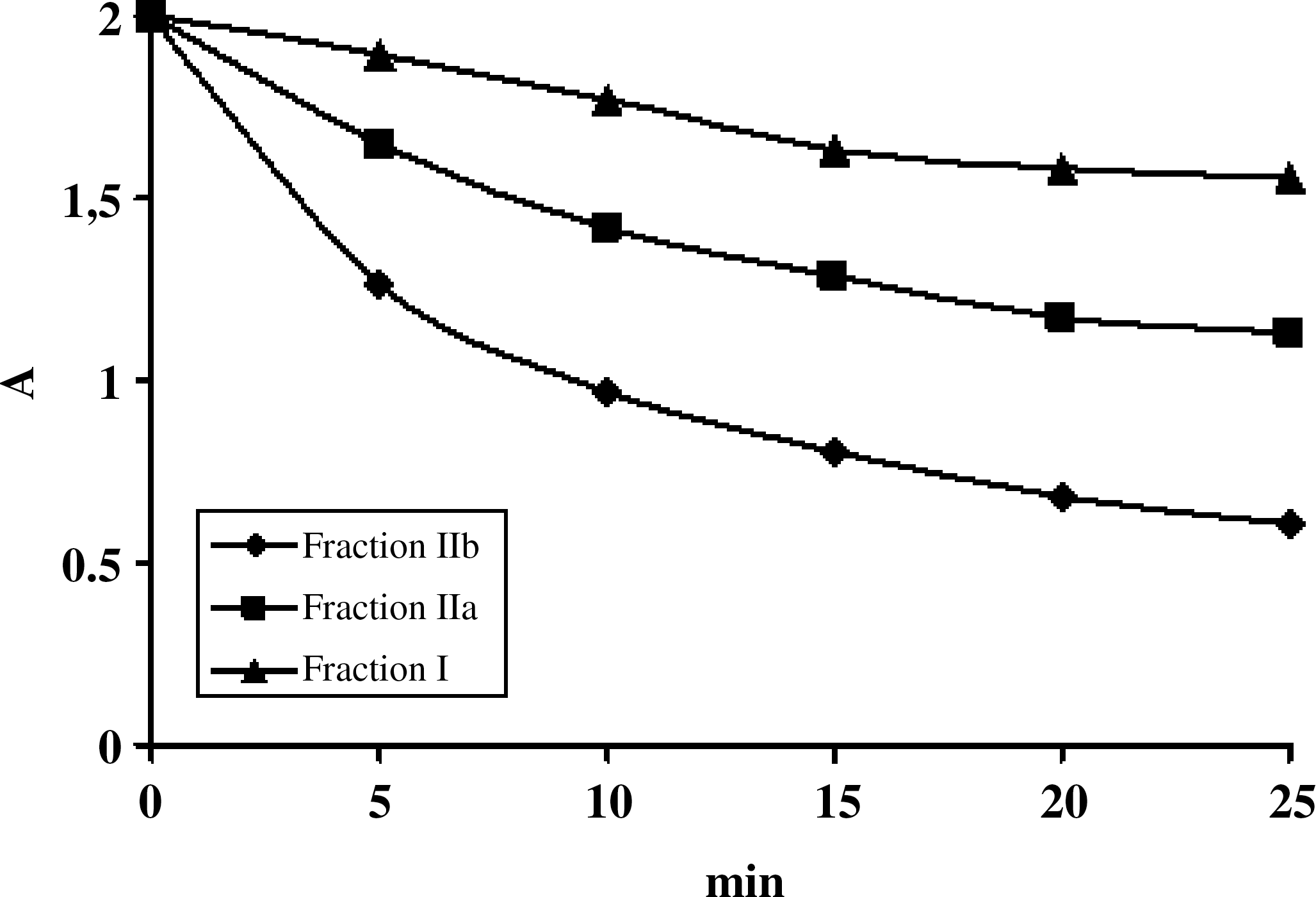
Free radical scavenging activity of sour cherry seed kernel extract measured by the galvinoxyl method. Each fraction showed free radical scavenging activity, but fraction IIb had the highest antioxidant capacity.
Discussion
It is well known that nutrition has a crucial role in the prevention of different chronic diseases. Numerous reports have shown that bioactive constituents and nutraceuticals, such as unsaturated fatty acids, polyphenols, anthocyanidins, and proanthocyanidins, extracted from different plants have protective effects against the development of cardiovascular disorders, tumors, diabetes, and many other diseases. 19 –21 Earlier we investigated the effects of sour cherry seed kernel extract in different animal models of ischemia/reperfusion-induced damage. 15,16 Because cherries and different seeds have been reported to contain many bioactive constituents and because of the observed positive effects, we hypothesized that sour cherry seed kernel contains pharmacological active compounds. In the present study we reported the isolation, extraction, and identification of the active constituents of sour cherry seed kernel. The oil fraction contains mainly mono- and n-6 polyunsaturated fatty acids. The evaluation of these fatty acids is very controversial: previous works have shown beneficial effects of n-6 fatty acids, but now high n-6 fatty acid intake is not suggested. Furthermore, there are increasing findings showing the crucial role of the n-6:n-3 fatty acid ratio in the prevention of various diseases. It seems that the high n-6:n-3 ratio would be detrimental for health. 12 From these results we concluded that the sour cherry seed kernel oil in combination with other foods or nutraceuticals that contain n-3 fatty acids would be protective against different chronic diseases. There are additional bioactive components in sour cherry seed kernel oil, namely, β-tocopherol, γ-sitosterol, vitamin E, and squalene, that possess well-defined pharmacological effects. The combined effect of these compounds is expected to make sour cherry seed kernel oil a valuable dietary supplement in prevention and mitigation of chronic diseases, in particular, in the inflammatory features of such diseases. The pharmacological effects of both the oil and solid fractions of sour cherry seed kernel are the subject of ongoing investigation in our laboratory and others.
After the isolation of the kernel oil the remaining solid fraction was further extracted. The extraction resulted in fractions containing different polyphenol-, anthocyanidin-, and proanthocyanidin-like molecules. These compounds are powerful antioxidants with well-documented effects that have been extensively studied in various disease models. Our previous rat studies demonstrating of the capacity of sour cherry seed kernel extract to protect against ischemia/reperfusion-mediated tissue damage 15,16 used the total solid fraction of the seed kernel and did not attempt to characterize effects of component compounds. For the explanation of our earlier results we must investigate the separated fractions of the kernel to clarify the precise mechanisms of action at the molecular level. Based on the outcomes of the experiments reported here, some preliminary estimations may be made of the cytoprotective mechanisms for sour cherry seed kernel extract: for example, polyphenol-, anthocyanidin-, and proanthocyanidin-like compounds, which are powerful scavengers of free radicals, almost certainly moderate tissue damage by reactive oxygen produced during the cascade of inflammatory processes. On the other hand, there is increasing evidence to show the cytotoxic effects of polyphenols. Shao et al. 22 reported that high-dose grape seed proanthocyanidin extract exhibits cytotoxic activity. Cranberry proanthocyanidins showed also cytotoxic effects to human cancer cells. 23 However, these results suggest that uncontrolled intake of these polyphenols would be dangerous for the intact organs and cells as well. There is no common stand about the daily intake of nutraceuticals that contain different bioactive constituents, and no uniform regulation about these products is available. Presently, because regulation of dietary supplements is still very loose in the United States in contrast to standards in the European Union, 24 manufacturers and marketers of such products must be attentive to safety-related issues concerning their consumption by the public and include clearly written language in an easily understood explanation. Accordingly, sour cherry seed kernel extract-derived products offered to the public will contain caveats on use that take into account adverse effects known to be associated with any of the component compounds.
Our previous studies 15,16 were focused on the prevention of the development of ischemic diseases by the natural product of P. cerasus. The importance of the investigation is emphasized that prevention, by administration of drugs before disease development, of an actual disease is about 10 times more cost-effective than its therapy in hospitals. In many investigations, interventions were added during ischemic and/or reperfusion periods. Thus, it is often justified on the grounds that time must be allowed for the actual intervention to reach the ischemic tissue and must be available to act during ischemia/reperfusion period and follow-up. In our previous studies 15,16 it is impossible to ascertain whether the observed protection of P. cerasus and its active components arises as a direct consequence of the reduction of ischemic/reperfusion injury or is secondary to the prevention. Thus, acceptable evidence for direct ischemic injury could only be obtained from studies in which an intervention is given coincident with the onset of ischemia. However, the components and their chemical structures of P. cerasus suggest that these naturally occurring molecular structures are functional in the prevention of disease development rather than in the treatment of an actual acute or chronic disease.
In conclusion, the analysis of sour cherry seed kernels conducted in the present study reveals that the seed contains several classes of compounds with known therapeutic uses. The results, taken in context with previous animal studies accomplished by this laboratory that demonstrate protective effects of the kernel extract, 15,16 suggest that the seed may be used in a broad range of applications that promote good health and decrease the risk of developing serious chronic illnesses, with particularly important potential as a preoperative conditioning agent given to patients prior to surgery as a means of enhancing tissue ischemic tolerance and resistance to cellular injury. In addition, further studies are warranted on the potential utility of the flavones, other flavonoid compounds, and tocopherols composing sour cherry pit's kernel as a means of enhancing tissue ischemic tolerance or resistance to cellular injury.
Footnotes
Acknowledgments
This study was supported by grants OTKA 72315, OTKA 78223, GVOP-3.2.1.-2004-04-0269/3.0, and TAMOP-4.2.2-08/1-2008-0007. The authors extend their sincere thanks to Stephanie C. Fox, J.D./CEO, QueenBeeEdit, for editing the manuscript.
Author Disclosure Statement
No competing financial interests exist.