







Abstract
Twenty-three honey samples of Apis mellifera L. forged on plants from northeastern Brazil were analyzed to determine total phenolic content, flavonoid content, antioxidant activity, and antiacetylcholinesterase activity. The total phenol content was determined by using the Folin–Ciocalteu method, and the flavonoid content was analyzed using by the aluminum chloride method. The antioxidant activity was evaluated using the diphenyl-1-picrylhydrazyl–scavenging test. Honey samples from Lippia sidoides Cham. (mean [±standard deviation] 50% inhibitory concentration [IC50], 4.20±1.07 mg/mL) and Myracrodruon urundeuva Fr. All. (IC50, 28.27±1.41 mg/mL) showed better antioxidant activity and presented higher total phenol values (108.50±3.52 mg gallic acid equivalents/100 g for L. sidoides and 68.55±1.01 mg gallic acid equivalents/100 g for M. urundeuva). Several honey samples had relevant results on antiacetylcholinesterase assay. The biological activity of honeys is related to their floral origin, and medicinal plants constitute a useful resource for the generation of functional foods.
Introduction
I
Honey has been used by humans since ancient times, both in traditional medicine as well as for preserving food by retarding deterioration, rancidity, or discoloration caused by light, heat, and some metals. Honey is one of the most complex mixtures of carbohydrates and other smaller components produced in nature. Studies have indicated that honey contains about 200 substances, 2 and it is the only concentrated form of sugar available in the world. 3 Honey has been popularly used in the treatment of burns, gastrointestinal problems, asthma, infected wounds, and skin ulcers. 4
The composition of honey depends on the honeybee species, the flower type used in gathering nectar and pollen, and the climatic conditions. Sugars represent the largest portion of the composition of honey (95%–99% of honey solids), whereas proteins, aromatic aldehydes, aromatic carboxylic acids and esters, carotenoids, terpenoid derivatives, flavonoids, and other compounds appear in smaller proportions. Many compounds in this wide assortment of smaller constituents show antioxidant properties, including the phenolic compounds that also contribute to the sensory qualities of honey.
Honey has many antioxidant properties that make it beneficial to human health by fighting damage caused by oxidizing agents. Additionally, because honey contains both hydrophilic and lipophilic antioxidants, its compounds can exhibit antioxidant activity in different areas of the cell. 5 This study investigated several honeys of different floral origins, including honey from important Brazilian medicinal plants such as Lippia sidoides Cham. and Myracrodruon urundeuva Fr. All. (Table 1). L. sidoides (Verbenaceae) is a shrub native to semi-arid northeastern Brazil and is widely used in folk medicine as an antiseptic. 6 The effectiveness of this therapy has been demonstrated by studies performed with the essential oil of the leaves, which contains 2 phenolic terpenes, thymol and carvacrol, as major constituents, with bactericidal and fungicidal activities. 7 –9 Flavonoids, naphthoquinones, free and glycosylated sterols, and organic acids have all been found in organic solvent extracts of the plant leaves. 10 –12 M. urundeuva (Anacardiaceae) is native to northeastern Brazil, extending up to São Paulo and Mato Grosso do Sul. It occurs widely in semi-arid and also in dry and subhumid forests. 13 It is one of the main plants of northeastern Brazilian traditional medicine. Phytochemical analysis of M. urundeuva has shown the presence of various phenolic compounds, including catechic and pyrogallic tannins, dimeric chalcones, and other flavonoids with biological activity. 14 The plant is indicated for use as an anti-inflammatory and antiscarring agent. 6
All counties were located in Ceará State, Brazil.
Alzheimer disease has been responsible for 50%–60% of the total number of cases of diseases among persons over 65 years old. It is related to the reduction of acetylcholine levels in the cells. Acetylcholinesterase is responsible for the reduction in acetylcholine in the nervous synapse, causing the loss of cholinergic neurons. An increase in the acetylcholine level should help combat this disease. 15 Acetylcholinesterase inhibitors have demonstrated efficiency in the clinical treatment of Alzheimer disease. New natural inhibitors of acetylcholinesterase in foods could show promise as a treatment of Alzheimer disease. The consumption of foods with therapeutic benefits is a growing goal for achieving a healthy lifestyle. Therefore, it is important to perform more studies to elucidate the potential of protective activities of honey, through its antioxidant and antiacetylcholinesterase activities, for reducing dietary-related chronic diseases, such as Alzheimer disease and cancer. 16
Materials and Methods
Honey samples
Twenty-three honey samples of Apis mellifera from northeastern Brazil forged on different plants were obtained from apiarists and beekeeper associations from collection sites. The honey samples were from different botanical sources, including the following: Hyptis suaveolens Poit., Anacardium occidentale L., Spermacoce verticillata L., Mimosa verrucosa Benth., Piptadenia moniliformis Benth., Myracrodruon urundeuva Fr. All., Licania rigida Benth., Lippia sidoides Cham., Serjania species, and Ziziphus joazeiro Mart. The other honey samples were heteroflorals (Table 1). Honey samples were collected between July 2007 and April 2009. All samples were transferred to the laboratory, stored in amber flasks, and kept at 4°–5°C until analysis.
Total phenolic content
The Folin–Ciocalteau method 17 was used to determine the total phenolic content of the honeys. The honey sample (5 g of each) was diluted to 50 mL with distilled water and then filtered. One aliquot of 0.5 mL of this solution was then mixed with 2.5 mL of Folin–Ciocalteau reagent (Sigma-Aldrich Chemie, Steinheim, Germany) for 5 minutes, and 2 mL of 75 g/L sodium carbonate (Na2CO3) was added. After incubation at room temperature for 2 hours, the absorbance of the reaction mixture was measured at 760 nm against a methanol blank (Biomate Spectrophotometer). Gallic acid (Sigma-Aldrich Chemie) was used as a standard to produce the calibration curve. The mean of 3 readings was used, and the total phenolic content was expressed in milligrams of gallic acid equivalents (GAE)/100 g of honey.
Total flavonoid content
The total flavonoid content was determined by using the Dowd method, with adaptations. 18 A 5-mL aliquot of 2% aluminum chloride in methanol was mixed with the same volume of a honey solution (0.02 mg/mL). Absorption readings at 415 nm were taken after 10 minutes against a blank sample consisting of a 5-mL honey solution with 5 mL methanol without aluminum chloride. The total flavonoid content was determined by using a standard curve with quercetin as the standard. The mean of 3 readings was used and expressed as milligrams of quercetin equivalents (QE)/100 g of honey.
Antioxidant activity
The free antiradical activity of the honey samples was measured by using the 2,2-diphenyl-1-picrylhydrazyl (DPPH) method. The radical-scavenging activity of honey in the presence of the stable free radical DPPH (95%, Sigma-Aldrich Chemie) was determined spectrophotometrically (Biomate Spectrophotometer). A 1.25-mL aliquot of a honey solution (0.025 g/mL) was mixed with 1.5 mL of a 90-mg/L solution of DPPH in methanol. After 15 minutes of incubation, the absorbance was read at 517 nm against a water/methanol (1:1) blank. Ascorbic acid was used as a positive control. The radical-scavenging activity was calculated as follows: % inhibition=[(blank absorbance – sample absorbance)/blank absorbance]× 100. The mean of 3 IC50 values (concentration causing 50% inhibition) for each honey sample was determined graphically. 2
Antiacetylcholinesterase thin-layer chromatography
The antiacetylcholinesterase activity assay was based on the Ellman method adapted by Rhee et al. 19 Samples (1.5–2.5 mL) were applied to a thin-layer chromatography plate (DC-Alufolien, silica gel 60 F254, 0.2 mm; Merck, Whitehouse Station, NJ, USA). The plate was sprinkled with the following solutions: 1 mM of 5,5′-dithiobis-[2-nitrobenzoic acid] (Ellman reagent) and 1 mM acetylcholine iodide. It was then left to rest for 3 minutes. After drying, the plate was sprayed with 3 U enzymes/mL, and after 10 minutes the yellow color appeared. Where the enzyme is inhibited, a white spot appears. Physostigmine was used as control.
Results
The total phenolic content of honey samples from northeastern Brazil varied from 10.21 to 108.5 mg (Table 2), as determined by using the standard curve of gallic acid (R2=0.9912). The highest values were observed for the monofloral honey samples of L. sidoides, followed by that of M. urundeuva. The total flavonoid content of the honey samples varied from 0.25 to 8.38 mg (Table 2) using the quercetin standard curve (R2=0.9995). The heterofloral honey sample (S19) showed the highest value, followed by the honey of the flowers of L. rigida, another heterofloral honey sample (S03), and by a honey sample from flowers of M. urundeuva.
Values are expressed as means±standard deviations.
GAE, gallic acid equivalents; IC50, 50% inhibitory concentration; QE, quercetin equivalents.
Table 2 shows the results of the analysis of the radical scavenging activity of the honey samples. The IC50 values ranged from 4.2 to 106.72 mg/mL. The highest value for DPPH radical–scavenging activity was found for L. sidoides, followed by heterofloral honey sample (S03). The IC50 values for ascorbic acid and butylated hydroxytoluene (a synthetic antioxidant) were 0.255 mg/mL and 0.307 mg/mL, respectively.
The honey samples from flowers of M. urundeuva (S08 and S22), Serjania sp, H. suaveolens, and a heterofloral honey sample (S19) tested in the assay for acetylcholinesterase inhibitors presented inhibition spots with sizes similar or identical to those of the standard physostigmine. Table 2 displays the results.
Discussion
Functional food is defined as a food or food ingredient that can provide beneficial health effects in addition to the traditional nutrients that it contains. 20 Phytochemicals are among the most important functional food components. A number of phytochemicals, such as allyl sulfides, catechins, flavonoids, genistein, indoles, limonoids, monoterpenes, phenolic acids, and phytosterols, have been thoroughly studied for their potential to prevent cancer. As suggested by in vitro studies, coumarins and triterpenoids are thought to be inhibitors of tumor initiation, and carotenoids, phenolic compounds, terpenes, tocopherols, and flavonoids are known to prevent oxidative damage by eliminating free radicals. 21
Although different plants present different phenolic compounds and therefore present variations in the total phenolic content, 20 the data observed for northeastern Brazilian honey samples (10.21 to 108.5 mg of GAE/100 g honey) are similar to those described for honey samples from Burkina Faso, 2 with values in the range of 32.59–114.75 (mg of GAE/100 g honey) obtained by using the same method. However, honey samples in this study presented substantial differences with respect to honey samples from Chile, with total phenolic content varying from 0.0 to 8.83 mg/100 g of honey. 22 Total phenolic contents of 10 honey samples of different floral origin from Poland have been shown to vary by 21.7–75.3 mg GAE/100 g of honey, 23 whereas honey samples from Slovenia varied between 44.8 and 241 mg GAE/kg of honey. 24
Honey samples from Yemen present phenol content ranging from 75.13 to 246.21 mg catechin equivalents (CE)/100 g of honey. 25 In samples from Chile, flavonoid content ranged from 0.014 to 13.8 mg QE/100 g of honey. 22 Flavonoid contents in Burkina Faso honey samples studied by Meda et al. 2 were 0.17–8.35 mg QE/100 g of honey. In the analysis of northeastern Brazilian honey samples, a low correlation (r=0.15) between the total flavonoid and total phenolic contents was observed. Meda et al. 2 also described a low correlation (r=0.11) between the total amount of flavonoids and the total amount of phenolic compounds.
A linear correlation was observed (R2=0.583) between the DPPH radical–scavenging results and the total phenolic levels of northeastern Brazilian honey samples, suggesting that phenolic compounds correlate better to the radical-scavenging activity of these honeys (Fig. 1). Meda et al. 2 reported IC50 values of 1.63–29.13 mg/mL for honey samples. Liviu et al. 26 studied 23 honey samples collected in different Romania regions and confirmed a variation in the antioxidant properties and total phenolic contents in honey samples depending on their botanic or geographic source. Lachman et al. 27 analyzed 40 honey samples, mainly from northern Moravia, and found extensive variation. They suggested that the differences depend on the geographic location and period of honey collection. They used the Folin–Ciocalteau method to determine the total phenolic content and have reported values of 89.9–215.2 mg GAE/kg. A linear correlation (R2=0.852) was observed between the total phenolic content and the antioxidant activity, suggesting that phenolic compounds are directly responsible for the antioxidant properties of honey.
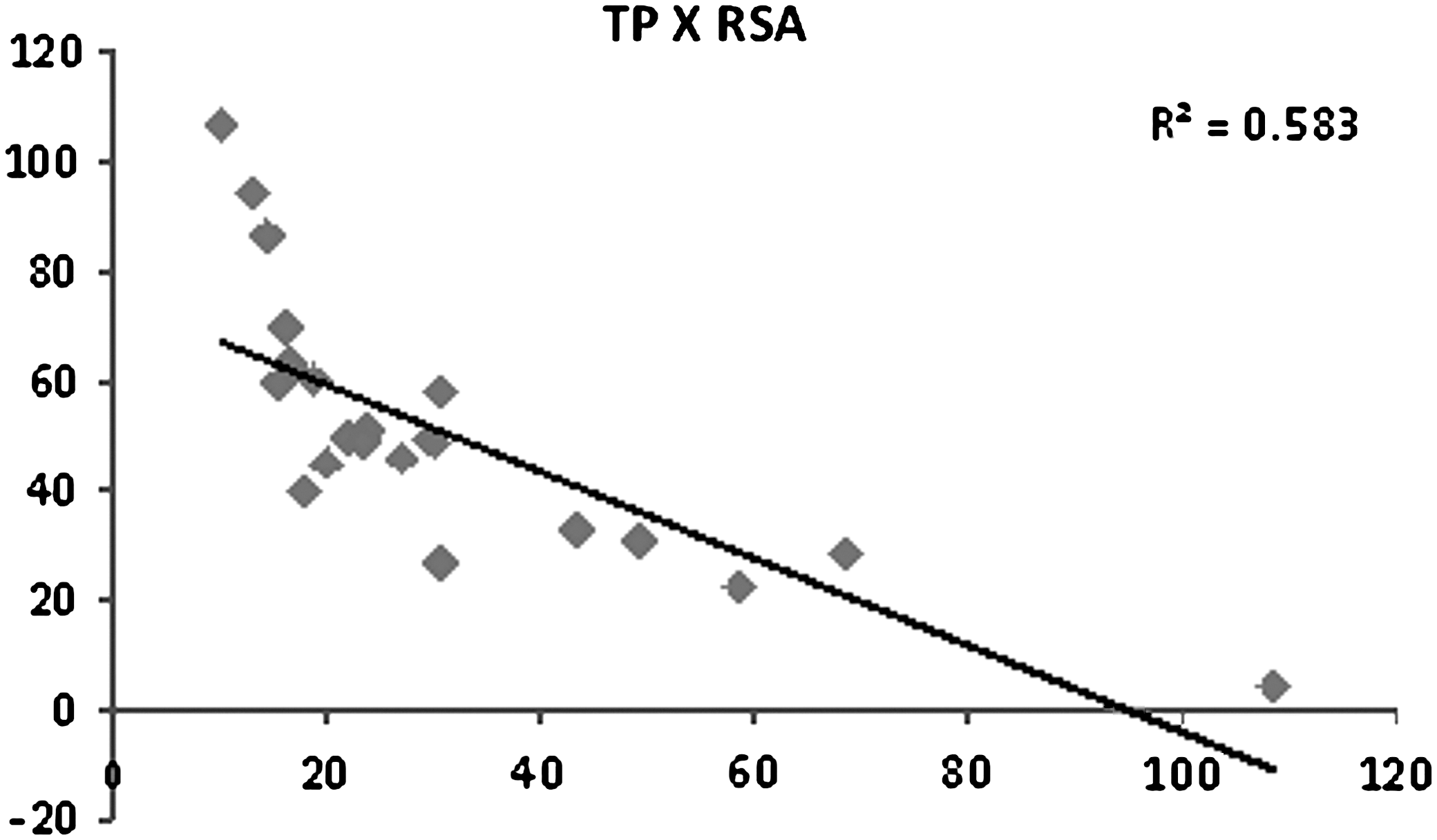
Correlation between total phenols and radical-scavenging activity for northeastern Brazilian honey samples. RSA, radical-scavenging activity; TP, total phenols.
However, Atoui et al. 28 suggested that similar results for phenolic levels do not necessarily correspond to the same antioxidant responses because the amount of phenolics found in the Folin–Ciocalteau assay also depends on their chemical structure. According to Gheldof et al., 29 the antioxidant capacity in honey samples is the result of the combined activity of a wide range of compounds, including phenolics, peptides, organic acids, enzymes, Maillard reaction products, and possibly other minor components.
Differences in the activities and phenol content of 2 honey samples of M. urundeuva are probably due to seasonal variation in phenolic compounds: S08 was collected in November (dry period) and S22 in June (rainy period). The effects of seasonal climate changes in the Caatinga biome on tannin levels of M. urundeuva and Anadenanthera colubrina had been previously reported by Monteiro et al. 30
Honey is an ideal energetic food because of its sugar content. However, the importance of medicinal plants in furnishing nectar for Apis mellifera is often overlooked, as indicated in our study of honey samples from northeastern Brazil. L. sidoides and M. urundeuva are widely used medicinal plants in northeastern Brazil, and honey from their flowers showed high total phenolic content and antioxidant activity. Thus, northeastern Brazilian honey may have therapeutic potential as a functional food because of the antioxidant and antiacetylcholinesterase activities.
Footnotes
Acknowledgment
The authors thank Ceará State Support to Micro and Small Companies Service (SEBRAE) for the honey samples.
Author Disclosure Statement
No competing financial interests exist.