






Abstract
Thirteen black currant varieties (Ribes nigrum L.) cultured in Serbia were characterized for their pomological properties and chemical composition (total phenolics, total anthocyanins, anthocyanin aglycones, sugars, and vitamin C). The average amount of vitamin C varied from 122.4 to 193.2 mg/100 g fresh weight (FW), while concentration of invert sugars ranged from 6.3% to 11.1%. The highest amounts of total phenolics and anthocyanins were detected in variety Ometa (278.9 mg of gallic acid equivalents per 100 g of FW [mg GAE/100 g FW] and 135.4 mg/100 g, respectively). Quantitative analyses of anthocyanin aglycones in berries were performed using high-performance liquid chromatography, and delphinidin was found to be dominant compound in 11 varieties. Total phenolics and anthocyanins contents decreased during the processing of berry fruits to juices, and the reduction of anthocyanins was more pronounced, 12%–80%. The radical scavenging activity of black currant juices was investigated by 1,1-diphenyl-2-picrylhydrazyl, and the IC50 value ranged from 1.9 to 4.0 mg/mL. Our results also showed that freezing as a way of preservation and storage could save important phytochemicals and health benefits of berries and berry juices. The amount of total phenolics in berries increased during 1 year of storage by 46.09%–171.76% and in juices by even 107.58%, while the amount of total anthocyanins in berries and juices decrease by 5.63%–52.76% and 13.04%–36.82%, respectively.
Introduction
D
Black currant (Ribes nigrum L.) is native to central and northern Europe and northern Asia. The area of conventionally or organically grown black currants has rapidly increased in Europe during the last decade. 4 Nowadays, most of the production of black currant berries is for use in processed products, especially juices. 5 Black currant fruits have long been known to be a good source of vitamin C, but they also contain high levels of polyphenolics, particularly flavonols and anthocyanins, 6 which also contribute to the high antioxidant activity of black currant. 7,8 As their shelf life is typically short, the processing and storage effects on the quality of berries have been extensively studied, especially freezing as the most common processing and preservation technology applied to berries. 9 When berries are frozen, chemical changes can occur, including concentration of solutes and chemicals, enzyme activity, and oxidative reactions. Häkkinen et al. 10 found that only 15% of quercetin and 30% of myricetin present in unprocessed berries were retained in juices made by common domestic methods. During 9 months of storage at −20°C, quercetin content decreased markedly in bilberries and lingonberries, but not in black currants and red raspberries. 10
The objective of the present study was to evaluate black currant varieties cultured in Serbia in terms of their phenolic compounds, and to investigate the effects of processing to juices, freezing and storage on the content of those health-promoting phytochemicals in berries and juices. Radical scavenging activity was analyzed in pressed juices just after processing and after 1 year of storage at −18°C. Additionally, berries of all cultivars were characterized by some chemical parameters, such as vitamin C, titratable acidity, total sugars, invert sugars, and sucrose. Pomological properties and generative potential of all cultivars are also presented.
Materials And Methods
Berries
Black currant cultivars: Ben Sarek, Ben Nevis, Ben Lomond, Malling Juel, Bona, Ometa, Tenah, Tsema, Titania, Silmu, Öjebyn, Triton, and Čačanska crna. Experimental fields were conducted on village Mislođin (Serbia), situated between 44° 30′ and 44° 45′ north latitude and 20° and 20° 20′ east longitude. Altitude is between 80 and 90 m. Mislođin is located almost in the center of the northern warm temperate belt, with a milder climate than the typical pannonian, continental. The average annual temperature in this area is ∼11°C, and during the year, the amount of rainfall is ∼640 L of water per square meter. The plantation was built on sandy-loam soil type, and the average water pH was 6.3. The experiment was built by a random field with five repetitions (samples were taken from five bushes, bush is a repeat). Planting was done with 1-year seedlings at a distance of 1.8 m between rows and 0.8 m between seedlings within the row, yielding ∼6900 (6944) plants per hectare. Berries were hand-harvested in the third year of vegetation in June–July 2008, depending on the commercial ripening time for each cultivar (85% colored fruit).
After harvesting, the berries were divided into three groups. The first was stored at +5°C and analyzed within 24 h, while the second was frozen and stored at −18°C for 1 year. The third part of fresh undamaged berries were selected and manually crushed to obtain juices that ran freely from the crushed fruit. For analyses, juices were centrifuged at 14,000 g for 20 min, stored at +5°C, and analyzed within 24 h. A part of the juices was frozen and stored at −18°C for 1 year.
Chemicals
The anthocyanin standards, delphinidin and cyanidin, were purchased from Polyphenols AS (Sandnes, Norway).
Pomological properties and generative potential
Fruit characteristics (berry weight, mass and length of the cluster, the number of clusters per bush, yield per bush) were measured on fruits harvested in the full maturity stage.
Determination of soluble solid, acidity, vitamin C, and total sugars
The soluble solid content, expressed as percentage (Brix%), was determined by refractometer (Atago pocket PAL-1, Kyoto, Japan). Titratable acidity was determined by titrating 25 g of berries with 0.1 N NaOH up to pH 7.0. Acidity was expressed as percent of malic acid. An iodometric titration method was performed for the determination of vitamin C. 11 Titration was performed with potassium iodate (KIO3) to appear light violet color.
The concentration of vitamin C was calculated on the basis of consumption of KIO3 and expressed in percent of fresh weight (FW). Total sugars, invert sugars, and sucrose were determined based on the reduction properties of sugar using Luff-Schoorl reagent. 12 The concentrations are expressed in percent of FW.
Determination of total phenolic content
The total concentration of phenols was estimated by the Folin–Ciocalteu method with slight modifications. 13 The berries (10 g) or the juice sample (10 g equivalent of fresh berry) were extracted with MeOH for 30 min in the ultrasonic bath and then filtered. Two hundred microliters of extracts were added to 1 mL of 1:10 diluted Folin–Ciocalteu reagent. After 4 min, 800 μL of sodium carbonate (75 g/L) were added. After 2 h of incubation at room temperature, the absorbance at 765 nm was measured. Gallic acid (0–100 mg/L) was used for calibration of a standard curve. The results were expressed as milligrams of gallic acid equivalents per 100 g of FW (mg GAE/100 g FW). Triplicate measurements were taken and mean values were calculated.
Total anthocyanins content
The total anthocyanin content was investigated according to the procedure described in European Pharmacopoea 6.0, 14 with slight modifications. Briefly, fresh berries (50 g) were crushed extemporaneously. To ∼10 g of crushed, accurately weighed berries or juice (10 g equivalent of fresh berry), 95 mL of methanol was added and mechanically stirred for 30 min, and then filtered into a 100-mL volumetric flask. The filter was rinsed and filtrate was diluted to 100 mL with methanol. A 50-fold dilution of this solution in a 0.1% (v/v) solution of hydrochloric acid (HCl) in methanol was prepared. The absorbance of the solution was measured at 528 nm, using a 0.1% (v/v) solution of HCl in methanol as the compensation liquid.
The percentage content of anthocyanins, expressed as cyanidin-3-glucoside chloride, was calculated from the following expression:
where A is absorbance at 528 nm and m is the mass of the substance to be examined in grams. (The specific absorbance of cyanidin-3-glucoside chloride at 528 nm is 718.)
Quantitative analysis of anthocyanin aglycones
Analysis was performed according to Nyman and Kumpulainen
15
with slight modifications. About 5 g of crushed, accurately weighed berries or juice (5 g equivalent of fresh berry) were extracted with 40 mL of mixture prepared of 50 mL MeOH, 33 mL H2O, and 17 mL 37% HCl on ultrasonic bath for 20 min. The extract was filtered through a 0.45-μm filter into a polypropylene vial and hydrolyzed for 60 min in water bath at 100°C. After quick cooling
1,1-Diphenyl-2-picrylhydrazyl radical scavenging activity
The free radical scavenging activity of berries or juices on the stable 1,1-diphenyl-2-picrylhydrazyl (DPPH) radical was carried out according to the procedure described previously,
16
with slight modifications. The juices samples (2 g) were diluted with distilled water up to 10 mL, centrifuged (2500 g; 10 min), and the supernatant was used for analyses. The antiradical capacity of each sample was evaluated using a dilutions series to obtain a large spectrum of sample concentrations. Extracts (100 μL) were mixed with 1400 μL of 80 μM methanolic solution of DPPH. Absorbance at 517 nm was measured after 20 min. The percentage of inhibition was calculated using equation:
where A 0 is absorbance of the control and A i is absorbance of the samples. IC50 values were estimated using a nonlinear regression algorithm. All test analyses were run in triplicate. Trolox was used as a positive control.
Statistical analysis
All data were reported as mean±standard error of triplicate determinations and analyzed using one-way analysis of variance with significant differences between means determined at P<.05, measured with Duncan's multiple range tests. Radical scavenging activity data are presented in original values in table, but the statistical test was performed on its reciprocal data since the IC50 value is inversely proportional to antiradical activity. Factor analysis for pomological properties and degree of linear dependence between metabolites has been done with STATISTICA 7 software package. For determination of sequential classification according to the desirable properties among all examined varieties, Ivanovic's distance (I-distance) was used. 17
Results And Discussion
Pomological properties and generative potential
Based on the data shown in Table 1, the most promising with respect to the yield production were varieties Tsema, Malling Juel, Bona, and Titania. Variety Tsema achieved the highest yield per bush (1.97 kg), as a consequence of the fact that it achieved highest values in almost every observed yield component. Variety Bona is characterized by very attractive clusters of the highest mass (13.45 g) and the largest berries (1.89 g) of all varieties tested, which is in accordance with the results of Nikolić et al. 18 Good production results were also achieved by variety Titania, which had high yield per bush, thus confirming the results of Kawecki et al. 19 Compared with our results, Giongo et al. 20 reported lower values of yield and fruit characteristics for varieties Ben Lomond, Ben Nevis, Ben Sarek, Titania, and Tsema.
Means followed by different letters differ significantly based on Duncan's test at P<.05.
Factor analysis (Fig. 1) showed that two pomological characteristics, number of cluster per bush and weight of cluster, are positively correlated with Factor 1 as well as yield per bush. Therefore, we conclude that those parameters are responsible for yield per bush variance with significant regression coefficients b 1=0.72 and b 2=0.71, respectively. Extracted factors together are explaining near 80% of total variance.
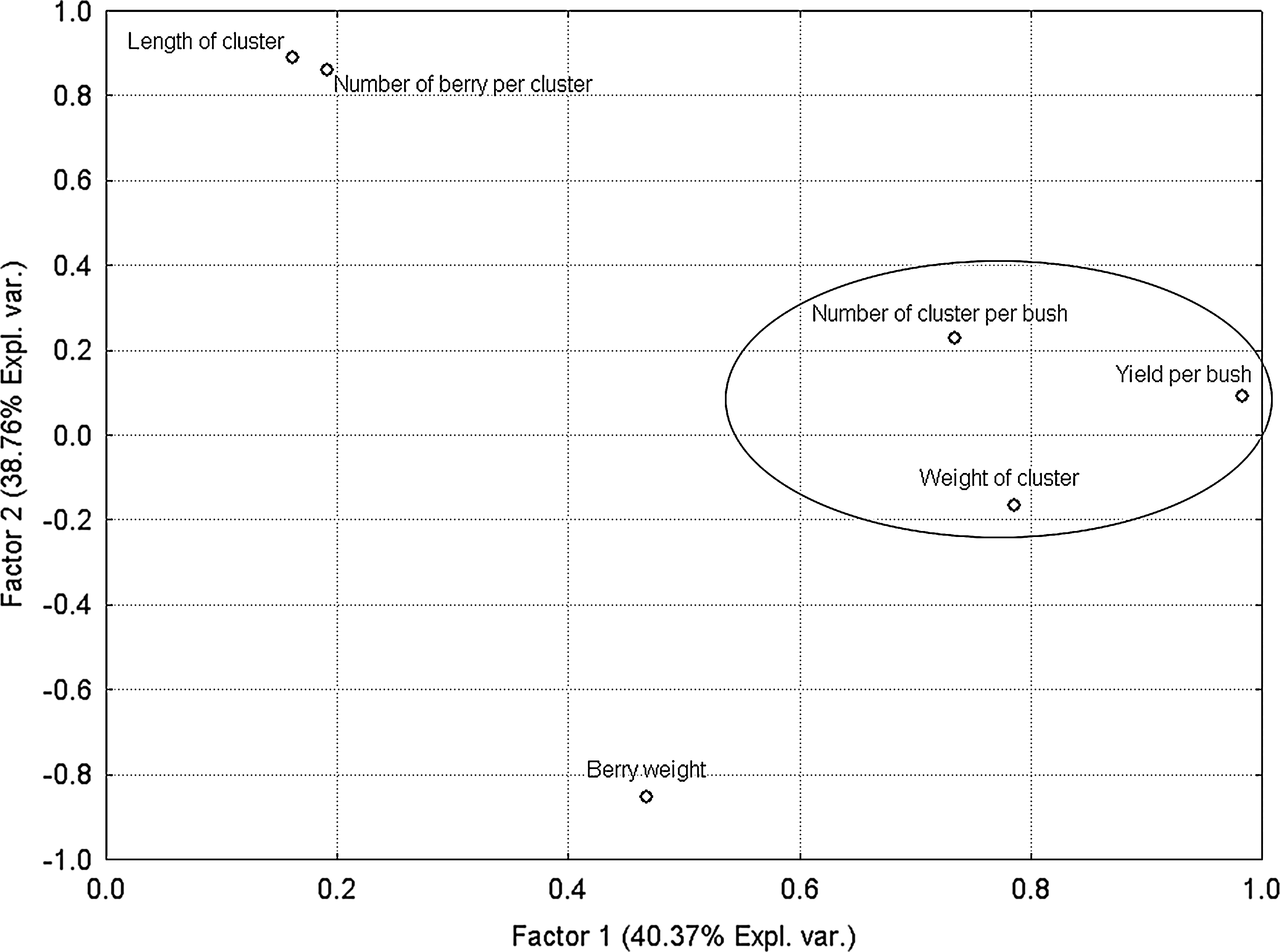
Factor loadings of pomological parameters (Varimax normalized).
Chemical composition
Vitamin C content, soluble solids, total sugars, sucrose content, invert sugar content, and titratable acidity were analyzed in black currant berries after harvesting (Table 2). Berries of all black currant varieties possessed great amounts of vitamin C, and the average amount varied from 122.4 to 193.2 mg/100 g. The greatest amounts were found in varieties Čačanska crna (193.2 mg/100 g) and Tsema (172.9 mg/100 g), (Table 2). The vitamin C content is of significant commercial and nutritional importance. Häkkinen et al. 10 detected vitamin C in variety Öjebyn in the amount of 904 mg/kg FW, while Banaszczyk and Plocharski 21 reported that variety Öjebyn cultured in Poland were low in vitamin C. Rubinskiene et al. 22 found similar amounts of vitamin C in variety Ben Lomond cultured in Lithuania, while varieties Ben Lomond and Tsema cultured in Serbia contained greater amounts of vitamin C in comparison with the same varieties cultured in Southern Italy. 23
Means followed by different letters differ significantly based on Duncan's test at P<.05.
Difference between concentrations of invert sugars in berries of different varieties was noticeable (6.3%–11.1%). For dry food colorants production, an important index is the amount of invert sugar because it increases sticking of food pigment particle to dryer's walls during spray-drying and consequently decreases the yield of dry colorant. 22 The amount of sucrose also varied among different varieties reaching the maximum in variety Bona (1.3%). The amounts of total sugars (7.1%–12.1%) were within the range of the values reported by Gavrisheva et al. 24 for black currant berries cultured in the lower Volga region.
The content of soluble solids also varied in different cultivars (12.3%–18.2%), (Table 2). This is in accordance with the results obtained by Rubinskiene et al. 22 which analyzed nine black currant varieties cultivated in Lithuania and showed that soluble solids varied from 14.0% to 16.1%.
Total phenolics
The amount of total phenolics in berries and related pressed juices are presented in Tables 3 and 4, respectively. The total phenolics content in fresh berries ranged from 137.7 to 278.9 mg GAE/100 g FW, while in pressed juices it was lower, 47.5–102.9 mg GAE/100 g of juice. Among fresh berries, variety Ometa contained the highest amount of total phenolics. Generally, the amount of total phenolics was smaller in our samples then in cultivars analyzed by Plessi et al. 25 and Benvenuti et al. 23 No significant correlation between yield per bush and total phenolics were observed.
Means followed by different letters differ significantly based on Duncan's test at P<.05.
GAE, gallic acid equivalents.
Means followed by different letters differ significantly based on Duncan's test at P<.05.
In all juice samples, decrease in the amount of total phenolics by 44.4%–75.8% was observed. The highest amount of total phenolics was noticed in pressed juice of Ben Lomond berries (102.9 mg GAE/100 g of juice), which was also one of the variety containing high amount of total phenolics in berries (221.7 mg GAE/100 g FW). However, it could be noticed that the phenolic content order in the different varieties of berries was not the same as in juices. The black currant cell wall is characterized by a high pectin content, and during mashing of berries, released pectins influenced the extractability of phenolics. 26 According to the literature data, black currant varieties differ in the skin thickness and the amount of pectin, which could explain the difference in the phenolic order in berries and juices.
Changes in the amount of total phenolics in berries were noticed after 1 year of freezing (Table 3). In all cultivars, the amount of total phenolics increased by 46.09%–171.76% and varieties Malling Juel, Čačanska crna, Ometa, and Tsema continued to yield the highest phenolic content. A similar trend was noticed in our previous study, where total phenolics increased in frozen black currant fruits. 27 As the phenols are largely complexes with cell walls polysaccharide, 28 increasing of their content during storage might be due to degradation of cell membranes and cell walls, which enables phenolics more easily extractable. Also, Piljac-Žegarac et al. 29 noted that it is possible that during storage, some compounds are formed that react with the Folin–Ciocalteu reagent and enhance the phenolic content. In all juices samples (Table 4), the amount of total phenolics also increased by even 107.58% after 1 year of storage. Increases in the phenolic content during storage were also noticed in our previous study with red currants juices 30 as well as in other berry juices. 31
Total anthocyanins
The amount of total anthocyanins varied in berries as well as in pressed juices (Tables 3 and 4, respectively). Among fresh berries, the greatest amount of total anthocyanins was noticed in variety Ometa (135.4 mg/100 g FW), followed by Malling Juel, Öjebyn, and Silmu, while the smallest was noticed in variety Ben Nevis (27.3 mg/100 g FW) (Table 3). Plessi et al. 25 and Benvenuti et al. 23 found greater amounts of anthocyanins in varieties Ben Lomond, Tenah, Titania, and Tsema they analyzed. Such difference could be explained by different methods used for the analyses (the HCl/methanol method according to Pharmacopoea 6.0 vs. the pH differential method). No significant correlation has been noticed between yield per bush and total anthocyanins.
As expected, total anthocyanin contents were much lower in juices than in the corresponding raw material because the greater amounts of anthocyanins were detected in exocarp (Table 4). The greatest loss of total anthocyanins during juice processing (more than 80%) was noticed in varieties Tsema, Öjebyn, Titania, Malling Juel, Čačanska crna, and Ben Lomond, which is in accordance with the results reported by Sandell et al. 31 The most stable were anthocyanins in variety Triton, their amount decreased by 12%.
After 1 year of freezing, the amount of total anthocyanins in berries decreases by 5.63% in variety Tenah to 52.76% in variety Čačanska crna (Table 3), and Ometa remained the variety with the highest anthocyanin content. Similar results were observed for juices, where the amount of total anthocyanins decreased by 13.04%–36.82% (Table 4).
Anthocyanin losses can be attributed to oxidative and enzyme-catalyzed reactions. When berries are frozen, the solutes are more concentrated, and thus can be more easily oxidated. 9
Quantitative analysis of anthocyanin aglycones
Although a lot of studies deal with anthocyanin glycosides 32 –34 or flavonol aglycones 8 in currant berries, only a few reported quantification of anthocyanin aglycones. 15,34 In our study, the HPLC method was developed for quantitative analysis of anthocyanin aglycones in black currant berries and related pressed juices. The most ubiquitous anthocyanin aglycones were found to be cyanidin and delphinidin and their amounts varied among cultivars (Fig. 2). The amount of delphinidin varied from 16.3 to 53.5 mg/100 g FW, while the cyanidin amount ranged from 2.2–40.9 mg/100 g FW (Table 3). The highest amount of delphinidin was found in variety Triton, while variety Malling Juel contained the highest amount of cyanidin. Among 13 analyzed varieties of black currant, in 11 varieties delphinidin was dominant aglycone, while in varieties Malling Juel and Čačanska crna, cyanidin dominated (Table 3). Cyanidin was reported by Nyman and Kumpulainen 15 as dominant aglycone in the black currant they analyzed (variety not specified), while in the study of Koponen et al., 34 the amounts of cyanidin and delphinidin in black currants they analyzed were quite similar (99.3 and 101.7 mg/100 g FW, respectively).
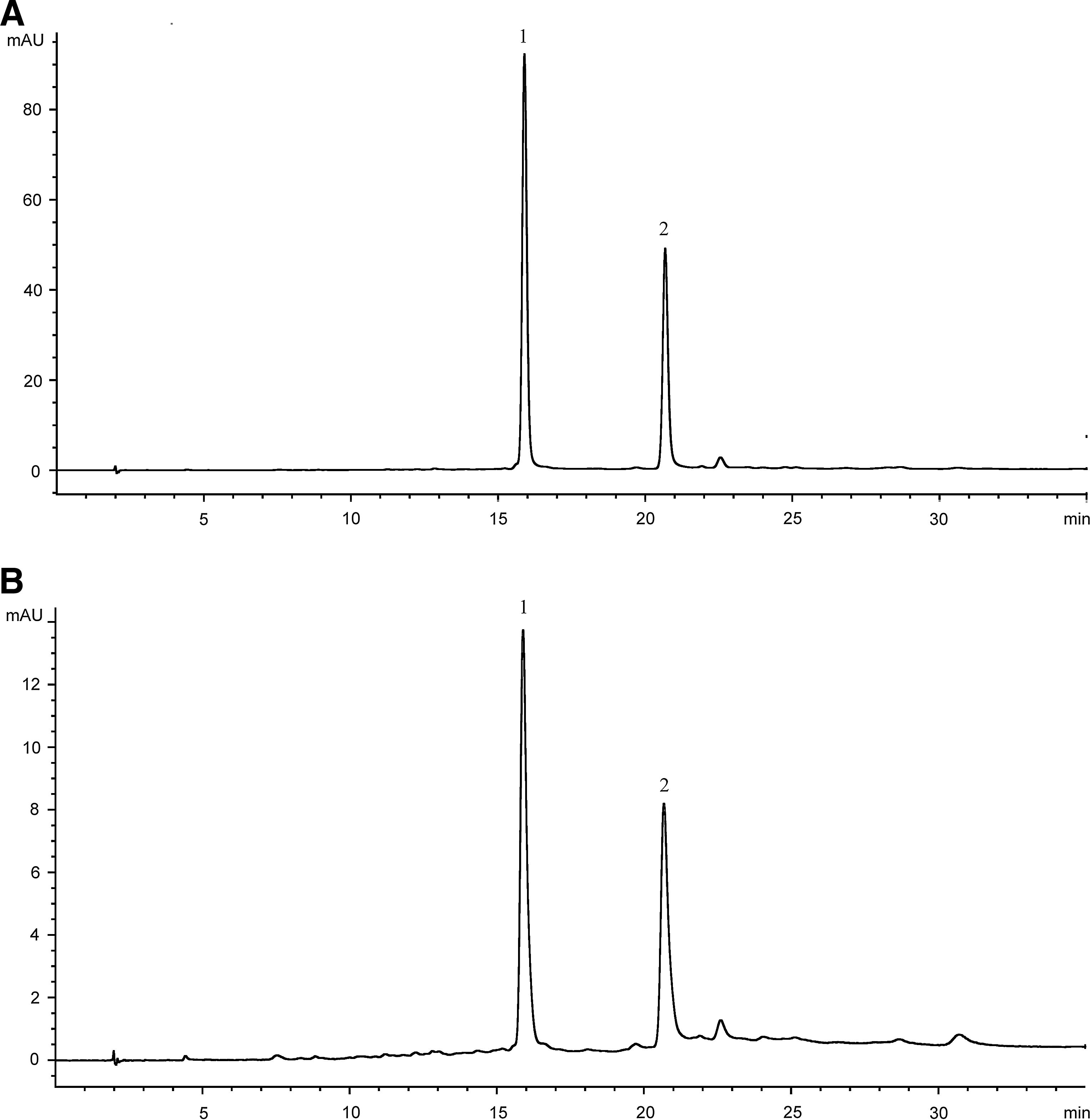
Reverse-phase high-performance liquid chromatography chromatograms of anthocyanin profiles of black currant variety Tsema fruit
Significant losses in the amounts of cyanidin and delphinidin in pressed juices were recorded, which is in correlation with the loss of total anthocyanins. The highest amount of delphinidin was noticed in the juice of variety Triton (17.0 mg/100 g of juice), which also contained the highest amount of total anthocyanins, while the highest amount of cyanidin was noticed in the juice of variety Silmu (10.0 mg/100 g of juice) (Table 4).
After 1 year of storage, the amount of aglycones in both berries and juices remained nearly the same (Tables 3 and 4).
Radical scavenging activity
There is a growing interest in the possibility that consuming a diet rich in antioxidants may reduce the risks of many common chronic diseases. 3 Black currant berries are mainly consumed in the form of juice, which has been reported to maintain berry antioxidant activity. 35 DPPH is a free radical compound and has been widely used to test the free radical scavenging ability of various samples. In our study, pressed juices of 13 black currant varieties were tested and results showed that there were differences in radical scavenging activity among juice samples (Table 4). Although juices contained lower concentrations of total phenolics and total anthocyanins in comparison with related berries, radical scavenging activity was significant. Among samples investigated, juice of variety Ben Lomond showed the strongest DPPH radical scavenging activity with an IC50 value of 1.9 mg/mL followed by juice of variety Triton (2.0 mg/mL). Statistically significant correlation between radical scavenging activity and the total phenolics content was observed in fresh juices as well as in juices after 1 year of storage (R 2 =0.78 and R 2 =0.82, respectively), thus confirming that phenolic compounds are highly effective free radical scavengers in in vitro conditions.
After 1 year of storage at −18°C, the radical scavenging activity of juices was changed depending of cultivar (Table 4). In varieties Silmu, Ben Sarek, Tsema, and Tenah, radical scavenging activity significantly increases, while in other varieties such an increase was not noticed. The results could be explained by potential changes of other antioxidant compounds, such as vitamin C, which contribute to the antioxidant activity, but are not measured in our juice samples.
Sequential classification according to Ivanovic's distance
For sequential classification of varieties, yield, vitamin C content, total phenolic content, and total anthocyanine content have been chosen as desirable properties, and yield has been taken into account as the most important property. Discrimination effects are calculated as the distances from a fictitious variety being defined with maximum values of desirable properties; the sequential order of the varieties is in reciprocal relation with the height of calculated I-distances. The developed rank list (Table 5) indicates the current position of the analyzed black currant varieties, but also points out to the possible future trends in choosing the right variety for cultivation and the food processing industry.
Summary
Due to the great importance of berry fruits in health and food chemistry, the determination of active compounds in different cultivars is important. According to our results, varieties Tsema, Malling Juel, Bona, and Titania were ranked at the top positions using classification according to Ivanovic's distance where yield, content of vitamin C, total phenolics, and antocyanines were chosen as desirable properties. The overall results indicated that, depending on the intended use, different varieties could be more or less suitable. Variety Čačanska crna had the highest amount of vitamin C, while varieties Ometa, Malling Juel, and Tsema were the most abundant in total phenolics and total anthocyanins, thus being the most suitable varieties for fresh consumption in terms of nutritional value. Total phenolic content of berries increased during cold storage, while radical scavenging activity was cultivar-dependent and remained nearly the same or increased. Our results suggest that freezing as a way of preservation could save important phytochemicals and health benefits of berries and berry juices.
Footnotes
Acknowledgment
The authors acknowledge their gratitude to the Ministry of Education and Science of Serbia for financial support, project number 46013.
Author Disclosure Statement
No competing financial interests exist.