







Abstract
We hypothesized that a high-protein diet and/or resveratrol supplementation will improve acute inflammatory responses in rats after receiving experimental abdominal radiation treatment (ART). Based on our previous study, the period of 10 days after ART was used as an acute inflammation model. Rats were exposed to a radiation dose of 17.5 Gy and were supplied with a control (C), 30% high-protein diet (HP), resveratrol supplementation (RES), or HP with RES diet ([HP+RES]). At day 10 after ART, we measured profiles of lipids, proteins, and immune cells in blood. The levels of clusters of differentiating 4+ (CD4+) cells and regulatory T cells, serum proinflammatory cytokines, and 8-hydroxy-2′-deoxyguanosine (8-OHdG) in urine were also measured. ART caused significant disturbances of lipid profiles by increasing triglyceride (TG) and low-density lipoprotein cholesterol (LDL-C), and decreasing high-density lipoprotein cholesterol. The proinflammatroy cytokine levels were also increased by ART. All the experimental diets (HP, RES, and [HP+RES]) significantly decreased levels of TG, monocytes, proinflammatory cytokines, and 8-OHdG, whereas the platelet counts were increased. In addition, the HP and [HP+RES] diets decreased the concentrations of plasma LDL-C and total cholesterol. Also, the HP and RES diets decreased regulatory T cells compared with those of the control diet in ART group. Further, the HP diet led to a significant recovery of white blood cell counts, as well as increased percentages of lymphocyte and decreased percentages of neutrophils. In summary, RES appeared to be significantly effective in minimizing radiation-induced damage to lipid metabolism and immune responses. Our study also demonstrated the importance of dietary protein intake in recovering from acute inflammation by radiation.
Introduction
R
There have been several previous reports that suggested that higher dietary protein consumption might reduce the inflammation caused by radiation. High-protein diet (22%) increased intestinal villous length and proliferation of crypt cells compared with standard diet (16% protein) for intestinal injury by radiation. 15 Antioxidant levels are decreased due to radiation, and high-protein diet (33%) increased the antioxidant levels more than did the 7% protein diet. 16
It has been reported that radiation-induced ROS production and inflammation can be prevented with flavonoids, 17 including phenols such as resveratrol. 18 Trans-resveratrol is found in grape skin, mulberries, wine, peanuts, and Japanese knotweed, a medicinal plant. 18 Hydroxyl groups in resveratrol are attracted to hydroxyl and hydroperoxyl radicals and can then scavenge free radicals. 19 Resveratrol enhances nuclear factors-like 2, nicotinamide-adenine dinucleotide phosphate dehydrogenase 1, and glutathione S-transferase 1 genes, while reducing CD4+, IL-1β, and toll-like receptor 4 protein in high-fat and high-carbohydrate diets. 20 Thus, resveratrol can act as an acute antioxidant and has anti-inflammatory effects. 20,21 Resveratrol has also been demonstrated to have antitumor and cardioprotective effects. 22,23 Particularly, colon cancer was reduced after an oral administration of 200 μg/kg resveratrol in rat. 24 In one study, oral administration of resveratrol in mice with ileitis increased regulatory T (Treg) cell production, and proliferation and regeneration of intestinal epithelial cells; it also decreased neutrophil levels and decreased the expression of the proinflammatory cytokines TNF-α and IL-6, in the ileum. 17
In the present study, we hypothesized that a high-protein diet with or without resveratrol supplementation may enhance the nutritional and immune status of mice subjected to acute-phase inflammation induced by abdominal radiation treatment (ART).
Materials and Methods
Animals
Female Wistar rats (150–160 g in body weight) were purchased from Central Lab Animal, Inc. Rats were kept at 22°C±2°C room temperature and 55–60% relative humidity with a 12-h light/dark cycle. This protocol was approved by the committee on the Ethics of Animal Experiments of Sookmyung Women's University.
Diets and radiation treatment
Rats were divided into two groups: a group receiving radiation treatment (ART) and group not receiving the radiation treatment (non-ART). Each group was then subdivided into four groups according to the types of diet (n=6 for each group): control diet (C), control diet with 2 mg/kg body weight (b.w.) resveratrol supplementation (RES), 30% high-protein diet (HP), and 30% high-protein diet with 2 mg/kg b.w. resveratrol supplementation ([HP+RES]). Composition of each diet is shown in Table 1.
Diet compositions for both ART and non-ART groups were the same.
Composition of the AIN-93M for maintenance of adult rodents.
Modified AIN-93M purified rodent diet with 30% protein by weight.
Oral administration of 2 mg/kg b.w. resveratrol in water every other day.
ART, abdominal radiation treatment; b.w., body weight; HP, high-protein diet; RES, resveratrol.
Rats in ART groups were irradiated with a dose of 17.5 Gy in the abdominal parts of the pelvis 25 after anesthesia with 0.2 mL intraperitoneal injection of rompun and keramine (2:8 v/v). Radiation was implemented at the Department of Radiation Oncology, Ajou University of Medicine (Suwon, Republic of Korea). Rats in the RES and [HP+RES] groups were orally administered 2 mg/kg b.w. of resveratrol powder (3,4′,5-trihydroxy-trans-stilbene; Sigma-Aldrich) mixed in water every other day for 10 days.
Blood collection
On day 10 after ART, whole blood was collected directly from the heart. Histological examination through gross and microscopic changes in rats confirmed that the optimal timing for radiation-induced acute inflammation is 10th day after ART. 25 Blood in a sodium heparin tube was centrifuged at 4°C and 1512 g for 30 min and was stored in order to isolate serum. Blood for complete blood cell count was drawn directly from the heart into EDTA tubes (18 mg EDTA).
Hematological analyses and blood chemistry
The concentrations of total protein and albumin, total cholesterol, triglyceride (TG), high-density lipoprotein cholesterol (HDL-C), low-density lipoprotein cholesterol (LDL-C), and very-low-density lipoprotein cholesterol (VLDL-C) were measured using chemical reagents of clinimate total protein and albumin, pureauto S CHO-N, TG-N, cholestest N HDL, LDL-C, and VLDL-C (Daichi); an autoanalyzer was also utilized (Hitachi 7600-210). Complete blood cell count was carried out using the Coulter counter method with an automatic hematology analyzer (Hemavet 850).
Cytokine production in serum
Rat IL-lβ, IL-6, and TNF-α kits were purchased from R&D Systems, Inc., and enzyme-linked immunosorbent assay (ELISA) was performed according to the manufacturer's instructions.
Flow cytometry analysis
Populations of CD4+ and CD25+ cells in blood were measured by the two-color, FITC anti-rat CD4, PE-Cy5.5 anti-rat CD25, and isotypic controls (eBioscience). Then, the stained cells were fixed with PE anti-rat forkhead box P3 (Foxp3+) antibody. The stained cell pellet was then analyzed by FACS Calibur (BD Biosciences). These surface and intracellular immunofluorescent stainings were performed according to the protocols provided by eBioscience protocols.
HPLC analyses for 8-OHdG in rat urine
Rat urine samples were collected before sacrifice day. Urine samples were cleaned of impurities and were mixed with an equal volume of a 4% acetonitrile solution containing ribonucleoside markers, 120 μg/mL 8-hydroxyguanosine, 130 mM NaOAc, and 0.6 mM H2SO4. Each sample was adjusted to a final pH of around 2. The mixture was centrifuged at 11356 g for 5 min to remove any precipitates. The HPLC method described elsewhere was modified to analyze 8-hydroxy-2′-deoxyguanosine (8-OHdG). 26,27
Statistical analysis
Data from all studies are expressed as means±SDs. Student's t-test was performed to assess the differences between the results of non-ART and ART in the same diet. Duncan's multiple-range test was performed to assess the differences among experimental diets within the same treatment groups (non-ART or ART group). Differences with P values<.05 were used to indicate significance. All data were analyzed using the SPSS 18.0.
Results
Food consumption and body weight
Table 2 shows changes in body weight and food intake. The ART treatment significantly reduced the rats' food intake and body weight gain. Food consumption and body weight changes did not significantly differ between the non-ART and ART groups during the study period. Reduced food intake was observed from day 5 to 10 after radiation, and loss of body weight was observed from day 10.
Significant difference among days in each condition at P<.05 by Duncan's multiple-range test.
Significant difference due to radiation effect within same experiment diet at P<.05 by t-test. ## P<.01.
C, control diet; HP, 30% high-protein diet; RES, 2 mg/kg b.w./every other day of resveratrol; [HP+RES], 2 mg/kg b.w./every other day of resveratrol with 30% high-protein diet.
Blood analysis
Total protein and albumin levels
As shown in Table 3, total protein and albumin levels were significantly lower in the ART groups than in the non-ART group, when compared between groups fed the same type of diet (P<.001 for all four comparisons). Total plasma protein levels were significantly different between the experimental diets in the ART group, with the HP group exhibiting the highest levels (P<.05).
Significant difference among experiment diets in non-ART group at P<.05 by Duncan's multiple-range test.
Significant difference among experiment diets in ART group at P<.05 by Duncan's multiple-range test.
Significant difference from radiation effect within the same experiment diet at P<.05 by t-test. ## P<.01, ### P<.001.
C, control diet; HP, 30% high-protein diet; RES, 2 mg/kg b.w./every other day of resveratrol; [HP+RES], 2 mg/kg b.w./every other day of resveratrol with 30% high-protein diet; HDL-C, high-density lipoprotein cholesterol; LDL-C, low-density lipoprotein cholesterol; VLDL-C, very-low-density lipoprotein cholesterol.
TG and cholesterol levels
Table 3 shows the levels of TG, total cholesterol, HDL-C, LDL-C, and VLDL-C. TG, HDL-C, and LDL-C levels were significantly different between the C and C+ART (TG, P<.001; HDL-C and LDL-C, P<.01). TG and LDL-C levels increased, whereas HDL-C levels decreased. Compared with the TG and LDL-C levels in the C group, the levels in the C+ART group were significantly higher. In particular, TG levels were ninefold higher after the ART. Plasma TG levels were significantly lower in the HP and [HP+RES] groups compared with the C group. In addition, TG levels were significantly higher in the C+ART group than in the other ART groups fed experimental diets (P<.001). LDL-C levels were significantly lower in the HP+ART and [HP+RES]+ART compared with the C+ART (P<.01). HDL-C and LDL-C levels were significantly different between the ART and non-ART groups fed the same diets, except between the HP and HP+ART.
Proinflammatory cytokine concentrations
The levels of serum proinflammatory cytokines are shown in Figure 1. Compared with the HP+ART, RES+ART, and [HP+RES]+ART groups (all P<.001), the C+ART rats showed elevated levels of IL-1β, IL-6, and TNF-α. In addition, the experimental diets normalized the cytokine levels; no significant differences were noted in IL-1β and TNF-α levels between the RES and RES+ART groups. For IL-6, no significant differences between the HP and HP+ART or between [HP+RES] and [HP+RES]+ART were observed. There were also no major differences in TNF-α production among the entire HP, RES, and [HP+RES] groups and the non-ART group fed the control diet. For the non-ART group, IL-1β production increased for all experimental diets (P<.01). In addition, compared with the non-ART C group, IL-6 production increased through RES and decreased due to HP and [HP+RES] (P<.001).
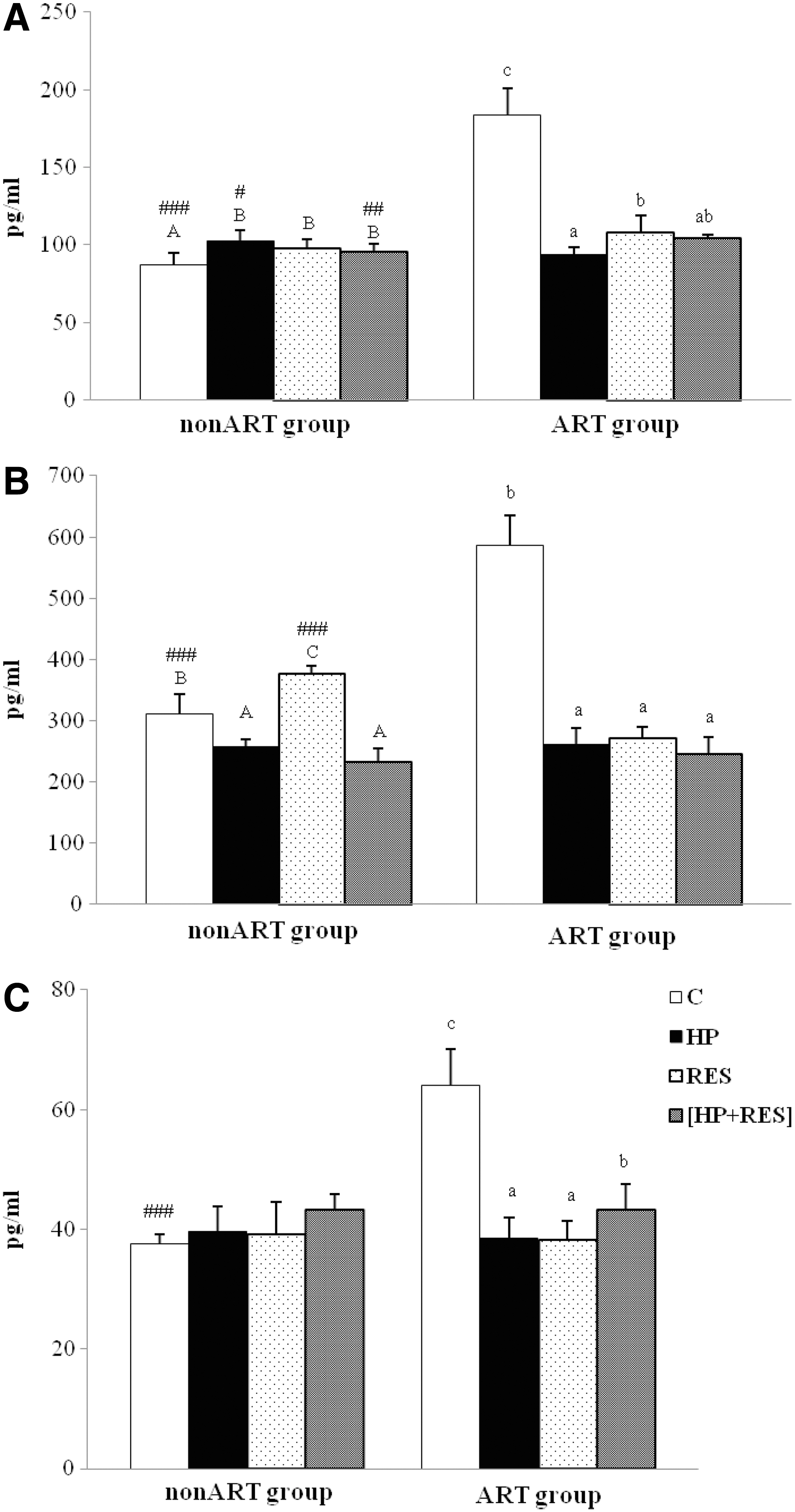
Proinflammatory cytokine production change following dietary and ART:
Hematological analysis
Changes in blood cell levels and white blood cell (WBC) proportion are shown in Table 4. Red blood cell (RBC) and WBC counts in the C+ART group increased significantly compared with those in the C group (RBC, P<.05; WBC, P<.001), whereas platelet counts in the C+ART group were significantly decreased compared with those in the C group (P<.001). In the ART group, the platelet counts in all rats fed experimental diets increased significantly following the initial reduction stemming from the ART (P<.01). The increased WBC count resulting from ART was reduced by HP.
Significant difference among experiment diets in non-ART group at P<.05 by Duncan's multiple-range test.
Significant difference among experiment diets in ART group at P<.05 by Duncan's multiple-range test.
Significant difference due to radiation effect within same experiment diets at P<.05 by t-test.
P<.05, ## P<.01, ### P<.001.
C, control diet; HP, 30% high-protein diet; RES, 2 mg/kg b.w./every other day of resveratrol; [HP+RES], 2 mg/kg b.w./every other day of resveratrol with 30% high-protein diet; RBC, red blood cell; WBC, white blood cell.
The WBC proportion was affected by ART; lymphocyte and basophil percentages significantly decreased (P<.001 and P<.05, respectively), and the percentages of monocytes and neutrophils both increased (P<.05 and P<.001, respectively). All experimental diets had significantly influenced the proportion of WBC in ART group except in the case of basophils. When we compared the C and HP in ART groups, rats that were fed high-protein diet had an increased proportion of lymphocytes and a decreased proportion of monocytes, neutrophils, and eosinophils. In addition, rats in the RES+ART and [HP+RES]+ART groups had significantly lower percentages of monocytes and eosinophils compared with those in the C+ART group (both P<.001). However, rats that were fed RES+ART and [HP+RES]+ART had increased neutrophil percentages compared with those in the C+ART rat group (P<.001).
CD4+ cell and CD4+CD25+ cell populations
As shown in Figure 2, ART had a marked impact on CD4+, CD4+CD25+, and Foxp3+ cell populations. ART significantly decreased the CD4+ cell population. The CD4+ cell population of the [HP+RES] group increased compared with that of the [HP+RES]+ART (P<.01). The ratio of CD4+CD25+ cell to CD4+ cell populations increased. The ratios of HP, RES, and [HP+RES] decreased significantly compared with HP+ART, RES+ART, and [HP+RES]+ART (HP vs. HP+ART, P<.001; RES vs. RES+ART and [HP+RES] vs. [HP+RES]+ART, both P<.01). All experimental diets had increased ratios compared with C (P<.05). Foxp3+ expression in CD4+CD25+ cells was significantly increased. The HP and RES diets reduced Foxp3+ expression in CD4+CD25+ cells compared with HP+ART and RES+ART, respectively (HP vs. HP+ART, P<.05; RES vs. RES+ART, P<.01). ART rats that were fed HP and RES diets had significantly decreased Foxp3+ expression in CD4+CD25+ cells compared with rats in the C+ART group (P<.001).
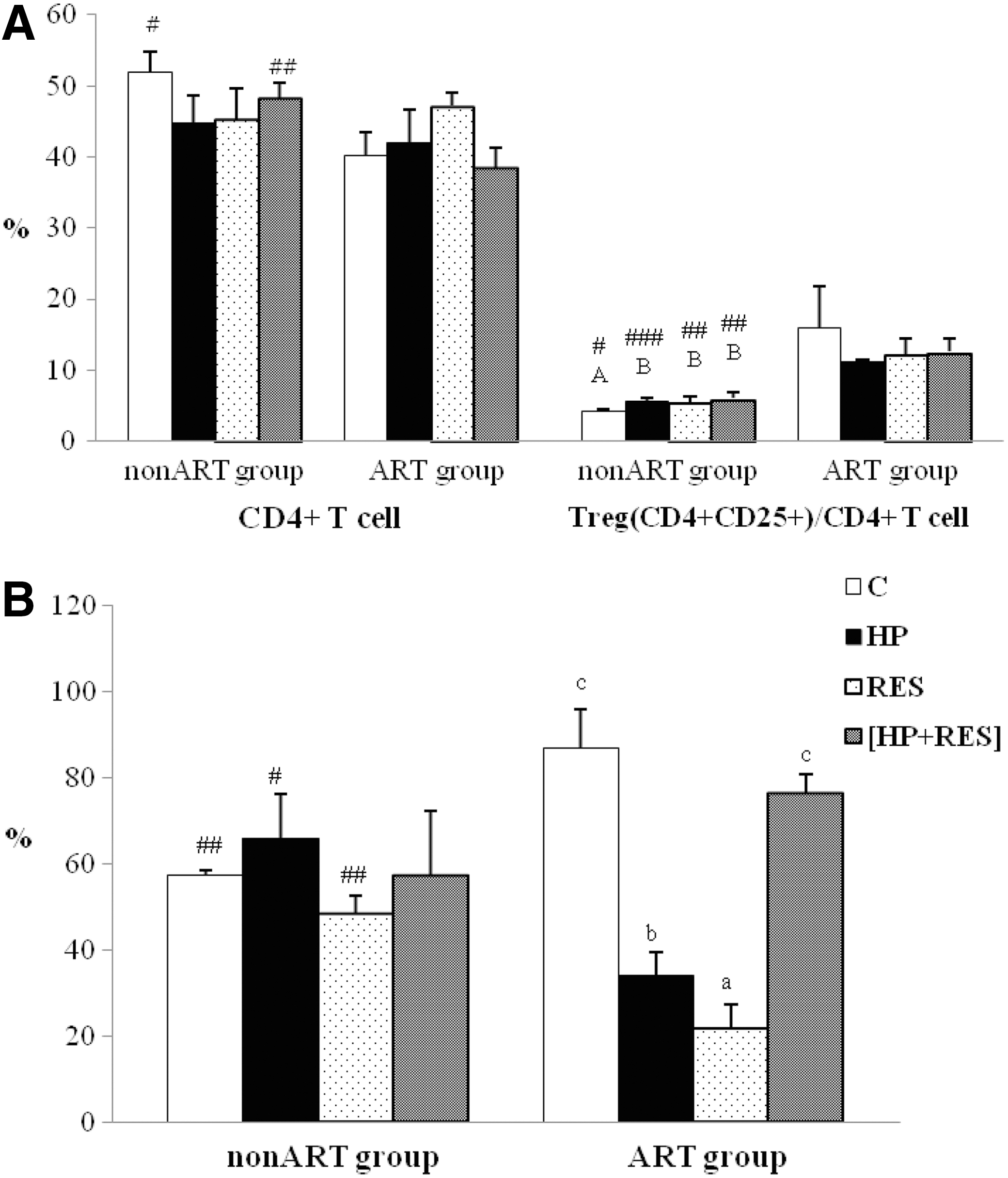
ART enhances regulatory T cells.
Urinary 8-hydroxy-2′-deoxyguanosine levels
To investigate DNA damage, urinary 8-OHdG levels were measured (Fig. 3). The level of 8-OHdG in the C+ART group increased compared with that of the other groups (HP+ART, RES+ART, and [HP+RES]+ART, P<.01). The 8-OHdG levels of HP+ART, and [HP+RES]+ART decreased significantly compared with those of HP, and [HP+RES] (both P<.01).
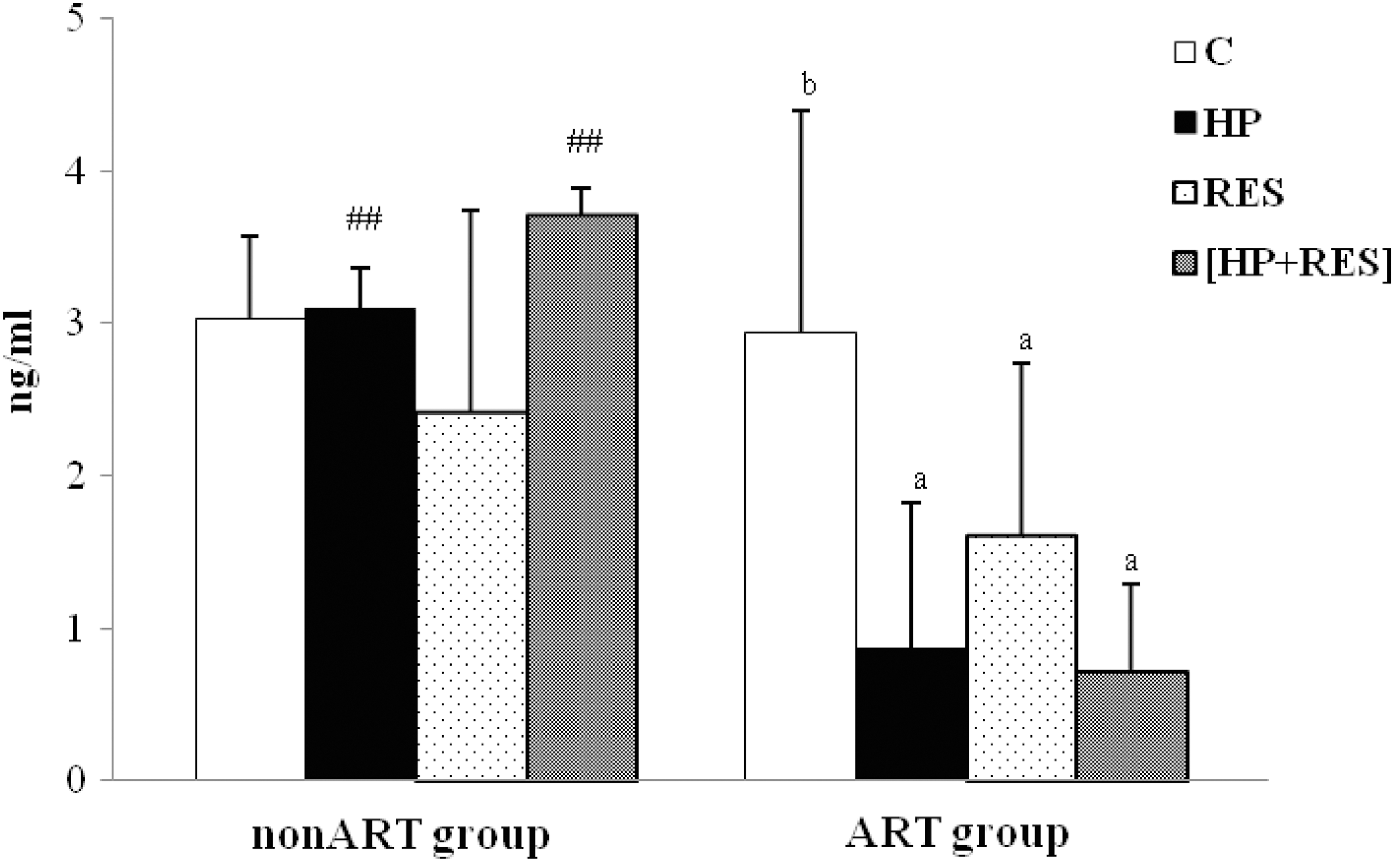
Experimental diets impacted 8-OHdG in urine. Rats were exposed to a radiation dose of 17.5 Gy after adaptation days and were administered a control diet (C), 30% high-protein diet (HP), control diet with resveratrol (RES), or a 30% high-protein diet with resveratrol ([HP+RES]). a,bSignificant difference among experimental diets in ART group at P<.05 by Duncan's multiple-range test. ##Significant difference from the radiation effect within the same experimental diet at P<.01 by t-test. 8-OHdG, 8-hydroxy-2′-deoxyguanosine.
Discussion
Even though radiation is one of the most effective chemotherapies, it may cause acute or chronic inflammatory responses. 1,6,28 In addition, ROS produced by radiation may directly and indirectly attack normal cells and destroy DNA and RNA. 1 –3 Destroyed DNA may promote the 8-OHdG formation, an oxidized form of deoxyguanosine, because ROS react with nucleic acid bases as carcinogens, particularly guanine. 29,30 Even though elevated levels of 8-OHdG after the radiation were not observed in this study, patients with radiation are generally assumed to be under the risk of inflammation and cell damage. 11 Thus, they are encouraged to consume enough dietary protein to repair damaged cells, to increase protein levels, and to improve lipid profiles. 5 Resveratrol has been reported as an anti-inflammatory agent and a scavenger of free radicals in both humans 20,21 and rodent models. 31 However, the effects of resveratrol supplementation in the irradiated rat model have not been investigated yet. Thus, we investigated the effects of high-protein diet with or without resveratrol supplementation during acute inflammation in the irradiated rats.
Radiation increased serum levels of LDL-C and TG. Previous studies reported higher activities of lipoprotein lipase (LPL), hydroxymethylglutaryl CoA reductase, and cholesterol 7 alpha-hydroxylase after radiation. 32,33 Even though we did not directly measure the activities of those enzymes, elevated levels of serum LDL-C and TG might have been due to the changes of enzyme activities. High-protein diet with or without resveratrol supplementation ([HP+RES] and HP, respectively) modulated plasma LDL-C levels that were increased after radiation. In addition, the irradiated rats in HP and [HP+RES] groups showed decreased serum TG levels compared with those in the C+ART group. Previously, Shin et al. examined whether higher protein diet (33%) decreased plasma lipid oxidation and increased liver antioxidant levels, such as vitamins C and E and glutathione, compared with those of rats fed 7% protein diet. 16 It has also been reported that resveratrol improved lipid metabolism by suppressing LDL peroxidation in human plasma and rabbit femoral smooth muscle cells 34 and by inhibiting platelet aggregation in humans 23 and animal models. 22,35 Metabolically, elevated serum levels of TG might be related to the increased release of TG from lipoprotein by activated LPL, which are associated with cachexia. 36 Cachexia is a result of reduced caloric intake and metabolic alterations of lipogenesis and lipolysis through changed TG lipases on the advanced cancer patients with radiation treatment. 8,9 The rats in current study showed reduced food intake and a loss of body weight after radiation treatment, which are identical to the initial symptoms of cachexia. The irradiated rats in HP, RES, and [HP+RES] did not seem to recover from the weight loss. However, high-protein diet with or without resveratrol supplementation improved the levels of TG, cholesterol, and LDL-C compared with the values in irradiated control group. These results indicate that high-protein diet with or without resveratrol might be helpful for restoring abnormal lipid profiles after radiation treatment.
The general wound healing process includes inflammatory phase, proliferative phase, and tissue remodeling phase. 6 Chemokines and cytokines that are produced in the inflammatory phase affect the next phase, proliferative phase, and activate monocytes and macrophages and accelerate cell migration as well. 6 Several studies reported that radiation generates chemokines 37 and proinflammatory cytokines, such as IL-6, IL-1β, and TNF-α, 38 –41 and thus causes inflammation and cytotoxicity. 42 –44 Those proinflammatory cytokines activate inflammatory phase in host response. 45 In addition, radiation promotes the activity of Treg cells that suppress the activities of helper T and B cells. 46 We observed, in our present study, that radiation may induce inflammatory responses via elevated levels of proinflammatory cytokines and ratio of CD4+CD25+ cells to CD4+ T cells, and suppressed CD4+ T cell percentages. We observed that both high-protein diet and resveratrol supplementation might alleviate radiation-induced inflammation more efficiently compared with normal diet. Experimental diets (i.e., HP, RES, and [HP+RES]) modulated proinflammatory cytokine productions, which were increased by ART. Previously, it has been reported that resveratrol administration decreased proinflammatory cytokine production and intestinal inflammation as well. 17 It may be related to the chalcone compound in resveratrol, which lowered the production of IL-6, TNF-α, and IL-8. 47 In addition, the ratio of Foxp3-expressing cells to CD4+CD25+ cells was significantly decreased in HP and RES groups compared with C+ART, even though the percentages of CD4+ T cell and the ratio of CD4+CD25+ cells to CD4+ T cells were not significantly altered by the experimental diets. In addition to the significant effects on the levels of proinflammatory cytokines and Foxp3 expression, high-protein diet also affected the percentages of immune cells. Radiation increased the total WBC and percentage of monocytes and neutrophils. Neutrophils act in innate immune system as phagocytes. Lymphocytes act in adaptive immune system, particularly in inflammation phase. 48 HP increased the suppressed lymphocyte percentages and decreased the elevated neutrophil and monocyte percentages that were caused by radiation, whereas RES and [HP+RES] changed the percentages of monocytes only. In a previous report, it was observed that depletion of the lymphocyte population and increase of WBC count due to the elevated neutrophil percentages that might be elevated and restored before other immune cells. 28
In conclusion, high-protein diet with or without resveratrol supplementation may effectively relieve radiation-induced inflammation by modulating the proinflammatory cytokine production, restoring the immune cell populations, and normalizing serum lipid profiles.
One of the limitations of present study is that only one level each of resveratrol supplementation and protein content was administered. Protein content (30%) and the dose of resveratrol (2 mg/kg every other day) were primarily chosen based on the previous reports and potential practical application. There have been several studies with 30% protein content as a high-protein diet. 16,49,50 As for the dose of resveratrol supplementation, 2 mg/kg of resveratrol that can be converted to 120 mg of resveratrol for body weight of 60 kg person is the amount of resveratrol from three to six bunch of grapes. 23 However, further studies with multiple doses of resveratrol supplementation are needed to clarify the significant synergic effects with high-protein diet on acute-phase inflammation. Studies to elucidate the potential mechanism of high-protein diet through an observation of lipid-peroxidation enzymes would be suggested as another future investigation.
Footnotes
Acknowledgment
This work was supported by Sookmyung Women's University Research Grants 2012 (1-1203-0087).
Author Disclosure Statement
No competing financial interests exist.