







Abstract
O
Our group evaluated pineapple juices as functional food with potential role in the management of mandibular third molar surgery, detecting the proteolytic activity using an in vitro assay system. Varieties of pineapples cultivated in Brazil—Smooth Cayenne and Pérola—were purchased at the fruit and vegetable central market (CEASA, Porto Alegre, RS, Brazil). Ripened pineapple fruits were peeled and blended in an electric blender with phosphate buffer (1 g/mL, pH 8.0) with Triton 1%. The solution was centrifuged at 9000 g for 10 min at 4°C to obtain a clear juice. The protein concentration (without substrate) was ∼40 μg/mL. The proteolytic activities of 100 μL pineapples juices obtained from Smooth Cayenne and Pérola varieties were determined using the method of Kunitz, 2 modified by Walter. 3
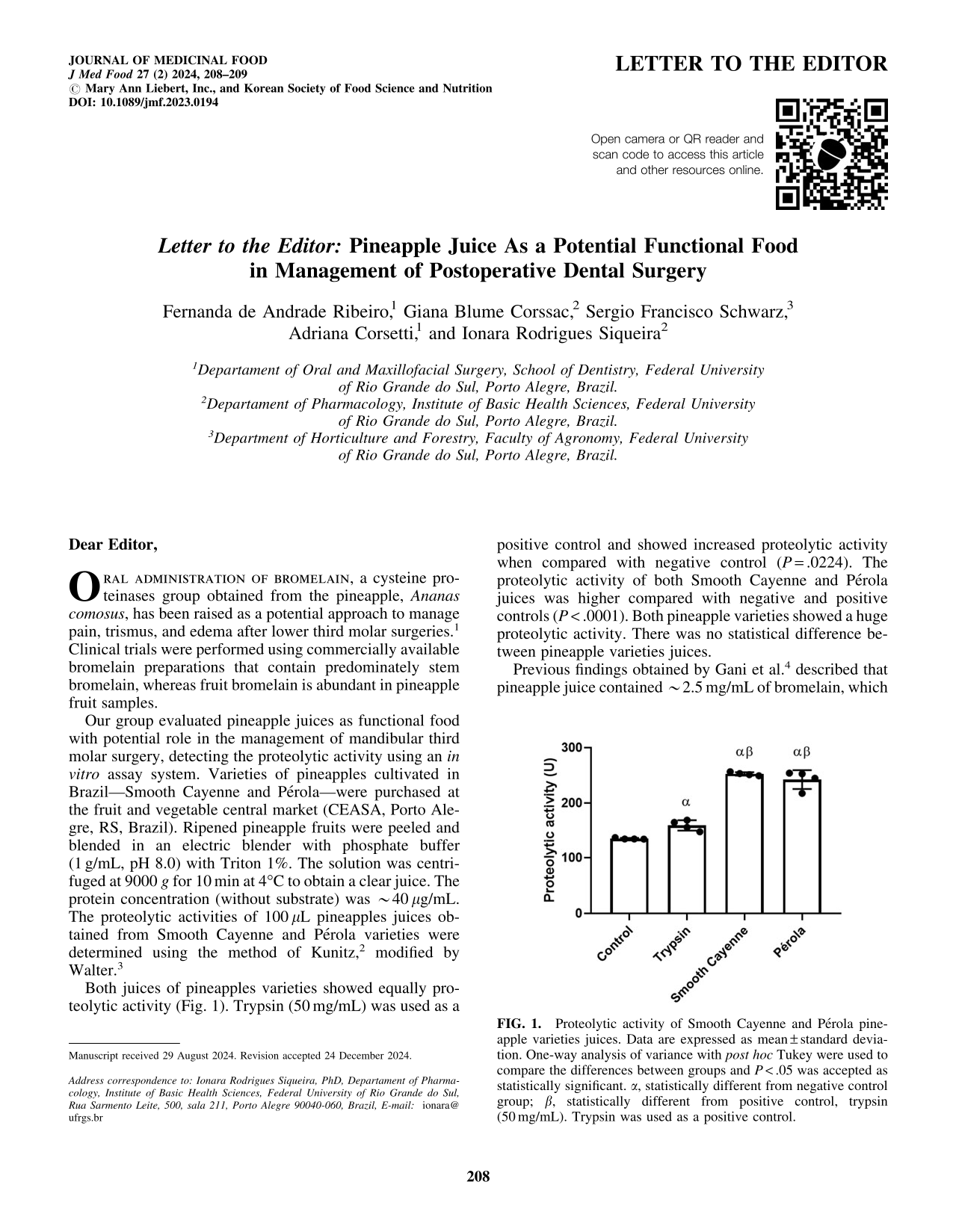
Both juices of pineapples varieties showed equally proteolytic activity (Fig. 1). Trypsin (50 mg/mL) was used as a positive control and showed increased proteolytic activity when compared with negative control (P = .0224). The proteolytic activity of both Smooth Cayenne and Pérola juices was higher compared with negative and positive controls (P < .0001). Both pineapple varieties showed a huge proteolytic activity. There was no statistical difference between pineapple varieties juices.
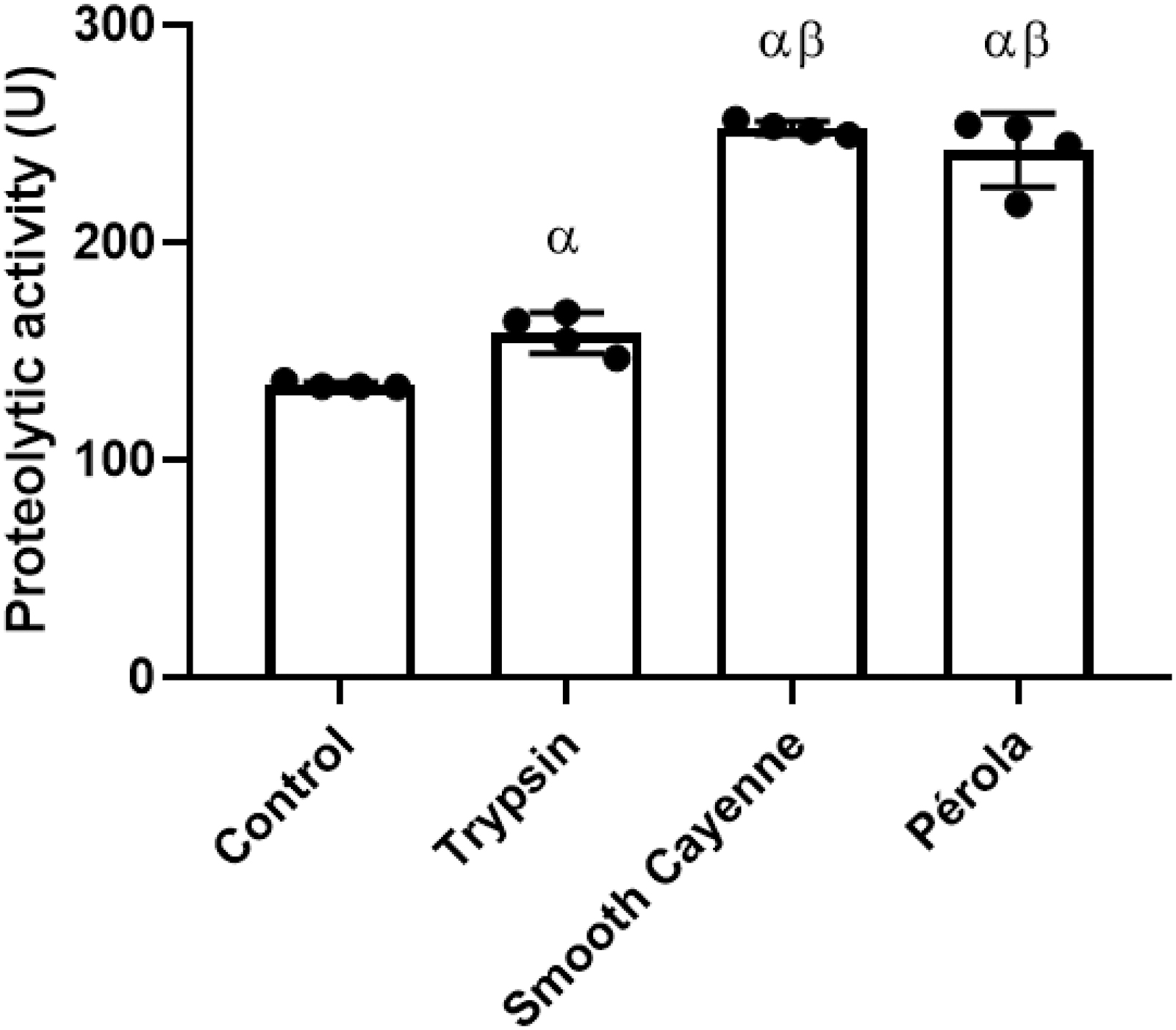
Proteolytic activity of Smooth Cayenne and Pérola pineapple varieties juices. Data are expressed as mean ± standard deviation. One-way analysis of variance with post hoc Tukey were used to compare the differences between groups and P < .05 was accepted as statistically significant. α, statistically different from negative control group; β, statistically different from positive control, trypsin (50 mg/mL). Trypsin was used as a positive control.
Previous findings obtained by Gani et al. 4 described that pineapple juice contained ∼2.5 mg/mL of bromelain, which might represent 100 mL of pineapple juice can achieve this dose, 40 mg, tested in a clinical trial performed by Liu et al. 5
In this context, it is possible to suggest that pineapple juice can be a potential functional food and can be considered as an alternative or adjuvant management of postoperative dental surgery, such as in mandibular third molar surgery. However, further preclinical and clinical studies are required to fully elucidate its efficacy and mechanisms of action.
Footnotes
Authors' Contributions
F.A.R. contributed to conceptualization (equal), formal analysis (supporting), investigation (equal), methodology (equal), validation (equal), visualization (supporting), and writing—original draft (supporting). G.B.C. was involved in formal analysis (lead), investigation (equal), methodology (equal), validation (equal), visualization (lead), and writing—original draft (supporting).
S.F.S. carried out conceptualization (equal), methodology (equal), and writing—review and editing (supporting). A.C. carried out conceptualization (equal), methodology (equal), and writing—review and editing (supporting). I.R.S. was in charge of conceptualization (equal), funding acquisition (lead), formal analysis (supporting), methodology (equal), validation (equal), supervision (lead), writing—original draft (lead), and writing—review and editing (lead).