







Abstract
Abstract
Background:
The skin fixative used in Mohs chemosurgery contains zinc chloride and is referred to as Mohs paste (MP). However, MP shows a remarkable change in rheological characteristics after its preparation.
Objective:
To prepare an MP with stable rheological characteristics, we prepared a modified MP (mMP) using zinc oxide 10% single ointment (Zn _ointment ), which is an oil-based ointment.
Methods:
We evaluated mMP by determining its rheological characteristics, depth of tissue fixation, and observation of the tissue surface after treatment.
Results:
The viscosity of mMP increased after three months. However, the treatment-dependent viscosity of mMP could be obtained by mixing with glycerin. The viscosity and spreadability of mMP _3mth , which was three months after preparation, were 1992.0 ± 376.5 Pa·s and 2.1 ± 0.1 cm, respectively. In contrast, the viscosity and spreadability of MP mixed with glycerin were 436.9 ± 0.0 Pa·s and 2.8 ± 0.0 cm, respectively. The fixed invasion depth of MP was significantly higher than that of mMP (p < 0.05).
Conclusion:
This study of a mixture of MP and Zn _ointment showed that the viscosity of mMP could be adjusted with glycerin. Also, the tissue fixation of mMP progressed slowly compared with that of MP. This finding suggests that mMP is effective and safe for Mohs treatment.
Introduction
S
Mohs chemosurgery is a technique for secondary excision and the procedure is repeated to remove the cancerous areas.10–12 Mohs chemosurgery is a technique that fixes tissue in vivo before the surgical procedure. This technique was developed by Frederic E. Mohs and offers remarkably high cure rates. 11 Mohs surgery is considered an effective technique for treating many recurrent or histologically aggressive lesions such as basal cell carcinomas and squamous cell carcinomas. It allows the removal of cancer tissue and achieves a high cure rate, while sparing healthy tissue and leaving the smallest possible scar. Reeder et al. reported that there was an upward trend in the utilization of Mohs surgery from 1995 to 2010 in the United States, particularly for the head and neck region, where tissue preservation is essential. 13
The skin fixative used in Mohs chemosurgery contains zinc chloride (ZnCl2) and is referred to as Mohs paste (MP).10–12 ZnCl2 is highly soluble in water and is hygroscopic and even exhibits deliquescence. Furthermore, zinc (Zn2+) ionized by the discharge from ulcerated tissue denatures tumor tissue and microvessels and immobilizes wound skin and tissue. 14 In addition, Zn2+ ions denature bacterial cell membranes, giving the compound antibacterial activity. 15 These properties are expected to reduce infection and malodor.
Fixation and tissue resection using MP are repeated until a completely cancer-free plane is reached. 16 However, the rheological characteristics of MP undergo a remarkable change after its preparation, namely the softening of MP and strong viscosity and reduction in spreadability over time.17,18 These rheological characteristics make treatment using MP difficult. Specifically, the change in rheological characteristics makes it difficult to apply MP to the target tumor part uniformly. 19 The absorption of discharge from the tumor and ulceration by MP increases its fluidity, and the softened MP comes into contact with normal tissue in the periphery, causing necrosis. 17 Although studies have examined an optimal ointment base for the MP preparation that overcomes these detrimental effects, results to date have been controversial.17,20 One study reported that these changes in the rheological characteristics of MP are caused by its water-absorbing base.20,21
To prepare MP that has stable fluidity and supports skin protection by zinc oxide (ZnO),22,23 we prepared a modified MP (mMP) using ZnO 10% single ointment (Zn _ointment ), which is a topical oil-based ointment. In this study, we describe the rheological characteristics of mMP and histologically evaluate tissue fixed by mMP.
Materials and Methods
Determination of rheological characteristics
Rheological characteristics were determined under the following conditions in triplicate, and the mean values were calculated. Spreadability and viscosity of the ointment were evaluated using a spread meter (Imoto Machinery Co., Ltd., Kyoto, Japan). A 0.5-cm3 sample of ointment was placed on the spread meter, which was then placed in an incubator with an ambient temperature of 25°C ± 2°C. The diameter of the ointment was visually measured after 30 seconds. The yield value was calculated with the following formula using the spread diameter after 30 seconds.
24
where F indicates the yield value (Pa·s), W is the mass of the glass plate (g), V is the volume of the sample (cm3), G is gravitational acceleration (980 cm/s2), π is circular constant (3.14), and D is diameter (mm) when sample spreading stopped.
Depth of tissue fixation after Mohs treatment
MP _fresh , mMP _fresh , mMP _3mth , and mMP _3mthG , which are MP after preparation, mMP after preparation, mMP after three months, and mMP after three months with viscosity regulated with glycerin, respectively, were applied to edible pork of uniform thickness to observe the fixed invasion depth of the tissue, under the temperature condition of 25°C. After 1, 3, 6, and 12 hours, the treated pork was cut into 3-mm-thick slices, and the depth of tissue fixation as measured from the surface of the pork was assessed (in mm). The measurement was repeated for three slices, and the mean value was defined as the fixed invasion depth of the tissue.
Observation of the tissue surface after MP _fresh and mMP _3mthG treatment
After 12 hours, treated pork tissues were soaked in 15% formalin solution (Muto Pure Chemicals Co., Ltd., Tokyo, Japan) for 24 hours. The tissue sample was paraffin embedded using the Tissue-Tek TEC 5 Tissue Embedding Console System (Sakura Seiki Co., Ltd, Tokyo, Japan) after dehydration with ethanol and xylene, and the tissue was cut into 2-μm-thick sections using a microtome (REM-710; Yamato Kohki Industrial Co., Ltd, Saitama, Japan). Histological observation was performed after hematoxylin-eosin staining. 25
Observation of ZnO crystals in ointment and the surface of cells
Samples were applied to microscope slides and held in place with a coverslip, and the ZnO crystals in ointment were observed. ZnO crystals in ointment and the surface of cells treated with MP _fresh and mMP _3mthG were observed through a 40 × and 10 × objective on an optical microscope (BX53; Olympus, Tokyo, Japan).
Microscopy
Slides were observed on a BX53 optical microscope (Olympus) and photographed using a E-410 digital camera system (Olympus). Contrast and color level adjustments were performed using the software ImageJ for the entire image, but no region- or object-specific editing or enhancements were performed.26,27
Statistical methods
Variables are expressed as mean ± standard deviation, depending on their distributions. Fixed invasion depth of the tissue after 12 hours was compared by one-way analysis of variance. All calculations were conducted using PASW Statistic version 18 (IBM, Tokyo, Japan). A value of p < 0.05 was considered statistically significant.
Ethics
The study was approved by the Internal Review Board of the National Hospital Organization Beppu Medical Center (2017-007) and was conducted in accordance with the guidelines of the Declaration of Helsinki. 28
Results
Preparation of MP and mMP
The formulations of prepared MP and mMP are shown in Table 1. MP was prepared as follows: ZnCl2-saturated water was made by dissolving 50 g of ZnCl2 in 25 mL of water. 25 g of ZnO starch powder was mixed into the saturated water. Viscosity was regulated with 5 mL of glycerin. mMP was prepared by mixing MP and Zn _ointment (Yoshida Pharmaceutical Company Limited, Tokyo, Japan) in equal amounts. MP after preparation, MP after three months, and MP after three months with viscosity regulated with glycerin were defined as MP _fresh , MP _3mth , and MP _3mthG , respectively. Similarly, mMP after preparation, mMP after three months, and mMP after three months with viscosity regulated with glycerin were defined as mMP _fresh , mMP _3mth , and mMP _3mthG , respectively.
Glycerin was used to regulate viscosity. Zinc oxide starch powder (composition: zinc oxide starch powder 12.5 g and potato starch 12.5 g). Zn _ointment (composition: zinc oxide 10 g, beeswax 12.5 g, and soybean oil 32.5 g).
MP, Mohs paste; mMP, modified MP; Zn _ointment , zinc oxide 10% single ointment.
Determination of rheological characteristics
The results of spreadability and viscosity measured using a spread meter are shown in Table 2. The viscosity and spreadability of MP _fresh were 442.5 ± 78.9 Pa·s and 2.8 ± 0.1 cm, respectively. However, measurement of the viscosity and spreadability of MP _3mth and MP _3mthG was considered excessively difficult. The viscosity of mMP _fresh , mMP _3mth , and mMP _3mthG was 1287.5 ± 297.2, 1992.0 ± 376.5, and 436.9 ± 0.0 Pa·s, respectively, while spreadability was 2.3 ± 0.1, 2.1 ± 0.1, and 2.8 ± 0.0 cm, respectively. The viscosity and spreadability of Zn _ointment were 741.3 ± 49.7 Pa·s and 2.5 ± 0.0 cm, respectively. Although the viscosity of mMP _3mth increased, that of mMP _3mthG , which was adjusted using glycerin, showed similar rheological characteristics to MP _fresh .
Values are the mean ± standard deviation (n = 3).
Viscosity and spreadability of MP three months after preparation could not be measured.
MP _fresh , MP immediately after preparation; mMP _fresh , mMP immediately after preparation; mMP _3mth , mMP three months after preparation; mMP _3mthG , mMP _3mth whose viscosity was regulated by glycerin; ND, not detected; Pa·s, pascal second; Zn _ointment , zinc oxide 10% single ointment.
Observation of ZnO crystals in MP, mMP, and Zn _ointment
Photographs of ZnO crystals in MP, mMP, and Zn _ointment with a light microscope are shown in Figure 1. The photographed crystals were ZnO. In MP _fresh and mMP _fresh , ZnO crystals were confirmed (Fig. 1a, b). Because the hardness of mMP _3mth was increased three months after preparation, the cover glass could not compress the sections, and the image was therefore unclear. However, the presence of ZnO crystals was confirmed in mMP _3mth (Fig. 1c) and mMP _3mthG (Fig. 1d). The image of ZnO in mMP _3mthG was unclear because of the glycerin (Fig. 1d). The presence of ZnO crystals was confirmed in Zn _ointment , the marketed product mixed into MP (Fig. 1e).
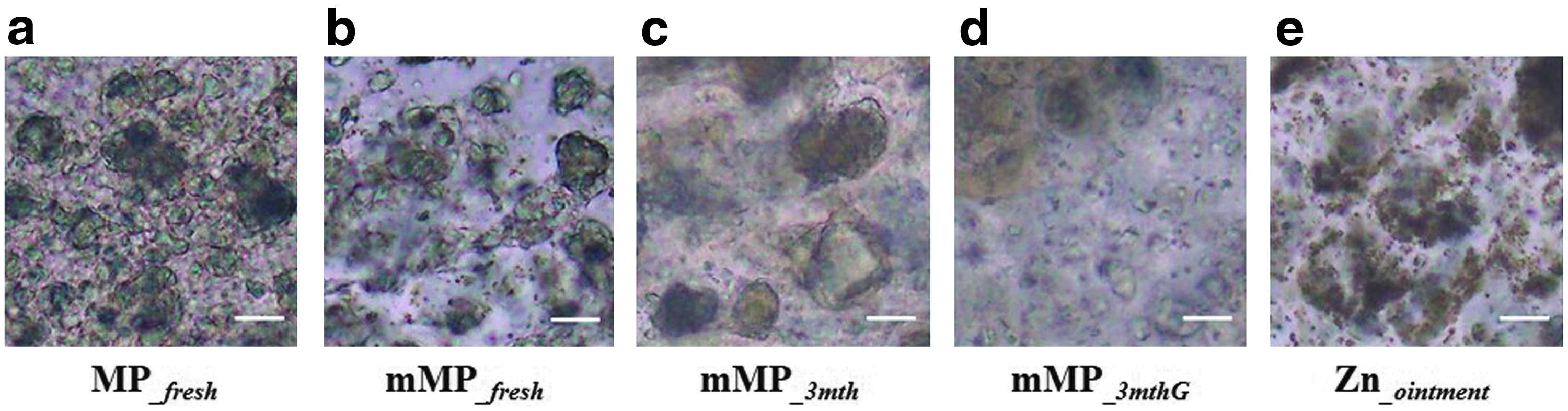
Optical microscope photograph of prepared MP, mMP, and Zn_
ointment
(magnification, ×400). The bars in the images represent 50 μm. ZnO crystals were confirmed clearly in the MP
_fresh
and mMP
_fresh
Observation of the tissue surface after MP _fresh and mMP _3mthG treatment
Images of the tissue surface after the 12-hour MP _fresh and mMP _3mthG treatment are shown in Figure 2. Tissue destruction was not observed in untreated tissue (Fig. 2a). The progress of destruction and coagulation on the tissue surface that had been treated with MP _fresh was observed clearly (Fig. 2b). Compared with tissue treated with MP _fresh , tissue surface that had been treated with mMP _3mthG showed less destruction (Fig. 2c). In both images, the progress of structural destruction of the tissue due to dehydration by MP _fresh and mMP _3mthG was observed (Fig. 2b, c).
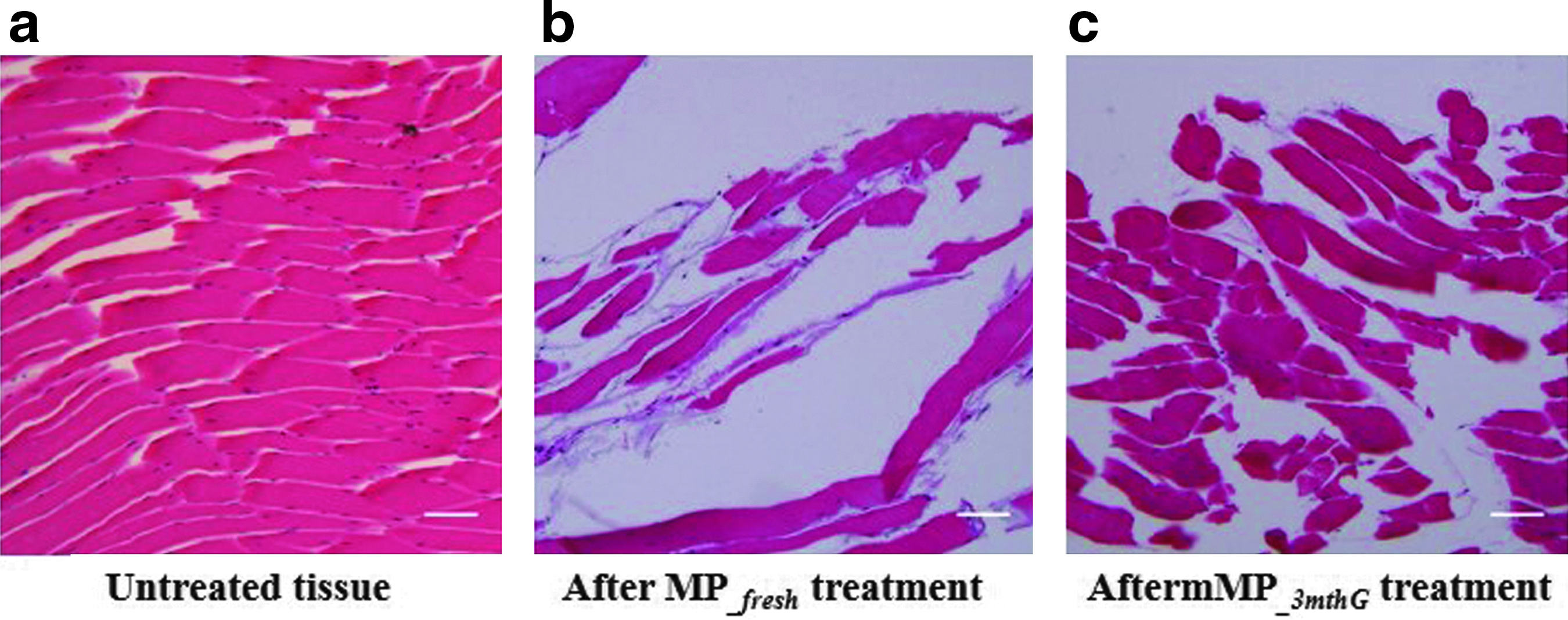
Optical microscopy of pork tissue after 12-hour treatment with MP
_fresh
and mMP
_3mthG
(magnification, ×100; hematoxylin-eosin stain). The bars in the images represent 100 μm. Tissue destruction was not observed in nontreated tissue
Comparison of the depth of tissue fixation after treatment
The depth of tissue fixation is compared in Figure 3. The depths of tissue fixation after 12 hours of MP _fresh , mMP _fresh , mMP _3mth , and mMP _3mthG were 11.3 ± 0.6, 5.3 ± 0.5, 6.1 ± 0.1, and 6.3 ± 0.6 mm, respectively. Although the depth of tissue fixation did not significantly differ between mMP _fresh , mMP _3mth , and mMP _3mthG , that after 12 hours of MP _fresh was significantly higher than that after mMP _fresh , mMP _3mth , and mMP _3mthG (F (89.16, 3, 8) = 89.158, p < 0.001), indicating that the progress of tissue fixation with MP _fresh was faster than that with mMP _fresh , mMP _3mth , or mMP _3mthG .
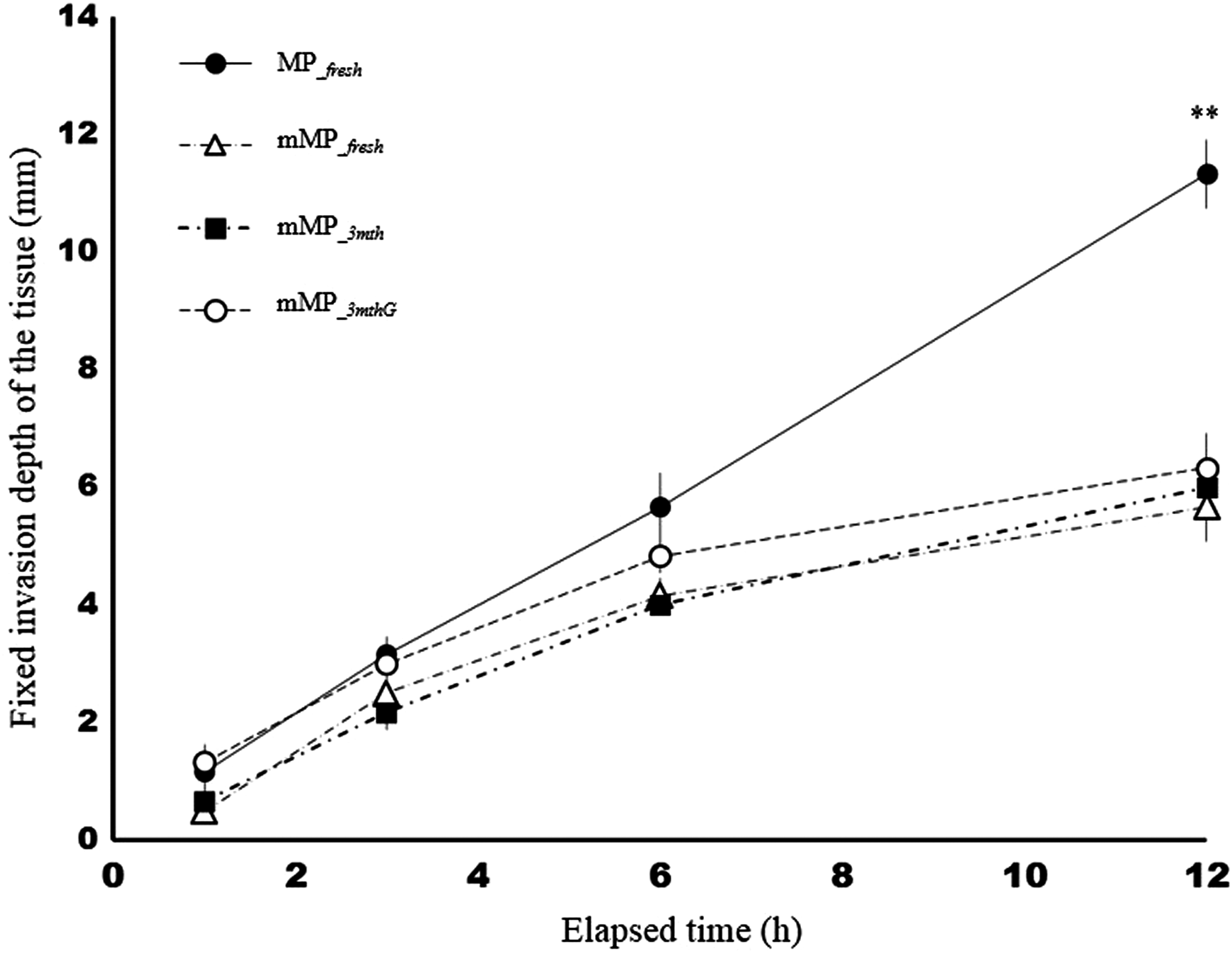
Relationship between elapsed time (h) and fixed invasion depth of the tissue (mm). Bars represent standard deviation of the mean. MP _fresh , MP immediately after preparation; mMP _fresh , mMP immediately after preparation; mMP _3mth , mMP three months after preparation; mMP _3mthG , mMP _3mth whose viscosity was regulated by glycerin. **Twelve hours later, the fixed invasion depth achieved by MP _fresh was significantly higher than that achieved by mMP _fresh , mMP _3mth , or mMP _3mthG (p < 0.05).
Discussion
In this study of a skin fixative containing ZnCl2, we showed that an adjustment of viscosity was possible after an interval of three months and that the progress of fast tissue fixation could be controlled by decreasing the concentration of ZnCl2. Three months after preparation, it was hard to apply MP to tissue because it had solidified, and could not be mixed with glycerin. In contrast, although the viscosity of mMP _3mth increased, it could be mixed with glycerin, and treatment-dependent viscosity was obtained. The viscosity and spreadability of mMP _3mth were 1992.0 ± 376.5 Pa·s and 2.1 ± 0.1 cm, respectively. However, the viscosity and spreadability of mMP _3mthG adjusted with glycerin were 436.9 ± 0.0 Pa·s and 2.8 ± 0.0 cm, respectively. The viscosity and spreadability of MP _fresh were 442.5 ± 78.9 Pa·s and 2.8 ± 0.1 cm, respectively. mMP _3mthG had values of viscosity and spreadability that were similar to those of MP _fresh (Table 2). Preparation of MP just before treatment was needed to stiffen it. However, this was not required after mixing MP with Zn _ointment .
Starch consists of amylose and amylopectin, and occurs as a dense structural crystal formed by hydrogen bonds. 29 Therefore, water molecules cannot infiltrate starch. 30 These hydrogen bonds are weakened by the presence of zinc ions, however, which allows the infiltration of water molecules into the starch. 31 The macromolecules amylopectin and amylose are released from starch penetrated by water, which leads to a rapid increase in hardness and viscosity.17,30 The amount of starch in mMP was small (∼6.25 g) compared with the volume of starch in MP (12.5 g). Zn _ointment is composed of beeswax, soybean oil, and ZnO, and mixing it with glycerin was easy. Therefore, the viscosity of mMP could be adjusted with glycerin even though an interval of three months had passed from the time of preparation. Tissue fixation by Mohs treatment causes pain, which is the result of albuminoid degeneration of cellular tissue induced by Zn. The ZnCl2 concentration of prepared MP and mMP were 47.6% and 23.8%, respectively. The ZnCl2 concentration in prepared mMP was approximately half of that in MP (Table 1). Therefore, tissue fixation using mMP progresses more slowly than that with MP (Figs. 2 and 3). We consider that the pain of tissue fixation using mMP is less than that caused by MP. ZnO works by providing a skin barrier and helps heal skin irritations such as cuts, burns, scratches, and irritation caused by poison ivy.22,23 The concentration of ZnO in the prepared MP was approximately equal to the concentration of ZnO in mMP. Therefore, we consider that the skin protection effect of mMP is similar to that of MP. The presence of ZnO crystals in mMP _3mth was confirmed by microscopy (Fig. 1).
Yanazume et al. reported that the use of MP is convenient for massive genital bleeding from the uterine cervix or vaginal stump due to recurrent gynecologic cancer. 32 Atypical genital bleeding due to gynecologic cancer such as cervical cancer is a major risk factor for death, and treatment to arrest such bleeding must be performed immediately. This study of a mixture of MP and Zn_ointment showed that the arrest of bleeding could be achieved quickly because the viscosity of mMP could be adjusted currently with glycerin. This finding might influence patient outcome.
Several limitations of this study warrant mention. First, we were not able to perform an assay for Zn2+ ions in mMP _3mth because our hospital did not have the required measuring equipment. However, the tissue fixation effect of mMP was observed in medical practice, and tissue was fixed in all cases. Second, application to a moist tissue surface such as the vaginal wall or nasal cavity may be difficult, because we used hydrophobic Zn _ointment as the ointment base in this study. A previous study reported successful treatment using MP on moist tissue surface. 33 The viscidity of MP using the hydrophilic ointment base seems to be superior in a wet environment. However, in these reports, techniques such as application of MP to a dressing and pressing the dressing against skin tissue were performed so that MP is in contact with skin tissue.19,34 We thought that treatment with mMP using a similar technique was possible. Finally, we did not check the change in viscosity by changing the proportion of MP and Zn _ointment in the mixture. Adjustment of viscosity is possible by adjusting the volume of glycerin. Moreover, satisfaction was obtained in the clinical setting with regard to the tissue fixation effect, and the pain of patients who were treated with mMP was minimized. Therefore, assessment of mMP that has been mixed with a topical oil-based ointment is required.
Overall, these results indicate that mMP is effective for treating local skin invasion by malignancy and bleeding from malignant wounds and has a promising effect on reducing odor and exudates. The preparation of mMP should be learned by oncologists, palliative care nurses, and pharmacists involved in cancer care.
In conclusion, this study of a mixture of MP and Zn _ointment showed that the viscosity of the mixture could be adjusted with glycerin, and the presence of ZnO crystals in mMP _3mth was confirmed; therefore, we expected that mMP has a skin protective effect even three months after preparation. Furthermore, the rapid fixation of skin tissue could be controlled. This finding suggests that the rheological characteristics of mMP could be adjusted by Zn _ointment and glycerin. In the treatment of skin invasion of locally advanced, unresectable tumors, the prescription of a zinc-containing paste is a major factor influencing treatment outcome.
Footnotes
Author Disclosure Statement
No competing financial interests exist.