







Abstract

Dear Editor:
Creative arts therapy (CAT) requires the implementation of a personalized expressive intervention by a board-certified music therapist or registered art therapist, and the presence of a therapeutic process. 1 CAT is based on the recognition that a patient's deepest thoughts and feelings can be expressed more easily through visual and/or auditory media.1,2
A pilot program evaluation study was conducted to assess patient–family perspectives associated with engagement in a CAT program within a comprehensive palliative care consult service. The study was approved by the University of Colorado Institutional Review Board.
Patients selected music and/or art therapy with therapeutic goals tailored to the individual participants, including: legacy building, relaxation, empowerment, reminiscence, expression, and fostering relationships. The CAT involved one session or two sessions if both music and art therapies were chosen. The average session lasted one to two hours. Music and art therapy interventions included:
Listening to participant-preferred music Selecting preferred artistic works Playing an instrument or singing for expression Creating art works for personal meaning making Music- and imagery-led relaxation Music and/or art discussion Music- and art-facilitated reminiscence Lyric and image analysis Legacy building through recording, soundtrack creation, song writing, and creation of artistic keepsake items Therapeutic conversation.
The participants were hospitalized adult patients with serious illness and their families receiving ongoing palliative care services at the University of Colorado Hospital between October 1, 2016, and June 1, 2017. Patients were excluded if they chose not to participate or were unable to verbalize their desire to participate in a CAT session. Forty patients and/or family members completed a three-question semistructured interview within one day post-CAT session.
Iterative qualitative methods were performed, involving summative team-based thematic analysis. Inductive coding and synthesis of themes until saturation were achieved through a consensus approach. Dominant themes were grouped into broader categories through conceptual mapping (Fig. 1).
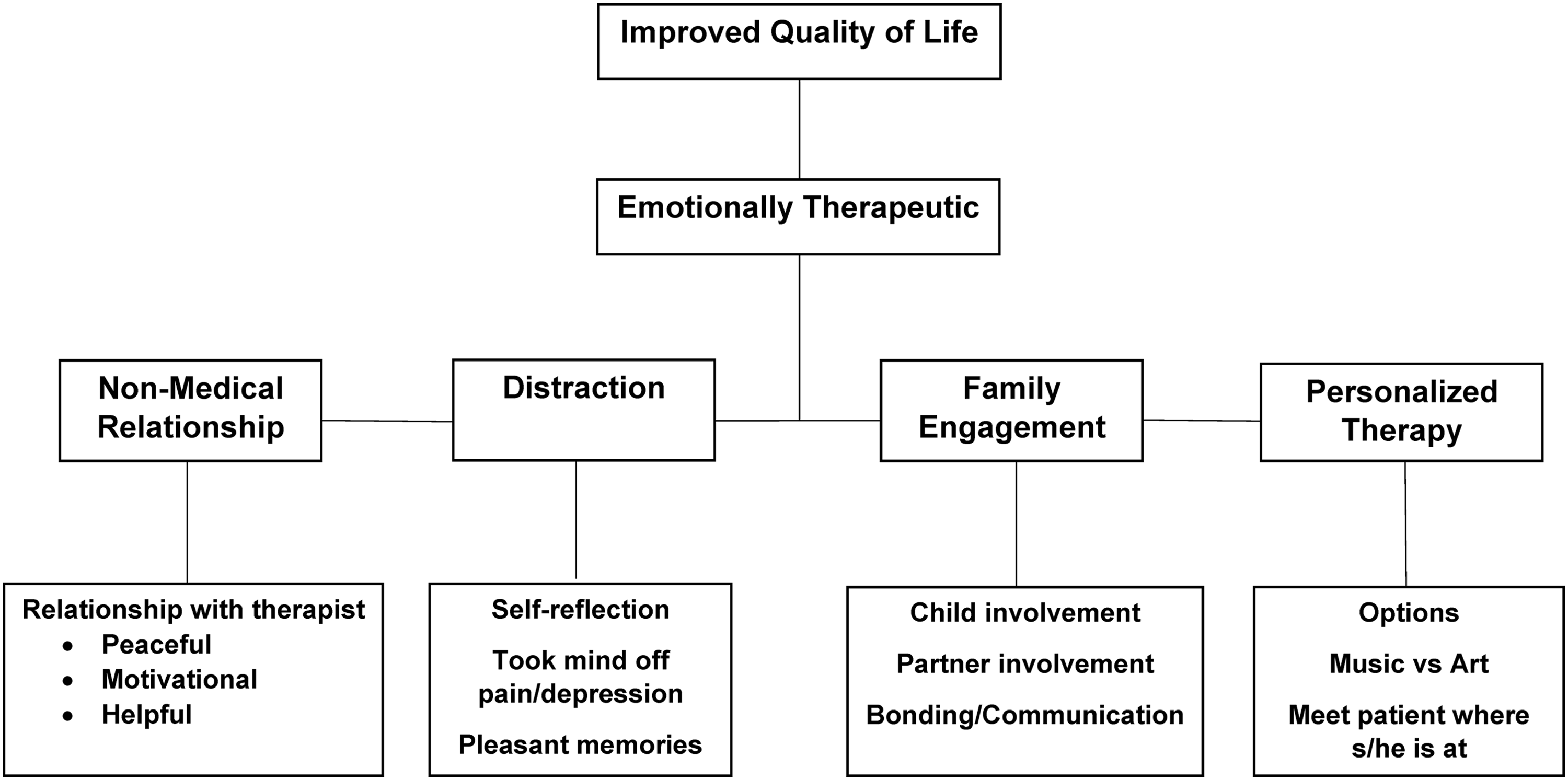
Conceptual mapping of qualitative themes.
Quality-of-life benefits through emotionally therapeutic effects were the dominant theme in 95% of participants. Subthemes were (1) engaging in a nonmedical relationship with the therapist, (2) providing distraction, (3) facilitating family engagement, and (4) personalizing care. Patients reported that engagement in a nonmedical relationship with the music and/or art therapist provided opportunities to be at peace, feel motivated, and be creative. In addition, patients described the CAT session(s) as fostering self-expression and personalizing care through choice of music and/or art therapy integrated into their hospital experience. For the 5% of participants who did not describe a positive experience from the CAT, responses were most commonly described either as CAT not being for everyone or needing to be in the right mindset to participate. These results support prior findings of the benefits of CAT.1,3
This pilot program evaluation provides preliminary support for the integration of CAT within comprehensive palliative care services for patients and families to improve quality of life through emotionally therapeutic effects. Rigorous studies with larger sample size are needed to characterize optimal features of CAT interventions such as frequency, duration, and modality. 1