







Abstract
Background:
Pediatric residents lack training in expressing condolences to bereaved families after a child's death. We previously developed a novel curriculum that improved residents' comfort with expressing condolences, and now we report assessment of the longitudinal impact of this curriculum on residents' practices of condolence expression.
Methods:
We applied Kern's 6-step approach to develop, implement, and evaluate a condolence expression curriculum. Residents completed surveys before, immediately after, and six months after participating in the educational intervention to assess curricular impact over time.
Results:
Twenty pediatric residents participated in the curriculum. Residents reported an increase in their practice of expressing condolences following participation in the curriculum, as well as appreciation for the value of the intervention.
Conclusion:
A condolence expression curriculum has potential to increase residents' practice of condolence expression to bereaved families over time. Future work will focus on the impact of curricular dissemination across pediatric residency programs.
Background
Bereaved parents value receiving support from their children's health care teams. 1 Pediatric residents provide direct care to dying children and have opportunities to meaningfully communicate with bereaved families after a child's death. Recently, a national survey of pediatric residents revealed deficits in formal training related to expressing condolences. 2 To address this gap, we developed and piloted a novel condolence expression curriculum using Kern's 6-step approach. 3 The curriculum was easily implemented, well received by pediatric residents, and led to a short-term increase in comfort expressing condolences. 4 Based on the success of this early pilot study, we expanded the cohort to include additional residents and followed the full cohort longitudinally over six months to assess the long-term impact of this curriculum on residents' practices of condolence expression.
Methods
An Institutional Review Board approved this study to explore curriculum impact on second-year pediatric residents during their one-month oncology rotation at a large free-standing children's cancer hospital. The full details of the study, including curriculum development, implementation, and evaluation methods, were previously published. 4
Briefly, we utilized Kern's 6 step approach to develop an innovative, single timepoint educational intervention that included the following components: a small-group didactic and case-based discussion, skill practice and demonstration, and reflection via a semistructured debriefing. For the purposes of the intervention, condolence expression was defined as the act of communicating with a patient's family in the days, weeks, or months after he/she has died to convey sympathy. Methods of condolence expression include a written card or a letter, a phone call, attending a personal memorial service, attending an annual institutional bereavement service, or electronic communication.
Residents completed a preimplementation survey before participating in the educational intervention to obtain baseline levels of comfort with and practices of condolence expression. Immediately following the intervention, residents completed a postimplementation survey to evaluate curricular objectives and gather feedback. Six months after completion of the education, residents filled out an electronic postimplementation survey to assess curricular impact over time. A total of four reminder e-mails were sent to residents every two weeks to encourage survey completion.
To calculate the percentage of deaths in which residents expressed condolences to bereaved families, resident responses to two quantitative questions were compared between the pre- and six-month postintervention surveys: (1) In the past six months, how many patient deaths have you experienced? (2) If you experienced a patient death in the past six months, how many times did you express condolences to the family? Content analysis of free-text survey responses was conducted, and responses were categorized to identify themes. Any variances in categorized responses were discussed among team members to reach consensus.
Results
A total of 20 pediatric residents engaged in condolence expressing training over the nine-month study period (Table 1). Response rate for six-month survey completion was 75% (15/20). In the six months before completing condolence expression education, residents experienced an average of 4.6 deaths, and in the six months after engaging in the educational intervention, residents experienced an average of 3.8 deaths. Quantitative data demonstrated an increase in the percent of deaths in which condolences were expressed to bereaved families from 10% of deaths before curriculum implementation to 25% of deaths after curriculum implementation (Fig. 1).
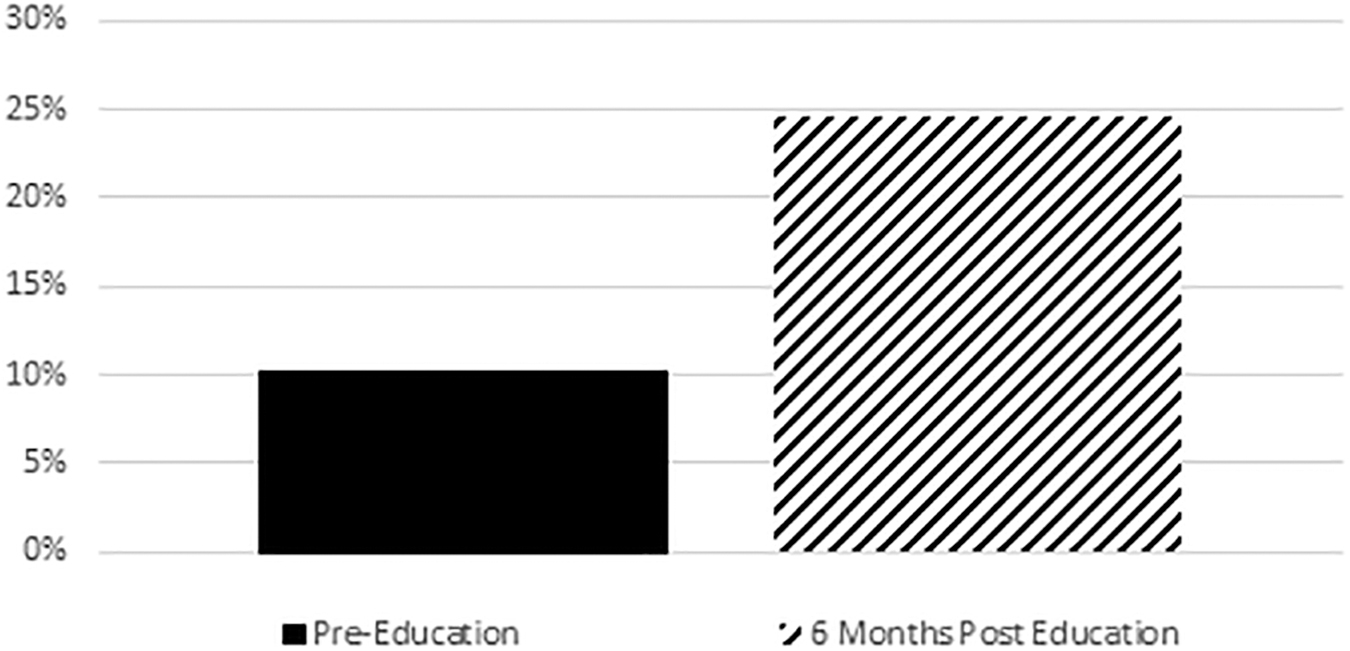
Percent of deaths that condolences were expressed.
Participant Demographics and Baseline Experience With Condolence Expression
Two main themes emerged from content analysis, exemplified by the following free-text quotes. First, pediatric residents clearly perceived value in this educational intervention; “I think the program is important and should continue.” Second, they were motivated to continue integrating condolence expression into their clinical practice moving forward; “Yes, I am still planning on expressing condolences.”
Conclusion
We developed and implemented a novel curriculum for pediatric residents that increased their practice of expressing condolences to bereaved families over time. While successful, this study should be interpreted with respect to its limitations. First, single center design and small sample size preclude generalizability. Second, our data are limited by recall bias. We preemptively informed residents of our plan to solicit information on number of deaths and frequency of condolence expression in the follow-up survey; however, we did not require them to track the number of deaths in real time due to concern for participation burden. Third, while we are encouraged by the preliminary results of this novel intervention, we also recognize that significantly more progress still needs to be made to further increase rates of condolence expression. Future work will involve collaboration with pediatric residents to identify and target additional barriers to expressing condolences to inform subsequent expansion of this curriculum.
In summary, a relatively simple, brief, one-time interactive curriculum was valued by trainees and also appeared to increase their practice of condolence expression over time. We encourage educators tasked with teaching pediatric residents how to navigate difficult communication encounters to incorporate condolence expression training routinely. Future work will focus on curricular dissemination with the goal of studying curriculum uptake, implementation, and impact across multiple pediatric residency programs nationally.
Footnotes
Acknowledgments
The authors thank Mr. Dave Ricker (Aaron), Ms. Terri Braswell (Heather), and Ms. Lisa Trumbo (Trevor) for sharing their perspectives as bereaved parents to inform educational content.
Authors' Contributions
T.A. contributed to study design, data collection, data analysis, and interpretation, as well as drafting and revising the manuscript. T.P. contributed to drafting and revising the manuscript. A.P. contributed to study design and revising the manuscript. K.B. contributed to study design, data collection, data analysis, and interpretation, and revising the manuscript. J.L. contributed to revising the manuscript. S.K.H. contributed to revising the manuscript. E.C.K. contributed to study design, data analysis and interpretation, and revising the manuscript.
Funding Information
This work was supported in part by ALSAC of St. Jude Children's Research Hospital. Additionally, Dr. E.C.K. receives salary support from the National Cancer Institute (K08CA266935).
Author Disclosure Statement
No competing financial interests exist.