







Abstract
This article reviews formal and informal mechanisms through which the World Health Organization (WHO) is promoting policies for the advancement of women's health. Specific attention is given to select examples of innovative strategies the WHO has adopted in recent years to increase political commitment to women's and children's health and influence the development of policies supportive of country efforts to achieve Millennium Development Goals 4 (MDG4) and MDG 5 (to reduce child mortality and improve maternal health, respectively).
Introduction
The World Health Organization (WHO) is the United Nations (UN) agency in charge of global health and has contributed to the adoption of health policies at country level since its establishment in 1947. This article reviews formal and informal mechanisms through which WHO is promoting policies for the advancement of women's health. Specific attention is given to select examples of innovative strategies the WHO has adopted in recent years to increase political commitment to women's reproductive and sexual health and influence the development of policies supportive of country efforts to achieve Millennium Development Goals 4 (MDG 4) and 5 (MDG 5) (reduce child mortality and improve maternal health, respectively). These are two of the eight MDGs that 189 governments committed themselves to achieve by 2015 at the UN Millennium Summit in 2000 (Table 1). This commitment represents the establishment of an unprecedented global partnership to meet the needs of the world's poorest populations. The health and well-being of women and children are at the core of this worldwide effort and fundamental to WHO's scope of work. Although this article concentrates on WHO's role in informing the policy dialogue about women's sexual and reproductive health and the continuum of care for maternal, newborn, and child health, WHO is committed to the improvement of women's health across the life course. WHO's 2009 landmark report entitled “Women and Health: Today's Evidence, Tomorrow's Agenda” calls for coherent leadership to increase the visibility of women's health issues beyond the reproductive period and address the gender and social inequities responsible for women's lack of access to needed healthcare. 1
WHO is staffed by approximately 8000 people distributed across its headquarters, 6 regional offices, and 147 country offices (Fig. 1). The extensive reach of the organization provides an advantageous framework for the formulation of appropriate health policies at national, regional, and global levels.
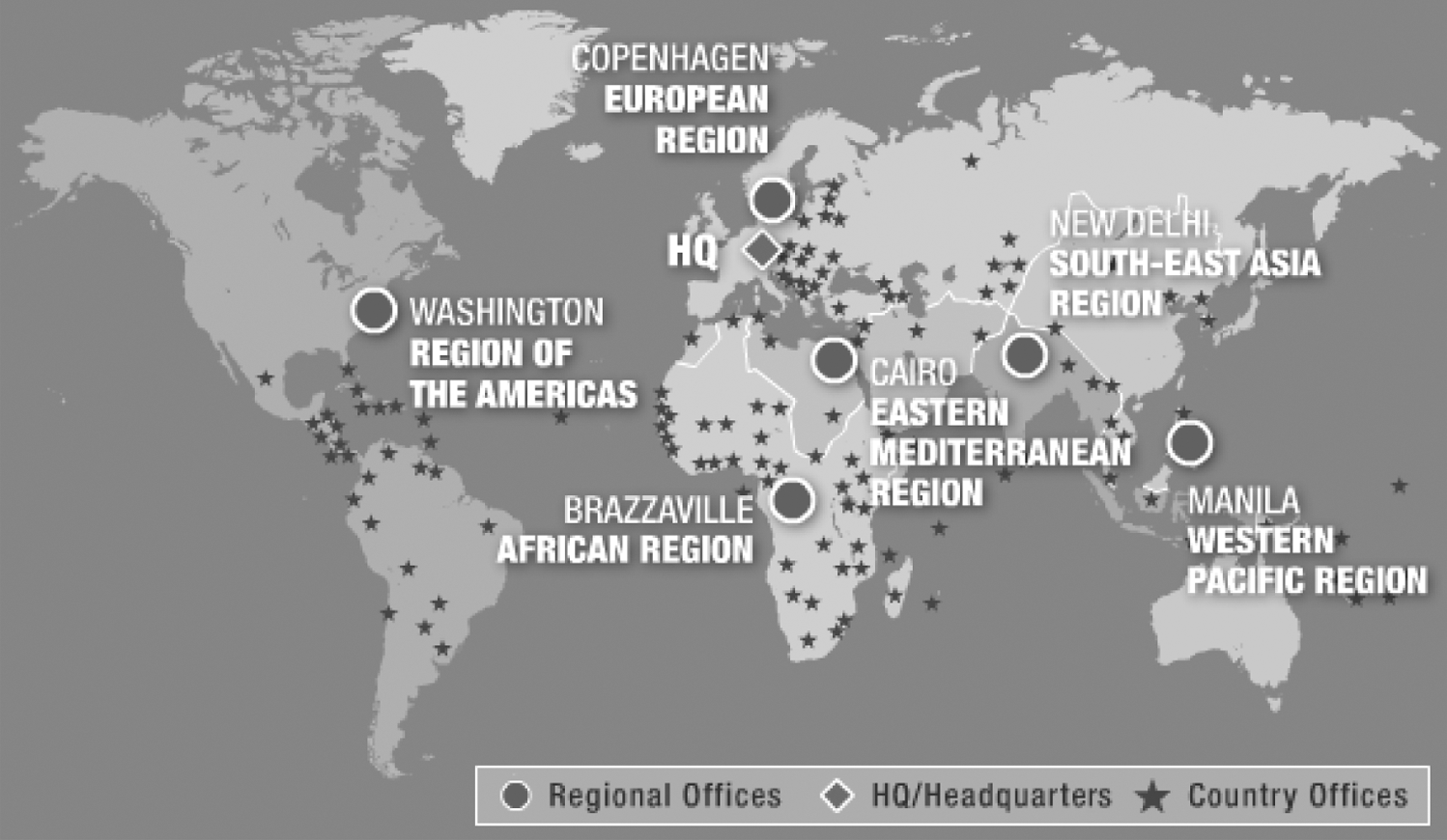
Map of World Health Organization offices.
WHO in Action—A Leader in Policy Development and Champion of Women's Health
The mandate of the WHO includes articulation of evidence-based policy options. This objective is achieved in part through the annual World Health Assembly attended by delegations from each of WHO's 193 member states. The World Health Assembly has the authority to adopt conventions, agreements, and regulations, and to make recommendations with respect to international health matters. Member states are not bound to accept these conventions or agreements but are expected to provide reasons for their rejection. 2 The Assembly is advised by an Executive Board that consists of 34 member countries elected on a 3-year cycle and has played a direct role in the promotion of policies related to women's health. The 57th World Health Assembly held in 2004, for example, resulted in the adoption of WHO's first strategy on reproductive health, Resolution WHA 57/13. 3
This strategy is in keeping with MDG 5 and was developed in response to a resolution adopted by the 55th World Health Assembly to recognize the programs and plans of action agreed to by governments at the International Conference on Population and Development in Cairo, 1994, the United Nations Fourth World Conference on Women in Beijing, 1995, and their respective 5-year follow-up review conferences, WHA 55/19, 2002. 4 It commits WHO to work with its member states to effectively promote and implement programs and policies targeting five reproductive and sexual health priorities: (1) improving antenatal, delivery, postpartum, and newborn care, (2) providing high-quality services for family planning, including infertility services, (3) eliminating unsafe abortion, (4) combating sexually transmitted infections (STIs), including HIV, reproductive tract infections, cervical cancer, and other gynecological morbidities, and (5) promoting sexual health. 2
WHO also influences policy development through its annual reports and other definitive reports on health issues prepared in consultation with experts and interagency groups. WHO's 2005 report, “Make Every Mother and Child Count,” is a clear enunciation of the organization's increasing focus on women's health and, importantly, placed the concept of the continuum of care for maternal, newborn, and child health (MNCH) at the center of renewed global efforts to strengthen primary healthcare. 5 The Women and Health report published in late 2009 similarly reflects the organization's growing commitment to women's health issues and includes policy recommendations for improving women's access to needed care at all stages of the life course. 1 In addition, the final report of the WHO Commission on the Social Determinants of Health released in 2008 has profound implications for shaping policies geared toward addressing persisting inequities in health, including those rooted in women's lack of empowerment. 6 The report's chapter on gender equity, for example, describes the importance of putting into place policies tackling social relations that perpetuate the intergenerational transfer of poverty and translate into poor health outcomes for women and girls.
WHO and Global Initiatives
WHO is participating in new global partnerships and initiatives with clear policy implications, such as the Partnership for Maternal, Newborn, and Child Health (PMNCH) launched in 2005 and the Countdown to 2015 (
In 2008, the Countdown to 2015 findings were shared and discussed with Parliamentarians participating in the 118th Inter-Parliamentary Union (IPU) Assembly in Cape Town, South Africa. (Parliamentarians are members of the legislature in countries whose system of government is based on a Westminster model, for example, United Kingdom, Italy, Zambia, and many others.) This led to a commitment by Parliamentarians to take appropriate measures in their respective countries and report back on progress made in successive IPU Assemblies. 10 WHO, along with other UN agencies (UNICEF, UNFPA, World Bank) and the PMNCH, has played a key role in engaging Parliamentarians in the Countdown effort and in communicating with priority and donor countries about the policy relevance of the Countdown findings.
Such initiatives as Countdown to 2015 are providing new opportunities for the WHO to influence legislation and inform policymakers about women's health. Specifically, they are enabling WHO to develop advocacy messages based on the latest available evidence as a means of promoting political commitment to MDGs 4 and 5. Other innovative practices are being adopted by WHO to foster greater political action for women's reproductive and sexual health. These approaches build off the work of civil society organizations and local leadership and complement the top down formal approaches to developing policy recommendations/guidelines the WHO engages in.
Innovative Approaches: A Partnership with Italy's Parliamentarians and Women's Health Organizations
Establishing partnerships between the WHO and women's health organizations has the potential to bring about the development of ideas for comprehensive policies reflective of the needs of women and children on the ground. Ideas generated through this collaborative process can then be presented to legislators and public officials in the form of concrete and well-articulated proposals. This is the strategy that WHO Department of Reproductive Health and Research (RHR), the PMNCH, and the National Observatory for Women's Health (ONDa), an Italian nongovernmental organization (NGO), are using to improve the health of women and children both in Italy and globally.
The first step in implementing this strategy involved reviewing and identifying key issues that could be presented and discussed in a meeting with a bipartisan group of Italian Parliamentarians working with ONDa. On January 23, 2009, the first annual meeting with this group of legislators was held at WHO headquarters. The meeting was jointly organized by RHR, PMNCH, ONDa, the Permanent Mission of Italy to the United Nations Office, and other international organizations based in Geneva. Two key issues were discussed: (1) the alarming rise in cesarean sections in Italy and (2) the importance of increasing development aid for the achievement of MDGs 4 and 5, even at a time of global financial crisis and particularly in African countries.
Italy's national cesarean section rate is 38.5%, a figure far exceeding the 10%–15% referred to by WHO as an upper threshold for medically indicated cesarean sections. 11 Among others, two factors are believed principally responsible for the escalation of surgical deliveries in Italy: the lack of legal provisions ensuring the routine availability of analgesics during labor and delivery and practitioners' fear of malpractice litigation and the burden of shouldering all associated legal costs.
In relation to development aid, critical voices have highlighted that the G8 nations are not all delivering the development aid committed to at the 2005 Gleneagles Summit. 12 (The G8 is a forum established in 1975 of 8 governments: Canada, France, Germany, Italy, Japan, Russia, the United Kingdom, and the United States. The heads of government of the G8 countries meet annually at a summit hosted by one member state on a rotational basis. The host country sets the summit agenda and the ministerial meetings to be held throughout the course of the year.) At present, Italy contributes to several international initiatives, such as the Global Fund to fight HIV, Tuberculosis and Malaria, which was launched at the Genoa G8 Summit in 2001, and the Global Alliance for Vaccines and Immunization. Italy also supports activities of the UN agencies and NGOs working at the country level and recognizes the need to progressively increase the portion of its gross domestic product (GDP) allocated to development assistance in order to sustain these activities.
To address these two issues, the Italian Parliamentarians participating in the January 2009 meeting agreed to work together as the Italian Women Parliamentarians for Reproductive Health Group to draft and submit two parliamentary resolutions. Senator Laura Bianconi led the effort to develop a resolution introducing legislation to create conditions supportive of a reversal in the increasing trend toward cesarean deliveries in Italy (e.g., giving all women the option of analgesia during labor), and Senator Rossana Boldi spearheaded the drafting of a resolution to ensure Italy delivers on its commitments to provide development assistance, particularly for MNCH. The process of developing the Italian international aid resolution was presented as a case study by Senator Barbara Contini during a special session on the Countdown to 2015 effort at the 120th Inter-Parliamentary Union meeting in Addis Ababa, Ethiopia, April 2009.
Both resolutions were approved by the Italian Parliament and favorably received by the government on June 9–10, 2009, including a pledge to progressively increase the percentage of GDP allocated to development assistance by 2015 and to concentrate this assistance on efforts to reduce maternal, newborn, and child mortality at the local level. 13 The passage of the two resolutions heralds an important turning point in Italy's willingness to prioritize the lives of women and children around the world.
The second meeting of the Italian Women Parliamentarians for Reproductive Health, held in Geneva in February 2010, called for political action to maintain and increase financial support for MDGs 4 and 5 and the development of a project on modes of delivery (cesaran vs. vaginal) in Italy. The emergence of breast cancer as a global women's health issue characterized by large geographical and socioeconomic inequities in access to care was also discussed.
The successful and ongoing efforts of the Italian Women Parliamentarians for Reproductive Health group are testament to the potential impact collaborative initiatives, facilitated by UN agencies like WHO, can have on mobilizing high-level politicians to take action to improve women's and children's health. The ability of healthcare providers to adhere to guidelines and implement best practices related to the achievement of MDGs 4 and 5 hinges on the existence and enforcement of a supportive legal framework. Politicians are responsible for putting into place such a framework that will create the conditions needed to simultaneously improve medical practices and health-seeking behaviors at the community level. The Italian Women Parliamentarians for Reproductive Health initiative has proven to be an important step to sensitizing Italian politicians about the pivotal role they play in safeguarding women's and children's health at home and abroad.
Conclusions
In response to the evidence that MDG 5 is the MDG showing the least progress, the G8 Health Experts Group under the Italian Presidency developed a document highlighting gaps in women's health that informed the discussion on health issues at the G8 Summit in 2009. This document, prepared in collaboration with experts from the other G8 countries and the European Union, succeeded in stimulating debate and much needed action for women's health. Canada, the host of the 2010 G8 summit, has built on this momentum and took strong actions to ensure that the G8 countries continue prioritizing the achievement of MDG 5. The G8 Millennium Development Goal summit, held on September 20–22, 2010, in New York, was also informed by a recent academic analysis of maternal mortality estimates that showed that progress in reducing maternal deaths in a short period of time is possible but that accelerated efforts are still needed for the world to achieve the MDG 5 targets. This analysis highlighted the particular importance of policies that guarantee pregnant women's access to HIV services in high HIV prevalent countries as a key strategy for reducing maternal mortality. 14
The months following the 2010 G8 Summit and launch of the Global Strategy for Women's and Children's Health
What matters most to me is people. And two specific groups of people in particular. I want us to be judged by the impact we have on the health of the people of Africa and the health of women. … Improvements in the health of the people of Africa and the health of women are key indicators of the performance of WHO.
Footnotes
Disclosure Statement
The authors have no conflicts of interest to report.