







Abstract
Background:
Online education is not new. Their main options are talks, videos, and virtual courses. The quality and quantity of talks, together with the level of the speakers, is variable and heterogeneous. The arrival of the COVID-19 pandemic accelerated this process. The objective of this study was to analyze the result of a questionnaire on the current state of online education.
Methods:
Retrospective descriptive observational study based on a questionnaire. The participants consulted were Latin American physicians with different specialties.
Results:
A total of n = 361 participants were recruited. 26.9% had between 6 and 15 years of work experience. 63.1% carried out teleconsultation with their patients, and 96.1% attended between 1 and 10 talks/courses/webinar during the pandemic, whereas 1.6% did not attend any. “Talks” given received a rating of “Very Good” by 51.2%, and a 59.5% considered that the “Hybrid” option would be the best modality for future medical congresses in the postpandemic era. 84.7% considered that other possibilities of online teaching and online surgical training should be explored.
Conclusion:
Online education has marked the way of transmitting knowledge in recent years. It has been well accepted by those attending academic meetings.
Introduction
Online education is not new. It has been implemented for years, although intermittently. The main options are talks, videos, and virtual courses. The accessibility and the form of contact between students and organizers is simple, but we do not know its true academic scope. 1 Quality and quantity of the talks, along with the level of the speakers, is variable and heterogeneous. The COVID-19 pandemic accelerated this process, but did not solve current problems.2–4
In this study, we analyze a survey carried out on students who attend different types of online education in relation to its usefulness and possible changes necessary for its better use.
Objectives
The objective of this study was to analyze the result of a questionnaire on the current state of online education.
Material and Methods
Retrospective descriptive observational study based on an anonymous questionnaire carried out by the DAICIM Foundation (Buenos Aires, Argentina) from August to October 2020. The participants consulted were Latin American physicians with different specialties. The following variables were analyzed: professional experience, attendance at online academic activities, and opinion about expectations for the future of education.
The questionnaire was based on eight multiple-choice questions, grouped into three items: health care (two questions), academic (two questions), and future in education (four questions) (Fig. 1).
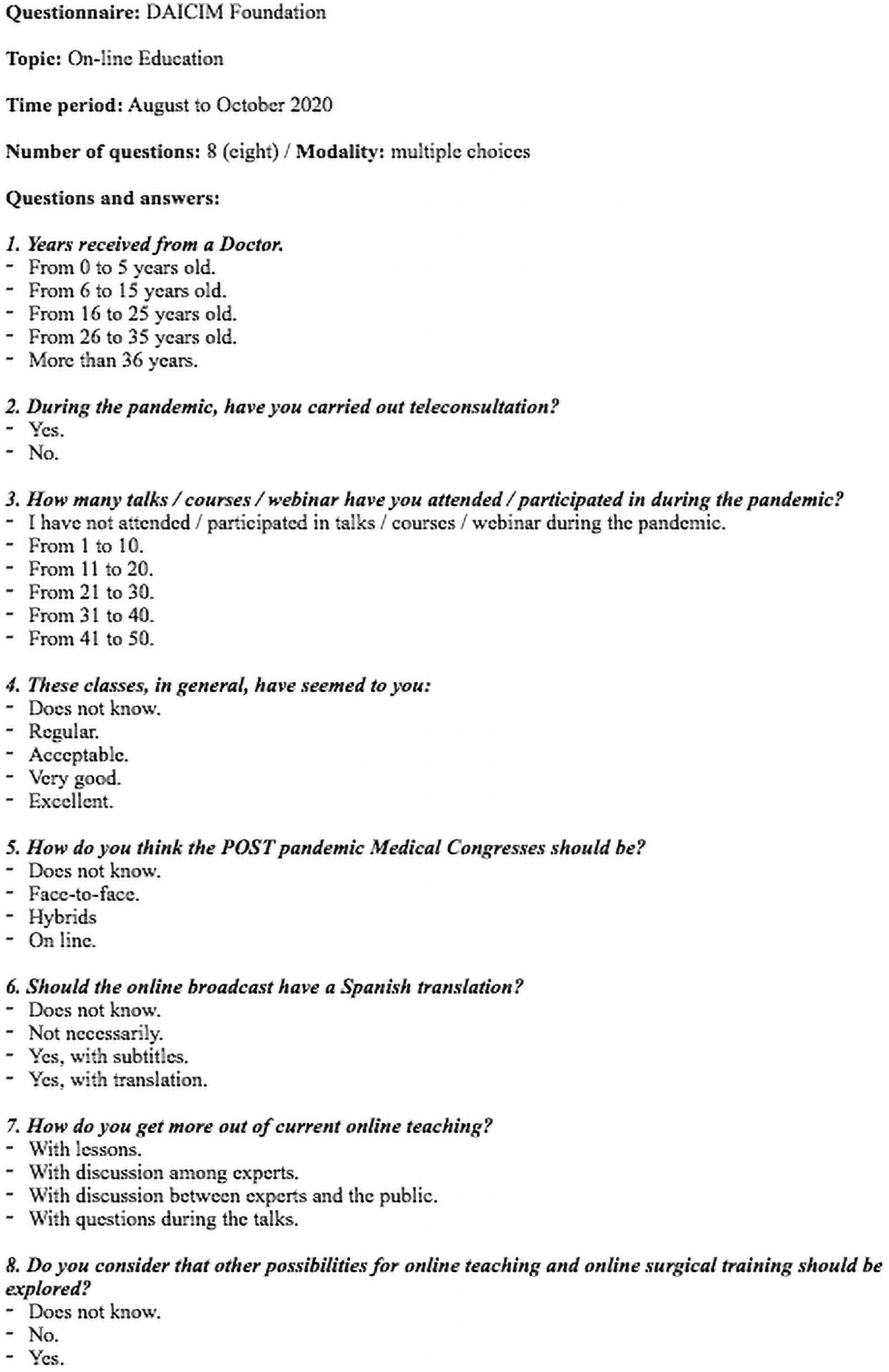
Questionnaire.
Results
A total of n = 361 participants were recruited. Most of the interviewees (26.9%) had between 6 and 15 years of work experience (Fig. 2). 63.1% (228 ± 0.48) carried out teleconsultation with their patients, whereas 36.9% (133 ± 0.48) did not.
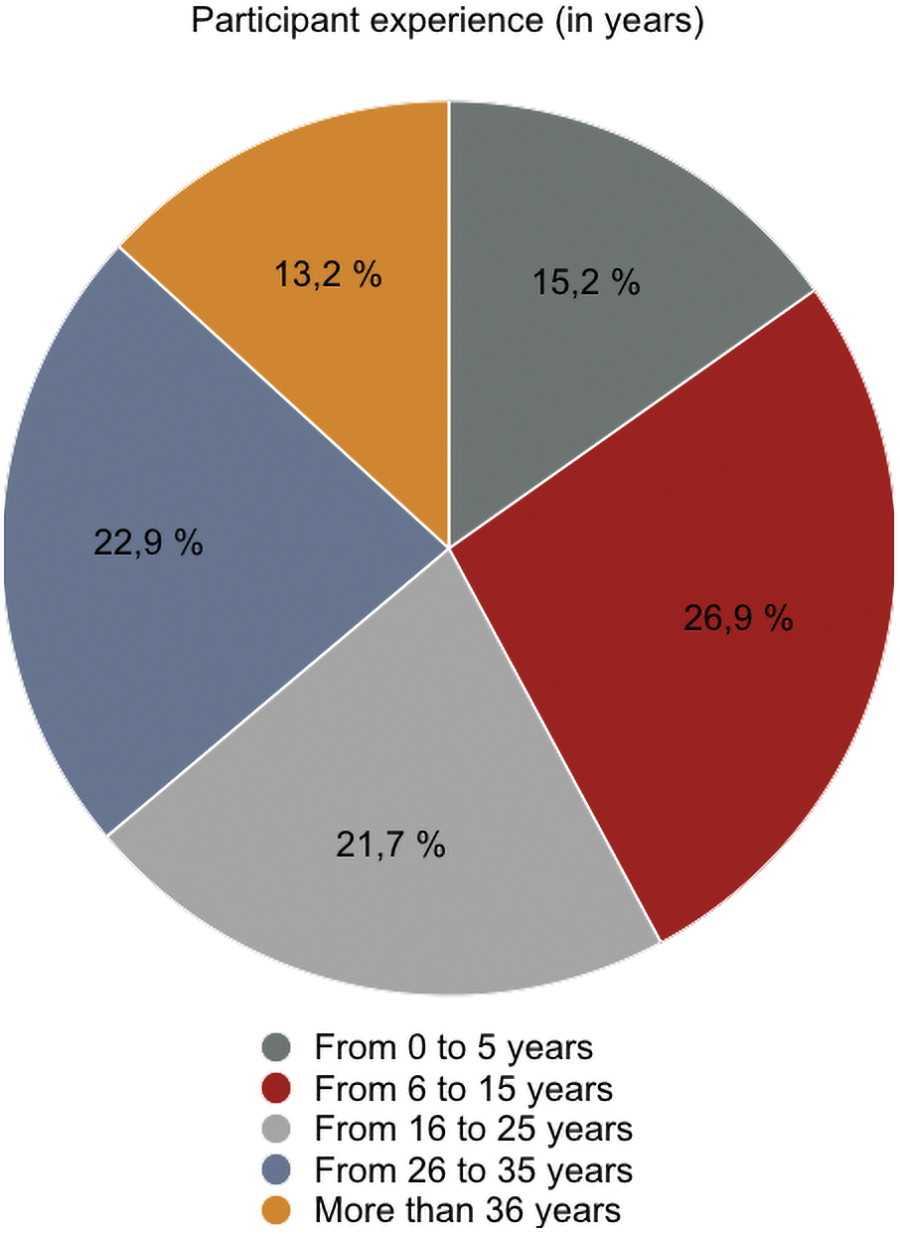
Professional experience of the interviewed participants expressed in years. Color images are available online.
96.1% (347 ± 0.19) of those questioned attended between 1 and 10 talks/courses/webinar during the pandemic, 1.4% (5 ± 0.11) between 11 and 20, and 0.8% (3 ± 0.09) to >31, whereas 1.6% (6 ± 0.12) did not attend any. The talks given received a rating of “Very Good” by 51.2% (185 ± 0.50) (Fig. 3).
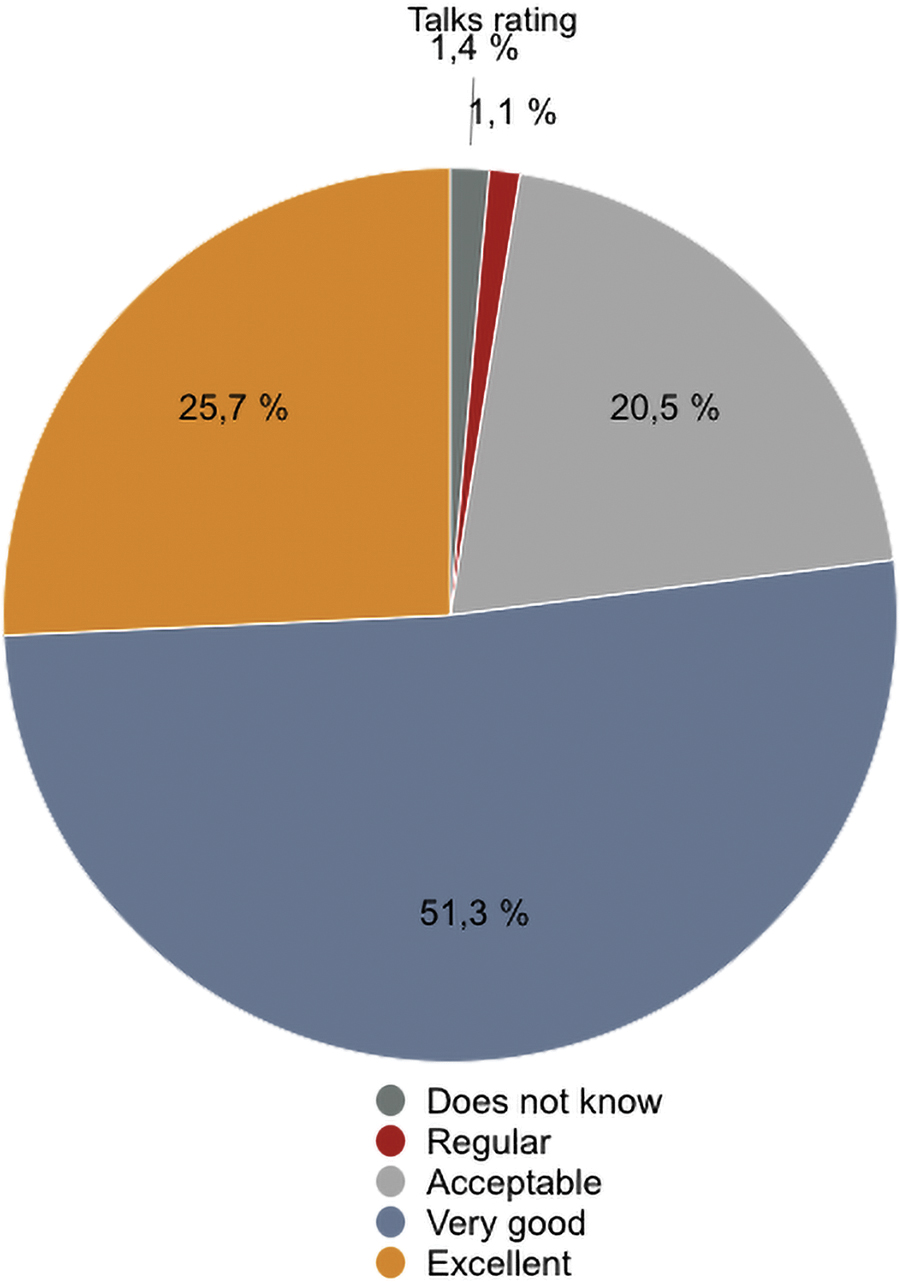
Rating of the online classes attended by the interviewed participants. Color images are available online.
Regarding the modality of the congresses in the postpandemic era, 59.5% (215–0.49) considered that the “Hybrid” option would be the best, whereas 20.7% (75–0.40) agreed that it should follow the format traditional “face-to-face” (Fig. 4). No clear trend was observed in relation to the interaction between the experts and the attendance auditorium during the talks, although the majority preferred a discussion between both factions (Fig. 5). Regarding language, the majority stated that there should be a translation into the local original language with subtitles (78.4% ± 0.41–283) (Fig. 6). Finally, the vast majority comprising 84.7% (306 ± 0.35) considered that other possibilities of online surgical teaching and training should be explored, whereas 4.4% (16 ± 0.20) did not believe it necessary, and 10.8% (39 ± 0.30) did not know.
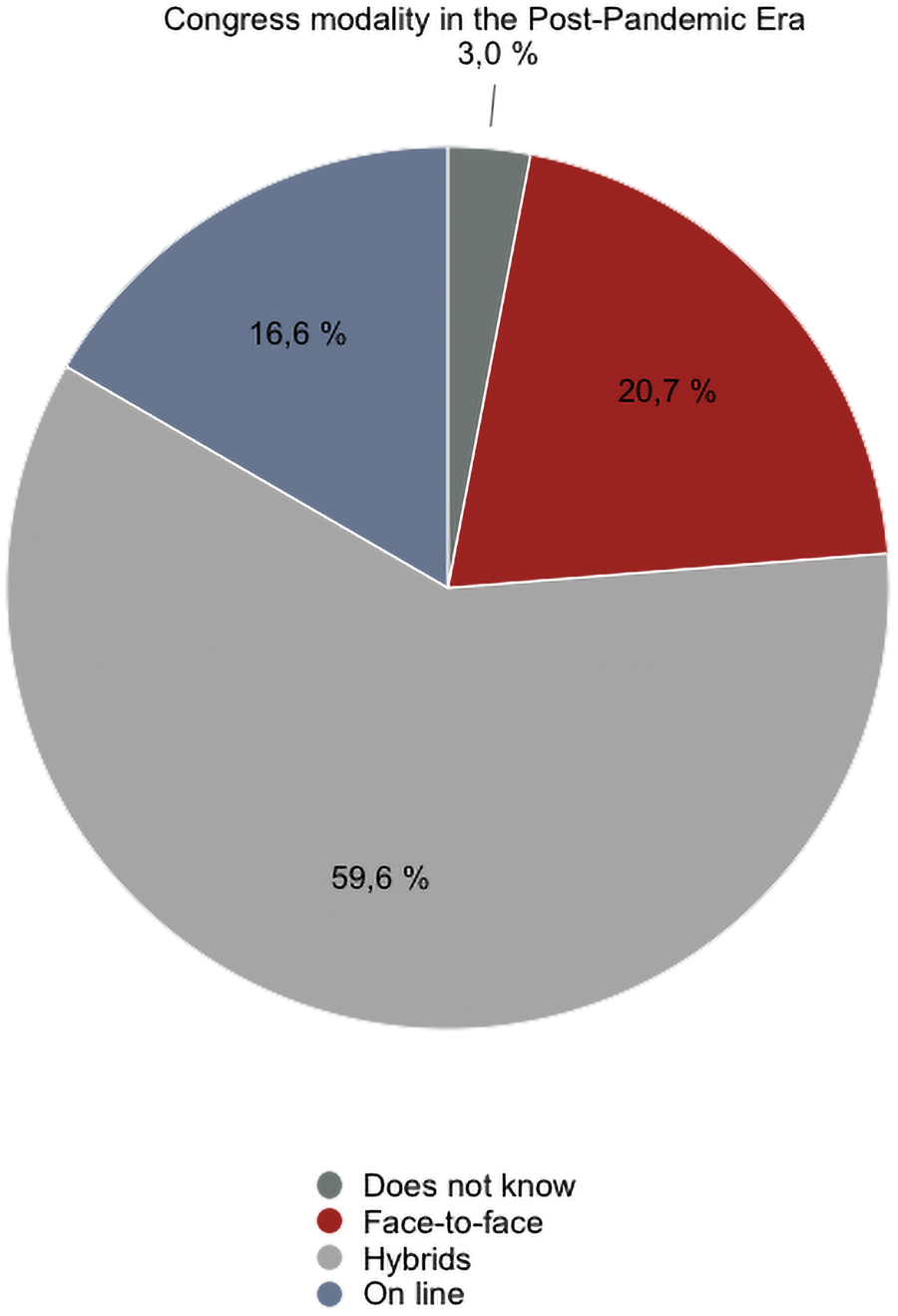
Considerations by the participants of the modality of medical congresses in the postpandemic era. Color images are available online.
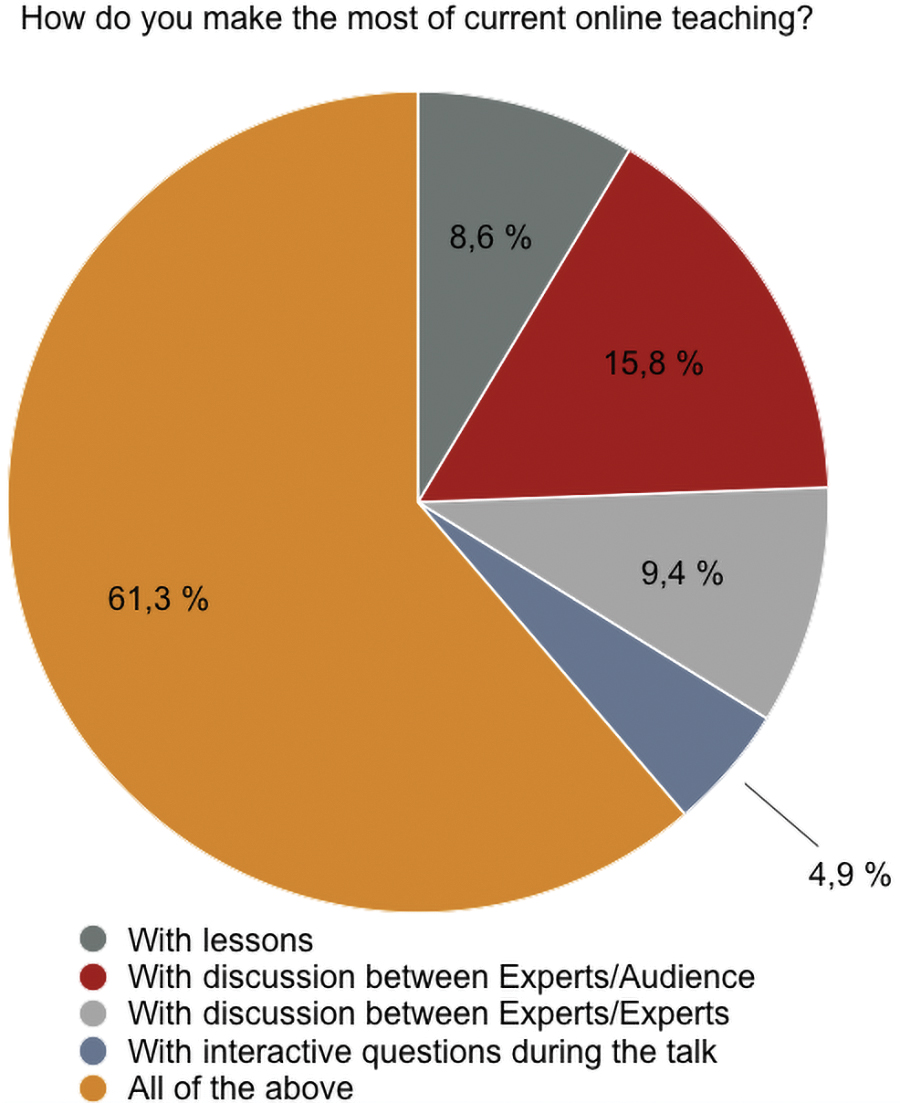
Opinion of the interviewees about the preferences regarding the characteristics of the online lessons. Color images are available online.
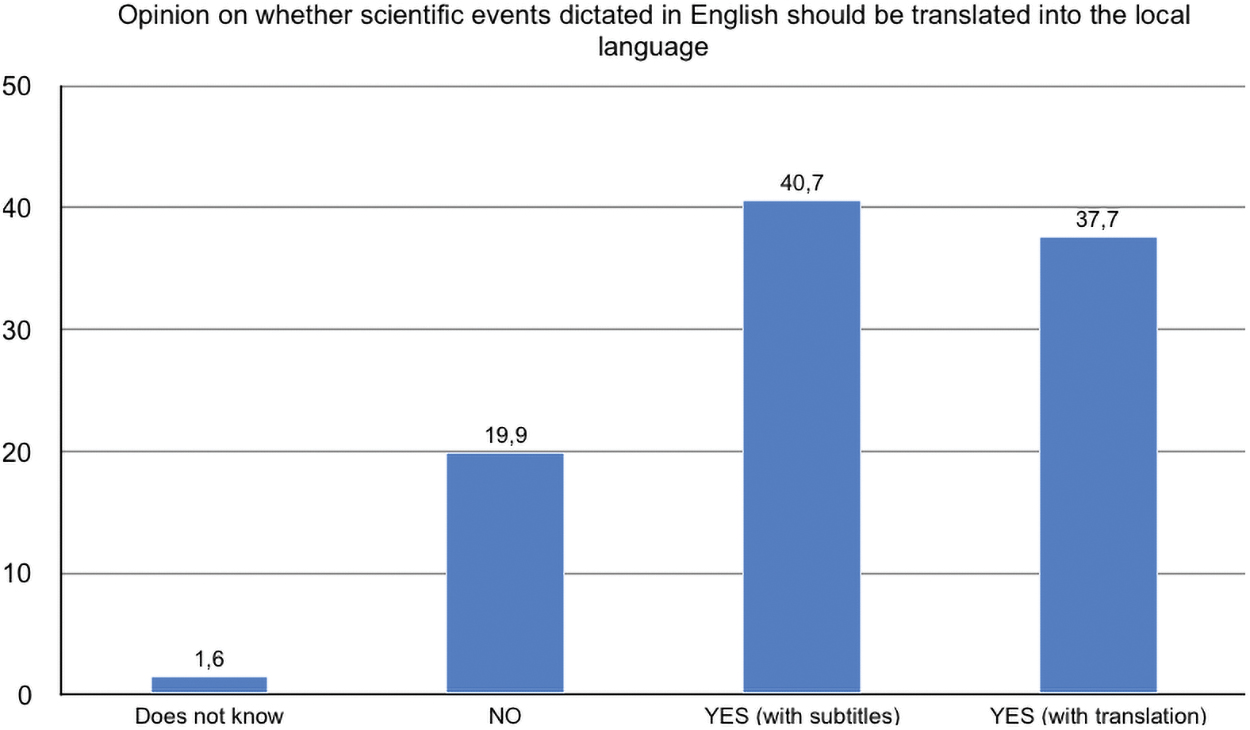
Relationship between the English language and its translation into the local original language in future online scientific events. Color images are available online.
Discussion
Not many years ago, in the scientific academic world, the way to keep up to date was to attend congresses, seminars, and workshops in different places in the same country or in the world. A large number of institutions have invested in building structures, technologies, and in trying to summon world leaders on specific medical issues. 5 All these factors come together in such a way, resulting in a hierarchical scientific education that is costly, both for the organizers and for those attending these events. The natural consequence of this situation is a great limitation for many physicians who want to obtain a certified and quality education. Educational programs must achieve minimum standards and be evaluated according to the Kirkpatrick's pyramid model. 6 In fact, students are likely to be analyzed and qualified by artificial intelligence in the near future. These data obtained by correct feedback will allow them to analyze their personal academic progress and compare it with the general average.
Online education could allow great teachers to interact with students from all over the world, only through a computer connected to the internet. 7 But this alone is not enough. To take full advantage of this revolution in online education, talks, seminars, and congresses must be adapted to the current needs of students and not to the comforts of speakers8,9 (Fig. 7). The evolution in telecommunications has facilitated the diffusion of scientific research and works at a global level.10–13 Furthermore, it has allowed fluid contact of doctors with each other, and between the doctor and the patient. 14 In this study, we observed that >60% of the respondents had carried out teleconsultation with their patients, reflecting an important relationship on the part of medical personnel with telecommunications. This could have a favorable impact not only on the attention to the needs of the patients, but also on the benefits taking into account the academic point of view.15,16 So much so that >75% of the participants attended at least one online academic activity in the last time. This same group considered that future scientific meetings should have an online component and not be totally face-to-face, which could be setting a trend in the organization of medical meetings in the coming years. Along these lines, most of the participants considered that not only distance education should be exploited in this decade, but also that online surgical training should be, which represents a real challenge for the organizations in charge.17,18 In the same way, it should be noted that language is no longer a barrier.
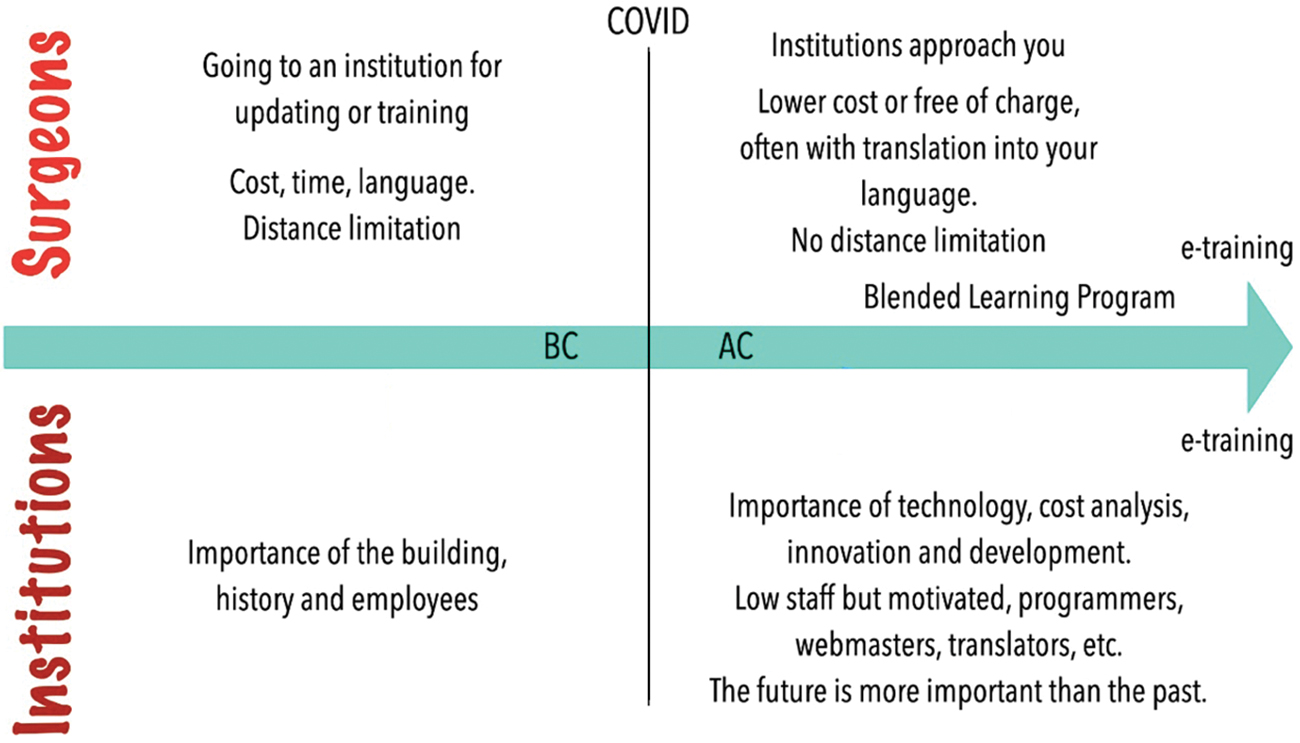
Evolution of education through the COVID pandemic (this scheme is focused on surgeons). AC, after COVID; BC, before COVID. Color images are available online.
We believe that the current concept is that online education, enhanced by the pandemic, was already among us. New forms of online education must be sought. It is not correct to say “distance education,” because it is exactly the opposite, and distances are shortened by technology. This is a possibility of bringing together those who create the knowledge with those who apply it, despite the fact that there is a great geographical distance between them, avoiding costly trips or transfers. For this reason, those who invested in buildings were probably wrong.
This study presents some limitations. The low number of participants, the heterogeneity of the respondents in relation to their experience in medical and scientific activities, and the lack of homogeneity of the courses they attended can be listed.
Conclusion
Online education has marked the way of transmitting knowledge in recent years. It has been well accepted by those attending academic meetings. Its activity must continue to be exploited, since it will represent the main teaching manner of medical education in the coming years.
Footnotes
Disclosure Statement
No competing financial interests exist.
Funding Information
No funding was received for this article.