







Abstract
The DNA fragment encoding predicted main antigenic region, aa 14–245 on N protein of Rift Valley virus (RVFV) was cloned into the vector pET-28a (+) and p3xFLAG-CMV-10. The recombinant pET-28a-N1 protein was expressed in Escherichia coli BL21 (DE3) with 1 mM isopropyl-b-thio-galactopyranoside at 37°C for 5 hours, and purified by protein purifier. Three monoclonal antibodies (mAbs) named 3A5, 3A6, and 3A7 against N protein were obtained by fusing mouse myeloma cell line SP2/0 with spleen lymphocytes from pET-28a-N1 protein-immunized mice. Finally, the mAbs were characterized by enzyme-linked immunosorbent assays, indirect immunofluorescent assays, and Western blot. The results show that all the mAbs possess high specificity and react with both prokaryotic and eukaryotic N protein, which could provide important materials for the research on the function of N protein and the diagnostic methods of RVFV.
Introduction
Rift Valley Fever (RVF) disease is a serious mosquito-borne zoonosis caused by Rift Valley Fever virus (RVFV). It can cause massive deaths in ruminants and fatal hemorrhagic fever in humans. RVF was first reported in Kenya in 1912 and was endemic throughout eastern Africa.(1) RVFV was isolated from dead sheep in 1931.(2) In the year 1977, the initial case of RVF in Egypt was detected,(3) which brought great harm to the local area. In 2000, RVF epidemics spread to Eurasia, and then erupted in Saudi Arabia and Yemen.(4) Since then, the range of RVF epidemics was enlarged. In recent years, with the increasing frequency of international communication, the prevalence area of RVF epidemics was further expanding and aroused world-wide attention.
RVFV is a single strand negative-sense RNA virus, belonging to the family Phenuiviridae, genus Phlebovirus.(5) RVFV genome size is 10.4 kb and is segmented into three different genes: L gene (6.4 kb ), M gene (2.3 kb ), and S gene (1.7 kb ).(6) L gene encodes endonuclease and RNA-dependent RNA polymerase. M gene encodes precursor capsule glycoprotein G, and S gene mainly encodes nucleocapsid protein N and nonstructural protein NSs.(7) Among them, N protein is very conservative and expressed in large quantities after viral infection, which can induce large amounts of antibodies.(8) Because of that, N protein is widely used in detection of RVFV, although it does not induce neutralizing antibodies.(9,10)
Given the severity of RVF and its increasing prevalence, a diagnostic approach is urgently needed.(11) In this study, the main antigen region of N protein was selected to generate monoclonal antibodies (mAbs), which could provide important materials for the research on the function of protein and the diagnostic methods of RVFV.
Materials and Methods
Plasmid construction and protein expression
Through epitope prediction and hydrophilicity analysis, the 14–245 amino acids at the N-terminal of N protein were selected for amplification. The template of N protein (GenBank:MF593930. 1) was synthetized with codons optimization by Sangon Biotech (Shanghai) Co., Ltd., and forward primer: 5′-CGCGGATCCATGGATAACTATCAGGAACT-3′; reverse primer: 5′-CCGCTCGAGTCAGGCGGCGGTCTTGTAGGC-3′. Then, the target gene was cloned into the pET-28a (+) vector that was used in the Escherichia coli protein expression system. The recombinant plasmid, named pET-28a-N1, was then transformed into competent E. coli BL21 (DE3) cells and induced by 1 mM isopropyl-b-thio-galactopyranoside (IPTG) at 37°C for 5 hours. pET-28a (+) was used as control plasmid and induced under the same condition. The bacteria pellet was harvested and resuspended by phosphate-buffered saline (PBS). After ultrasonication, the broken bacteria were obtained for sodium dodecyl sulfate polyacrylamide gel electrophoresis (SDS-PAGE) and Western blot. Results showed that the protein was expressed in the bacterial fragmentation supernatant, which can be further purified by protein purifier. Finally, the purified protein was divided into small aliquots to be stored at −80°C for subsequent experiments.
mAb production
The mAbs against the N protein were produced according to our laboratory methods.(12) As hereunder, 6- to 9-week-old female SPF BALB/c mice purchased from the Laboratory Animal Center of Huazhong Agricultural University were immunized with 50 μg purified protein at 2-week intervals after the protein and Freund's adjuvant were emulsified in a 1:1 volume ratio. The procedure included three times immunizations followed by a final booster injection. The first immunization was given with a complete Freund's adjuvant, the second and third immunizations were given with an incomplete Freund's adjuvant, and the final immunization was given with no Freund's adjuvant. Then mice splenocytes were harvested and fused with SP2/0 using PEG4000. The positive hybridoma cells that were screened using enzyme-linked immunosorbent assay (ELISA) and Western blot were cloned by a limiting dilution. After three times limiting dilution, the 105–106 hybridoma cells secreting antibodies stably were injected into liquid paraffin-pretreated abdominal cavities of BALB/c mice. Ten days later, the ascites that contain mAbs were harvested and characterized by ELISA, Western blot, and indirect immunofluorescence assay (IFA). The Research Ethics Committee of the College of Veterinary Medicine of Huazhong Agricultural University approved the animal experiments described herein.
Indirect enzyme-linked immunosorbent assay
In total, 1 μg/mL purified protein was coated overnight at 4°C in the 96-well ELISA plate by carbonate buffer solution (pH 9.6). The wells were washed with PBS containing 0.05% Tween-20 (PBST) one time and blocked with 1% bovine serum albumin (BSA) in PBS (PBSA) for 0.5 hours at 37°C, then drained and incubated with 100 μL/well twofold mAb dilutions in PBSA (from 1:200 to 1:6,553,600) for 2 hours at 37°C. After washing three times, horseradish peroxidase (HRP)-conjugated goat anti-mouse immunoglobin G (IgG) was added for 0.5 hours at 37°C. After washing, the wells were incubated with 50 μL/well substrate solution A (0.1 M citrate/phosphate buffer [pH 5.0]) and 50 μL/well substrate solution B (0.04% o-phenylenediamine; 0.14% H2O2) for 10 minutes at room temperature. The reactions were terminated by adding 50 μL/well 2 M H2SO4, and optical densities were measured at 630 nm.
Immunofluorescence assay
The primers used to amplify RVFV N gene here were synthesized with forward primer: 5′-CCCAAGCTTATGGATAACTATCAGGAACTGGCCAT-3′; reverse primer: 5′-CGGGGTACCGGTCAGGCGGCGGTCTTGTAGGCCT-3′. The target gene was cloned into the p3xFLAG-CMV-10 vector, and the recombinant plasmid named p3xFLAG-CMV-10-N1 was transfected into hela cells when the cells reached 70%–80% confluence. At 48 hours post-transfection, the cells were processed with absolute methanol for 10 minutes. After washing three times by PBS, the wells were drained and blocked by 1% BSA in PBS (PBSA) for 30 minutes, then incubated with 1 μL mAb diluted by 500 μL PBS for 2 hours at room temperature followed by AlexaFluor 488-labeled goat antimouse IgG. Fluorescent images were measured using fluorescent microscope (Zeiss).
Western blot analysis
The hela cells were transfected with p3xFLAG-CMV-10-N1 plasmid for 48 hours, then, cell lysates were collected and separated by SDS-PAGE together with pET-28a-N1 protein, and then transferred to nitrocellulose membranes. The membranes were blocked for 2 hours with 2% BSA in TBST buffer (0.01 M Tris–HCl [pH 8.0], 150 mM NaCl, and 0.05% Tween-20) before being reacted with a 1:500 dilution of mAbs for 2 hours. After washing three times by TBST, HRP-conjugated goat antimouse IgG (Southern Biotechnology, Birmingham, AL, USA) secondary antibodies (dilution of 1:3000 in blocking solution) were incubated with membranes for 0.5 hours at 37°C. After washing three times, the specific band was visualized by enhanced chemiluminescent reagent (Thermo Fisher Scientific).
Identification of mAb isotype
The subtype identification kit (BF16002X; Beijing Biodragon Immunotechnologies Co., Ltd.) was used to identify the subtypes of the mAbs.
Results
Expression of recombinant RVFV N protein
The recombinant plasmid pET-28a-N1 was transformed into competent E. coli BL21 (DE3) cells to express recombinant protein according to our previous method.(12) SDS-PAGE and Western blot results showed that recombinant RVF N1 protein was presented in the bacteria supernatant (Fig. 1A, B). The N1 protein was purified by Nickel column. As shown in Figure 1C, the purified N1 protein was of high purity and the molecular weight of recombinant protein was ∼28 kDa.
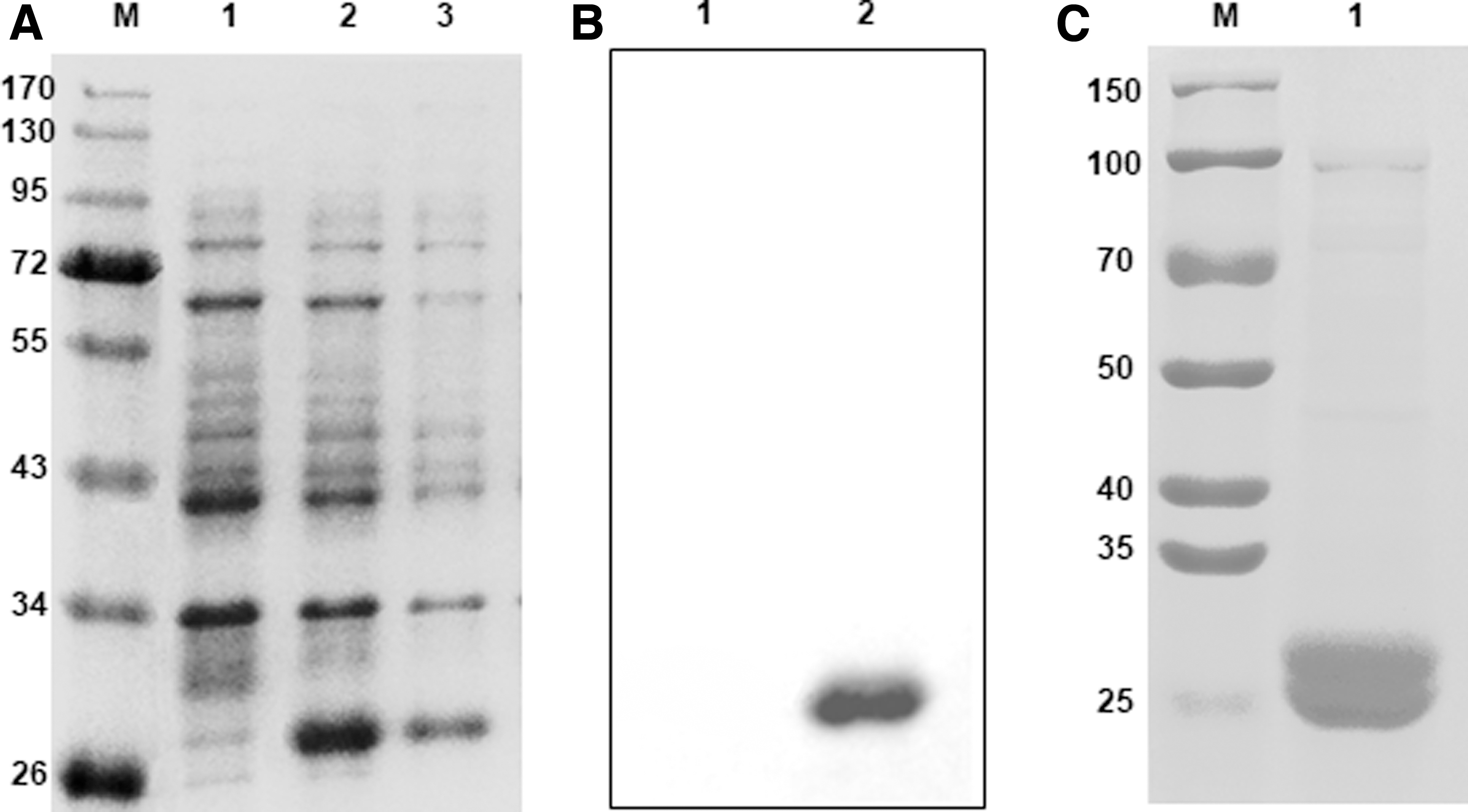
The expression and purification of recombinant protein pET-28a-N1.
Production of mAbs against RVFV N protein
After subcloning three times by limiting dilution, three mAbs (named 3A5, 3A6, and 3A7) against N protein were obtained and further characterized by ELISA, Western blot, and IFA.
Indirect ELISA and mAb isotype identification
The titers of mAbs purified from the ascites were determined by indirect ELISA. The mAbs were diluted from 1:200 to 1:6,553,600. The titers of 3A5, 3A6, and 3A7 were 1:409, 600, 1:819, 200, and 1:1, 638, 400 respectively. The isotypes of these mAbs were all characterized to be IgG1 + Kappa subclass (Table 1).
Detection and Characterization of Monoclonal Antibodies
ELISA, enzyme-linked immunosorbent assay; mAbs, monoclonal antibodies.
Immunofluorescence assay
The recombinant plasmid p3xFLAG-CMV-10-N1 containing full-length N1 gene was transfected into hela cells when the cells reached 70%–80% confluence. mAbs of 3A5, 3A6, and 3A7 as primary antibodies were incubated with cell wells, respectively, and then AlexaFluor 488-labeled goat antimouse IgG as secondary antibody. The result demonstrated that all strains of mAbs showed specific green fluorescence, whereas negative control cells did not show any fluorescence (Fig. 2).
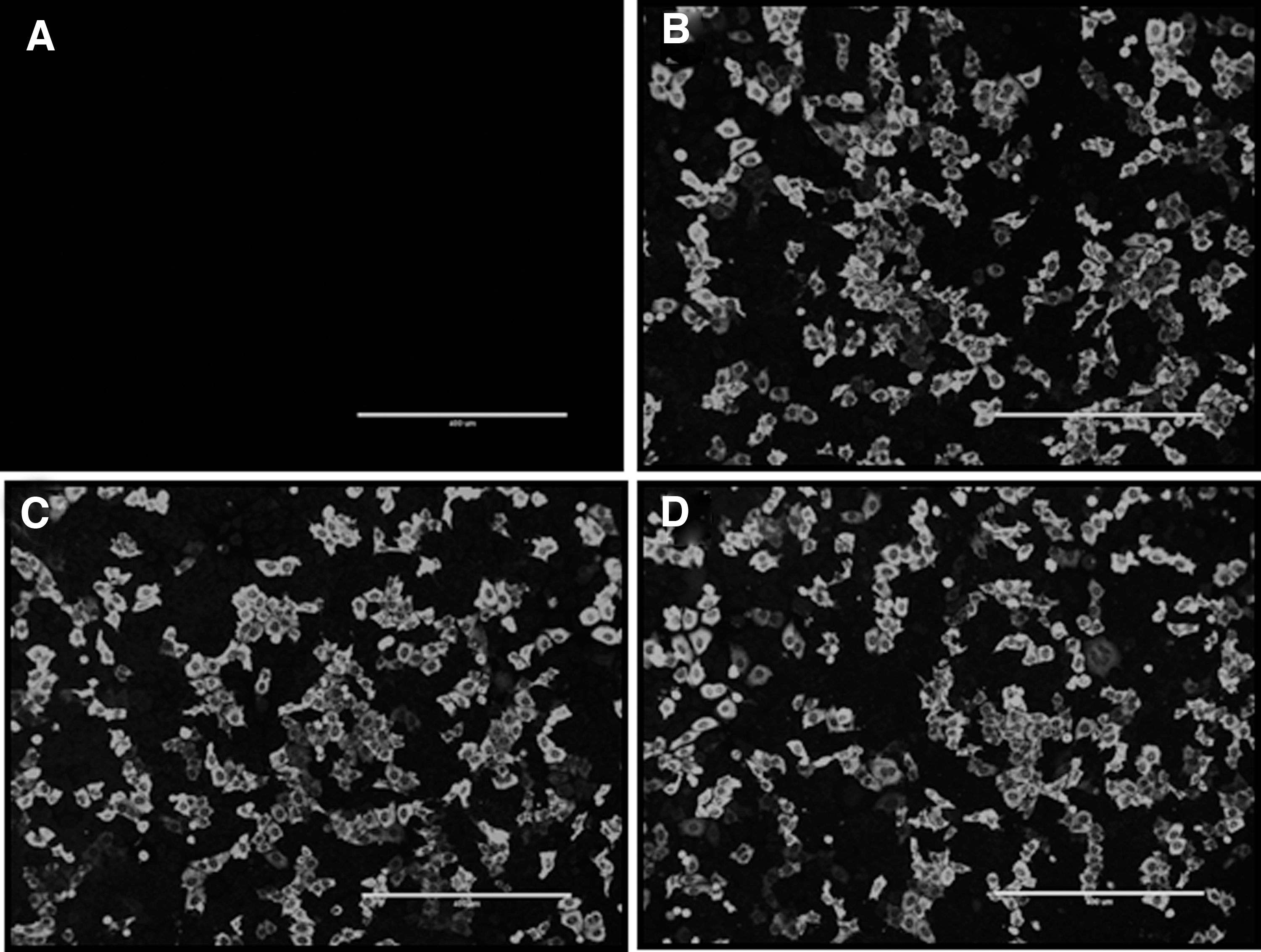
IFA of hela cells transfected p3xFLAG-CMV-10-N1 plasmid with different mAbs.
Western blot analysis
Western blot assay was applied to analyze the specificity of mAbs. The results showed that all strains of mAbs specifically reacted with the pET-28a-N1 protein (Fig. 3A), whereas no reaction was observed with p3xFLAG-CMV-10-N1 protein that was linearized (Fig. 3B).
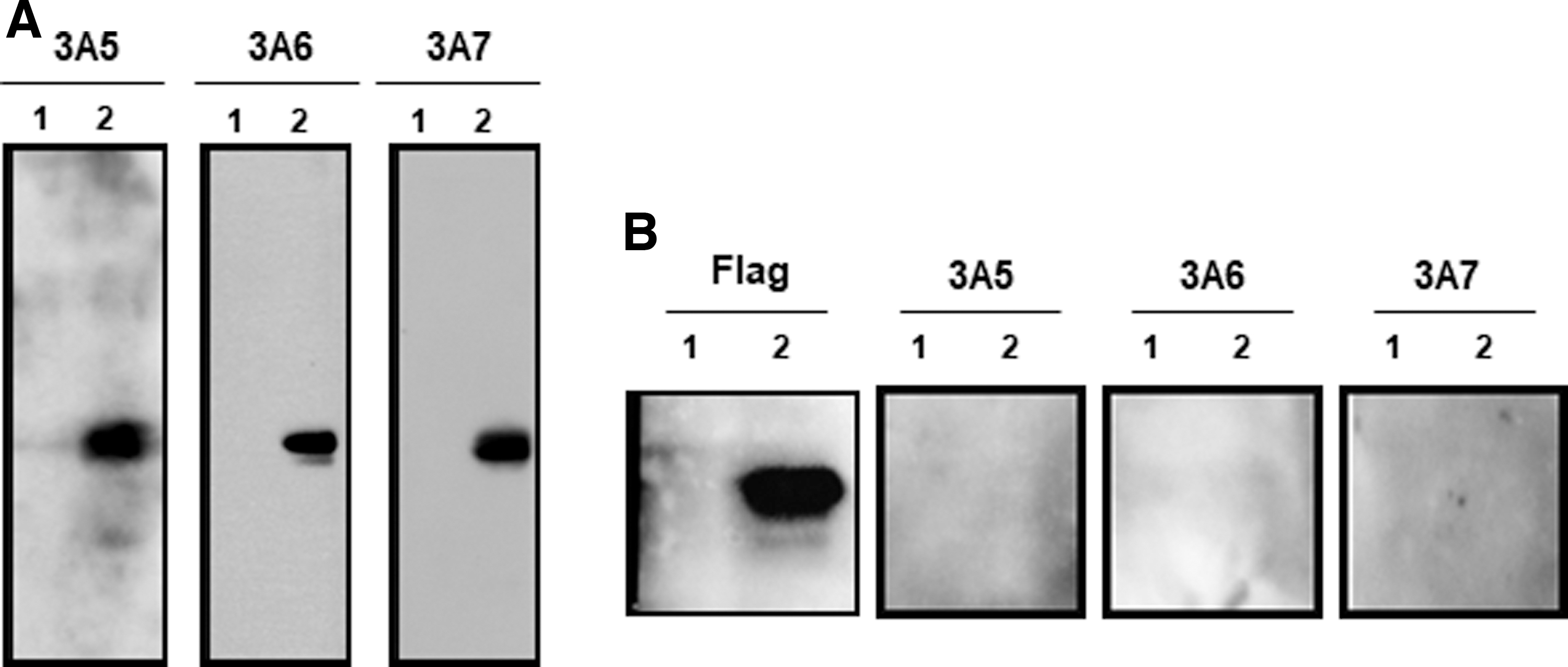
Western blot analysis of monoclonal antibodies against N protein. pET-28a-N1 prokaryotic protein and p3xFLAG-CMV-10-N1 eukaryotic protein were separated by SDS-PAGE and transferred to nitrocellulose membranes.
Discussion
RVF is a highly harmful and contagious disease caused by RVFV. Studies had reported that RVFV was found in mosquitoes, ticks, mice, sheep, cattle, and nonhuman primates.(13–16) RVFV infection can cause mass abortions and neonatal death of sheep, goats, and cattle during pregnancy,(17) whereas to human beings, patients with severe RVF often show signs of hemorrhagic fever, and died within 3–6 days,(18) which indicates RVFV as a huge threat to animals and human beings. More serious still is that there is no licensed human RVF vaccine. Therefore, establishments of methods for early and rapid diagnosis are the most effective ways to prevent RVF. In this study, the high purity pET-28a-N1 protein was obtained and used to immunize mice for the production of mAbs, and three mAbs against N protein were obtained finally. All the mAbs showed high specificity in indirect immunofluorescent assays and western blot, which can be used as powerful tools to establish a detection method toward RVFV infection.
In this study, we obtained three N mAbs, all of them can show specific green fluorescence by IFA, whereas they did not react with eukaryotic p3xFLAG-CMV-10-N1 protein that was linearized in Western blot, indicating that mAbs of 3A5, 3A6, and 3A7 may identify spatially structural epitopes.(19) High specificity of antibodies depends on high purity of immunoprotein. To obtain recombinant N protein with high purity, the final product was purified by His-Ni column affinity chromatography. As shown in Figure 1C, though it is very pure, there is still a small amount of nontarget protein in the purified recombinant protein, prompting that the obtained protein should be further purified by using molecular sieve and ion exchange chromatography if possible.
In addition, on account of lacking strains and jurisdiction restrictions, although all the mAbs have good specificity, and react with both prokaryotic and eukaryotic proteins, the reactivity between them and RVFV is not clear; more characterizations on these mAbs need to be carried out in the future.
Footnotes
Author Disclosure Statement
No competing financial interests exist.
Funding Information
This study was supported by the National Program on Key Research Project of China (2016YFD0501102, 2017YFD0501803).