







Abstract
Multi-drug-resistant (MDR) bacteria in food animals are a potential problem in both animal and human health. In this study, MDR commensal Escherichia coli isolates from poultry were examined. Thirty-two E. coli isolates from broiler carcass rinses were selected based on their resistance to aminoglycosides, β-lactams, chloramphenicols, tetracyclines, and sulfonamide antimicrobials. Microarray analysis for the presence of antimicrobial resistance and plasmid genes identified aminoglycoside [aac(6), aac(3), aadA, aph, strA, and strB], β-lactam (blaAmpC, blaTEM, blaCMY, and blaPSE-1), chloramphenicol (cat, flo, and cmlA), sulfamethoxazole (sulI and sulII), tetracycline [tet(A), tet(C), tet(D), and tetR], and trimethoprim (dfrA) resistance genes. IncA/C plasmid core genes were detected in 27 isolates, while IncHI1 plasmid genes were detected in one isolate, indicating the likely presence of these plasmids. PCR assays for 18 plasmid replicon types often associated with MDR in Enterobacteriaceae also detected one or more replicon types in all 32 isolates. Class I integrons were investigated by PCR amplification of the integrase I gene, intI1, and the cassette region flanked by conserved sequences. Twenty-five isolates were positive for the intI1 gene, and class I integrons ranging in size from ∼1,000 to 3,300 bp were identified in 19 of them. The presence of class I integrons, IncA/C plasmid genes, and MDR-associated plasmid replicons in the isolates indicates the importance of these genetic elements in the accumulation and potential spread of antimicrobial resistance genes in the microbial community associated with poultry.
Introduction
Mobile genetic elements, particularly integrons and plasmids, are implicated in the acquisition and dissemination of antimicrobial resistance genes in E. coli.22,25,41 Antimicrobial resistance genes are typically incorporated into cassettes within integrons and conjugative transposons and are mobilized by a site-specific recombination that excises and integrates these cassettes. These integrons may be located on the bacterial chromosome, in transposons, or on plasmids. When carried on transposons and plasmids, integrons can acquire further mobility, which facilitates both intra- and interspecies gene transmission.9,26,33,36,40,41,45 Plasmids, which are circular, extra-chromosomal DNA structures, are also frequently associated with antimicrobial resistance.6,38 In addition to resistance genes, plasmids may also contain genes that aid in persistence, environmental adaptability, heavy-metal resistance, and virulence.6,8,24,29
While commensal E. coli are members of the normal gut microflora of humans and warm-blooded animals, a wide variety of infectious diseases can be caused by E. coli, such as extra intestinal infections and toxigenic enteric infections by strains such as E. coli 0157:H7.27,41 Infections caused by E. coli O157:H7 and other shiga-toxin producing E. coli (STEC) may lead to hemorrhagic colitis, thrombocytopenic pupura, and hemolytic uremic syndrome, which can be life threatening especially in children. 41 If pathogenic strains of E. coli become resistant to antimicrobials needed for treatment, the successful resolution of these infections may be jeopardized. Although E. coli isolated from poultry are rarely toxigenic, antimicrobial resistance is prevalent among these isolates, and could serve as a reservoir for pathogenic bacteria. Therefore, it is critical to determine the potential for acquisition of antimicrobial resistance genes and the prevalence of MDR in commensal and pathogenic E. coli.
The objectives of this study were to analyze the resistance genes of MDR E. coli isolates, the genetic elements involved in the propagation of resistance genes, and the presence of virulence genes characteristic of pathogenic strains. A total of 32 MDR E. coli isolates obtained from chicken carcass rinses were selected from the National Antimicrobial Resistance Monitoring System (NARMS) collection, four isolates from each of the first 8 years (2000 to 2007) when E. coli was collected by NARMS. Antimicrobial resistance genes and MDR plasmid genes were analyzed using DNA microarrays. Plasmid replicon types, the integrase gene (intI1), integron sizes, and virulence genes encoding intimin (eae) and Shiga-toxin (stx1 and stx2) were determined by PCR, and DNA sequencing was used to identify the genes in integron cassettes.
Materials and Methods
Bacterial isolates and antimicrobial susceptibility testing
E. coli were selected from the NARMS collection isolated by the Bacterial Epidemiology and Antimicrobial Resistance Research Unit from poultry carcass rinses obtained by the Food Safety and Inspection Service from 2000 to 2007. Standard methods were used as previously described (www.ars.usda.gov/Main/docs.htm?docid=6750&page=2). The Sensititre™ semi-automated broth microdilution system (TREK Diagnostic, Cleveland, OH) was used to test all E. coli isolates for susceptibility to amikacin, gentamicin, kanamycin, streptomycin, ampicillin, amoxicillin-clavulanic acid, ceftiofur, cetriaxone, cefoxitin, sulfamethoxazole, sulfisoxazole, trimethoprim-sulfamethoxazole, chloramphenicol, ciprofloxacin, nalidixic acid, and tetracycline. The isolates were first screened for the penta-resistant phenotype of chloramphenicol, ampicillin, streptomycin, sulfamethoxazole, and tetracycline resistance. From these, study isolates were selected based on their resistance to the maximum number of other antimicrobials tested. Four isolates with this basic profile were selected from each of the 8 years, 2000–2007, for a total of 32 study isolates.
DNA isolation and labeling
E. coli isolates were grown overnight at 37°C in LB broth. DNA was extracted using the GenElute Bacterial Genomic DNA kit (Sigma-Aldrich, St. Louis, MO). Cye dye-labeled dCTP (Amersham, Piscataway, NJ), Klenow fragment (New England Biolabs, Beverly, MA), and random 15-mer primers were used to label genomic DNA overnight in a 37°C water bath as previously described. 18 Labeled DNA was purified using the Qiagen PCR clean-up kit (Qiagen, Valencia, CA).
Microarray design and hybridization
The microarray contained probes for 1,262 genes. Of these probes, 775 represented antimicrobial resistance genes found in the National Center for Biotechnology Information (NCBI) database. The remaining 487 probes were designed to detect genes from IncA/C plasmids of several bacterial strains and the IncHI1 plasmid from Salmonella enterica subsp. enterica serovar Typhi CT18. 31 The IncA/C plasmid gene probes were based on the sequences of six representative plasmids: Yersinia ruckeri str. YR71 pYR1, Yersinia pestis biovar Orientalis str. IP275 pIP1202, Photobacterium damselae subsp. piscicida pP990180, S. Newport str. SL254 pSN254, P. damselae subsp. piscicida pP91278, and E. coli p1658/97. DNA sequences of Salmonella Typhi strain CT18 plasmid pHCM1 was used to design probes for the IncHI1 plasmid. Labeled DNA was hybridized to microarray slides as previously described.18,31 The slides were scanned using a ScanArray Lite microarray analysis system and ScanArray Express software version 1.1 (Packard BioChip Technologies, Billerica, MA). Positive hybridizations were determined and scored as previously described. 20
Integrase and integron PCR
Integrase I (intI1) was amplified using previously described methods. 18 Thermocycler parameters were as follows: 94°C for 10 min; 30 cycles of 94°C for 1 min, 54°C for 1 min, 72°C for 2 min; 72°C for 10 min. PCR products were examined on 2% agarose gels stained with ethidium bromide for the expected amplicon size of 568 bp. Preparation for amplification of gene cassettes within the conserved regions of class I integrons was performed using previously described methods. 28 Thermocycler parameters were also as previously described 46 followed by an examination of PCR products on 2% agarose gels stained with ethidium bromide.
DNA sequencing
A 20-μl sequencing PCR mixture contained 10 μl water, 8 μl BigDye Ready Reaction Mix (Applied Biosystems, Foster City, CA), 1 μl 3.2 pmol primer, and 1 μl template DNA. A product from the conserved sequence integron PCR was used as a template. Thermocycler parameters were as follows: rapid thermal ramp to 96°C, 96°C for 1 min; 25 cycles of rapid thermal ramp to 96°C, 96°C for 10 sec, rapid thermal ramp to 50°C, 50°C for 5 sec, rapid thermal ramp to 60°C, 60°C for 4 min; final rapid thermal ramp to 4°C, where the product is held until purification. All thermal ramps are 1°C per second. An ethanol/EDTA precipitation protocol was used to clean up sequencing reactions.
Plasmid replicon typing
Three panels of multiplex PCR were used to determine the presence of 18 plasmid replicons commonly found in Enterobacteriaceae. PCR primers and parameters were previously described.7,29
Multiplex PCR for pathogenic E. coli virulence genes
Primers and conditions used to amplify intimin (eae), shiga toxins (stx1 and stx2), and clpX (housekeeping gene used as a positive control) were previously described.16,23
Cluster analysis
Relationships between the isolates were determined by hierarchical cluster analysis using open-source CLUSTER 3.0 with a Euclidean distance for gene content.11,13 The resulting dendrogram was viewed with Java TreeView version 1.1.4r3 (http://jtreeview.sourceforge.net). 39
Statistical analysis
Linkage disequilibrium (LD) was calculated as an extension of Fisher's exact probability test on contingency tables 44 by the program Arlequin. 15 Standard settings were used: 10,000 steps in the Markov chain and 1,000 dememorization steps; calculations of D, D′, and r2 coefficients were made with a significance level of 0.05.
Results
Isolate selection and antimicrobial susceptibility
From 2000 to 2007, ∼9% (1,553/16,912) of the E. coli isolated from healthy chicken carcasses by NARMS were resistant to at least five antimicrobials, with at least 4% resistant to five or more antimicrobials each year. For a detailed analysis, a small sampling representative of MDR E. coli was chosen. Four isolates with the penta-resistant phenotype, plus as many other possible resistances, were selected for each of the 8 years. For 2000 and 2001, there were no penta-resistant isolates; therefore, isolates with the highest number of antimicrobial resistances for those years were selected. In all, 32 MDR isolates were identified for further genetic analysis. In addition to the base penta-resistant profile that most isolates exhibited, resistance to other antimicrobials included amoxicillin-clavulanic acid (31/32), ceftiofur (26/32), ciprofloxacin (1/32), gentamicin (22/32), kanamycin (22/32), nalidixic acid (12/32), and trimethoprim (17/32) (Table 1).
Clusters as determined by Euclidean distance for gene content calculated by CLUSTER 3.0 and presented in Fig. 1.
AMC, amoxicillin-clavulanic acid; AMK, amikacin; AMP, ampicillin; CHL, chloramphenicol; CIP, ciprofloxacin; FOX, cefoxitin; GEN, gentamicin; KAN, kanamycin; NAL, nalidixic acid; SMX, sulfamethoxazole; STR, streptomycin; SXT, trimethoprim-sulfamethoxazole; TCY, tetracycline; TIO, ceftiofur; CSs, conserved sequences; bp, base pair; HP, hypothetical protein.
Microarray analysis of MDR E. coli
Microarray analysis was used to detect the presence of antimicrobial resistance genes (Table 2). A variety of aminoglycoside resistance genes were detected among the isolates that were dominated by alleles of aac, aad, aph, and strAB. The β-lactam resistance genes detected include blaAmpC, blaCMY, and blaTEM found in many of the isolates in which blaPSE is occasionally detected. Chloramphenicol resistance genes detected in most isolates were cat and flo, with cmlA detected in less than one third of the isolates. The sulI and sulII genes encoding sulfa drug resistance were detected in most of the isolates. All the isolates had detected the tetracycline resistance gene tet(A) and the regulator tetR, while tet(D) was found in approximately a third of the isolates; tet(B) and tet(C) were also detected in four and three isolates, respectively. The trimethoprim resistance gene dfrA was detected in all but one isolate.
Genes and gene families with multiple probes are summarized and presented only once (full hybridization data are available in Supplementary Table S1).
Clusters as determined by Euclidean distance for gene content calculated by CLUSTER 3.0 and presented in Fig. 1.
Most of the isolates had positive hybridizations to multiple plasmid gene probes, indicating the presence of IncA/C and/or IncHI1 plasmids in these isolates. Twenty-seven isolates hybridized to multiple IncA/C plasmid gene probes, including the core genes associated with the IncA/C plasmid backbone (pYR1 genes) and genes associated with the Salmonella Newport MDR AmpC plasmid (pSN254 genes) (Table 3). In the majority of these isolates (16/27), genes were detected in all 12 regions that have been previously used to define the core backbone of IncA/C plasmids. 48 In the remaining 11/27 IncA/C positive isolates, six lacked regions 6–9, two lacked regions 6–8, one isolate each lacked regions 7–9 and 7–8, and one isolate lacked regions 1–2 and 10–12. Only one isolate, EC08, hybridized to enough of the IncHI1 plasmid gene probes (197/206) to indicate the presence of a HI1 plasmid in this isolate (Table 3).
IncA/C plasmid core regions are based on the assay by Welch et al. (2007). 48 Core regions are numbered in order from 1 to 12 around the positive strand of the IncA/C plasmid sequence. Regions are scored as present if genes within them were detected by microarray analysis of the isolate. These regions are identified with the full hybridization data in Supplementary Table S1.
Clusters as determined by Euclidean distance for gene content calculated by CLUSTER 3.0 and presented in Fig. 1.
Integron detection and analysis by PCR and sequencing
Microarray hybridizations to integron gene probes indicated that integrons may be present in a majority (25/32) of these isolates (Supplementary Table S1; Supplementary Data are available online at www.liebertonline.com/mdr). To determine the association of integrons with resistance genes, PCR was used to amplify the intI1 gene as well as gene cassettes located within the conserved regions of class I integrons. The intI1 gene was detected in 25 out of 32 isolates, while in 18 out of 25 of these isolates, gene cassette regions of 1,000 to 3,300 bp were identified (Table 1). Notably, isolate EC06 was negative for intI1 but yielded a 3,100 bp PCR product from the integron conserved region assay. Isolates that yielded conserved sequence PCR products were grouped together based on size, and one isolate from each group was selected for DNA sequencing analysis of the cassette amplicon, followed by a comparison with nucleotide sequences in the NCBI GenBank database using the basic local alignment search tool. The consensus regions of both the 1,000 bp integron of EC04 and the 1,100 bp integron of EC01 shared 100% identity; the closest match in the NCBI database was the aadA1 aminoglycoside resistance gene. The 1,300 bp integron cassette of EC02 was 100% identical to dfrA1, a trimethoprim resistance gene. The 1,400 bp cassette from EC09 5′ end shared 99.7% identity to dfrA1, and the 3′ end shared 99.8% identity to a hypothetical protein of unknown function found in E. coli isolated in China. 12 Five other isolates (EC07, EC08, EC11, EC20, and EC29) had integron cassettes with >99% homology to resistance genes at both the 5′ and 3′ ends (Table 1).
Detection of plasmid replicon types and virulence genes
Multiplex PCR analysis for 18 major plasmid replicon types associated with the family Enterobacteriaceae identified replicons in all 32 isolates (Tables 1 and 3). In only one isolate was a single replicon detected (EC17 with IncA/C), while three isolates (EC28, EC37, and EC39) contained six replicons. The most prevalent replicons among the study isolates were IncA/C (27/32), IncF (22/32), IncFIB (21/32), and IncB/O (18/32). IncI1 was present in nine isolates, and IncY was found in eight isolates. IncP (5/32) and IncK (4/32) were less prevalent, and IncFIC and IncHI1 were found in just one isolate each (1/32). In addition, all the isolates were PCR negative for STEC-associated genes (data not shown).
Cluster and LD analysis
Clustering of E. coli isolates based on antimicrobial resistance and plasmid genes detected by microarray analysis produced two major groups, A and B (Fig. 1; full cluster results are presented in Supplementary Fig. S1). The 17 isolates in group A were all IncA/C positive. With the exception of isolate EC35, which is missing in regions 7 and 8, these isolates contain all 12 IncA/C core regions (Table 3). Sixteen of the 17 isolates in this cluster were also positive for intI1, and 10 produced amplification products from conserved sequence PCR (Table 1). In addition, resistance genes, including aadA1, aadB, cmlA, and dfrA1, were also located within these variable-sized integrons. The majority of these isolates also contain other replicon types, the most common being IncF, FIB, and B/O.
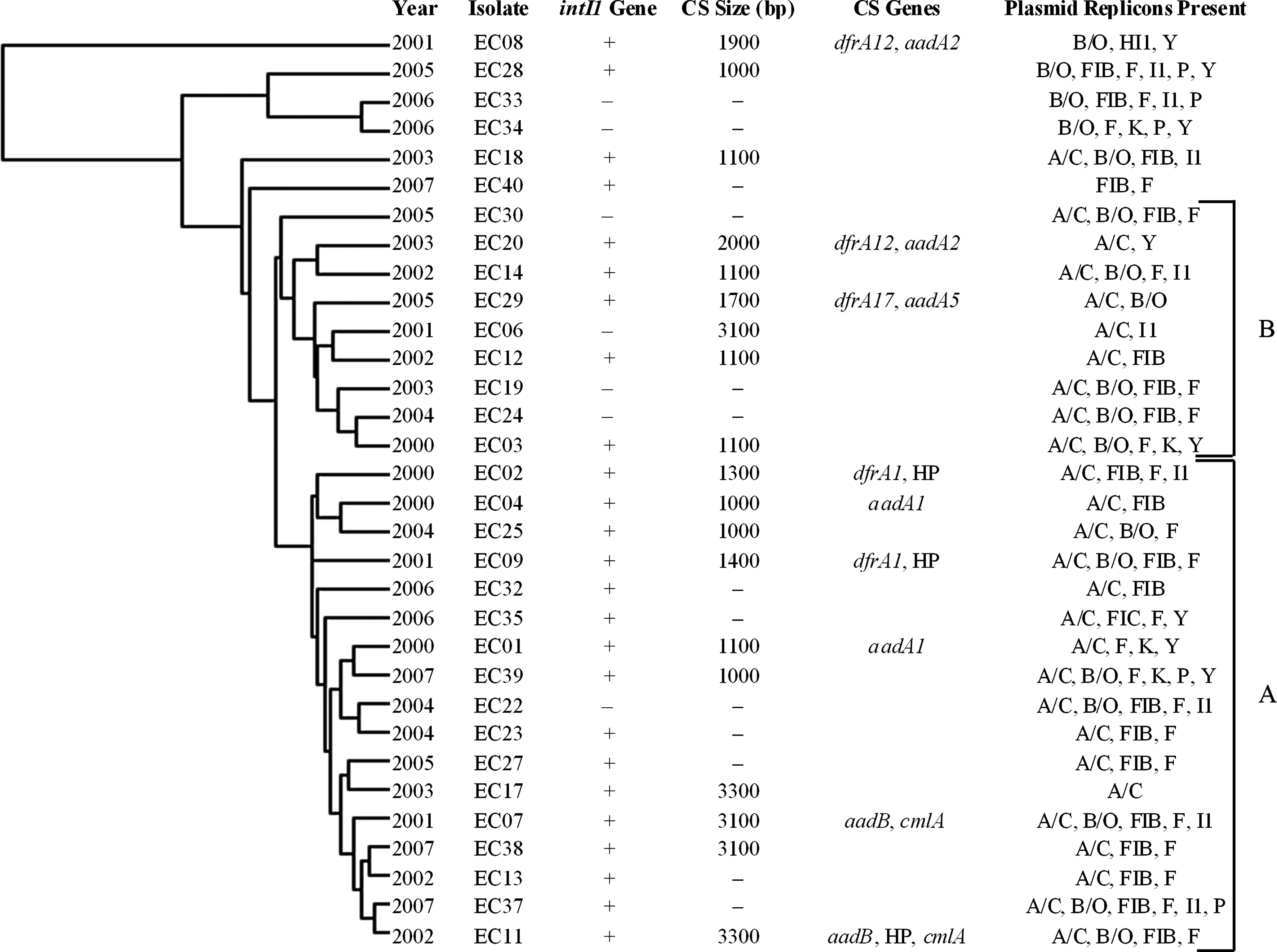
Cluster analysis of Escherichia coli isolates based on results of microarray detection of antimicrobial resistance and plasmid genes. Complete cluster analysis available in Supplementary Fig. S1.
The nine isolates in cluster B were also all positive by PCR analysis for the IncA/C replicon, but microarray analysis determined that not all 12 of the IncA/C core regions were present in these isolates. The missing regions include 6–9, 6–8, and 7–9 (Table 3). Five isolates in cluster B were also positive for intI1, and all of these contained cassettes detected by the conserved sequence PCR. Antimicrobial resistance genes located within integrons include dfrA12, dfrA17, aadA2, and aadA45. All the isolates had additional replicon types detected, the most numerous of which were also the most prevalent ones detected in cluster A, including IncF, FIB, and B/O.
The remaining six isolates (EC08, EC18, EC28, EC33, EC34, and EC40) did not group into clusters after the analysis (Fig. 1). Although EC40 was IncA/C negative by replicon typing, microarray analysis revealed the presence of IncA/C core regions 3–9. Microarray analysis also showed that the repA replicon typing target site is missing from this isolate and all other isolates that were PCR negative for IncA/C.
Pairwise LD showed a significant linkage (p≤0.05) between several plasmid replicon types, including IncA/C and P, FIB and K, Y and K, and other pairs of replicons (Fig. 2). However, almost all of the isolates that contained these replicons did not fall into groups identified by cluster analysis. Only isolates with IncA/C and P replicons formed groups by cluster analysis and also exhibited significant LD. Most of the IncA/C and P isolates were grouped apart from each other, with 3/5 IncP positive isolates (EC28, EC33, and EC34) among those that were not placed in any group by cluster analysis, and the remaining 2/5 found in group A (Fig. 1).
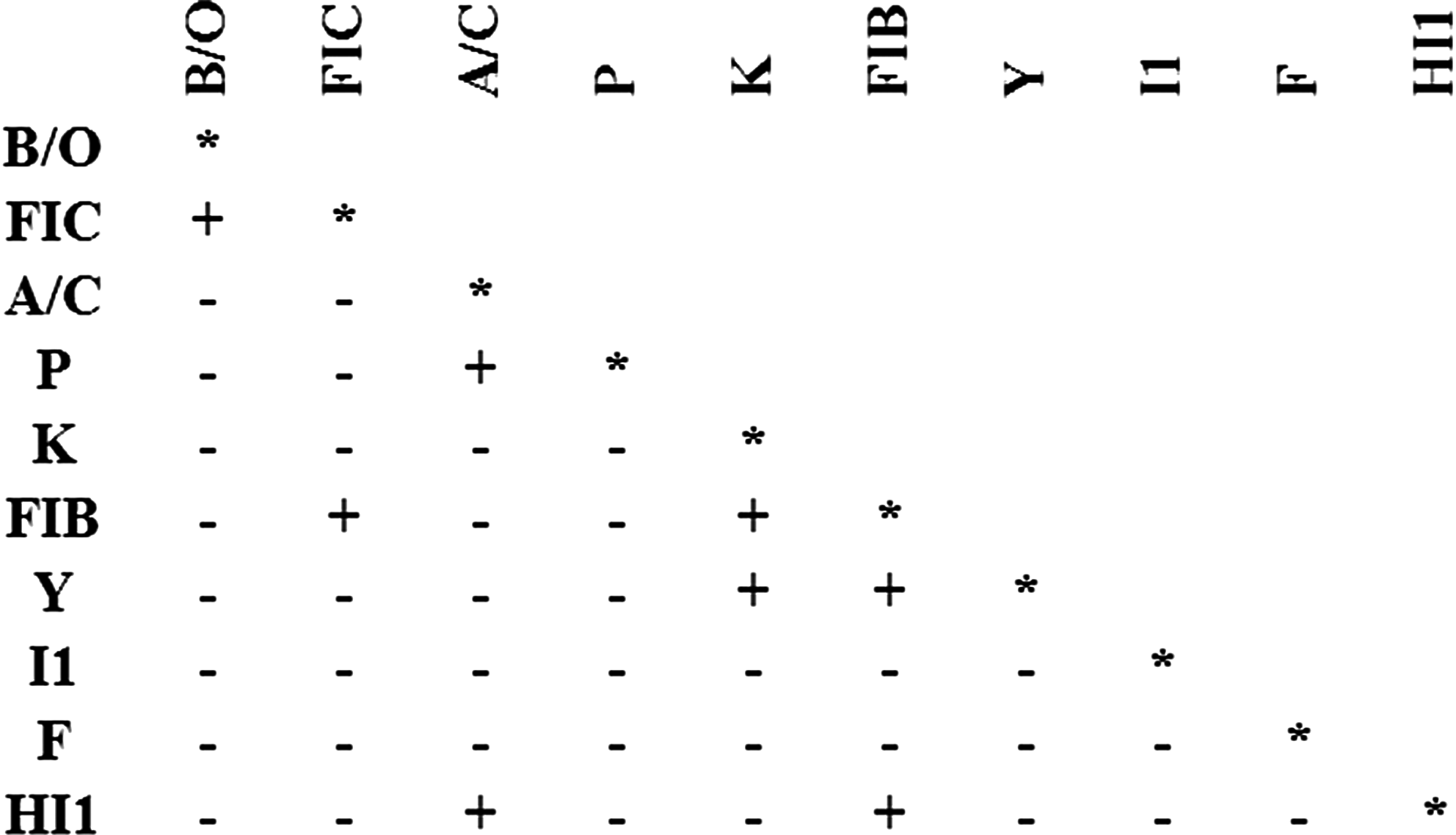
Pairwise linkage disequilibrium among 10 plasmid replicon groups of E. coli strains based on microarray data. A “+” indicates a p-value of 0.05 or less, indicating significant linkage, and a “−” indicates a p-value of >0.05 and no significant linkage.
Discussion
Analysis of MDR E. coli isolated from poultry carcass rinses identified antimicrobial resistance genes consistent with those previously found in animal isolates in the United States.5,22,35,42,43,47 IncA/C and IncHI1 plasmid genes were also detected with the microarray,14,34,48 and 84% (27/32) of the isolates in our study had IncA/C plasmids detected. These plasmids are known to encode MDR phenotypes and are a widespread cause of MDR in Enterobacteriaceae found in the United States. 48 Of the six other isolates, only EC08 appeared to have the IncHI1 plasmid. No virulence or toxin genes associated with pathogenic strains of E. coli were detected in any of these isolates. E. coli in this study are strongly associated with IncA/C plasmids, which in the United States are often found to confer the MDR phenotypes observed in this and similar studies. 32 We recently completed a study of MDR Salmonella enterica serovar Typhimurium isolated from animals, including poultry, and found that as many as half of the resistances observed appeared to be due to MDR-encoding IncA/C plasmids. 21 In a second study of Salmonella that included 17 serovars and isolates from 14 different species of clinically ill animals, IncA/C plasmids were detected with core regions very similar to the ones found in the current study. 30 These similarities suggest that it is possible that E. coli and Salmonella have exchanged these MDR plasmids with each other or acquired them from common environmental sources.
Cluster analysis based on the resistance and plasmid genes detected highlighted some of the genetic differences between these MDR E. coli isolates by grouping them into two major clusters. Antimicrobial resistance genes detected in members of cluster A include aac(6), aadA, strA/B, aph, blaAmpC, blaTEM, blaCMY, cat, flo, cmlA, sulI, sulII, tet(A), tetR, and dfrA. Genes aac(3), aadE, blaPSE-1, and tet(B) were present with less frequency. All 17 isolates in this cluster are IncA/C positive by microarray analysis and plasmid replicon typing. With the exception of one isolate that is missing in regions 7–8, each isolate contains all 12 IncA/C core regions. Regions 7–8, encoding hypothetical proteins and a DNA methylase, have been shown to be a part of an insertion deletion (indel) area.17,30,31,48 However, the deletion of only regions 7–8 was not described in three recent studies of IncA/C plasmids.21,30,48 Other replicon types within this group include IncB/O, FIB, FIC, F, I1, K, P, and Y. Cluster B was similar in antimicrobial resistance genes detected, including aac(3), aac(6), aadA, aph, strA, strB, blaAmpC, blaAmpR, blaCMY, blaTEM, cat, flo, sulI, sulII, tet(A), tetR, and dfrA. Other genes detected include aadE, blaPSE-1, cmlA, and tet(B), but these occurred less often. All isolates in cluster B are also IncA/C positive by microarray analysis and plasmid replicon typing; however, unlike the isolates in cluster A, all the isolates in cluster B lacked some of the core regions in IncA/C, which are 6–8, 6–9, or 7–9. These regions are parts of a large variable indel found in some lineages of the IncA/C plasmids as just described.17,30,31,48 The deletion of IncA/C regions 6–9 have been described in E. coli isolated from beef and chicken. 48 In addition to the genes found in regions 7–8, the 6–9 region also encodes a type IV conjugative transfer system.30,48 Other replicon types represented in group B are IncB/O, FIB, F, I1, K, and Y. All of the isolates in the current study were resistant to at least five classes of antimicrobials, which may be selected for those harboring IncA/C plasmids, as they often carry multiple antimicrobial resistance genes.
The remaining six isolates did not fall within clusters A or B, nor did they form a separate cluster. Each isolate had unique genetic properties that grouped them outside the two major clusters and not into a third cluster. For example, isolate EC18 had all 12 core regions of IncA/C but also hybridized to 27.2% of the IncHI1 plasmid probes on the microarray, resulting in a separation from cluster A. This isolate also contained replicons IncB/O, FIB, and I1. EC28 was IncA/C negative, and contained only region 10, but replicons IncB/O, FIB, F, I1, P, and Y were present. Region 10 has been investigated in Salmonella and other Enterobacteriacea and was found to encode hypothetical proteins of no known function.17,30,31,48 EC40 was also negative for IncA/C, but microarray analysis revealed that core regions 3–9 were present, which may indicate that these regions have been integrated into another plasmid or the chromosome. Only replicon types IncFIB and F were found in this isolate. EC33 and EC34 were more similar to each other than to the other four outliers. Both were IncA/C negative, with no core regions detected. They also hybridized to very few IncHI1 plasmid probes on the microarray. EC33 had replicons IncB/O, FIB, F, I1, and P, while EC34 had IncB/O, F, K, P, and Y. EC08 was the only isolate containing replicon IncHI1; replicons B/O and Y were also detected.
The six IncA/C-negative isolates outside the main clusters A and B demonstrate that while IncA/C appears to be a major factor in MDR E. coli, variability in MDR genetic elements clearly exists in isolates from poultry. Several plasmid groups in addition to IncA/C are often associated with antimicrobial resistance, which may be responsible for MDR development and spread. The most prevalent plasmid replicon types in our study besides the IncA/C isolates were B/O, FIB, and F. Replicons IncY, I1, P, and K were also identified but to a lesser extent, and IncFIC and HI1 were present in only one isolate each (none of the isolates had IncFIA, FII, HI2, L/M, N, T, W, or X detected). A previous study conducted by Lindsey et al. 32 examined replicon-type distribution in 35 E. coli isolated from 7 different animal sources with various resistance phenotypes. Nine isolates in that study were IncA/C positive; the two isolates from chickens were resistant to five antimicrobial classes. Other prevalent replicon types were IncF (n=25) and IncFIB (n=19). 32 Such a high prevalence of plasmids in isolates from both studies suggests that commensal E. coli is a plasmid reservoir, and could be capable of transferring resistance plasmids to pathogenic microorganisms. 24
Pairwise LD analysis of replicon types found significant LD. All isolates with IncK replicons also had Y replicons, while none of the IncK-containing isolates had the highly prevalent FIB replicon, indicating a negative association between these two replicon types. Similarly, only one IncFIB replicon was detected among the eight Y replicon positive isolates. LD was also found between the IncP replicon and the highly prevalent IncA/C replicon with only two of the five P-containing isolates also having A/C. Other linkages detected are questionable, as all of these included IncFIC or HI1, each of which was detected in only a single study isolate. This association did not appear to correlate with the clustering or with any phenotypic data. Further studies with a larger sampling of MDR E. coli isolated from chickens will be necessary to confirm these linkages and any correlations with the characteristics of E. coli from this source.
Class I integrons commonly found in E. coli and often associated with MDR4,10 were detected in 25 isolates, 17 of which also had cassette regions ranging in size from 1,000 to 3,300 bp. Eight of the 25 intI1 positive isolates were PCR negative for the cassette region, indicating that it is missing, too large to amplify, or not detected due to rearrangements in the 3′ conserved region of the integron that have been previously observed. 37 Since integrons may be located on the chromosome or on plasmids, further analysis is necessary to determine their location. A sequence analysis of cassette regions in these isolates detected genes either identical or highly homologous to the genes in E. coli isolated from animals and humans from many areas of the world. The aadA1 aminoglycoside resistance gene detected in EC01 and EC04 was previously found in clinical E. coli isolates in Europe, 34 and the dfrA1 trimethoprim resistance gene in isolate EC02 was described within the integrons of both animal and clinical isolates of E. coli in the United States. 3 In addition, integrons of similar size and sequence to those found in EC09 and EC29 were found in E. coli isolated from calf diarrhea in China. 12 The isolate EC08 integron sequence was very similar (99.8% at the 3′ end and 100% at the 5′ end) to one found in a clinical enteroinvasive E. coli isolate from a patient in Japan suffering from diarrhea, 2 and the integron in EC20 had been previously described in animal E. coli isolates as well as those causing human urinary tract infections in the United States. 3 Both the EC07 and EC11 integron sequences were similar to a 3,000 bp integron found in E. coli containing aadB and cmlA genes cassettes flanking an Open Reading Frame (ORF) of unknown function. 12 The similarity of integron sequences identified in the U.S. chicken isolates used in our study to sequences of E. coli from different sources around the world suggest that these antimicrobial resistance encoding genetic elements are wide spread in E. coli and that the E. coli which carry them may also be wide spread.
We found that the prevalence of MDR increased overall in E. coli during the first 8 years when NARMS isolated E. coli from poultry carcasses, although the resistance mechanisms involved did not change over this period. Interestingly, IncA/C plasmids were associated with the majority (27/32) of MDR E. coli examined over these 8 years. This is similar to our recent study of Salmonella Typhimurium MDR animal isolates, where half of the isolates were MDR-IncA/C positive, and the other half had MDR integrons similar to DT104, which has a penta-resistant gene cassette.21,29 The similarity of IncA/C plasmids found in E. coli and Salmonella suggests that exchange of these MDR plasmids has occurred in the past, perhaps in their common poultry environment where commensal bacteria could serve as reservoirs and donors of antimicrobial resistance, which has also been proposed in swine. 19 The detection of several isolates that were not IncA/C positive also suggests there are other genetic elements which may be responsible for MDR in E. coli that should be investigated in the future. Many of the integron cassette sequences in these U.S. poultry isolates were identical to sequences identified in E. coli from many other parts of the world, indicating that these MDR bacteria and genetic mechanisms are already prevalent worldwide. Further investigations of the mechanisms of antimicrobial resistance and mobile elements, including IncA/C and other plasmids, and integrons are needed to understand the development of MDR in commensal bacteria such as E. coli, how MDR is transferred to foodborne pathogens, and the potential impact on human health.
Footnotes
Acknowledgments
The authors thank Jovita Haro, Dr. Sutawee Thitaram, Benny Barrett, Alice Wilcher, and Takiyah Ball for technical assistance.
Disclaimer
The mention of trade names or commercial products in this article is solely for the purpose of providing specific information and does not imply the recommendation or endorsement by the U.S. Department of Agriculture.
Disclosure Statement
No competing financial interests exist.
References
Supplementary Material
Please find the following supplemental material available below.
For Open Access articles published under a Creative Commons License, all supplemental material carries the same license as the article it is associated with.
For non-Open Access articles published, all supplemental material carries a non-exclusive license, and permission requests for re-use of supplemental material or any part of supplemental material shall be sent directly to the copyright owner as specified in the copyright notice associated with the article.
