







Abstract
This study investigated whether antimicrobial-resistant Escherichia coli in apparently healthy sows and antimicrobial administration to sows and piglets influenced antimicrobial resistance in fecal commensal E. coli from piglets. Sixty sows from three herds and three of their piglets were sampled at several time points. Antimicrobial usage data during parturition and farrowing were collected. Clinical resistance was determined for two isolates per sampling time point for sows and piglets using disk diffusion. Only 27.4% of E. coli isolates from newborn piglets showed no resistance. Resistance to one or two antimicrobial classes equaled 41.2% and 46.8% in isolates from sows and piglets, respectively, for the overall farrowing period. Multiresistance to at least four classes was found as frequently in sows (15.6%) as in piglets (15.2%). Antimicrobial resistance in piglets was influenced by antimicrobial use in sows and piglets and by the sow resistance level (p≤0.05). Using aminopenicillins and third-generation cephalosporins in piglets affected resistance levels in piglets (odds ratios [OR] >1; p≤0.05). Using enrofloxacin in piglets increased the odds for enrofloxacin resistance in piglets (OR=26.78; p≤0.0001) and sows at weaning (OR=4.04; p≤0.05). For sows, antimicrobial exposure to lincomycin–spectinomycin around parturition increased the resistance to ampicillin, streptomycin, trimethoprim–sulfadiazine in sows (OR=21.33, OR=142.74, OR=18.03; p≤0.05) and additionally to enrofloxacin in piglets (OR=7.50; p≤0.05). This study demonstrates that antimicrobial use in sows and piglets is a risk factor for antimicrobial resistance in the respective animals. Moreover, resistance determinants in E. coli from piglets are selected by using antimicrobials in their dam around parturition.
Introduction
S
Resistance to antimicrobials in sows and piglets between birth and postweaning16,24 and the relationship with a low or high antimicrobial have been described. 17 Resistant E. coli are not restricted to one animal host and they can spread naturally from one animal host to colonize the intestinal tract of another animal host 14 or animal species. 15 Indeed, transmission of resistant bacteria from sows to piglets has been assumed. 19 Thus, one could question to what extent the presence of antimicrobial-resistant bacteria in sows influences the degree of antimicrobial resistance in piglets at birth and during the suckling period, periods with intensive contact between sows and piglets, and within the offspring, which transmission of bacteria is possible. 8 Furthermore, the administration of antimicrobials to sows and piglets during this period may increase the presence of antimicrobial-resistant bacteria in both sows and piglets. This can be either by a direct selection pressure in the treated animals or by the exposure to antimicrobials due to the shedding by treated animals. The hypothesis of a selection pressure exerted by antibiotic residues in fecal material and/or feed dust, or dust particles, originating from the treatment period, has been presented before.2,19 The information available on the interaction between antimicrobial use in sows and their offspring at the one hand and resistance in these animals at the other hand is scarce.
Therefore, the aim of this field study was to investigate whether the presence of antimicrobial-resistant E. coli in sows and the administration of antimicrobials to sows and piglets during farrowing influenced the antimicrobial resistance in fecal commensal E. coli in sows and the offspring by using multilevel models.
Materials and Methods
Study population and design
Three different Belgian pig herds were selected and visited between December 2010 and February 2011. The herds were farrow-to-finish herds with at least 200 sows. Piglets were weaned between 21 and 28 days of age. Herds were visited four times to collect samples for antimicrobial resistance profiling of fecal E. coli from apparently healthy sows and piglets and to register the antimicrobial drug consumption during the latest production cycle and the entire observation period of the sampled sows and piglets (from birth until weaning).
Twenty sows in gestation were randomly selected from each herd. From each sow, the fecal material was collected after rectal stimulation 1–3 days before parturition and within 12 hr after parturition. Sows were sampled a third time at weaning age of their piglets. For transport to the laboratory, the fecal material was kept in a clean recipient for each individual sow.
The fecal material was also collected from three randomly selected piglets from each sampled sow by means of a rectal swab. The selected piglets were sampled within 12 hr after birth and before any antimicrobial administration. Every piglet was identified by an ear tag and additional samples were taken from the same animal at 2 weeks of age and at weaning. The different sampling times for sows and piglets are presented in Table 1.
Twenty sows per herd.
Three piglets per sow.
—, Fecal samples were not taken from the respective animals at this sampling moment.
Isolation and identification
Immediately after collection, the samples were transported to the laboratory where they were processed within a few hours after arrival. For the isolation of E. coli, rectal swabs from the piglets were directly inoculated on MacConkey agar plates (MacConkey Agar No. 3; Oxoid Ltd.), whereas for the sows, a swab was used to inoculate the fecal material from the recipient on the plates. Plates were incubated aerobically for 24 hr at 37°C. From each culture, two suspected E. coli colonies were confirmed by means of positive glucose/lactose fermentation, gas production and absence of H2S production using Kligler Iron Agar (Oxoid Ltd.), indole production (Indole spot on; Becton Dickinson), and the absence of aesculin hydrolysis (Bile Aesculin Azide Agar; Oxoid Ltd.). 6
For antimicrobial resistance profiling, the Kirby-Bauer disk diffusion method was used for susceptibility testing of seven different antimicrobial agents. The Clinical Laboratory Standards Institute (CLSI) standards were followed for inoculum standardization, incubation conditions, and internal quality control organisms. 7 The following antimicrobial tablets (charge in μg) were used: amoxicillin/clavulanic acid (30 μg+15 μg), ampicillin (33 μg), ceftiofur (30 μg), tetracycline (80 μg), trimethoprim–sulfadiazine (5.2 μg+240 μg), enrofloxacin (10 μg), and streptomycin (100 μg). After 18 hr of incubation, inhibition zones were read and interpreted according to the manufacturer's guidelines. 22 The following clinical breakpoints were used: for amoxicillin/clavulanic acid R≤16, for ampicillin R≤16, for ceftiofur R≤19, for tetracycline R≤19, for trimethoprim–sulfadiazine R≤19, for enrofloxacin R≤18, and for streptomycin R≤22. The response measure for the E. coli isolates was dichotomized into resistant or susceptible according to the clinical criteria for resistance. Intermediate responses were allocated to the susceptible ones. To define resistance, the clinical criteria were used. Clinical resistance will be mentioned as “resistance.”
Quantification of antimicrobial drug consumption
To investigate the influence of antimicrobial drug use on the prevalence of antimicrobial resistance in fecal E. coli in the piglets, data concerning antimicrobial use in the sows were collected from the start from the latest production cycle (prepartum) until weaning (between 21 and 28 days of age) and for the piglets from birth until weaning.
Antimicrobial drug consumption was quantified as treatment incidences (TI) based on the used daily dose pig (UDDpig). The treatment incidence (TIUDD) is defined as the number of days per 1,000 that one pig is treated with one UDDpig. The UDDpig is defined as the administered dose of a drug per day per kilogram pig. 25 For each of the herds, a standardized growth table was used to estimate the body weight at the time of antimicrobial administration. This estimated body weight was used to calculate the UDDpig. For the sows, per herd, one out of the 20 selected sows was weighed. The body weight of the particular sow was used as the standard weight for all selected sows in one herd.
Treatment incidences based on the UDDpig (TIUDD) were calculated by means of the following formula, described by Timmerman et al.
25
For sows, the number of days at risk was taken for three time periods. The number of days at risk was taken (1) from day of insemination until 1–3 days before parturition (112–114 days), (2) from insemination until parturition (115 days), and (3) from insemination until weaning (136–143 days). For piglets, the number of days at risk was taken from birth until weaning (21–28 days).
Statistical model
The proportion of resistance (PR) was defined for each individual antimicrobial agent as the number of isolates to which resistance against this specific antimicrobial was measured as compared to the total number of isolates tested. In this study, multiresistance was defined as resistance to three or more antimicrobials.
Statistical models were built in SAS® 9.4 and used to estimate the PR for each individual antimicrobial agent. Let Yijt be the number of isolates to which resistance was found for animal j in nest i at measurement t, and nijt the corresponding number of isolates being tested. In this study, a total of 60 nests were available (i=1,…,60), and the number of animals per nest was 4, with j=1,2,3 corresponding to the piglets and j=4 corresponding to the sow. From every nest, 6 measurements were taken, as summarized in Table 1 (t=1, 2, 3 correspond to the subsequent measurements taken from the piglets, t=4, 5, 6 correspond to the measurements from the sows). Note that measurements are possibly associated because (1) measurements were taken at different time points from the same animals and (2) measurements are taken from animals in the same nest. To model the possible association between the resistance profiles of piglets and their sows, as well as the association of the resistance outcomes of the same animals at different measurements, a generalized linear mixed model was used. More specifically, it was assumed that Yijt is given by a binomial process with nijt the number of trials and pijt the PR for animal j in nest i at time point t. The probability pijt was modeled as follows:
where ζ is the vector of unknown fixed effect (regression parameters) and ui and vj(i) are normally distributed random effects with mean 0 and variances σ
2
and τ
2
, respectively. The parameters ui are nest-specific intercepts, measuring the deviation of the resistance profile of each nest from the average resistance profile. In a similar way, the parameters vj(i) are animal-specific parameters, measuring the deviation of the resistance profile of each animal within a nest. The notation j(i) is used to indicate this nesting effect of an animal j in nest i. By the use of nest- and animal-specific parameters, associations of the outcomes within nests and within animals were taken into account. In the fixed effects structure, differences with respect to measurements, herd, and the extent of exposure to antimicrobials were taken into account. The fixed effects structure can be written as follows:
where I(.) is an indicator function taking the value 1 if the expression within the brackets is correct and 0 otherwise. The function I(piglet) indicates whether animal j in nest i is a piglet or not, and a similar definition is used for I(sow). The α-parameters correspond with the differences among three herds, the β-parameters model the six time effects, the γ-parameters measure the effect of the extent of antimicrobial exposure on the resistance of the piglet, and the δ-parameters measure the effect of the extent of antimicrobial exposure on the resistance of the sow. The model was simplified in a stepwise way, keeping only the significant terms in the model (using Akaike's Information Criterion). A correction for multiple testing was inserted for the fixed effect time. For every resistance outcome in an animal at one of the sampling time points, the model was run with the accordingly effect of the extent of antimicrobial exposure of the piglet and the sow for the time period preceding the sampling. Thus, the model was rerun for every time point a resistance outcome was obtained to link the outcome with the preceding antimicrobial exposure.
To study whether the resistance of the sow has an impact on the resistance of the piglets, a similar model has been used. More specifically, the same generalized linear mixed model was used, but where now pijt denotes the PR for piglet j in nest i at time t and the fixed effects structure was specified as
where γk represents the effect of the resistance of the sow at time t′ on the resistance of the piglets at time k. This analysis is performed for each antibiotic and each time point t′ of measurement in the sow, separately.
Results
Descriptive statistics
E. coli antimicrobial resistance profile
Susceptibility testing was performed on 294 and 863 E. coli isolates from sows and piglets, respectively. Overall, 23.5% of the isolates from sows and 26.3% of the isolates from piglets were susceptible to all antimicrobials tested. Resistance to one or two antimicrobials was reported for 41.2% of the isolates in sows and 46.8% of the isolates in piglets. Resistance to at least three antimicrobials was found more frequently in isolates from sows (35.4%) than from piglets (26.9%) (p≤0.05). Resistance to all of the seven antimicrobials tested appeared in piglets for 2 isolates (total of 863 isolates), whereas in sows, the highest number of antimicrobials to which resistance was found in the same isolate was 6 (2 isolates of a total of 294 isolates tested) (Fig. 1). Herd 1, 2, and 3 differed significantly for the level of resistance to ampicillin, ceftiofur, enrofloxacin, streptomycin, trimethoprim–sulfadiazine, and tetracycline (p≤0.05) (Table 2).
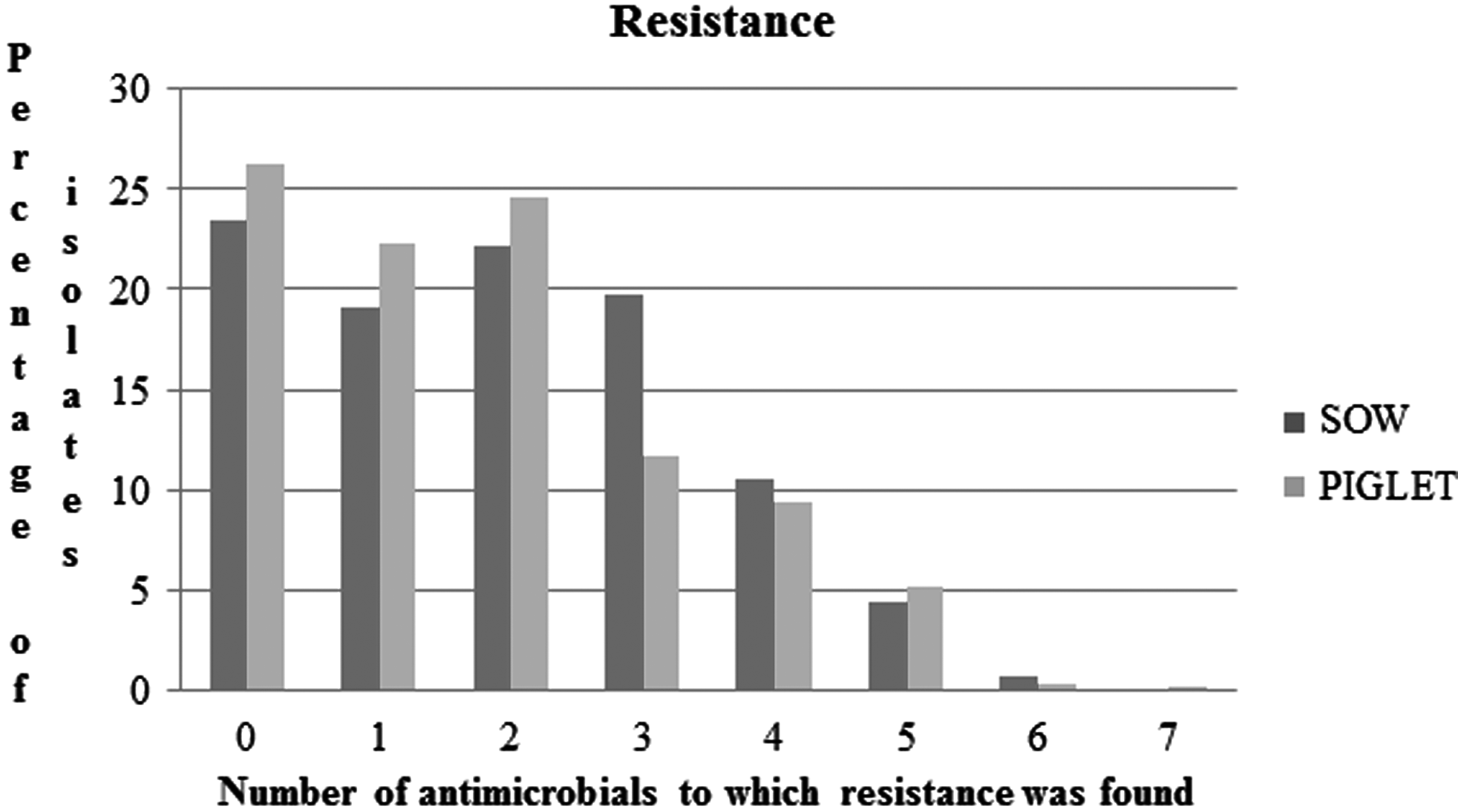
Resistance results for 294 and 863 Escherichia coli isolates from sows and piglets in three pig herds.
CI, confidence interval; OR, odds ratios.
–, not applicable.
Antimicrobial usage data in sows and piglets
Table 3 shows the TIUDD for the three herds at individual animal level (sows and piglets) during the prepartum period (from insemination until 1–3 days before parturition), within 24 hr after birth and at weaning (21–28 days after parturition). No antimicrobials at all were used in sows at herd 2 during gestation (prepartum) or lactation (postpartum). Herds 1 and 3 used antimicrobials in sows within 24 hr after birth. The highest use was reported in herd 3, where all of the 20 sows were treated with lincomycin–spectinomycin in the feed. All of the three herds used antimicrobials in piglets between birth and weaning age (21 or 28 days). For piglets, the highest use was reported at herd 2. No use in piglets was registered between 14 days of age and weaning.
Total number of sows per herd=20; total numbers of piglets per herd=60.
TIUDD=Treatment Incidence at the individual animal level (sow or piglet). The treatment incidence is defined as the number of days per 1,000 that one pig is treated with one UDDpig. The UDDpig is the administered dose of a drug per day per kilogram pig.
The number of days at risk=from day of insemination until 1–3 days before parturition (112–114 days).
The number of days at risk=from insemination until parturition (115 days).
The number of days at risk=from insemination until weaning (136–143 days).
The number of days at risk=not applicable.
The number of days at risk=from birth until weaning (21–28 days).
TI, treatment incidences; UDDpig, used daily dose pig.
–, no antimicrobials were used.
Fixed effects
Differences in resistance prevalence were observed between herds for all tested antimicrobials, except for amoxicillin–clavulanic acid. Herd 1 showed the highest levels of antimicrobial resistance for all animals tested (p≤0.05) (Table 2).
For amoxicillin–clavulanic acid, where only very low levels of resistance were observed, no effect was seen on the resistance outcome after antimicrobial exposure in sows and piglets. In general, antimicrobial exposure to the piglets solely resulted in higher odds for a positive resistance outcome in the piglets themselves (higher odds for ampicillin, ceftiofur, enrofloxacin, streptomycin, trimethoprim–sulfadiazine, and tetracycline; p≤0.05; Table 2) and did not result in higher odds for a positive resistance outcome in their dam at weaning, except for the administration of enrofloxacin to the piglets (enrofloxacin use in piglets versus no enrofloxacin use in piglets resulted in odds ratio for enrofloxacin resistance in sows=4.04, p≤0.05). Furthermore, antimicrobial exposure to lincomycin–spectinomycin in sows resulted in higher odds for a positive resistance result in the sows themselves (for ampicillin, streptomycin, and trimethoprim–sulfadiazine; p≤0.05; Table 2) and in their piglets (for ampicillin, enrofloxacin, streptomycin, trimethoprim–sulfadiazine, and tetracycline; p≤0.05; Table 2). In contrast, no effect at all was seen for the administration of marbofloxacin to the sows, neither for sows nor for piglets, however, only five sows were treated with this antimicrobial agent.
A positive resistance outcome for streptomycin and ampicillin in sows before parturition and at parturition, respectively, resulted in higher odds for resistance to the respective antimicrobials in their piglets at birth (p≤0.05). Positive resistance outcomes for tetracycline in sows at parturition resulted in higher odds for resistance to tetracycline in their piglets at 14 days after birth (p≤0.05).
Random effects
The chance on a positive resistance outcome significantly (p≤0.05) differed between nests (sow with three piglets) for ampicillin, enrofloxacin, trimethoprim–sulfadiazine, and tetracycline. The correlation of the resistance outcome between animals within a nest was 4.6%, 38.9%, 14.4%, and 6.8% for ampicillin, enrofloxacin, trimethoprim–sulfadiazine, and tetracycline, respectively. Furthermore, individual animal variances of outcomes measured at different time points were seen for ampicillin, enrofloxacin, streptomycin, trimethoprim–sulfadiazine, and tetracycline (significant random intercept on the individual animal level p≤0.05). The correlation of the resistance within an animal was 7.7%, 5.6%, 15.3%, 9.1%, and 10.9%, respectively, for ampicillin, enrofloxacin, streptomycin, trimethoprim–sulfadiazine, and tetracycline.
Discussion
The occurrence of clinically resistant E. coli isolates in piglets between birth and weaning may be called substantial with almost half of the isolates being resistant to one or two antimicrobials and more than a quarter of them being resistant to at least three antimicrobials.
During farrowing, E. coli isolates from sows were found more often resistant to at least three antimicrobials compared with piglet isolates. However, resistance to at least four antimicrobials was found as frequently in sows as in piglets (15.6% and 15.2% of the isolates in sows and piglets, respectively). High levels of antimicrobial resistance in young animals have been reported before.9,13,18,24 The presence of resistant E. coli strains in newly born piglets before any direct selection pressure, might put the sow forward as a resistance reservoir for her offspring, since young piglets are continuously exposed to the sow's microflora. Similarly, resistant E. coli have been found in young calves not previously exposed to antimicrobials. 3 The individual treatment of the dam has been proposed as a risk for the persistence of a resistant microflora, acting as a commensal resistance pool for the offspring.
Results from this research show a higher resistance frequency in isolates from pigs suckling sows with exposure to in-feed lincomycin–spectinomycin, although only used in one herd. Again, this might be the result of the transfer of resistant bacteria from the dam to her offspring. However, also, as the majority of orally administered spectinomycin is excreted unchanged in the feces, 12 this might form a direct selection pressure for suckling piglets. Treating sows and/or piglets involves a disturbance of the E. coli population, without inventing de novo or changing the presence of the antimicrobial resistance determinants itself, but by the selection of the less susceptible subpopulation.
The use of intramuscular marbofloxacin in the sow did not appear to affect resistance in E. coli isolates in piglets or in E. coli isolated from the sows themselves. Marbofloxacin is mainly excreted in the urine and the excreted residues are in an active form. 26 As a result, the residues might engender a selection pressure on the bacteria of animals in the surroundings. Yet, no link was found between the administration of marbofloxacin in sows and resistance in either the treated sows or in their piglets. This might be because of the treatment of too little sows (n=5), which lowers the power for detection of any trend.
The use of antimicrobials in piglets increased the prevalence of resistance in the piglets themselves. In this study, no effect of usage in piglets (amoxicillin and ceftiofur) on the presence of resistance in their dam was seen, except for enrofloxacin use in piglets toward enrofloxacin resistance in the sows. Resistance to quinolones is mainly determined by a mutation process, which is enhanced by antibiotic concentrations within the mutant selection window. 23 Small amounts of excreted enrofloxacin in urine from piglets might engender a selection pressure and select for mutants less susceptible to enrofloxacin. Resistance to amoxicillin and cephalosporins, antimicrobials, which are equally excreted in urine, 21 have other resistance mechanisms, for which the mutant selection window is less appropriate. 23
One of the herds showed significantly higher resistance outcomes compared with the other herds, whereas the extent to which antimicrobials were used in the currently observed sows in the current production cycle was not proportionally higher in comparison to the other herds. Yet, also the antimicrobial use in the other age categories and in the previous production rounds is likely to influence the resistance levels, as it maintains a commensal resistance pool, as previously described. In this study, no other herd-related factors than antimicrobial usage, which also might influence the selection and spread of resistance determinants, were investigated.
For most antimicrobials, a significant correlation between the occurrences of resistance in animals in one nest was observed, indicating that the resistance level in animals within a nest is more alike than from animals in different nests. Only amoxicillin/clavulanic acid and ceftiofur were not consistent with these results. Yet, the low resistance percentages noticed for these antimicrobials may partly explain this divergence. Although the observed correlations are significant for most antimicrobials, they are not always very high, illustrating that substantial different results can be found between animals in the same nest. This is likely the result of the fact that only two isolates are tested per animal, whereas a variation of E. coli populations is expected to be present within the gut of each animal.
Conclusion
In conclusion, the current results suggest that sows act as a reservoir for their newborns and that the administration of antimicrobial agents to sows during lactation is a risk factor for the persistence of resistant E. coli not solely for themselves, both also for their newborn offspring. Also, the administration of antimicrobials in the piglets exerts a direct selection pressure in the piglets themselves during lactation.
Footnotes
Acknowledgments
This work was supported by VEEPEILER Pig. The authors thank the farmers for participation in the study and A. Van de Kerckhove and S. Verbanck for technical assistance.
Disclosure Statement
No competing financial interests exist.