







Abstract

Dear Editor:
T
The isolate ECL-90 was recovered from the secretion of neck incision of a 24-year-old male patient in October 2017, who was admitted into a large tertiary hospital in Nanjing because of an acute community-acquired pneumonia. The patient subsequently developed a left orbital cellulitis resulting from the ascending infection of the respiratory tract. After receiving endoscopic sinus opening and drainage, and an anti-infective regimen, including meropenem, tigecycline, and fosfomycin, the patient recovered and was, therefore, discharged.
Antimicrobial susceptibility test using microbroth dilution method 2 showed that this strain was resistant to all of the antimicrobial agents except for amikacin, aztreonam/avibactam, tigecycline, colistin B, and fosfomycin (Table 1). Whole-genome sequencing was performed on the Hiseq 4000 instrument (Illumina, San Diego, CA). Average-nucleotide analysis identified ECL-90 as E. hormaechei. Multilocus sequence typing (MLST) analysis using MLST 2.0 assigned ECL-90 to sequence type (ST) 418, 3 which is known as one of the predominant epidemic clones of carbapenemase-producing Enterobacter cloacae in China.4,5 Antibiotic resistance genes were identified by using Resfinder v2.1, including genes conferring beta-lactam resistance (blaNDM-1, blaIMP-4, blaSFO-1, blaSHV-12, blaTEM-1B, and blaACT-16), colistin resistance (mcr-9.1), aminoglycoside resistance [aac(3)-IId, aac(6′)-IIc, aac(6′)-Ib3, aph(3″)-Ib, aph(3′)-Ia, aph(6)-Id, aph(6)-Id], fluoroquinolone and aminoglycoside resistance [aac(6′)-Ib-cr], macrolide resistance (ereA, mphA), phenicol resistance (catA2), sulfonamide resistance (sul1), tetracycline resistance (tetD), and trimethoprim (dfrA19).
The Minimum Inhibitory Concentration (μg/ml) of Bacteria
ECL-90 was susceptible to colistin although mcr-9.1 was detected. The IPTG-induced expression of mcr-9.1 in Escherichia coli BL21(DE3) containing pET28a-mcr-9.1 did not confer resistance to colistin, and the resistance to colistin could not be induced by using sub-MIC concentration of colistin. Broth conjugation assays using a sodium azide-resistant E. coli J53 isolate as a recipient showed that blaNDM-1 was transferable, but not for mcr-9.1 and blaIMP-4.
S1-pulsed-field gel electrophoresis analysis of the strain ECL-90 displayed four plasmids. This isolate was further sequenced by Nanopore platform (Nanopore, Oxford, United Kingdom), and hybrid assembly was performed with Illumina sequencing data by using Unicycler version 0.4.8, 6 resulting in a chromosome with size of 4,584,517 bp, and four plasmids (pECL-90-1, pECL-90-2, pECL-90-3, and pECL-90-4) ranging in sizes from 6,364 to 348,891 bp (Table 2). The completeness of these plasmids was further verified by PCR loop experiment (primers and the sizes of products are shown in Supplementary Table S1). blaACT-16 were identified in the chromosome, the other resistance determinants were carried by pECL-90-2 and pECL-90-3.
The Key Features of the Enterobacter hormaechei Isolate
NA, not applicable.
blaIMP-4 and mcr-9.1 were co-identified on an IncHI2/2A-type plasmid pECL-90-2, which was 348,891 bp in length with an average GC content of 48.59% (Fig. 1). Most of mcr-9 carried by E. hormaechei were associated with IncHI2 plasmids,7,8 suggesting the role of IncHI2-type plasmids in the silent dissemination of mcr-9 gene. Blasting the sequence of pECL-90-2 in GenBank showed that the best matches were pGW1 carried by a Cronobacter sakazakii strain GZcsf-1 (CP028975, 86.8% query coverage and 99.99% sequence identity) and plasmid p17277A_477 carried by a Klebsiella quasipneumoniae subsp. quasipneumoniae strain M17277 (CP043927, 79.54% query coverage and 99.99% sequence identity). The genetic context of mcr-9.1 gene identified in this study was “rcnR-rcnA-pcoE-pcoS-IS903-mcr-9-wbuC” (Fig. 1), which is known as a prevalent structure for mcr-9. 9 The downstream regulatory genes (qseC and qseB) detected in p17277A_477 (CP043927) were replaced by an IS26 in this study (Fig. 1). It is suggested that qseB/qseC system is vital for the induction of mcr-9-mediated colistin resistance.10,11 Therefore, the lack of qseB/qseC might cause colistin susceptibility in ECL-90.
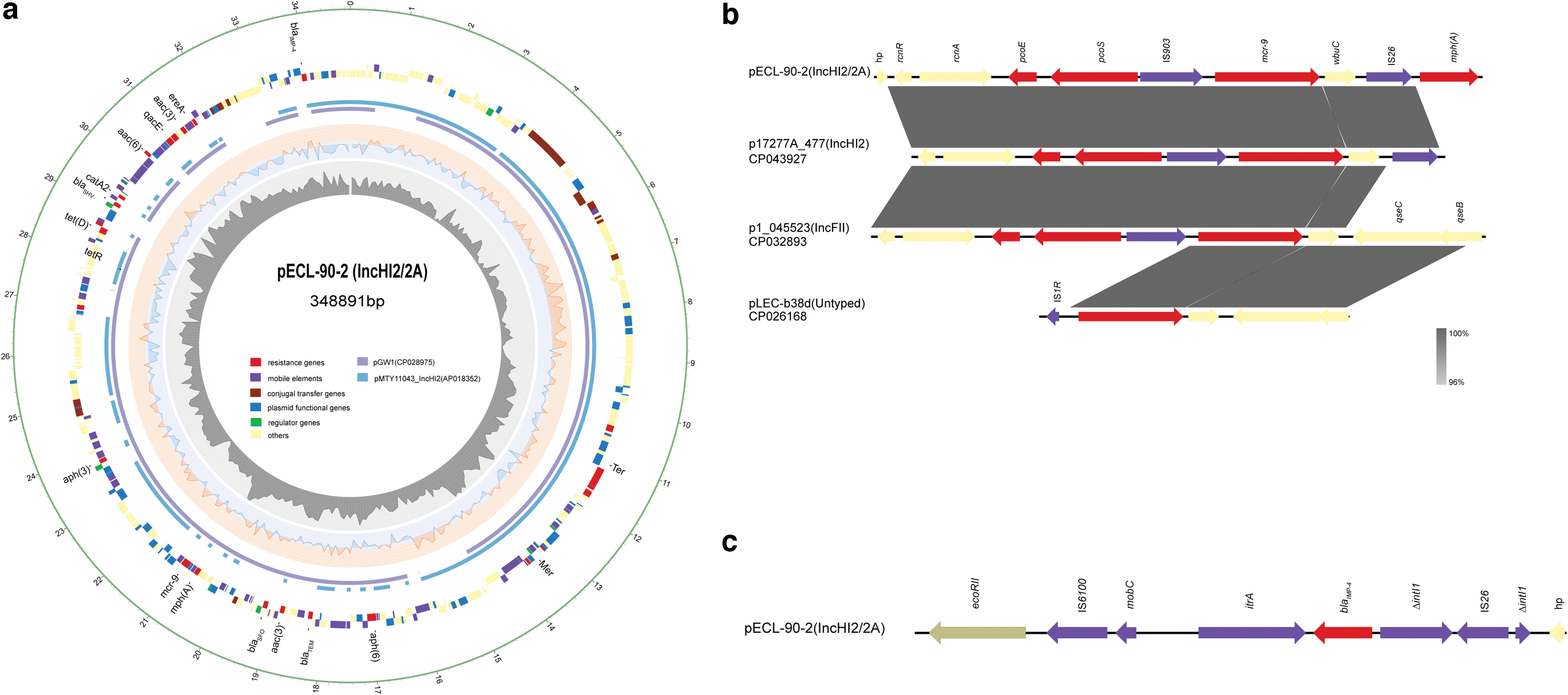
Analysis of mcr-9.1-harboring IncHI2/2A-type plasmid pECL-90-2 and the genetic context of mcr-9.1 and blaIMP-4.
The blaIMP-4 gene was carried by a class 1 integron designated as In823b, which located in an IS6100-IS26 transposon-like structure.12,13 The intl1 gene of In823b was disrupted by the insertion of IS26, and a single resistance gene cassette blaIMP-4-attCblaIMP-4 adjacent to a group IIc intron Kl.pn.I3 was identified (Fig. 1). The typical 3′-conserved segment of In823b was absent.
The blaNDM-1 gene was carried on a 44,961-bp IncX3 plasmid (pECL-90-3) (Fig. 2). Query against GenBank showed that pECL-90-3 shared the highest similarity with pNDM5-L725 carried by E. coli strain L725 (CP036205, 99.73% query coverage and 99.99% sequence identity) and pBM527-2 carried by Citrobacter sp. strain CF971 (CP041048, 99.73% query coverage and 99.99% sequence identity). The genetic context of blaNDM-1 gene detected in this study is “ISAba125–blaNDM-1–bleMBL” (Fig. 2), which has recently been named NDM-GE-U.S. and has been found to be widespread globally. 14
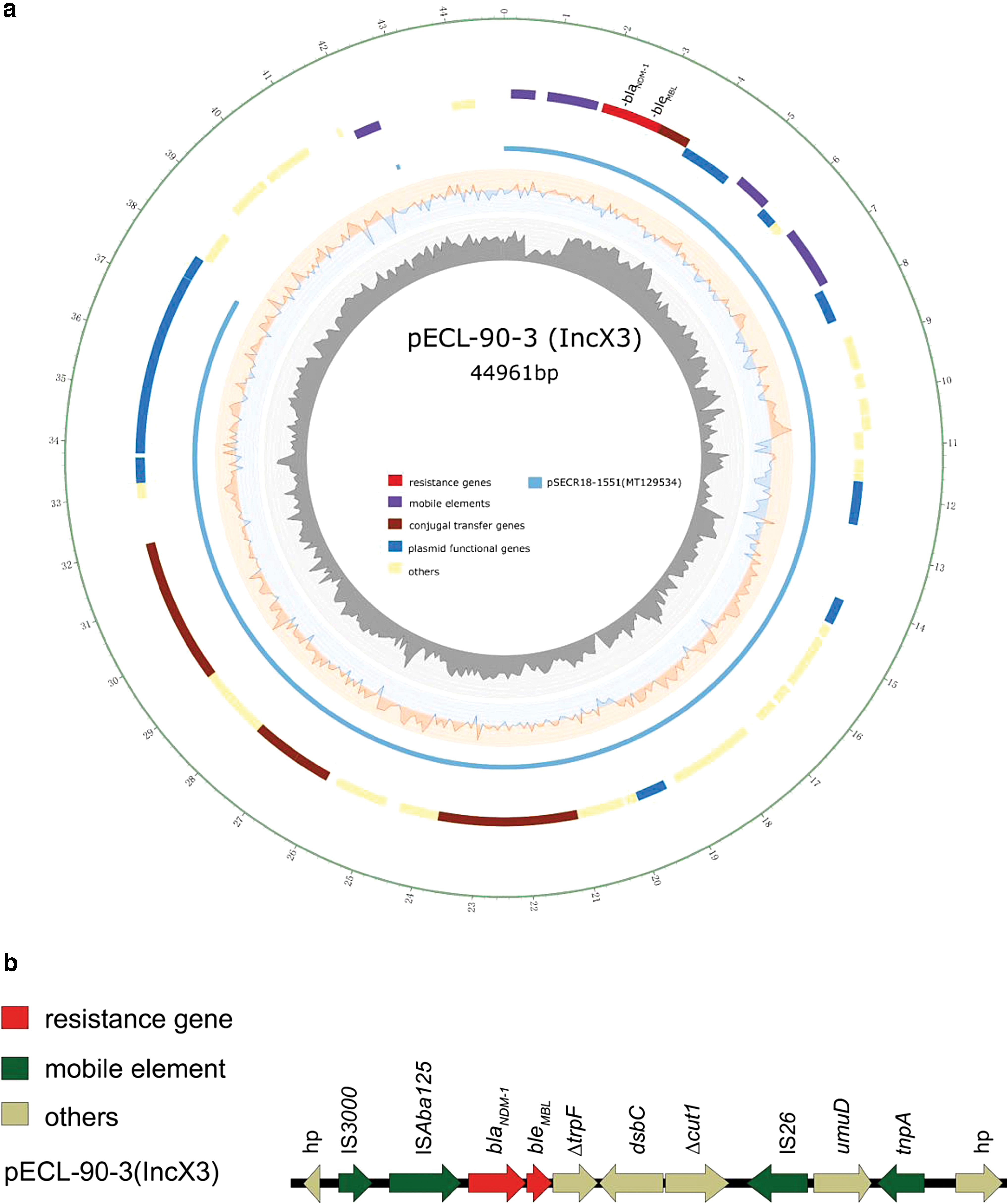
Analysis of blaNDM-1-harboring IncX3-type plasmid pECL-90-3 and the genetic context of blaNDM-1.
In summary, in this study for the first time we characterized a clinical epidemic E. hormaechei clone ST418 co-harboring blaNDM-1, blaIMP-4, and mcr-9.1. The convergence of genes mediating resistance to last-resort antibiotics in epidemic clones would largely facilitate their widespread in clinical settings.
Accession Number(s)
The chromosome of ECL-990 has been deposited in GenBank nucleotide sequence database under accession number of CP061744; four plasmids have been deposited in the GenBank nucleotide sequence database under accession number of CP061745 (pECL-90-1), CP061746 (pECL-90-2), CP061747 (pECL-90-3), and CP061748 (pECL-90-4).
Footnotes

References
Supplementary Material
Please find the following supplemental material available below.
For Open Access articles published under a Creative Commons License, all supplemental material carries the same license as the article it is associated with.
For non-Open Access articles published, all supplemental material carries a non-exclusive license, and permission requests for re-use of supplemental material or any part of supplemental material shall be sent directly to the copyright owner as specified in the copyright notice associated with the article.
