







Abstract

Ujvári and Magyar 1 state in their recent publication that “various efflux pumps have been reported to contribute to macrolide resistance in P. multocida” and that “primers specific for macA and macB genes coding a macrolide-specific ABC-type efflux protein were designed.” The first statement represents an incorrect citation of Dayao et al, 2 who provided a list of efflux systems found in genomes of respiratory pathogens, which were only annotated by RAST (Rapid Annotation using Subsystem Technology) and discuss that “the efflux systems of P. multocida and B. bronchiseptica isolates should also be investigated.” Importantly, it should be recognized that RAST annotations might be imprecise.
In addition, the functionality or substrates of the putative efflux systems have not been further investigated. MacAB is a part of a tripartite-type ABC transporter and its contribution to resistance against macrolides has been described for Escherichia coli, with the macAB sequences corresponding to accession number U00096. 3 The primers mentioned in the second statement of Ujvári and Magyar are based on the sequence of Pasteurella multocida NCTC10204 accession number LR134298. In both, the E. coli and the P. multocida genomes, genes designated macA and macB or macB1 can be found, respectively, but the length of the genes annotated as macA differs by 12 bp.
Depending on the alignment software used, nucleotide sequence identities for the macA genes in E. coli and in P. multocida range between 46.2% and 53.5% and those for macB genes between 56.1% and 58.9%. Alignments of the amino acid sequences deduced from the corresponding nucleotide sequences of E. coli and P. multocida resulted in identities of 33.8–35.0% for MacA and of 48.8–48.9% for MacB, depending on the alignment software used (Figure 1). These sequence identities are too low to assume the same functionality without functional analysis of the mac genes in P. multocida, which unfortunately has not been conducted.
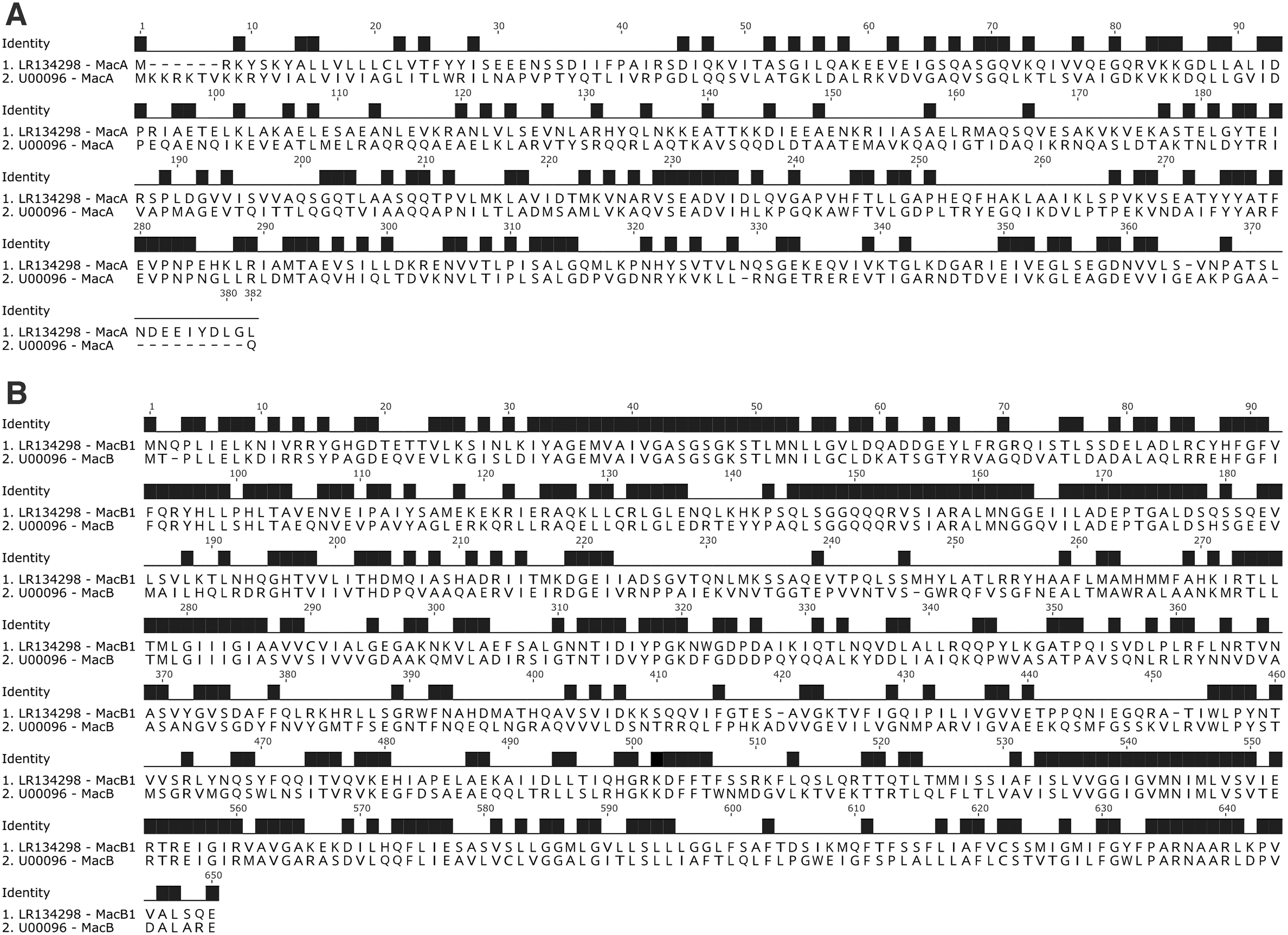
MAFFT alignment of the amino acid sequences of MacA
Moreover, the gene designations in the sequence of P. multocida NCTC10204 (LR134298) should be questioned. According to the macrolide-lincosamide-streptogramin (MLS) resistance gene nomenclature center, genes whose deduced proteins showing ≤79% amino acid identity with all previously characterized MLS resistance genes receive a unique designation. 4 Therefore, the role of the genes designated as macAB in macrolide resistance of P. multocida remains questionable and simply detecting the presence of the genes by PCR does not necessarily explain elevated minimal inhibitory concentrations (MICs) for macrolides of the respective isolates.
Furthermore, the MICs for erythromycin varied distinctly from 0.5 to 256 μg/mL for macAB-carrying P. multocida isolates from cattle and from 1 to 16 μg/mL for those from small ruminants reported by Ujvari and Magyar. 1 Moreover, a classification of the isolates as susceptible or resistant to erythromycin is not valid according to the recommendations of the Clinical and Laboratory Standards Institute (CLSI). In the relevant CLSI documents M100 and VET01S,5,6 no erythromycin-specific clinical breakpoints are available for P. multocida and a reference to outdated clinical breakpoints is not acceptable. A recent study also detected the macAB genes in bovine P. multocida from Australia and speculated about their role—when overexpressed—in tilmicosin resistance. 7
In conclusion, the mac-like genes in P. multocida have not been functionally characterized and further research, for example, by cloning these genes and expressing them in suitable P. multocida hosts, is needed to determine whether they are involved in macrolide resistance.
Footnotes
Authors' Contributions
Conceptualization by A.-K.S. and S.S. Methodology, validation, formal analysis, and writing—review and editing by A.-K.S., D.H., V.K., and S.S. Writing—original draft preparation and visualization by A.-K.S. All authors have read and agreed to the published version of the article. V.K. is supported by a scholarship of the Akademie für Tiergesundheit (AfT).
Disclosure Statement
No competing financial interests exist.
Funding Information
Valeria Kostova is supported by a scholarship of the Akademie für Tiergesundheit (AfT).