







Abstract
A Klebsiella quasipneumoniae subsp. similipneumoniae strain, named S915, belonging to the ST1859 O5:KL35, and harboring the plasmid-mediated quinolone resistance qnrE1 gene, was isolated from a soil sample cultivated with lettuce in Brazil. The core genome multilocus sequence typing analysis revealed that S915 strain was most related to a clinical strain of Brazil. Comparative genomic analysis showed that ST1859 O5:KL35 strains have been circulating in clinical settings and are closely related to multidrug resistance and multimetal tolerance. Strain S915 presented a plasmid contig co-harboring the qnrE1 gene and tellurite tolerance operon. The region harboring the qnrE1 gene (ISEcp1-qnrE1-araJ-ahp) shared high similarity with others from infected humans, ready-to-eat dish, and food-producing animals in Brazil. This is the first report of the plasmid-mediated qnrE1 gene in the environment. Our findings evidence the initial dissemination of the qnrE1 gene in the environment by the introduction of a clinical strain, which may be spread to different sectors, representing a One Health challenge.
Introduction
Fluoroquinolones are important agents used to treat severe infections, highlighting those caused by Salmonella. In contrast, fluoroquinolone resistance is growing and fluoroquinolone-resistant strains are listed as high-priority by World Health Organization.1,2 The plasmid-mediated quinolone resistance (PMQR) genes are known to mediate low-level resistance to fluoroquinolone agents and to be transferable by plasmids. 3 The qnrE family originated from Enterobacter species and the qnrE1 gene was first reported in 2017 from a clinical strain of Klebsiella pneumoniae of Argentina.4,5
Afterward, other three variants (qnrE2, qnrE3, and qnrE4; March, 2023) were described. In this context, the transposition of the qnrE1 gene was mediated by the ISEcp1 element from Enterobacter species to plasmids.5,6 In Brazil, the plasmid-mediated qnrE1 gene has already been reported in K. pneumoniae and Salmonella enterica strains from humans, animals, and food,7–13 but there are no reports in the national and global environmental sector. Therefore, we report a genomic analysis of a qnrE1-positive Klebsiella quasipneumoniae strain from a soil sample.
During an investigation of antimicrobial-resistant (AMR) strains in agricultural crops in Brazil, S915 strain was isolated in 2022 from a soil sample cultivated with lettuce in a vegetable garden located in Serrana City, São Paulo State, using MacConkey agar (Kasvi, Spain). Strain S915 was first identified as Klebsiella sp. by biochemical tests, which was later molecularly confirmed as K. quasipneumoniae using the species-specific target (blaOKP) 14 after genomic DNA extraction using PureLink™ Genomic DNA Mini Kit (Thermo Fisher Scientific, USA). Subsequently, antimicrobial susceptibility testing was performed by disk diffusion, E-test®, or broth microdilution methods according to European Committee on Antimicrobial Susceptibility Testing (version 10.0, 2020) and Clinical and Laboratory Standards Institute (M100 30th, 2020) guidelines.
Strain S915 was resistant to streptomycin, kanamycin, sulfamethoxazole/trimethoprim, and nitrofurantoin, but it was susceptible to nalidixic acid (minimum inhibitory concentration [MIC] 8 mg/L), ciprofloxacin (MIC 0.25 mg/L), levofloxacin (MIC 0.19 mg/L), amoxicillin/clavulanate, piperacillin/tazobactam, cefazolin, cefoxitin, ceftazidime, ceftriaxone, ceftaroline, cefepime, aztreonam, meropenem, imipenem, tetracycline, minocycline, tigecycline (MIC 1 mg/L), gentamicin, amikacin, chloramphenicol, and colistin (MIC 2 mg/L). Subsequently, AMR genes were searched,5,15 and S915 strain was positive for the qnrE1 gene.
In this regard, S915 strain was submitted to whole-genome sequencing using the Illumina MiSeq platform (Illumina Inc., USA). The draft genome was de novo assembled by SPAdes version 3.15.2. 16 Phylogenetic analysis was performed using the core genome multilocus sequence typing scheme with strains available at the Pathogenwatch platform. Resistome, metal tolerance genes, virulome, plasmid replicons, typing, and serotyping were determined using tools available at the Center for Genomic Epidemiology and BIGSdb-Pasteur. Plasmid contigs were predicted using mlplasmids version 2.1.0. 17 Genetic contexts were analyzed using ISfinder, BLASTn (https://blast.ncbi.nlm.nih.gov/Blast.cgi), and were manually curated with Geneious Prime® version 2023.0.4 (Biomatters Ltd, New Zealand).
K. quasipneumoniae subsp. similipneumoniae strain S915 (GenBank accession number JARJBI000000000) was assigned to ST1859 O5:KL35, an unusual clinical clone. Phylogenetic relatedness among 12 public genomes of ST1859 O5:KL35 from Philippines, China, and Brazil revealed that S915 strain was most related to Kp1345 strain isolated in 2017 from a hospitalized patient in Brazil (Fig. 1A). Comparative genomic analysis showed that this clone has been circulating since 2014 in clinical settings and is associated with multidrug resistance and multimetal tolerance, carrying a diversity of plasmid replicons. Besides, ST1859 O5:KL35 strains housed conserved virulence determinants (Fig. 1B). In Philippines, CTX-M-15- and NDM-7-producing ST1859 O5:KL35 strains were isolated from different clinical specimens (e.g., tracheal aspirate, urine, wound, blood, and pleural fluid) of infected humans, evidencing the success of this clone in medical clinics. 18
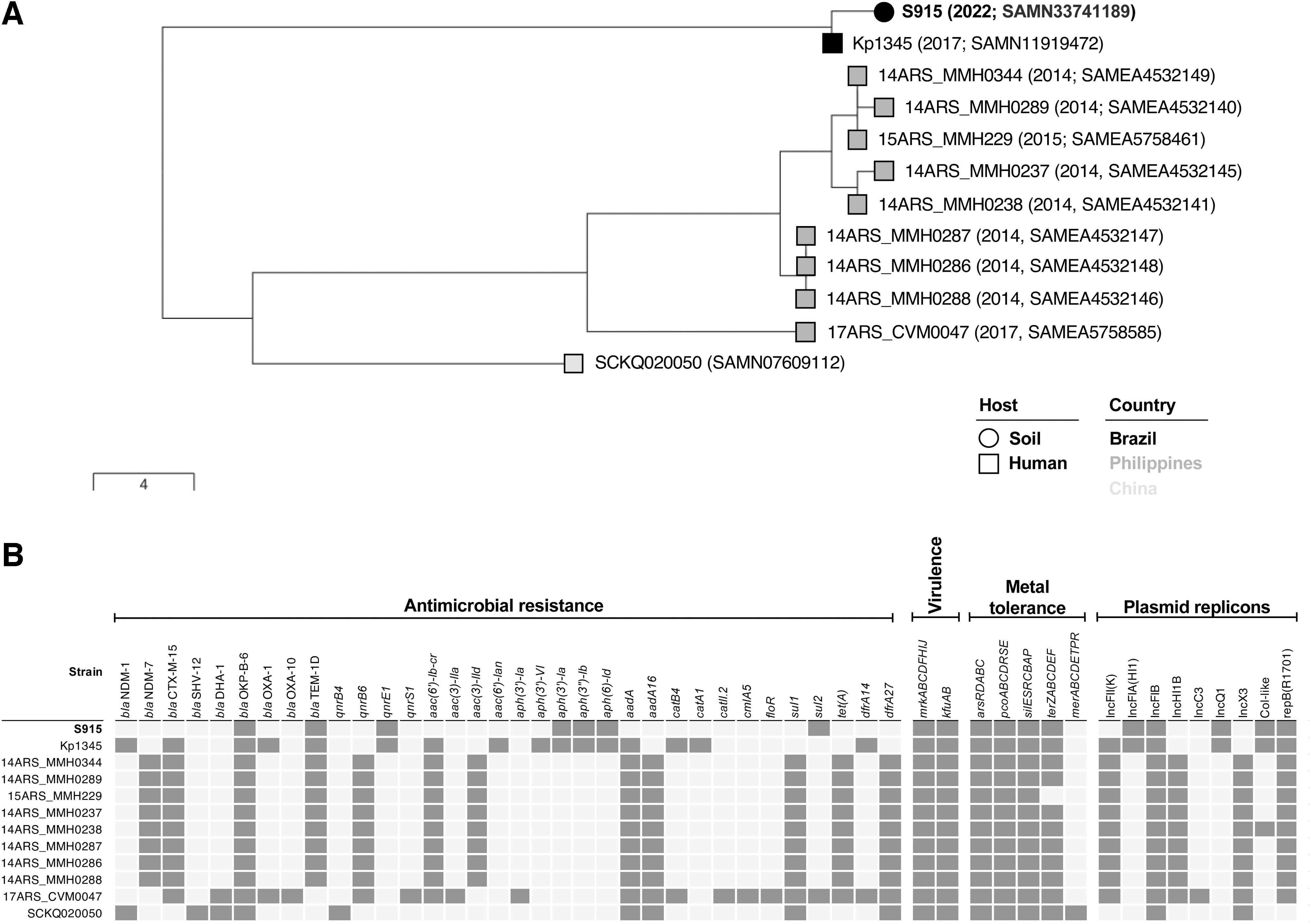
Overview of Klebsiella quasipneumoniae subsp. similipneumoniae ST1859 O5:KL35 strains.
Resistome analysis showed that S915 strain carried acquired resistance genes to fluoroquinolones (qnrE1), aminoglycosides [aph(3′)-Ia, aph(3″)-Ib, and aph(6)-Id], and folate pathway antagonists (sul2). In addition, intrinsic AMR genes were also identified, including blaOKP-B-6, oqxA, oqxB, and fosA. Mutations associated with resistance to fluoroquinolones (AcrR: P161R, G164del, F172S, R173G, F197I, L195V, and K201M), colistin (PmrB: S363I), and carbapenems (OmpK37: I70M and I128M) were identified, but it does not correspond with the susceptibility phenotype found, showing a failure in the phenotype–genotype relationship. In addition, tolerance genes to arsenic (arsRDABC), copper (pcoABCDRSE), silver (silESRCBAP), and tellurite (terZABCDEF) were also detected. Virulome analysis showed genes encoded type 3 fimbriae (mrkABCDFHIJ) and ferric iron uptake (kfuAB). Plasmid replicon types were identified, including IncFIA(HI1), IncFIB(K)(pCAV1099-114), IncQ1, Col440I, Col440II, and repB(R1701).
Although the plasmid-mediated qnrE1 gene is emerging in Brazil, sporadic reports have occurred in Argentina, 5 Uruguay, 19 and the United States (GenBank accession number CP027699). In this study, the qnrE1 gene was located in a plasmid contig with 51.6 kb in size; however, the qnrE1-bearing plasmid was not reconstructed due to the limitations of short-read sequencing. 20 Curiously, the plasmid contig harboring the qnrE1 gene also contained the tellurite tolerance operon (terZABCDEF).
Plasmid transfer by conjugation using Escherichia coli J53 (AzR) 5 as a recipient strain was unsuccessful. In South America, conjugative IncM1 plasmids (∼70 kb) are responsible for spreading the qnrE1 gene in addition to multidrug resistance genes, including blaCTX-M-8.7,8 Furthermore, a hybrid-plasmid IncFIB(mar)/IncHI1B housing the qnrE1 gene was identified in a CTX-M-15-producing K. pneumoniae strain from a native Amazonian fish in Brazil. 21 In contrast, S915 strain lacked the aforementioned plasmid replicons nor extended-spectrum β-lactamase-encoding genes, suggesting a new qnrE1-harboring plasmid.
The qnrE1 gene was located on a module of 4,811 bp containing ISEcp1-qnrE1-araJ-ahp (Fig. 2A). Comparative analysis revealed that this genetic context was closely related (>99.9% nucleotide identity) to others from K. quasipneumoniae subsp. similipneumoniae and Salmonella Typhimurium strains from infected humans, ready-to-eat dish, and food-producing animals in Brazil (Fig. 2B). Furthermore, the genetic context of this study, which presented a complete 1,035-bp ahp gene, differed from others of K. pneumoniae, Salmonella Enteritidis, Salmonella Newport, and Salmonella Infantis from human clinical samples and an infected parrot of Brazil and the United States by deletion of 708 bp in the ahp gene (Δ327 bp) (Fig. 2C).
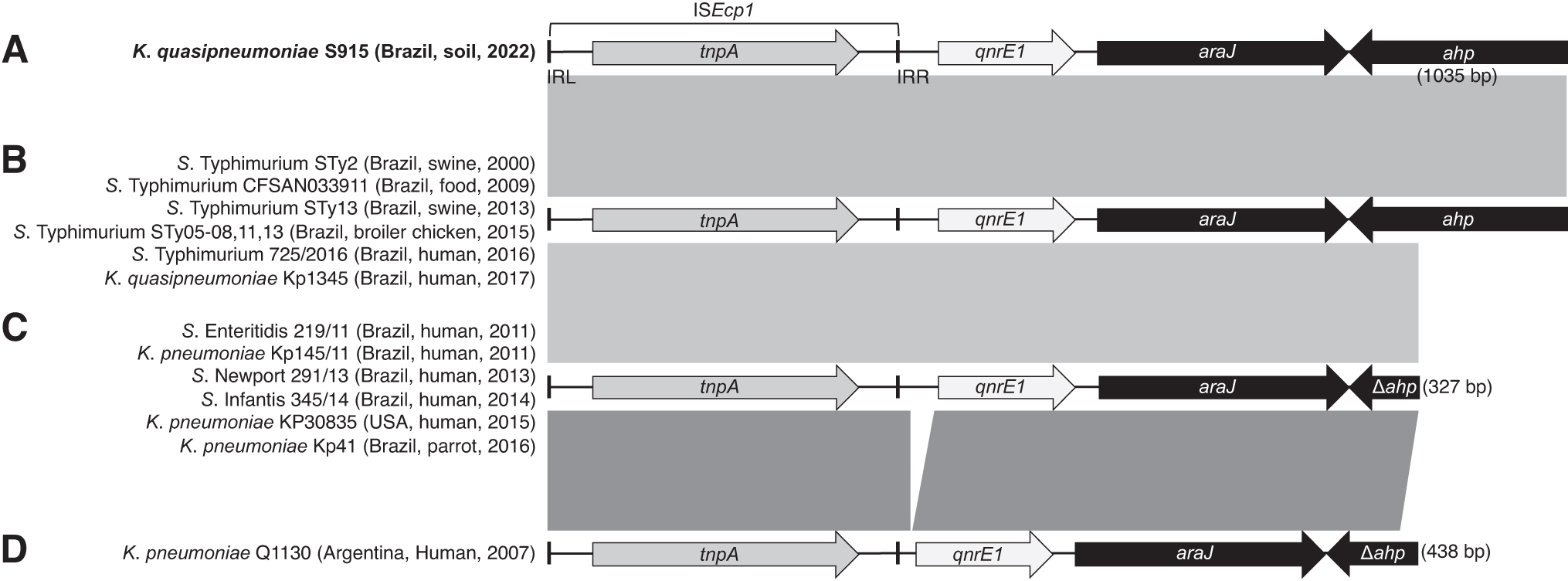
Comparison between genetic contexts of qnrE1 from this study
Comparing with the first report of the qnrE1 gene (Klebsiella pneumoniae Q1130 from a human in Argentina), 5 this genetic context differed by deletions of 597 bp in the ahp gene (Δ438 bp) and 152 bp in the intergenic region between ISEcp1 and qnrE1 (Fig. 2D). In general, this genetic context is linked to the dissemination of the qnrE1 gene since 2000s among Enterobacteriaceae from countries of the Americas, especially Brazil.
Soils are important hosts and drivers of AMR 22 and multidrug-resistant strains carrying clinically relevant AMR genes, including PMQR genes, have been described in soils mainly of countries considered agricultural superpowers.15,23 However, AMR transfer data are limited due to the lack of a whole-genome characterization. To the best of our knowledge, this is the first report of the plasmid-mediated qnrE1 gene in the environment. Our findings evidence the initial dissemination of the qnrE1 gene in the environment that may have started with the release of the clinical Kp1345 strain, which is genetically similar to S915 strain, into the soil. In this context, environmental strains can capture, harbor, and spread AMR genes to different bacterial species from distinct sectors, 22 representing a One Health challenge. Therefore, these results reinforce the need for continued surveillance of qnrE1 in strains from the environment sector.
Footnotes
Acknowledgments
The authors thank the Fundação de Amparo à Pesquisa do Estado de São Paulo (FAPESP) (grant no. 2018/01890-3), the Coordenação de Aperfeiçoamento de Pessoal de Nível Superior (88887.464733/2019-00, 88882.180855/2018-01, 88887.519091/2020-00, and Finance code 001), and the Conselho Nacional de Desenvolvimento Científico e Tecnológico (grant no. 308914/2019-8, 304905/2022-4, 130086/2021-5, 141016/2021-3, and 150712/2022-7) for fellowships. The authors also thank the Institut Pasteur teams for the curation and maintenance of BIGSdb-Pasteur databases. This study used facilities of the Brazilian Biorenewables National Laboratory (LNBR), part of the Brazilian Centre for Research in Energy and Materials (CNPEM), a private nonprofit organization under the supervision of the Brazilian Ministry for Science, Technology, and Innovations (MCTI). The High-Throughput Sequencing (NGS) open access facility staff are thanked for the assistance during the experiments (20220861).
Authors' Contributions
Conceptualization, methodology, software, formal analysis, investigation, data curation, writing—original draft, and writing—review and editing by R.L. and J.P.R.F. Methodology and formal analysis by M.S.R., L.D.R.S., and R.S.R. Conceptualization, investigation, data curation, supervision, project administration, funding acquisition, and writing—review and editing by E.G.S.
Disclosure Statement
The authors declare no conflicts of interest.
Funding Information
This study was supported by FAPESP (grant no. 2021/01655-7).