







Abstract
Antimicrobial resistance is currently considered a public health threat. Carbapenems are antimicrobials for hospital use, and Enterobacterales resistant to these β-lactams have spread alarmingly in recent years, especially those that cause health care-associated infections. The blaKPC gene is considered one of the most important genetic determinants disseminated by plasmids, promoting horizontal gene transfer. This study describes, for the first time in Ecuador, and worldwide, the presence of a blaKPC-2 gene in an isolate of Salmonella enterica serovar Infantis from a clinical sample. Through whole-genome sequencing, we characterized the genetic determinants of antimicrobial resistance in this Salmonella ST-32 strain. Our results showed the presence of several resistance genes, including blaCTX-M-65, and a conjugative plasmid Kpn-WC17-007-03 that may be responsible for the horizontal transference of these resistance mechanisms.
Introduction
Carbapenemases are β-lactamases able to hydrolyze almost all β-lactams, commonly produced by bacterial isolates resistant to most families of antibiotics. 1 Enterobacterales are known as frequent carriers of this type of enzyme, alarmingly spread in recent years among microorganisms responsible for healthcare-associated infections,2–4 increasing hospital morbidity and mortality.5,6
The emergence of carbapenemase-producing Gram-negative bacilli is a global public health problem affecting also Latin American and Caribbean countries. 7 In Ecuador, the appearance and expansion of the blaKPC gene have been described for more than a decade, and it has remained the most frequent mechanism of resistance against carbapenems.8–11 Although its detection has been restricted to some bacterial species such as Klebsiella pneumoniae in this country, its dissemination can occur between a wide range of species mainly through horizontal gene transfer, in various Enterobacterales including Salmonella enterica.
During the 70s and 80s, S. enterica showed a decrease in susceptibility to first-line antibiotics such as ampicillin, ciprofloxacin, and trimethoprim/sulfamethoxazole, giving rise to the use of cephalosporins and carbapenems as therapeutic options. S. enterica serovar Infantis is not the most isolated serotype in people or food. It is usually found in broiler and poultry farms, being a good reservoir for antimicrobial resistance mechanisms. A report in Ecuador has described isolates of S. enterica Infantis with phenotypic susceptibility patterns suggesting the presence of some genetic determinants such as extended-spectrum beta-lactamases (ESBL) and other antimicrobial resistance genes. 12 These phenotypes are classified as multidrug-resistant (MDR) due to the presence of several resistance mechanisms encoded in single or multiple plasmids.12–15
Here, we characterized phenotypically and genotypically the multidrug resistance pattern of an S. enterica serovar Infantis strain isolated from a clinical sample using classical microbiological techniques and whole-genome sequencing. We identified the genetic determinants carried by this strain and the type of plasmid that could be related to its transmission. Among other resistance mechanisms, we demonstrated the presence of the blaKPC-2 gene, making this the first worldwide report of this serotype carrying this gene. Also, we characterized the plasmid responsible for its horizontal transmission, the Kpn-WC17-007-03.
Material and Methods
Samples and bacterial isolation
An S. enterica isolated in 2018 from a patient’s wound exudate in a hospital in Azuay was sent to the National Reference Laboratory of Antimicrobial Resistance for identification and confirmation of serovar and resistance mechanisms. Vitek 2 Compact® (ID GN card) was used for identification, complemented with monovalent antisera for serotyping. A positive agglutination with somatic antigens 6, 7, and 14, flagellar antigen r, and 1.5 corresponds to S. enterica subspecies enterica serovar Infantis. 16 The isolate was stored in BHI + 20% glycerol cryovials to be maintained at −20°C for further analysis.
Antibiotic susceptibility testing and conjugation assays
The antibiotic susceptibility profiles were obtained by disk diffusion method (Kirby Bauer) and automated microdilution methodology using the Vitek 2 Compact® AST N272 and AST N403 card. In addition, complementary techniques like mCIM and eCIM 17 were performed for the identification of serine carbapenemases and metallo-carbapenemases, respectively. K. pneumoniae BAA ATCC 1706, K. pneumoniae BAA ATCC 1705, and E. coli ATCC 25922 were used as control strains. Susceptibility results were interpreted according to the CLSI M100 Ed. 32th. Conjugation assays were performed using E. coli J53 as the recipient cell, according to the protocol described by Bijay in 2019. 18
Standard PCR procedures
We conducted a multiplex PCR assay to detect the presence of genes that confer resistance to β-lactam antibiotics using the primers described by: blaKPC, blaVIM, blaIMP, blaNDM, and oxa-48-like; 19 and Uni-KPC. 20 All PCR assays were performed with GoTaq Green Master Mix × 2 (Kit Go Taq Green Master Mix; Promega, Madison, WI, USA) in a final volume of 25 μL, according to the protocols established by Poirel (2011). 19 The obtained blaKPC amplicon was shipped for Sanger Sequencing at Macrogen, Korea.
Whole-genome sequencing and bioinformatic analysis
Original S. enterica serovar Infantis and transconjugant strains were sent for sequencing in BioSequence Quito, Ecuador (NCBI—Sequence Read Archive access: SRR19650860). Libraries were prepared based on the Nextera Illumina library protocol into the MiSeq system platform. Sequencing was performed using indices N701-4 and S502-3 on an Illumina MiSeq with Nextera XT libraries to generate coverage of approximately 10 to 20 times per genome and the reads were clipped by adapter using trimmomatic. 21
The sequences obtained in fastq format were used for downstream analysis using the Galaxy platform with default parameters: FastQC for the sequence quality analysis; 22 SPAdes for bacterial genome assembly; 23 SeqSero 1.0 for the serotype characterization based on the Kauffman—White scheme; 24 MLST 2.0 to define bacterial type sequence; 25 ABRicate to search for acquired genes or chromosomal mutations involved in anti-microbial resistance; 26 and PlasmidFinder to determine the plasmids that may have transmitted the resistance 27 in the conjugation assay from S. enterica to E. coli J53. To find the plasmid containing the resistance gene, the blaKPC-2 sequence identified in the S. enterica serovar Infantis strain (INSPI strain database RAM181357) by PCR and Sanger sequencing (GenBank accession number: OM457046) was mapped to the contigs that resulted from genome assembly of the strain using Geneious v.9.0.5 (Biomatters Ltd.). A search for homologs of the resistance plasmid in the NCBI Genbank database was performed with BLAST.
To confirm that the whole plasmid was transferred during conjugation assays, raw reads from the E. coli conjugate were mapped to the resistance plasmid using Geneious v.9.0.5 (Biomatters Ltd.). We also performed a comparison of our S. enterica serovar Infantis strain with other S. enterica serovar Infantis reported across the world using the Galaxy Sienciano platform with default parameters: Multi Locus Sequence Typing (MLST)—BLAST with cgMLST from Salmonella profile with 3002 alleles. We generated a phylogenetic tree using the minimum spanning tree method MStreeV2, 20 edited in the iTOLs framework. 28
Results
Antimicrobial susceptibility profile
This isolate (coded as RAM181357 in the INSPI strain database) showed resistance to aminopenicillins, third and fourth-generation cephalosporins, monobactams, carbapenems, and quinolones (Table 1). Through mCIM and eCIM techniques (data not shown), we were able to phenotypically detect serin-carbapenemase activity. By PCR, we had a positive amplification for the blaKPC gene, which was identified as a blaKPC-2 by Sanger sequencing (GenBank accession number: OM457046).
Antibiotic Susceptibility Profile of Salmonella Infantis and Transconjugant Escherichia Coli J53
Susceptibility results were interpreted according to the CLSI M100 Ed. 32th. 29
European Committee on Antimicrobial Susceptibility Testing (EUCAST). 30
MIC, minimum inhibitory concentration; CAZ, ceftazidime; CIP, ciprofloxacin; SAM, ampicillin/sulbactam; MEM, meropenem; IMP, imipenem; FEP, cefepime; ETP, ertapenem; ATM, aztreonam; AK, amikacin; CZT, ceftolozane/tazobactam; CZA, ceftazidime/avibactam; TPZ, piperacillin-tazobactam; TGC, tigecycline; S, sensitive; I, intermediate; R, resistant.
Furthermore, we demonstrated that this blaKPC-2 gene can be transmitted, probably being part of a conjugative or mobilizable plasmid, given that we obtained a transconjugant that evidenced resistance to ceftazidime, ampicillin/sulbactam, piperacillin/tazobactam, carbapenems, and aztreonam while showing susceptibility to the remaining tested antibiotics (Table 1).
Genomic analysis
Using the SeqSero 1.0 tool based on the Kauffmann White scheme, we confirmed the Infantis serovar found by antiserums. The MLST analysis, by reading the housekeeping genes aroC-17, dnaN-18, hemD-22, hisD-17, purE-5, sucA-21, and thrA-19, showed that our strain belonged to ST-32.
We also wanted to show the relationship between our strain and other S. enterica serovar Infantis isolated from other countries. For that purpose, we compared the cgST obtained from our S. enterica serovar Infantis strain with other reports of S. enterica serovar Infantis in Latin America and the world as described in section 2.4 (Fig. 1).

Minimum spanning phylogenetic tree of the core genome of 40 S. Infantis isolates from human samples.
The tree shows 6 clusters of S. enterica serovar Infantis isolated from human samples across the world. Our isolate is closely associated with isolates reported in Ecuador, Brazil, Peru, Iran, the United Kingdom, the United States, Taiwan, and Switzerland.
In addition, we identified the following resistance genes using the ABRicate tool: blaCTX-M-65, blaKPC-2, aac(6′)-Iaa, ant(3″)-Ia, sul1, tet(A), dfrA14, floR, aph4-Ia, aac3-IVa, and aph(3′)-Ia. Through PlasmidFinder, we determined the presence of three plasmid replicons: IncFIB, IncM1, and IncX4. The last two were also present in the transconjugant E. coli J53.
A more robust analysis of our S. enterica serovar Infantis strain (biosample accession number SAMN29043418) allowed the assembly of a 65992 bp plasmid carrying the blaKPC-2 gene, which showed 99.95% identity and 99% query coverage with the plasmid Kpn-WC17-007-03 from Klebsiella pneumoniae strain 2017HL-00503 (GenBank accession number: CP094900). Mapping of the whole genome sequencing raw reads from the E. coli J53 transconjugant (biosample accession number SAMN31969690) to the S. enterica serovar Infantis resistance plasmid sequence, demonstrated that the plasmid containing the blaKPC-2 gene was transmitted during the conjugation assay (Fig. 2). A 11381 bp fragment of the plasmid containing the blaCTX-M-65 gene was assembled from our S. enterica serovar Infantis strain, but no reads from the E. coli J53 transconjugant mapped to this fragment, implying that the blaCTX-M-65 containing plasmid was not transferred to E. coli during conjugation assays.
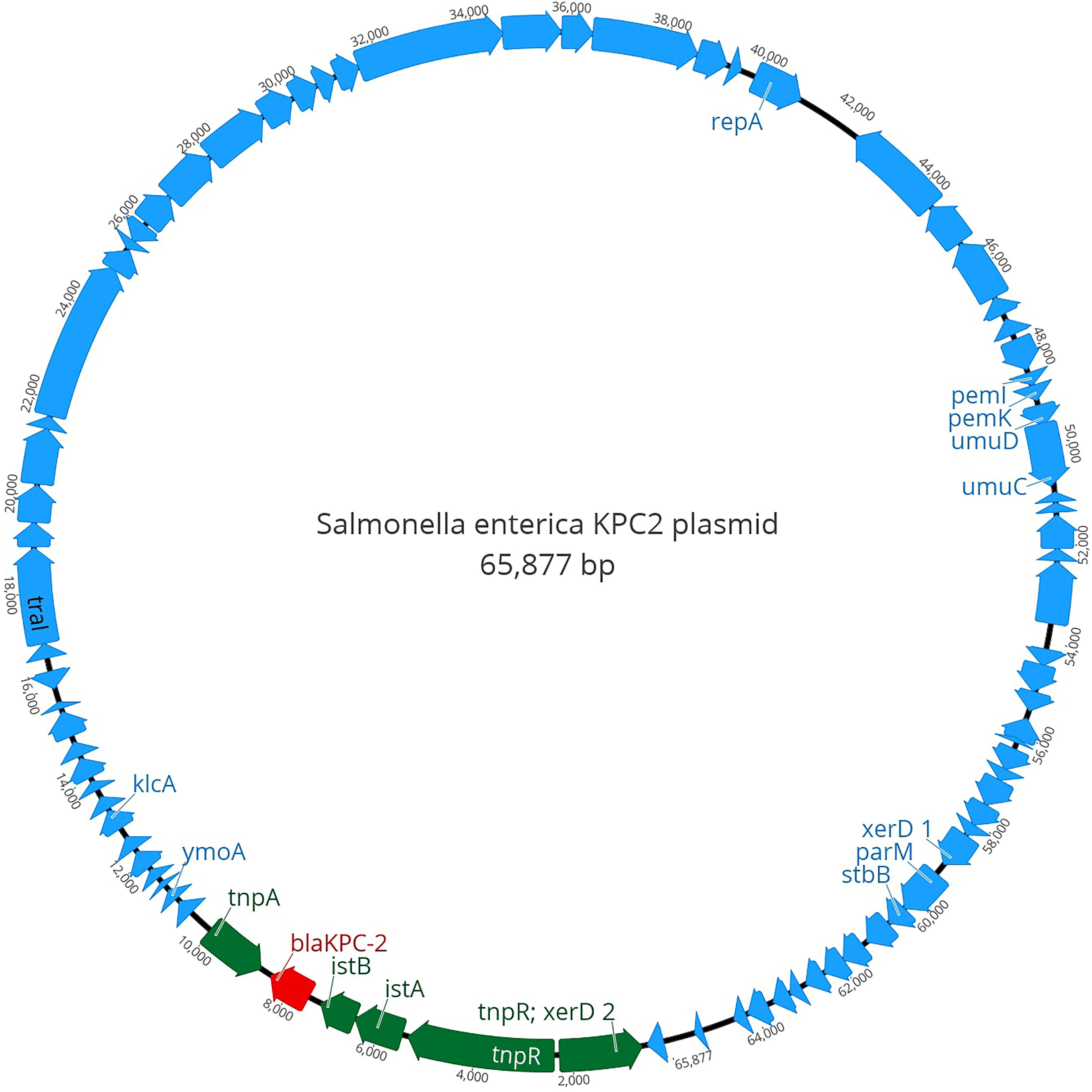
Genetic environment of blaKPC-2 gene in plasmid from Salmonella enterica serovar Infantis annotated using Geneiuous® 9.0.5 with reference map of Kpn-WC17-007–03 (accession number CP094900.1) as reference. The fragment in red from 881 bp corresponds to blaKPC-2.
Discussion
S. enterica serovar Infantis has gained importance in recent years for surveillance systems worldwide as it has become a carrier and possible disseminator of MDR genes both in animal health, the food production chain, as well as in infections associated with health care. Although it has fewer virulence factors than other serotypes such as Typhimurium, it can incorporate resistance genes, which represents a threat in reported human salmonellosis cases. 31
Mejía in 2021 (12) described phenotypes of S. enterica serovar Infantis, collected in 2015 and 2016, with antibiotic susceptibility patterns that suggested the presence of ESBL mechanisms, and Vinueza—Burgos in 2016 (15) detected CTX-M type genes in this bacterium, emphasizing that these resistance patterns may have implications for the management of these MDR microorganisms. Different serotypes of KPC-producing S. enterica have been found worldwide: Cubana (USA, 1998), Typhimurium (Colombia, 2013), Schwarzengrund (Argentina, 2013), and Javiana (Paraguay, 2017).32–35 However, a KPC-2-producing S. enterica serotype Infantis has not been described yet, making this work the first report in this regard.
The multilocus typing of the study isolate sequences allowed it to be identified as an S. enterica serovar Infantis ST-32. This is one of the most persistent and of which there are several reports in the world. As we can see in the phylogenetic tree (Fig. 1), our strain is more closely associated, in this region, South America, with the reports from Brazil, Peru, and Ecuador. This sequence type has been associated with the food production chain, specifically in lymph nodes of pigs, eggs, and chicken carcasses. In turn, Mejia in 2020, 36 mentions that there is a relationship between this sequence type with cases of human gastroenteritis in different geographical regions, which is of great concern and gives an idea that the productive chains of food derived from poultry and pigs can allow the dissemination of this pathogen to a greater or lesser degree.31,37 Hindermann, 2017, 38 associated this sequence type with blaCTX-M-65 ESBL gene transfer. Our isolate, in addition to blaKPC-2, also showed this resistance gene.
In this work, using the PlasmidFinder application, we identified two plasmid replicons corresponding to IncM1 and IncX4 in the S. enterica serovar Infantis that were also found in the E. coli transconjugant. However, when performing a more robust analysis, we found that those replicons were associated better (99.9% of identity and 99% of query coverage) with the plasmid Kpn-WC17-007-03. The sequence of this plasmid has been recently uploaded to the GenBank by the CDC and reported by Prussing et al. in October 2022 39 regarding a large K. pneumoniae outbreak in New York, USA. This plasmid carried a carbapenem hydrolyzing class A beta-lactamase gene. Since we found the blaKPC-2 both in the S. enterica serovar Infantis and the transconjugant E. coli and demonstrated the transference of the mentioned plasmid in the conjugation assay, we can conclude that this plasmid was responsible for the transmission of the blaKPC-2 resistance mechanism. A deeper analysis through third-generation sequencing would allow us to know the complete sequence of our plasmid.
Conclusions
In conclusion, to our knowledge, this is the first report of a KPC-2 producing an S. enterica serovar Infantis from a clinical isolate in the world. This MDR strain, closely related to other strains reported in the South American region which have been associated with the food production chain, is of great concern due to its ability to carry resistance mechanisms and spread them to other bacteria with clinical relevance. This emphasizes the importance of antimicrobial resistance surveillance in the community area to prevent and control the spread of microorganisms and resistance mechanisms between animals and humans.
Footnotes
Authors’ Contributions
F.V.: Conceptualization, investigation, methodology, writing—original draft preparation. V.A.: Investigation. C.S.: Investigation, formal analysis. H.Q.: Investigation. W.E.: Investigation, formal analysis, data curation. K.J.: Investigation, formal analysis. F.F.: Data curation. L.A.: Conceptualization, supervision and writing—reviewing and editing.
Disclosure Statement
Authors declare no conflict of interest
Funding Information
This research was funded by SEK International University, Ecuador. (Project code