







Abstract
Oligonucleotides have emerged as valuable new therapeutics. Presently, oligonucleotide manufacturing consists in a series of stepwise additions until the full-length product is obtained. Deprotection of the phosphorus backbone before cleavage and deprotection (C&D) by ammonolysis is necessary to control the 3-(2-cyanoethyl) thymidine (CNET) impurity. In this study, we demonstrate that the use of piperazine as a scavenger of acrylonitrile allows phosphorus deprotection and C&D to be combined in a single step. This reduces solvent consumption, processing time, and CNET levels. Additionally, we showed that substitution of piperazine for triethylamine in the phosphorus deprotection step of supported-synthesis leads to reduced reaction times and lower levels of CNET impurities.
Introduction
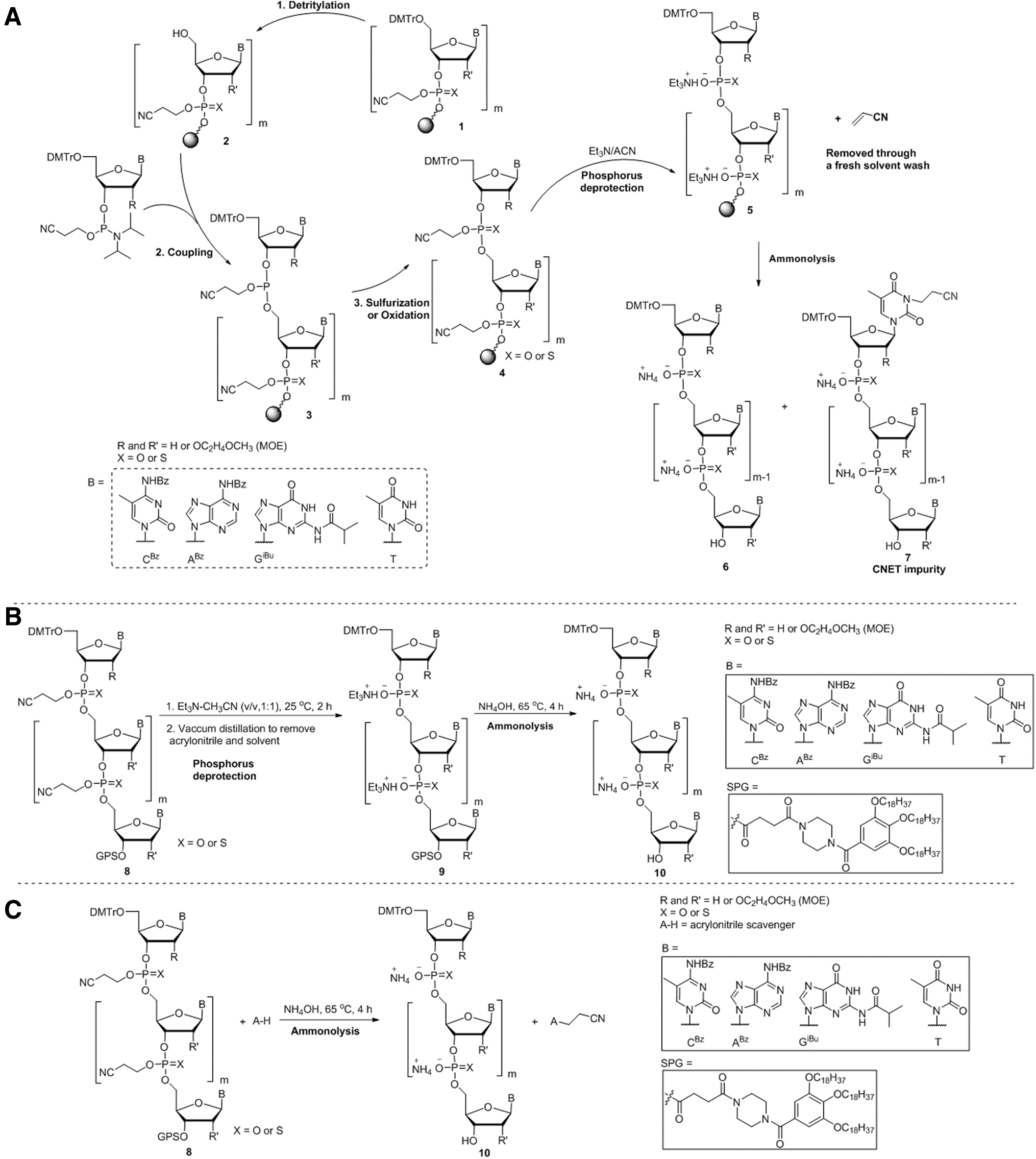
In recent years, oligonucleotide therapeutics have demonstrated their effectiveness in treating a variety of diseases.1–6 Consequently, oligonucleotides have emerged as viable alternative to traditional small molecules and protein drugs. 7 So far, 18 oligonucleotide drugs 8 have been approved, and hundreds more are currently being investigated in different stages of research and development. 6 The state-of-art synthesis of oligonucleotides from small-scale drug discovery to large-scale commercial manufacturing follows a well-developed procedure involving solid-supported synthesis (SPS) using a phosphoramidite approach.9–11 Chain assembly consists of repetition of a three- or four-step cycle.12,13 Upon completion of chain assembly, the fully protected, resin-bound oligonucleotide is subjected to phosphorus backbone deprotection by the reaction with a base, such as triethylamine (Et3N). 14 The oligonucleotide is then treated with ammonium hydroxide (NH4OH) to remove nucleobase-protecting groups and cleave the crude product from the resin (Scheme 1A).
The most common building blocks used in the approach are β-cyanoethyl-protected phosphoramidites.9–11 The Et3N phosphorus deprotection step involves removal of the β-cyanoethyl-protecting group and the resultant acrylonitrile by-product before ammonolysis. This operation minimizes the formation of 3-(2-cyanoethyl) thymidine (CNET) impurities to 0.2%–1.0%.14–17 The CNET impurity can arise through a slow Michael-type addition of thymine with acrylonitrile, which may occur during the Et3N phosphorus deprotection or the ammonolysis when the phosphorus deprotection is incomplete (Scheme 1A). CNET is difficult to remove during the purification process due to its structural similarity to the desired product.
The technology of oligonucleotide solid-supported synthesis has been developed over the course of decades; however, meeting large-scale drug demands remains a challenge due to scale-up limitations.3,5,6 To address the increasing demands for large-scale oligonucleotide active pharmaceutical ingredients, we have been developing a scalable large-scale liquid-phase oligonucleotide synthesis (LPOS) process and have recently reported our preliminary results.18,19 Similar to solid-supported synthesis, LPOS, which is also based on the phosphoramidite approach, utilizes β-cyanoethyl phosphoramidites as building blocks. Therefore, the liquid-phase synthesis process faces the same challenges associated with controlling CNET impurities. However, unlike solid-supported synthesis in which the acrylonitrile by-product from the phosphorus deprotection step can be easily washed away, the LPOS process utilizes an organic solvent soluble-protecting group (SPG) as the anchor to assemble the oligonucleotide chain.18,19 Consequently, the practice of washing away acrylonitrile from the solid support-bound products cannot easily be applied to LPOS.
To control the CNET impurity in LPOS products, we developed a Et3N deprotection-distillation-ammonolysis process based on the SPS phosphorus backbone deprotection strategy (Scheme 1B). 14 The first step is identical to SPS, where β-cyanoethyl is deprotected from the phosphorus backbone by treating the fully protected oligonucleotide product with a Et3N/ACN (1:1, v/v) solution. Subsequently, the acrylonitrile by-product and Et3N are distilled from the product under reduced pressure. The residue is treated with NH4OH to remove nucleobase and 3′-protecting groups. The Et3N deprotection-distillation-ammonolysis process typically results in CNET levels below 1%. This process has proven effective at 50 gram scale. However, during reduced-pressure distillation, a tendency for bumping and foaming was observed. Additionally, achieving the complete removal of solvents and acrylonitrile in large-scale production is a time-consuming process.
To simplify the deprotection procedure in LPOS, we envisioned a one-pot process (Scheme 1C). Our plan was to carry out both the phosphorus deprotection of the liquid-phase synthesis products and cleavage and deprotection in NH4OH solution by incorporating an acrylonitrile scavenger (A-H) to control the CNET impurity (Scheme 1C). If the released acrylonitrile can be completely consumed by a scavenger, it would obviate the separate time-consuming phosphorus deprotection and acrylonitrile distillation steps.
The selection criteria for a suitable scavenger are as follows: (1) It should exhibit superior reactivity with acrylonitrile compared to thymine. (2) The scavenger must not react with oligonucleotides, thereby avoiding the generation of new impurities. (3) The scavenger should not interfere with the subsequent purification process of the oligonucleotides and must be readily removed in the purification step. (4) The scavenger and acrylonitrile reaction product must be stable under the ammonolysis condition, so acrylonitrile is not released back to the reaction mixture. (5) The scavenger reaction product should be readily removed in purification. Keeping these considerations in mind, we assessed various potential acrylonitrile scavengers.
Results and Discussion
We evaluated various scavengers using a full-length 18-mer oligonucleotide SQ1-SPG with a mixed PO/PS backbone 2′-MOE gap-mer made from a single LPOS synthesis, and 28%–30% NH4OH heated at 65°C for 4 h as the ammonolysis condition (Table 1). Primary amines lacking steric hindrance were not considered in this study, based on previous findings by Hsiung, which revealed their reactivity with cytosine and adenosine. 20 We began by testing several reported sterically hindered primary and secondary amines as acrylonitrile scavengers. Compared to the control experiment (Table 1, entry 1), addition of 100 equivalents (relative to the 18 mer oligonucleotide, 5.9 equivalents to cyanoethyl groups) of t-butylamine 21 (Table 1, entry 3) or diisopropylamine (Table 1, entry 4) to the NH4OH ammonolysis solution did not reduce CNET impurity levels (Fig. 1).
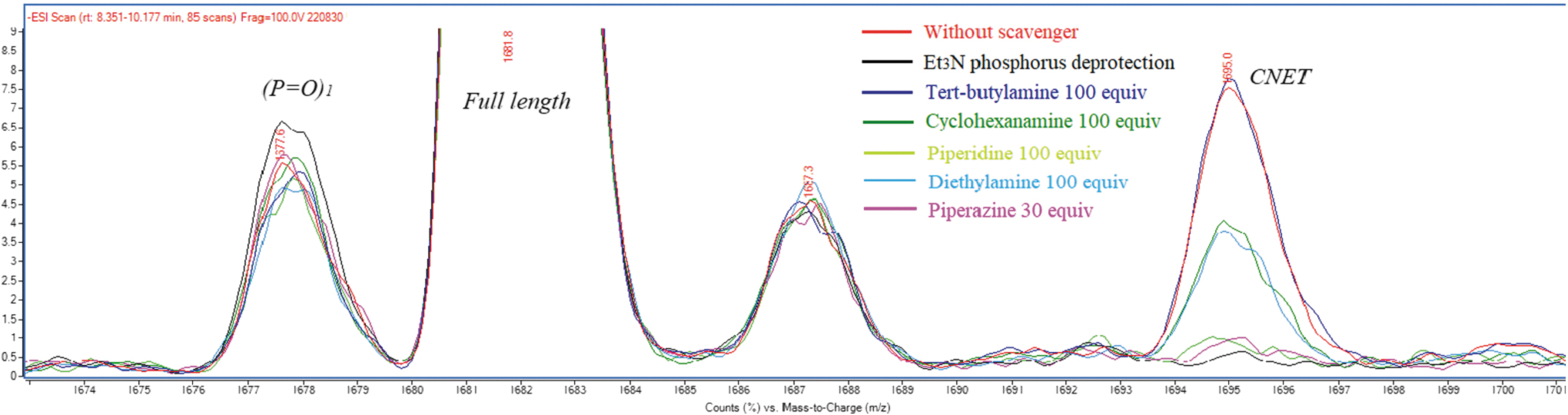
Overlays of mass chromatograms of crude SQ1-SPG obtained from ammonolysis in the presence of acrylonitrile scavengers. SPG, soluble protecting group.
3-(2-Cyanoethyl) Thymidine Impurity Levels in DMT-on Oligonucleotide Obtained from Ammonolysis in the Presence of Acrylonitrile Scavengers Without Prior Phosphorus Deprotection
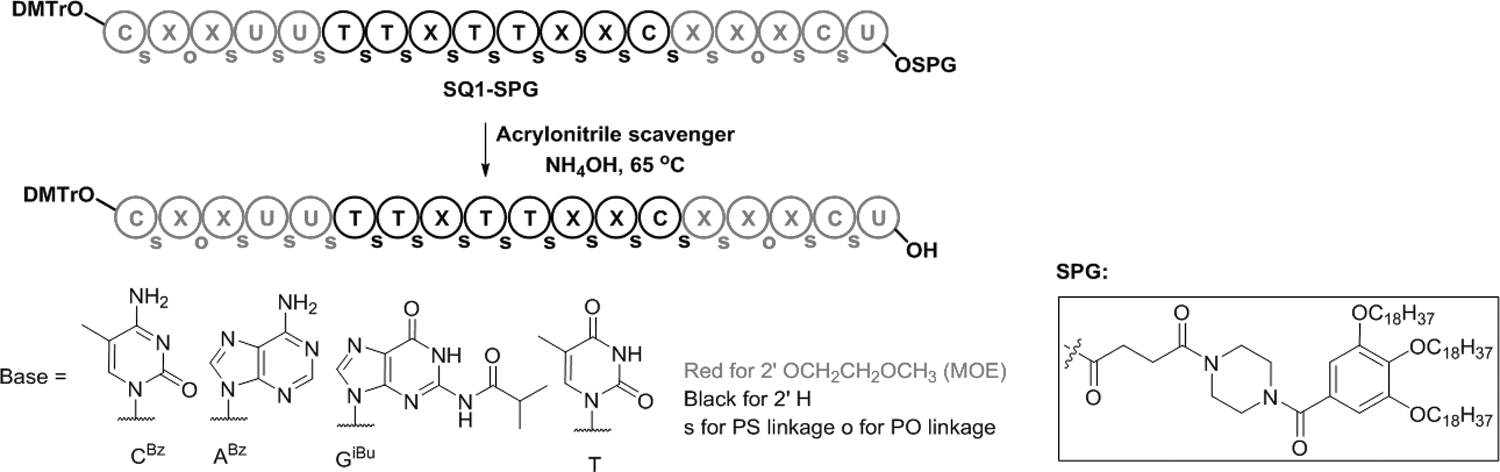
The equiv is relative to the 18-mer oligonucleotide, which contains 17 linkages, or 17 cyanoethyl protecting groups.
Operation: a mixture of SQ1-SPG (200 mg, 1.00 eq) and acrylonitrile scavenger in NH4OH (2.0 mL, 28% wt) in a sealed 8 mL tube was stirred at 25°C for 1 h and 65°C for 4 h. The reaction mixture was filtered and analyzed.
One milligram EDTA was added during ammonolysis to avoid the potential PO impurity increase caused by the trace amount of metals in the reaction mixture. 25
The CNET level of entries 3–9 and 12–17 was estimated based on the mass chromatograms overlay studies.
CNET, 3-(2-cyanoethyl) thymidine; EDTA, ethylenediaminetetraacetic acid; equiv, equivalent; NH4OH, ammonium hydroxide; PO, phosphodiester; SPG, soluble protecting group.
Cyclohexanamine, at 100 equivalents, showed an ∼50% reduction in CNET impurity compared to the direct ammonolysis of SQ1-SPG in NH4OH. However, a new impurity, with a mass equal to the oligonucleotide +82 (referred to herein as n + 82), was observed (Fig. 2). The n + 82 impurity may be produced via an amine replacement between the oligonucleotide bases and cyclohexanamine. The level of CNET impurity was comparable to the Et3N phosphorus deprotection strategy described above (Scheme 1B) when nitromethane 22 was used as the acrylonitrile scavenger, but several new impurities were observed whose structures were also not investigated.
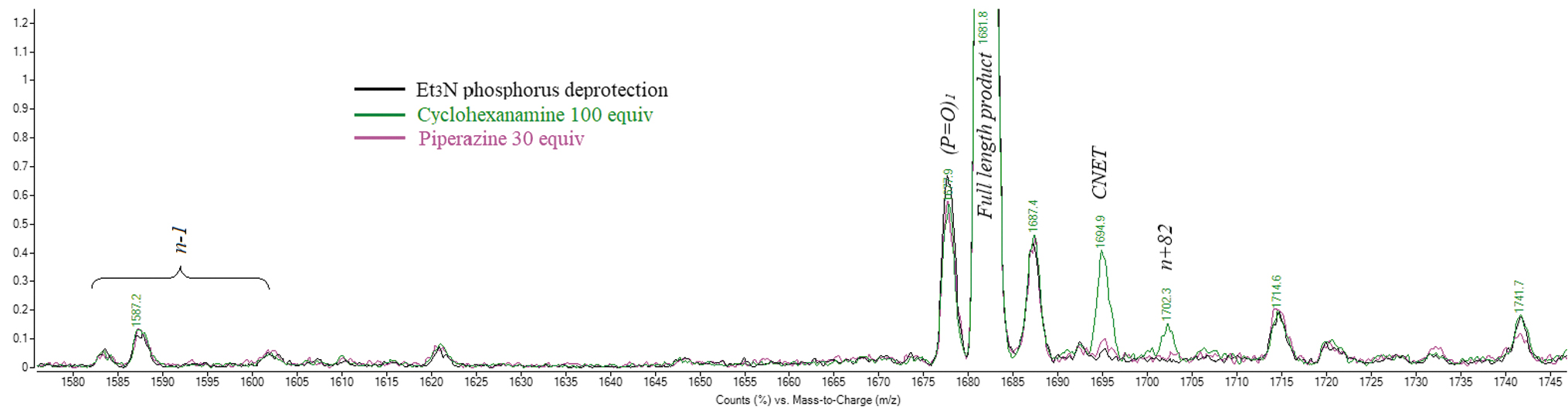
Overlays of the expanded mass chromatograms including (n − 1), P = O, CNET, and n + 82 Impurities of SQ1-SPG from the ammonolysis in the presence of acrylonitrile scavengers. CNET, 3-(2-cyanoethyl) thymidine.
Thymine analogs such as piperidine-2,6-dione (100 equiv) and pyrrolidine-2,5-dione (100 equiv) did not effectively reduce the CNET impurity (Table 1, entries 7 and 8). Secondary amines, diethylamine, and piperidine were also tested for their ability to control the CNET impurity. Diethylamine 23 (100 equiv) exhibited moderate effectiveness, reducing CNET impurity by ∼50% (Table 1, entry 9). In comparison, piperidine (100 equiv) exhibited higher efficiency and reduced the CNET impurity from 6.4% (Table 1, entry 1) to 0.58% (Table 1, entry 11). The effectiveness was comparable to the Et3N stepwise deprotection strategy. However, reducing the piperidine from 100 equiv to 40 equiv (Table 1, entry 10) led to an increase in the CNET impurity, rising from 0.58% to 1.1%.
In an attempt to discover a more effective acrylonitrile scavenger to further reduce CNET impurity and scavenger usage, we tested several cyclic secondary amines, including morpholine, thiomorpholine, pyrrolidine, azepane, 1,2,3,4-tetrahydroquinoline, and decahydroisoquinoline (Table 1, entries 12–17). However, none of these cyclic secondary amines demonstrated higher effectiveness than piperidine. On the other hand, the cyclic diamine piperazine displayed significantly higher acrylonitrile scavenging ability compared to piperidine. Using 30 equivalents of piperazine yielded a 0.69% CNET impurity (Table 1, entry 19), slightly higher than the 0.58% obtained with 100 equivalents of piperidine. A further study demonstrated that both nitrogen atoms in piperazine effectively react with acrylonitrile, and one molecule of piperazine exhibits the same acrylonitrile-quenching efficiency as two molecules of piperidine (for detailed study, please see Supplementary Data).
To validate the suitability of piperazine for use in the one-pot phosphorus deprotection and ammonolysis process, we conducted ammonolysis with addition of 100 equivalents of piperazine (65°C, 6 h) and analyzed the crude product using LC-MS. No new oligonucleotide impurities due to side reactions were observed, and the level of CNET was ∼0.4% in this experiment. Finally, we demonstrated the usefulness of this one-pot process on a 20-g scale reaction, achieving CNET levels of 0.65% with 30 equiv. of piperazine. From this experiment, we confirmed that there was no new oligonucleotide impurity formation compared with standard ammonolysis process. It was also confirmed that residual piperazine, as well as the piperazine and acrylonitrile adduct, have no detrimental impact on the subsequent platform oligonucleotide purification process (for detailed purification, please see Supplementary Data) and were readily reduced to undetectable levels in the final product. Due to the simplicity and robustness of the process, we intend to use it in our large-scale LPOS process.
Application in oligonucleotide solid-supported synthesis
The current Et3N phosphorus deprotection method for oligonucleotide solid-supported synthesis is highly effective and allows for control of CNET impurity levels to 0.2%–1.0%, which can vary with oligonucleotide sequences. It involves circulating a triethylamine acetonitrile (1:1, v/v) solution through the solid support-bound oligonucleotide in the synthesis column for 1.0–2.0 h, followed by washing with acetonitrile. However, CNET impurity in some sequences can be as high as 1.0% and can be very difficult to reduce further.
With the promising results obtained from the above study for scavenger-aided one-pot phosphorus deprotection and ammonolysis, the potential to reduce the reaction time of phosphorus deprotection in the solid-supported synthesis or even eliminate the phosphorus deprotection step was explored. We first tried the typical phosphorus deprotection procedure by utilizing piperazine as a replacement for Et3N, since piperazine should also effectively promote the phosphorus deprotection due to its basicity and can simultaneously react with by-product acrylonitrile. We conducted the deprotection reaction using various equivalents of piperazine and different reaction times. After the deprotection, the resin-bound oligonucleotide was cleaved and fully deprotected by ammonolysis, and the crude products were analyzed to determine CNET levels and any new impurities in the crude product. The results are summarized in Table 2.
3-(2-Cyanoethyl) Thymidine Impurity Levels in DMT-on Oligonucleotides Obtained under Different Phosphorus Deprotection and Ammonolysis conditions
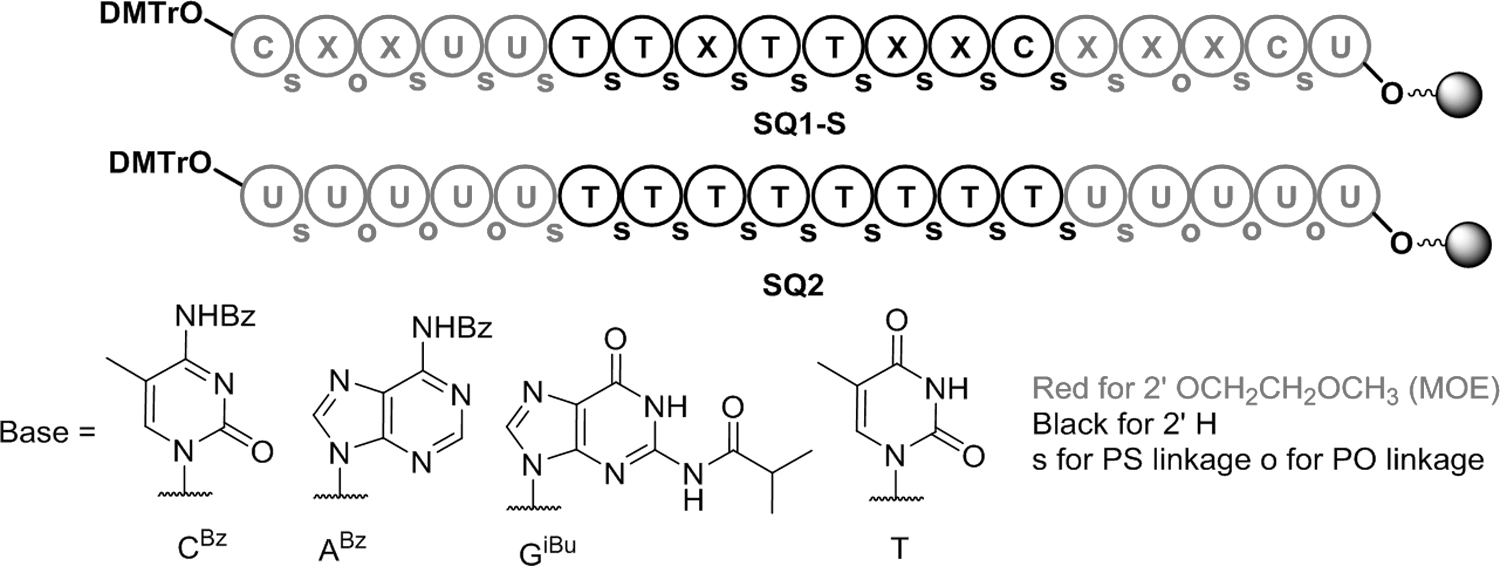
All syntheses were carried out on an AKTA 100 solid-supported synthesizer at 1.1 mmol scale using Biogen platform procedure. 12
The equiv is relative to the 18 mer oligonucleotide.
No new impurities were observed in all conditions studied in the experiment. Compared with Et3N, piperazine is much more effective at controlling CNET levels. As entries 2 and 3 demonstrate, much lower levels (0.12%–0.17%) of CNET impurity were obtained with much less piperazine and shorter time than with Et3N (0.7%, Table 2, entry 1). Utilizing piperazine (1:20, w/v) in acetonitrile for 10 min results in a lower CNET level compared to employing 50% Et3N for 90 min.
We then demonstrated the phosphorus deprotection and ammonolysis can be carried out concurrently in one pot with NH4OH in the presence of piperazine while maintaining control of the CNET impurity. Lower levels of CNET impurity (0.3%, Table 2, entry 4) were achieved by eliminating the Et3N phosphorus deprotection step and carrying out ammonolysis of the solid support-bound oligonucleotide with NH4OH in the presence of piperazine (30 equiv), compared with the 0.7% CNET impurity (Table 2, entry 1) from the standard Et3N deprotection procedure followed by ammonolysis.
To demonstrate further that piperazine is a superior CNET impurity control reagent to Et3N, we synthesized a full MOE U and deoxy T 18-mer oligonucleotide sequence SQ2 and tested the efficiency of CNET impurity control using piperazine. As SQ2 is a full MOE U and deoxy T oligonucleotide sequence, the number of potential reaction sites with acrylonitrile is three to four times that of a typical oligonucleotide sequence, making it challenging to control the CNET impurity using the conventional Et3N phosphorus deprotection strategy.
As shown in Table 2, entry 6, when the Et3N phosphorus deprotection step was followed by ammonolysis, 2.9% CNET impurity was observed in crude SQ2. Extending the Et3N deprotection time to 180 min (Table 2, entry 7), still produced 0.83% CNET impurity. In contrast, a 10 min phosphorus deprotection step using piperazine in acetonitrile (1:20, w/v) was sufficient to control the CNET impurity to ∼0.55% (Table 2, entry 9). By prolonging the deprotection time to 90 min, the CNET impurity was further reduced to 0.32%. The data clearly demonstrate the superiority of piperazine over triethylamine for phosphorus deprotection in solid-supported synthesis and its applicability to manufacturing of oligonucleotide drug substance. This new process not only significantly reduces CNET impurity levels but also significantly reduces process time.
After demonstrating a significantly more efficient phosphorus deprotection process, we proceeded to test the one-pot phosphorus deprotection and ammonolysis strategy on SQ2 synthesized using solid-supported synthesis. As shown in Table 2, entry 10, with 30 equivalents of piperazine in the ammonolysis reaction, the one-pot process effectively controlled the CNET impurity level of SQ2 to 0.64%.
In addition to Et3N, diethylamine (Et2NH) is used for phosphorus deprotection in solid-supported synthesis. 24 Et2NH exhibits similar effectiveness to piperazine for 2-cyanoethyl deprotection and CNET control in solid phase synthesis. As shown in Table 2, entry 11, the CNET impurity was 0.55% when the phosphorus deprotection of SQ2 was completed with a Et2NH acetonitrile solution (1:4, v/v) for 10 min. However, compared to piperazine, Et2NH is less efficient as an acrylonitrile scavenger (for detailed study, please see Supplementary Data), as the level of CNET impurity could not be well controlled even with 100 equivalents of Et2NH added to the NH4OH solution in the ammonolysis study of SQ1-SPG (Table 1, entry 9). Additionally, it's worth noting that Et2NH is considered a controlled substance by the drug enforcement administration and is more toxic than piperazine.
Conclusion
We have demonstrated that piperazine is a very efficient reagent for oligonucleotide phosphorus deprotection and acrylonitrile scavenging. As a result, it can be used in solid-supported synthesis to replace Et3N for the phosphorus deprotection reaction to control CNET impurities. Due to its efficiency in quenching acrylonitrile, piperazine allows the phosphorus deprotection and ammonolysis reactions to be carried out in one pot. This one-pot process simplifies both liquid-phase and solid-supported oligonucleotide synthesis processes by eliminating time-consuming steps and provides improved CNET impurity control. Owing to its improved efficiency and product quality, we plan to implement this process in our oligonucleotide manufacturing.
Footnotes
Acknowledgments
The authors would like to thank Dr. Daniel Capaldi of Ionis Pharmaceuticals for the review of this manuscript.
Author Disclosure Statement
X.Z., Y.F., F.A., T.P., W.Z., A.D., and J.Z. are employed by Biogen, Inc.; X.S. is employed by Leal Therapeutics, Inc.; and J.Y. is employed by Intellia Therapeutics, Inc. No competing financial interests exist.
Funding Information
This work was supported by internal funding from Biogen, Inc.

References
Supplementary Material
Please find the following supplemental material available below.
For Open Access articles published under a Creative Commons License, all supplemental material carries the same license as the article it is associated with.
For non-Open Access articles published, all supplemental material carries a non-exclusive license, and permission requests for re-use of supplemental material or any part of supplemental material shall be sent directly to the copyright owner as specified in the copyright notice associated with the article.
