







Abstract
In an effort to reduce concussions in football, a helmet safety-rating system was developed in 2011 that rated helmets based on their ability to reduce g-forces experienced by the head across a range of impact forces measured on the playing field. Although this was considered a major step in making the game safer, the National Football League (NFL) continues to allow players the right to choose what helmet to wear during play. This prompted us to ask: What helmets do NFL players wear and does this helmet policy make the game safer? Accordingly, we identified the helmets worn by nearly 1000 players on Week 13 of the 2015–2016 season and Week 1 of the 2016–2017 season. Using stop-motion footage, we found that players wore a wide range of helmets with varying safety ratings influenced in part by the player's position and age. Moreover, players wearing lower safety-rated helmets were more likely to receive a concussion than those wearing higher safety-rated helmets. Interestingly, many players suffering a concussion in 2015 did not switch to a higher safety-rated helmet in 2016. Using a helmet-to-helmet impactor, we found that the g-forces experienced in the highest safety-rated helmets were roughly 30% less than that for the lowest safety-rated helmets. These results suggest that the current NFL helmet policy puts players at increased risk of receiving a concussion as many players are wearing low safety-rated helmets, which transmits more energy to the brain than higher safety-rated helmets, following collision. Thus, to reduce concussions, the NFL should mandate that players only wear helmets that receive the highest safety rating.
Introduction
B
In a recent effort to reduce the prevalence of head injuries on the playing field, a helmet safety-rating system (the STAR Evaluation System) was developed in 2011 that rated helmets based on their ability to reduce g-forces experienced by the head across a range of impact forces measured on the field. 13 Based on data derived from a helmet drop assay as described by the National Operating Committee for the Safety of Athletic Equipment (NOCSAE), 14,15 helmets were rated 1 to 5 Stars, with a 5-Star rating being the best available helmet and a 1-Star rating the worst. Accordingly, of the helmet models commercially available at the time of this study, thirteen helmets received a 5-Star rating, eight received a 4-Star rating, three received a 3-Star rating, two received a 2-Star rating, one received a 1-Star rating, and one received a “Not Recommended” rating. Further studies that compared concussion rates between college players wearing a 1-Star helmet or a 3-Star helmet found that a lower percentage of players in a 3-Star helmet sustained concussions than in a 1-Star helmet. 16 These results helped to establish the merits of the helmet safety-rating system, which represented a new way by which players, parents, and football organizations could, through the purchase of a specific helmet, reduce the incidence of concussions on the playing field. Although the Star helmet rating system represented a major step in making the game safer, the NFL continues, even to this day, to adopt the position of allowing players to wear any helmet provided it is NOCSAE certified and as stated in Section 4, Article 3, of the NFL official play rulebook, “of a suitably protective nature” and “designed and produced by a professional manufacturer.” 17 This prompted us to ask: What helmets do NFL players wear and does the current NFL helmet policy make the game safer?
In this study, we assessed what helmets NFL football players wore during the 2015–2016 and 2016–2017 seasons, attempted to understand the factors that influence player helmet selection, identified the helmets worn by players suffering a concussion in 2015, and tested the extent to which helmet selection can influence the impact forces a player will be exposed to during helmet-to-helmet collision. The results presented in the study suggest that the current NFL helmet policy puts players at increased risk of receiving a concussion as many players are not prioritizing their safety when choosing a helmet.
Methods
Helmet identification
In this study, we identified the specific helmets worn by NFL football players on Week 13 of the 2015–2016 season and Week 1 of the 2016–2017 season during play. We selected these weeks for our study since there were no “byes” during these weeks and therefore all teams played. Video footage for each game was provided by the NFL Game Pass website (
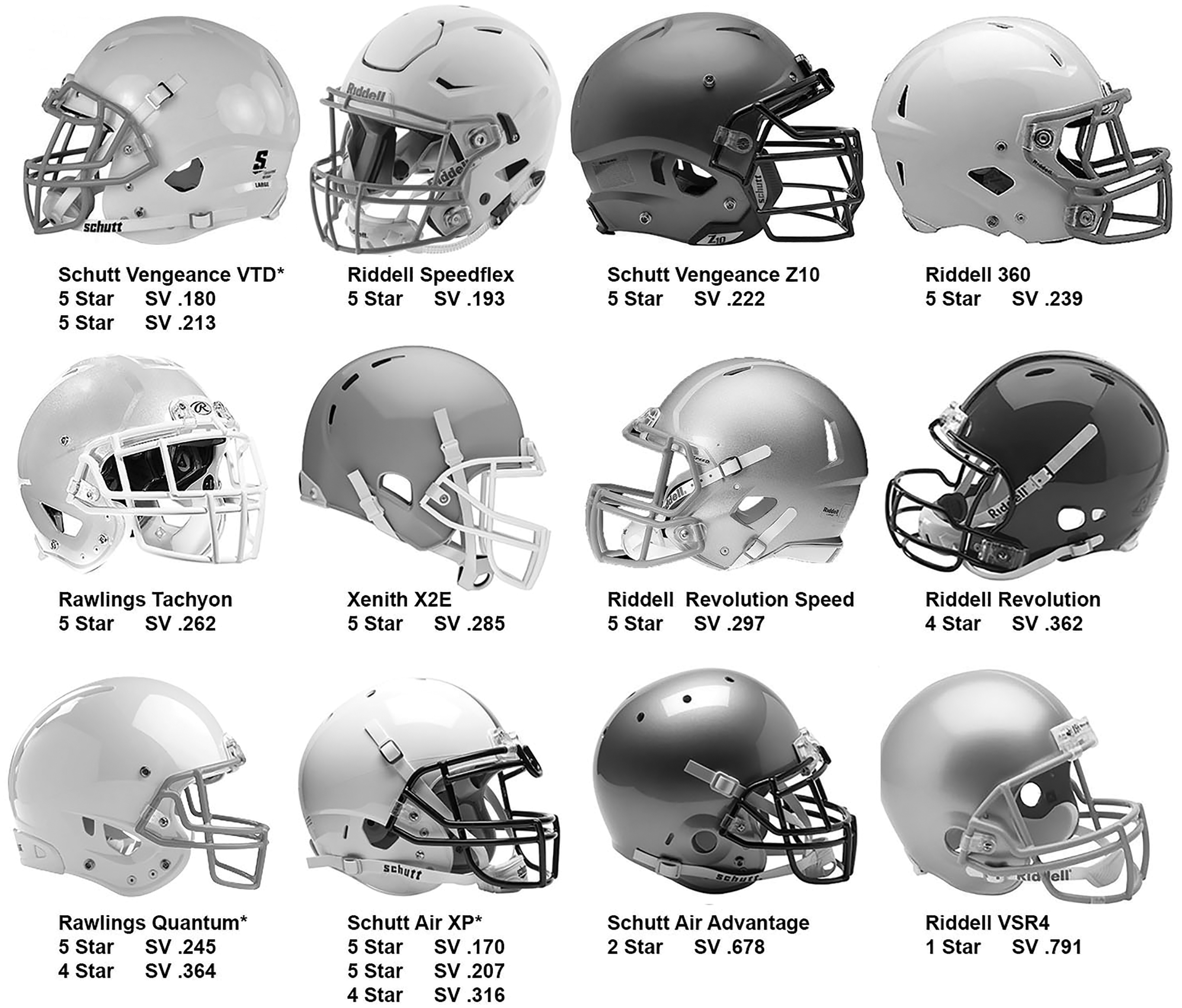
Identifying football helmets. Side view of 12 helmet types worn by players in the National Football League. Notice that helmets can be identified by their distinctive ear and head air vents and molding pattern. Helmet guards and chin straps are not used to identify helmets. The safety of helmets is identified both by its Star rating (1 being the lowest and 5 being the highest safety helmet) and Star value (SV), with the highest ranked helmet having the lowest SV value and vice versa, as determined by Rowson and Duma. 13 The STAR value for each helmet model is derived from 120 impacts on three new helmets as established in Rowson and Duma. 13 Star values were assigned a rating (Star rating) based on predetermined thresholds. These thresholds were determined based on a statistical analysis of the May 2011 Star values in the Rowson and Duma publication. 13 Helmet lines that had multiple models that were indistinguishable, based on ear vent patterns or helmet molding contours, are listed with the Star rating and Star value for each of the represented models.
Although there are a total of 1696 players in the NFL, a number of reasons prevented identification of all helmets worn. This includes a player's absence from the playing field (as a result of injury status or coach's decision), a player being outside of the camera's view, or helmets that could not be identified because of color (ear vent patterns were difficult to observe for helmets that were black or dark in color). Nevertheless, the helmets of nearly 1000 players were unambiguously identified for the observed week of each season. Additionally, for both the 2015 and 2016 seasons, each player's position, jersey number, and age was obtained through the team's official website or ESPN's NFL team roster website (
Data for players who suffered a concussion in 2015 season were obtained from Frontline's Concussion Watch website (
Analysis of the relationship between age and helmet choice
To determine the extent to which helmet selection could be correlated to a player's age, the age of each player whose helmets was identified was obtained through publically available records via the team's official website. Frequencies and percentages of the helmets Star ratings were calculated and for each Star rating category, the mean and standard deviation (SD) of the ages were calculated. A one-way analysis of variance (ANOVA) was used to compare the mean ages between each of the rating groups.
Helmet-to-helmet impactor
The helmet-to-helmet impactor (Custom Design and Fabrication South, Petersburg, VA), which was used in this study to determine impact forces experienced by the head when two helmets collided, was adapted from a cortical concussive device commonly used in traumatic brain injury studies. 18 Unlike the freefall pendulum impactor 19 or the linear impactor 20 that are commonly used to test helmets, this impactor measures forces during helmet-to-helmet collision, which more closely replicates the impact events that occur on the playing field. Linear force measurements were obtained using a PCB Piezotronics (model 356A66) triaxial accelerometer placed in a NOCSAE headform that had been secured into each helmet. The triaxial accelerometer was attached via a 10-foot cable assembly to a Photon dynamic signal analyzer run with RT Pro Photon 7.0 Software (Bruel and Kjaer, Inc.). Each helmet was secured at its crown to the moving arms of the pendulum using two regular 1/4″ × 3/4″ bolts attached to two 1/4″-20 rivet nuts embedded in each helmet. This point of attachment allowed for the same frontal portion of each helmet to be the contact point during each helmet-to-helmet collision (see below). The distance between helmets, or drop height, was in one foot increments from 1 foot to 8 feet. This was measured using hard plastic tubing with the same arc as the helmet travel that was cut into 1-ft, 2-ft, 3-ft, 4-ft, 5-ft, 6-ft, 7-ft, and 8-ft segments. Helmets were released from two fixed points equidistant from the center of the impactor apparatus, and the point of contact for the two helmets was at the bottom of the arc of travel.
Helmet-to-helmet impact experiment and data analysis
Data on the force of helmet collisions were collected during the course of a controlled experiment. Three different helmets were collided from heights ranging from 1 to 8 feet. The helmets were the 1-Star rated Riddell VSR4, the 4-Star rated Riddell Revolution, and the 5-Star rated Schutt Vengeance VTD II. Of these, the combinations tested were VSR4 versus VSR4, Revolution versus Revolution, VTD II versus VTD II, VSR4 versus VTD II, and VTD II versus VSR4. It should be noted that as the Riddell VSR4 is no longer commercially available, the helmets used in this study were purchased used. The force for each combination was measured using a triaxial accelerometer placed in the initially listed helmet. The experiment was repeated six times for each helmet combination, at each drop height. The results of these experiments were plotted using bar plots with y-axis values indicating the mean force of each helmet combination. A two-factor ANOVA was used to assess whether the difference between each helmet combination was statistically significant. Differences were deemed significant if their Tukey adjusted p value was less than 0.05. Statistical significance is marked on the graphs.
Results
In this study, we identified the specific helmets worn by NFL football players on Week 13 of the 2015–2016 season and Week 1 of the 2016–2017 season. Film footage provided by the NFL Game Pass website (
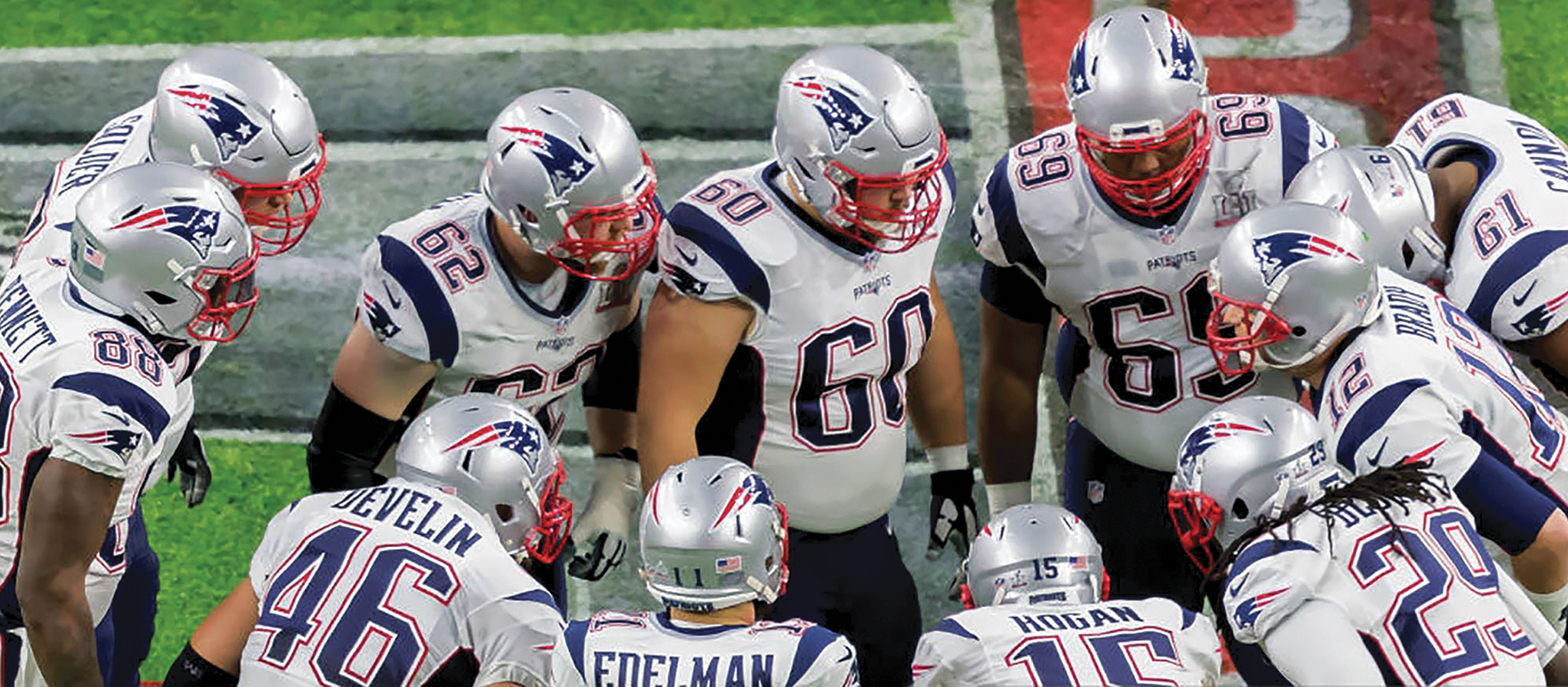
Football helmets worn by the New England Patriots. New England Patriots quarterback Tom Brady, and the offensive line in a huddle during the Super Bowl LI between the New England Patriots and Atlanta Falcon on February 5, 2017, at NRG Stadium in Houston. A wide selection of helmets can be seen worn on the playing field, which includes: Riddell VSR4 (Tom Brady [12]), Riddell Revolution Speed (Develin [46], Edelman [11], Thuney [62], Mason [69]), Riddell Speedflex (Bennett [88], Solder [77], Andrews [60], Cannon [61]), Schutt Vengeance VTD (Blount [29], Hogan [15]). Photograph taken by Leslie Plaza Johnson/Icon Sportswire via Getty Images.
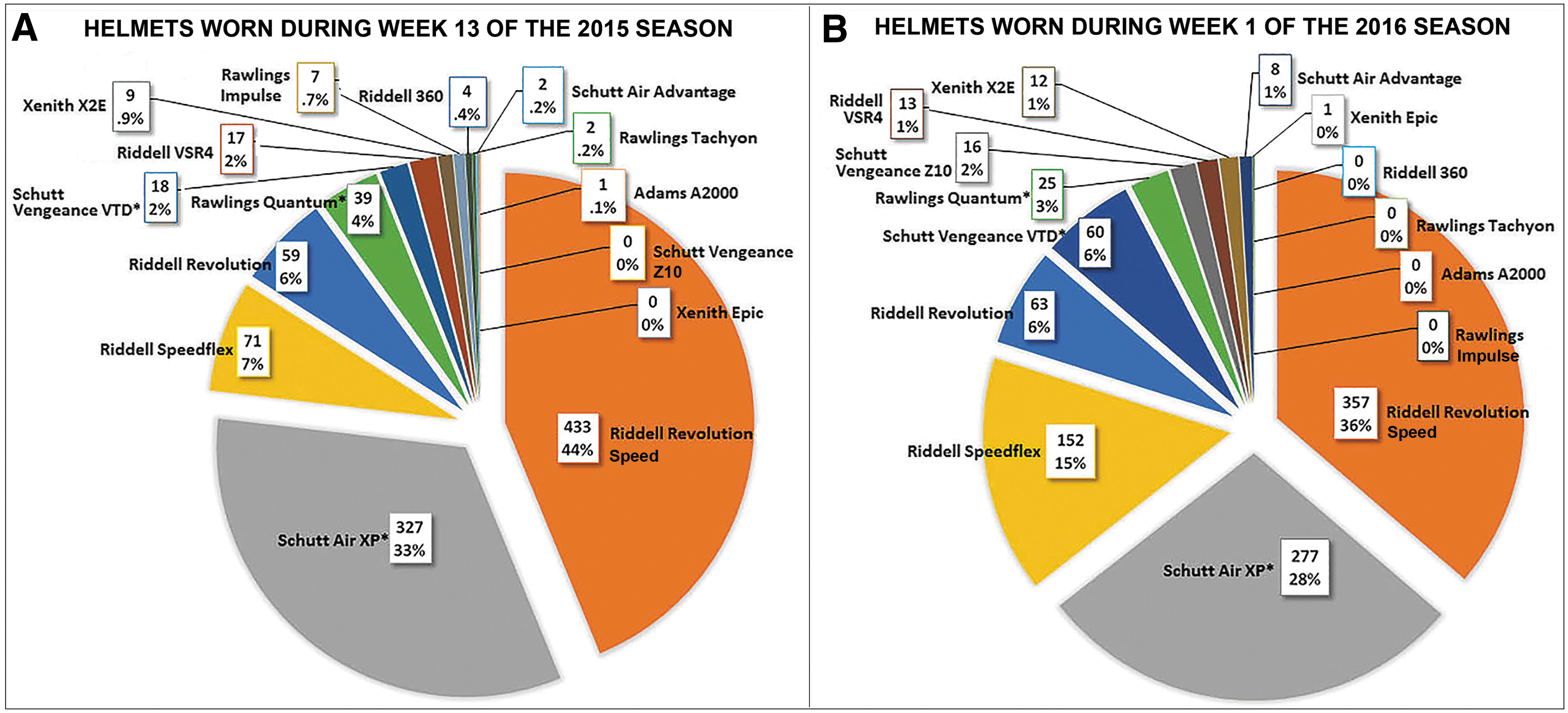
Helmet Makes and Models Worn in the National Football League (NFL) in 2015 and 2016. Helmets worn in the NFL on Week 13 of the 2015 season
To elucidate what factors may drive helmet choice, we next sought to determine the extent to which helmet selection could be correlated with position played. We reasoned that players on the offensive and defensive lines may have different helmet requirements than those playing positions in the open playing field, such as wide receivers and cornerbacks. This may include such differences in a helmet's field of view, padding, and number of air vents. An examination of helmets worn by position showed clear differences in choice (Fig. 4); wide receivers, corners, and safeties preferred the Schutt Air XP helmet at almost twice the level as all other positions, whereas players on the defensive and offensive lines preferred the Riddell Revolution Speed. Although quarterbacks and punters also showed a preference for these two helmets, a wider range of safety-rated helmets were selected in these two groups over any of the other positions examined. Centers displayed the least variety in helmet choice. These results suggest that a player's position is a factor that influences helmet choice.

Helmet types worn based on player's position. Helmet types worn based on football player's positions for Week 1 of the 2016 season. A total of 829 players' helmets were identified, 126 of which were wide receivers, 35 quarterbacks, 28 centers, 65 tight ends, 93 cornerbacks, 76 running backs, 55 punters/kickers, 99 linebackers, 48 defensive tackles, 64 offensive tackles, 82 safeties, and 58 offensive guards. The percentage of players, for each position, wearing a specfic helmet is listed.
As the NFL is made up of a collection of players drafted in varying years and their football careers overlap with the production and availability of specific helmets (
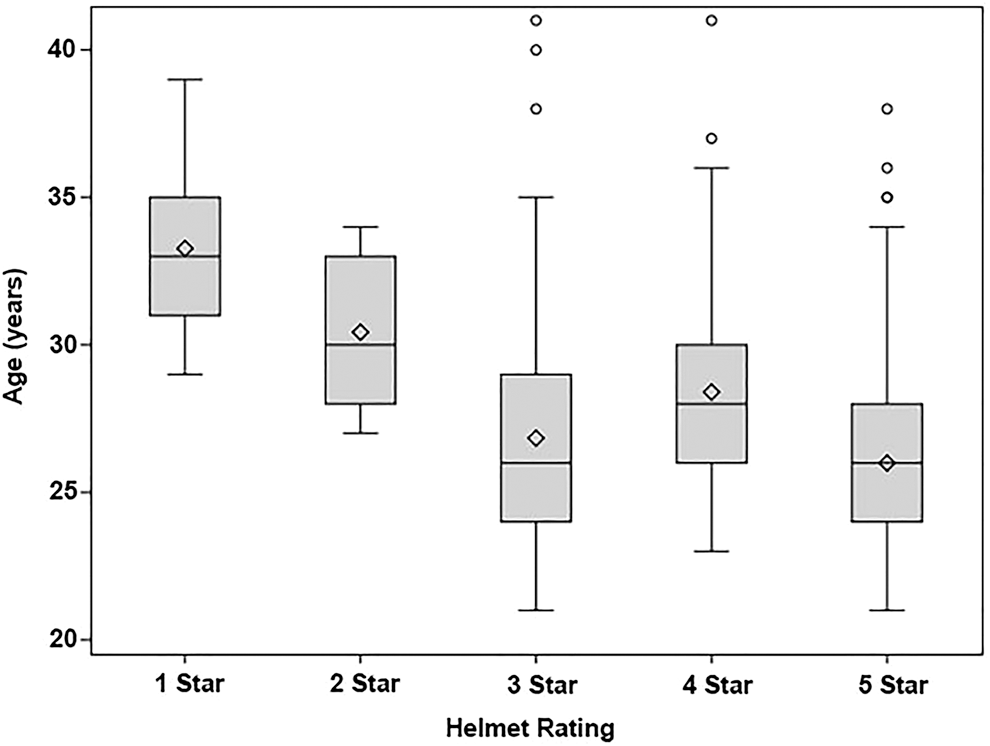
Helmet types worn based on player's age. Average age of National Football League players wearing helmets of a specific Star rating. Data were derived from football players for Week 1 of the 2016 season (see Fig. 3). Age was determined for each football player as of Sept. 11, 2016, which was the date in which Week 1 of the 2016 season took place, using the website
By examining helmet production date with Star rating, we found helmets with an older production date scored consistently lower in Star-safety rating than newer produced helmets. Specifically, the Riddell VSR4 (introduced in 1992) and Schutt Air Advantage (introduced in 1987) received a 1 and 2-Star rating, respectively, whereas the Riddell Revolution (introduced in 2002) received a 4-Star rating. The Riddell Revolution Speed (introduced in 2008), Schutt Vengeance (introduced in 2012), and Riddell Speedflex (introduced in 2014) scored a 5-Star rating. Consistent with the notion that helmet selection is correlated with a player's age is the observation that Tom Brady (age 39), Drew Brees (age 37), Antonio Gates (age, 36), Philip Rivers (age 34), Adrian Peterson (age, 31), and 11 other players wore the 1-Star Riddell VSR4 during the 2015 and 2016 seasons. Collectively, these data show that, on average, older players wear helmets with a lower safety rating.
Using a helmet-to-helmet impactor system, we next sought to determine the g-forces experienced by the head when helmets of varying Star ratings collided through the range of impact forces recorded on the field. We reasoned, based on data derived from the Star helmet safety-rating system, 13 that helmets with a higher Star rating would register lower g-forces than helmets with a lower Star rating at all drop heights. In this experiment, NOCSAE-approved headforms were strapped inside opposing helmets and g-forces were measured by a triaxial accelerometer embedded within each headform following impact (Fig. 6A). However, unlike other helmet impact studies that assess linear forces using the NOCSAE helmet drop assay that registers impact forces of a helmet dropped from varying heights on a rubber-covered metal stud, 13,21 we assessed these forces using a helmet-to-helmet impactor. This machine, which was adapted from a cortical concussive device commonly used in traumatic brain injury studies, 18 allows for helmet-to-helmet contact that more closely replicates the impact events that occur on the playing field. In this experiment, the Schutt Vengeance VTD II helmet represented a 5-Star helmet, the Riddell Revolution represented a 4-Star helmet, and the Riddell VSR4 represented a 1-Star helmet.
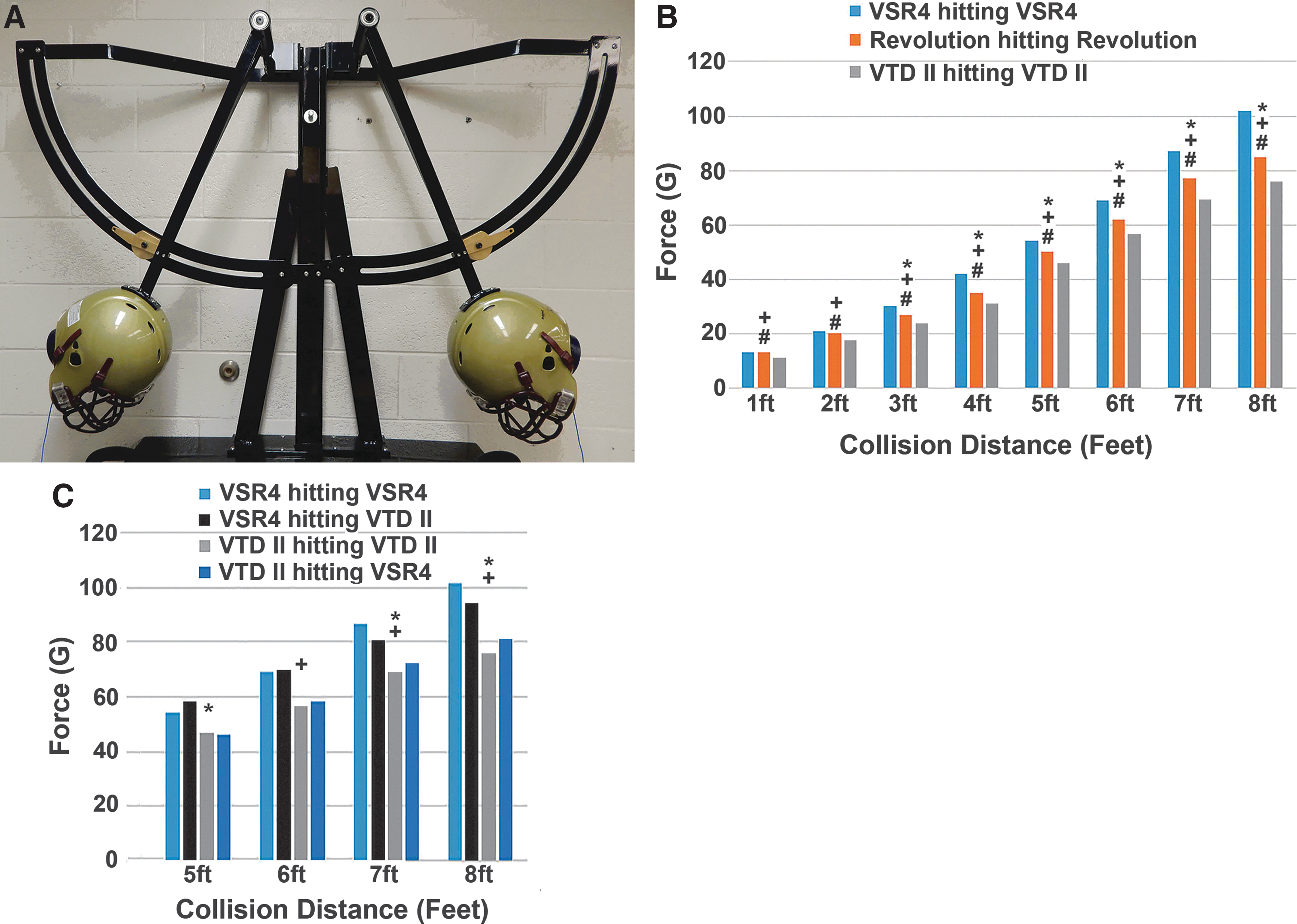
Helmet-to-helmet impact data.
In close agreement with previous results comparing helmet safety using the NOCSAE helmet drop assay, 13,21 we found that the headform in the 5-Star Vengeance VTD II helmet experienced significantly less g-forces than that experienced by headforms within either the 4-Star Riddell Revolution and the 1-Star Riddell VSR4 at all but the lowest drop heights. (Fig. 6B). Likewise, the 4-Star Riddell Revolution experienced significantly less g-forces than that experienced by the headform within the 1-Star Riddell VSR4 helmet at nearly all drop heights. Specifically, when two 5-Star helmets collided, the g-forces experienced by the head were 10% less in the three middle drop heights and 30% less in the three highest drop heights than that measured for two 1-Star helmets colliding. Likewise, headforms within the 5-Star Vengeance VTD II helmets experienced 20% less g-forces at the highest two drop heights than that observed for headforms within two 4-Star helmets colliding. As the playing field is composed of players wearing a variety of Star-rated helmets, we next sought to determine the g-forces experienced by the head when a 5-Star helmet collides into a 1-Star helmet (Fig. 6C). Surprisingly, we found that the 5-Star helmet's ability to protect the head was reduced, with g-forces experienced by the headform in the 5-Star helmet increasing by 15% at the highest impact forces tested. However, the g-forces experienced within the 1-Star helmet in these collisions decreased by nearly 10% at the highest impact forces tested. Collectively, these results suggest that a player's choice of helmet greatly influences the g-forces that a player will be exposed to during helmet-to-helmet collision and that the presence of lower safety-rated helmets on the playing field may represent an increased risk to any player involved in a helmet-to-helmet collision with a player wearing these helmets.
As there are a variety of factors that influence the likelihood of a player receiving a concussion following a helmet collision (i.e., impact force,
22
player position,
23
and concussion history
24
), it is difficult to ascertain the extent to which helmet choice puts players at an increased risk of receiving a concussion. However, in an effort to determine if there was a correlation between helmets worn and the likelihood of receiving a concussion, we examined the 2015 NFL concussion data of players who suffered a concussion during that season (Fig. 7A). Of the 185 concussions reported during the regular season and playoffs (
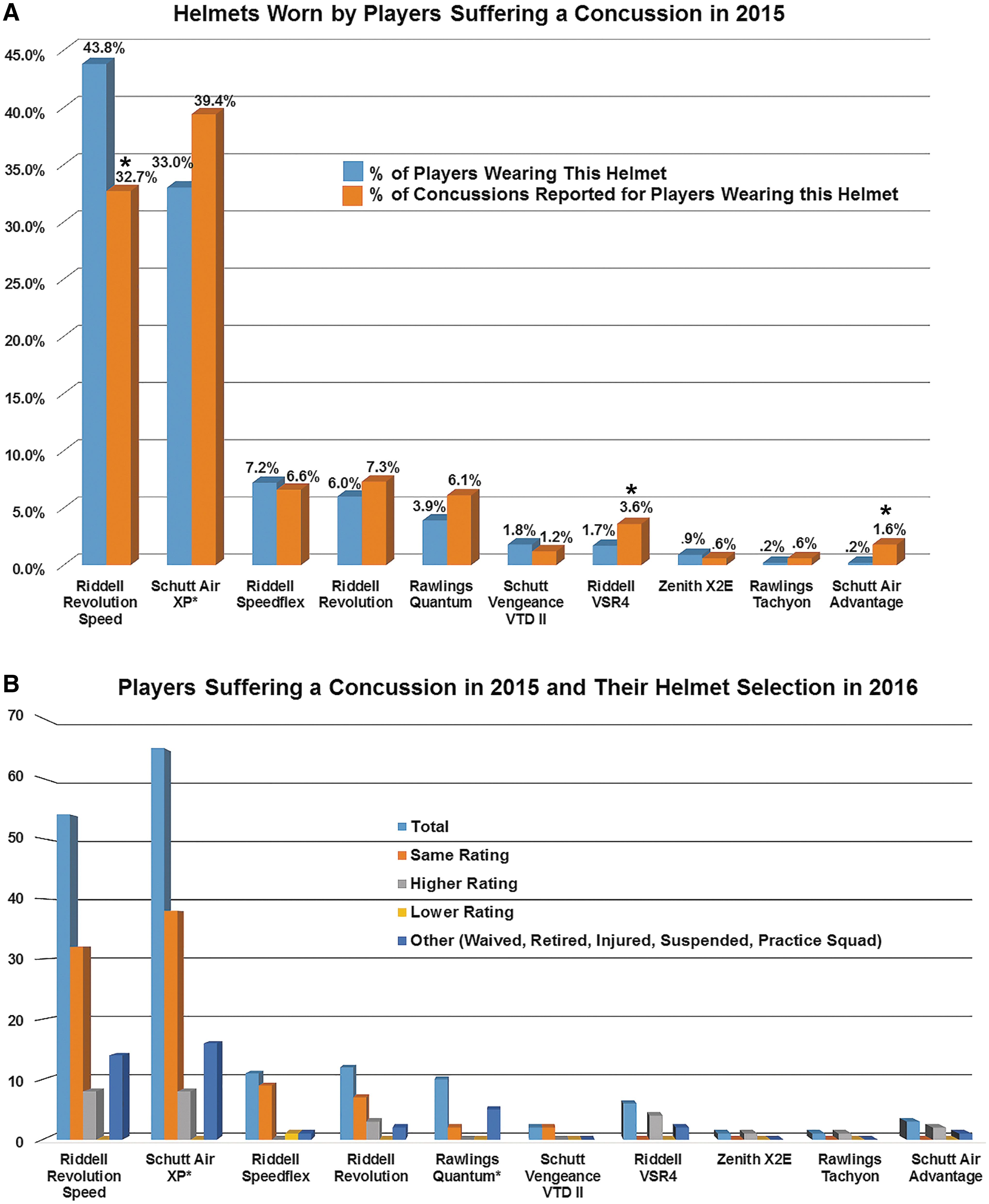
Helmets worn by players suffering a concussion during the 2015 season and their helmet selection in 2016.
Conversely, the Riddell VSR4 (1-Star) and the Schutt Air Advantage (2-Star) were worn by approximately 1.7% and 0.2% of the players in the 2015 season, respectively, but were worn by 3.4% (VSR4) and 2.3% (Air Advantage) of players receiving concussions for that year. A Fisher's exact test determined that the number of concussions was statistically different than expected for the Riddell Revolution Speed, the Riddell VSR4, and the Schutt Air Advantage helmets. These data suggest that helmet choice may factor into whether a player receives a concussion following a helmet collision. Finally, we were interested in determining the helmets worn by these players at the start of the 2016 season (Fig. 7B). We reasoned that if players prioritized their safety, those players that suffered a concussion in 2015 would select a higher safety-rated helmet to wear at the start of the 2016 season. Interestingly, of the nine players receiving a concussion wearing a 1-Star (VSR4) or 2-Star (Air Advantage) helmet in 2015, six were still playing football at the start of the 2016 season and all had switched to higher safety-rated helmets. However, of the 12 players receiving a concussion wearing a 4-Star (Riddell Revolution) helmet, 10 were still playing football at the start of the 2016 season and of those, only 30% had switched to a higher safety-rated helmet while the other 70% continued to play in these helmets.
Discussion
To determine if the current NFL helmet policy is consistent with the NFL's aim to limit concussions on the playing field, we assessed what helmets NFL players wore during the 2015–2016 and 2016–2017 seasons, attempted to understand the factors that influence player helmet selection, and tested the extent to which helmet selection can influence the impact forces a player will be exposed to during helmet-to-helmet collision. Using stop-motion footage for the 16 games played during Week 13 of the 2015–2016 season and Week 1 of the 2016–2017 season, we found that players wore a wide range of safety-rated helmets, including the 5-Star Riddell Revolution Speed and Schutt Vengeance VTD II, the 4-Star Riddell Revolution, the 3-Star Schutt Air XP, the 2-Star Schutt Air Advantage, and the 1-Star Riddell VSR4. To elucidate what factors may drive helmet choice, we then determined the extent to which helmet selection could be correlated with player position or age. An examination of helmets worn by position showed clear differences in choice: wide receivers, corners, and safeties preferred the Schutt Air XP helmet, whereas defensive and offensive line players preferred the Riddell Revolution Speed. Although quarterbacks and punters also showed a preference for these two helmets, a wider range of safety-rated helmets were selected in these groups over the other positions examined.
We also found a clear correlation between player's age and helmet choice, with older players preferring helmets produced earlier in their career. As helmets with an older production date score consistently lower in Star safety rating than newer produced helmets, older players were, on average, wearing helmets with poorer safety ratings. Using a helmet-to-helmet impactor system, we then sought to determine the g-forces experienced by the head when helmets of varying Star ratings collided through a range of impact forces. We found that when two 5-Star helmets collided, the g-forces experienced by the head were roughly 20% less than that observed for two 4-Star helmets colliding and roughly 30% less than that observed for two 1-Star helmets colliding. Finally, an examination of the helmets worn by players that received a concussion in the 2015 season provided evidence that wearing a lower safety-rated helmet increased a player's risk of receiving a concussion following a helmet collision.
Our determination of the helmets worn by players in the NFL has provided an interesting look at the factors that may influence helmet choice and how this decision may put players at increased risk for concussion. Nevertheless, the data obtained for this study have some limitations. For example, our data on player helmet selection were derived not from all 1696 players in the NFL but approximately 60% of the players. This was because during the observation weeks, some players were injured, not needed by the coach, or unavailable for play. In some instances, players did see limited time on the playing field but were outside of camera view. In other instances some helmets could not be identified for players wearing team helmets that were dark in color. Efforts to obtain this information directly from NFL teams were unsuccessful. An additional confounder was the fact that a number of helmets were represented by more than one model, which were indistinguishable from each other based on air vents or exterior molding contours. This includes the Schutt Vengeance line (includes the VTD II and VTD Pro); the Schutt Air XP line (includes the Air XP, Air XP Pro, Air XP Pro VTD II, and Air XP Pro Q10); and the Rawlings helmet line (includes the Quantum, Quantum Plus, and Impulse). In these instances the helmets identified were designated as a Schutt Vengeance VTD II, Schutt Air XP, and Rawlings Quantum, respectively.
Additionally, players may choose to have the inner liner of their helmet customized for better protection. Consequently, the safety rating of these helmets are unknown but were nevertheless designated the Star rating of the original helmet. Lastly, as this study tested the extent to which helmet selection can influence the impact forces a player will be exposed to during helmet-to-helmet collision, it was necessary to establish a methodology to test helmets, as commonly used approaches like the NOCSAE helmet drop assay, 8,12 the freefall pendulum impactor, 19 or the linear impactor 20 do not simulate helmet-to-helmet collisions. To recreate these playing field-relevant collisions, we adapted a cortical concussive device commonly used in traumatic brain injury studies 18 to accommodate two helmets that could be collided across impact forces measured on the playing field. As expected, our results were in close agreement with previous results comparing helmet safety using the NOCSAE helmet drop assay. 13,21
Aside from the findings described above, additional observations arose from this study. One surprising finding was the number of premier players, particularly at the quarterback position, continuing to wear helmets with a low safety rating even years after the helmet rating system was established and after these helmets stopped being produced for the general public. For example, through the 2015 and 2016 seasons, as well as at the start of the 2017 season, quarterbacks Tom Brady (New England Patriots), Drew Brees (New Orleans Saints), and Philip Rivers (Los Angeles Chargers) wore the 1-Star VSR4, a helmet that its manufacturer, Riddell, stopped selling to the public in 2010. The use of this 1-Star helmet was not restricted to quarterbacks but also was observed being worn by wide receivers, tight-ends, and linebackers, which are positions that commonly experience high impact forces. 2,7 Additionally, our helmet-to-helmet impact study suggests that players wearing low safety-rated helmets (1-Star) experience significantly more g-forces upon impact than players in a similar impact wearing 4- or 5-Star rated helmets. This is relevant since studies have shown that repetitive hits at subconcussive thresholds may have an accumulative effect leading to pathophysiological changes to the brain and neurological impairment later in life. 25 –29 These physiological changes include cerebrovascular reactivity alterations, 29,30 abnormal white matter integrity, 31 –34 and alterations in brain metabolism. 35
Another surprising finding was observed when a 5-Star helmet collided with a 1-Star helmet. In these instances, we found that the 5-Star helmet's ability to protect the head was reduced, with g-forces experienced by the headform in the 5-Star helmet increasing by 15% at the highest impact forces tested. However, the g-forces experienced within the 1-Star helmet in these collisions decreased by nearly 10% at the highest impact forces tested. Although we are unclear why this phenomenon occurred, it may be related to a helmet's stiffness, which would affect its force or load capacity. In a preliminary experiment to access the extent to which each helmet's shell deforms upon helmet-to-helmet collision (using Fuji Pressure film placed at the center of the impact site), we found that at the highest drop heights, when two 5-Star helmets collide, the surface area of contact was nearly five times larger than that for when two 1-Star helmets collide (data not shown). Consequently, when a 5-Star helmets collides with a 1-Star helmet, the impact energy may be unequally distributed between helmets, with more of the total impact energy being absorbed by the 5-Star helmet. Finally, we found that a number of players that suffered a concussion in 2015 did not switch to a higher safety-rated helmet in 2016.
In the absence of a direct mandate from the NLF requiring that all players wear only helmets with the highest safety rating, our study shows many players are not prioritizing their health when it comes to helmet selection. Although not examined in this study, players may be either unaware of the helmet safety-rating system or may be using other motives when choosing a helmet to wear on the play field. Indeed, our study shows that both player age and position are factors that influence helmet selection. Nevertheless, other factors like look, comfort, familiarity, reliability, peer selection, and safety may also influence a player's choice on what helmet to wear on the player field. For younger players, like those in Pop Warner or high school football where budget is a concern, helmet price may be an additional factor influencing helmet choice. Moreover, the influence of what role models wear cannot be understated in this cohort of young players. Also, unlike the NFL where the players have access to, and information about, the varying football helmets available so as to make an informed decision, parents and younger players may be unaware of how helmets are tested for safety and how this relates to impact force exposure during play.
An additional confounder into helmet selection is that for play below the college level, helmet choice may be decided by any of a number of people (parents, players and/or coaches) all having different motivations for their decision. For example, a player may prioritize helmet choice based a helmet's comfort or look, a coach may prioritize helmet choice based a helmet's price (as a school's budget may be fixed and a main determinant), and a parent may prioritize helmet choice based on its safety rating. Consequently, if the NFL and the National Football League Players Association are serious about making the game safer, they should agree to a helmet policy that puts player's safety first. Additional efforts by the NFL to promote this mandate through cost sharing and public awareness at all levels of play would ensure that younger players were protected at the highest level and that football can continue to be viable as a sport.
Collectively, these novel data suggest that both the NFL and players share responsibility for the continued prevalence of head injuries on the playing field. The current NFL helmet policy puts players at increased risk of receiving a concussion by allowing players the right to choose helmets that are not of the highest safety rating, and many players are choosing to wear helmets with a low safety rating. As older players are the largest group wearing lower safety-rated helmets, the prevalence of head injuries on the playing field should be reduced as these players retire. Nevertheless, the NFL should change their helmet policy by mandating that players only wear helmets that receive the highest safety rating. This policy change would likely represent the simplest and most straightforward way to reduce concussions in football.
Footnotes
Acknowledgments
The authors would like to thank Mike Grieve of Custom Design and Fabrication South for designing and constructing the helmet impactor, Dr. Rene Morrissey for critically reviewing this manuscript and the Virginia Commonwealth University's President Quest fund, the Virginia Neuroscience Initiative, and the Morrow Foundation for providing funding for this project.
Author Disclosure Statement
No competing financial interests exist.