






Abstract

O
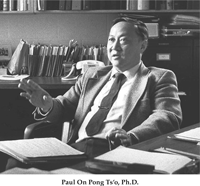
Paul On Pong Ts’o was born to an Episcopalian minister, the Rev. Canon Paul S.F. Ts’o and Mrs. Amy Hoh Ts’o, in Hong Kong, on July 17, 1929. His youth was marked by the advent of World War II during which he followed his family to Guilin, China, as they sought to stay ahead of the Japanese forces. During those tumultuous times, he received much of his primary and secondary education at the True Light School in Hong Kong, whose principal was his mother.
He went on to receive a bachelor’s degree from Lingnan University in Canton, China in 1949. From there, he immigrated to the United States, enrolling at Michigan State University and receiving his Masters degree in 1951. He completed his Ph.D. in Biochemistry in 1955 from the California Institute of Technology in Pasadena, CA, under the mentorship of Dr. James Bonner and stayed on there as a research fellow for 7 years.
From there, he was more than ready to start a professional life, one primarily driven by intellectual curiosity. One of his daughters, Pauline Ts’o, recalls he once told her that as a young man, he prayed his life would be useful. To that end, he was always interested in applying his new-found knowledge to the development of medical therapies and diagnostic techniques in addition to adding to the body of basic science.
For over 40 years, he was on the faculty list at Johns Hopkins University and a full professor from 1967 to 2002 during which he was the Director of the Biophysics Division of JHU School of Public Health for 18 years. After 2002, he held the position of a Senior Associate. During his 45 years at Hopkins, he won numerous awards and published or edited 13 books in his area of expertise. He was one of 1,000 scientists from all fields, whose publications were most cited during the period 1965–1978 and was a member of the Board of Scientific Counselors (Basic Sciences) for Intramural Programs, National Cancer Institute, from 2006 to 2010.
Dr. Ts’o also generously shared his expertise overseas. Since 1972, he was a member of the Academia Sinica of Taiwan, Republic of China. He was later appointed the founding Chair of the Advisory Committee of the Molecular Biology Institute of Taiwan. Dr. Ts’o was a primary advocate of cancer research in Taiwan. He organized the “Medical Oncology Class” that subsequently evolved into the Clinical Cancer Research Center, bringing new cancer therapy to the island. In 1994, he was appointed convener of the Medical Biotechnology Subcommittee of the Academia Sinica. He organized several international symposia to encourage development of medical biotechnology in Taiwan.
His research at Johns Hopkins University focused on the many facets of biophysics, chemistry, and the molecular biology of nucleic acids. His projects included research into the 3-dimensional spatial relationships of genes and chromosomes in the nucleus of human cells. By doing so, he improved our understanding of gene expression, its inhibition through antisense technology, and the discernment for targeted delivery of therapeutic drugs to cells in a tissue-specific manner.
Of particular relevance, his efforts to better understand gene function through the invention of nonionic antisense oligonucleotides stand out. This group at JHU researched various nonionic backbones, such as a vinyl backbone, and phospho-ethyl-triester backbone. After 22 years of study, the conclusion was that only methylphosphonate analogs should be used. He termed this family of oligonucleotide analogs: Matagen™, an acronym for Masking Tape for Gene Expression (Ts’o, 1991). These neutral backbone oligonucleotides are structurally similar with phosphodiester-linked analogs and are yet resistant to all nucleases. Moreover, it is believed that because of the backbone neutrality, these oligonucleotides can penetrate the cell wall presumably through diffusion and elicit an “anti-code” effect within the targeted cell. The utility of the methylphosphonate backbone was shown in numerous studies (Miller and Ts’o, 1988).
After his retirement from active teaching at Johns Hopkins, Dr. Ts’o was instrumental in founding Genta, a cancer therapeutics company. More recently, he held the positions of CEO and CTO for Cell Works Inc. Cell Works Inc. developed a drug delivery system that promised to have greater efficacy against cancer with less toxicity to the patient. With his history with antisense, he recognized early on that the promise of this emerging technology was limited by poor and nonspecific uptake of the antisense by the cell. To address this deficiency, his team created a ligand-directed drug delivery system employing an asialoglycoprotein receptor-specific ligand as a targeting agent. The small glycopeptide ligand enabled the antisense payload to distribute quickly and efficiently to the liver followed by internalization through receptor-mediated endocytosis. The proof-of-concept conjugates were demonstrated to be effective against hepatitis B virus (Duff et al., 2000) in vitro and a later study showed that a different conjugate was effective against malignant hepatocellular cancer cells in tumor-bearing nude mice.
Cell Works Inc. also developed a blood test that detects and characterizes cancer cells from many different organs with only a small sample of blood required. This highly sensitive test can be used in conjunction with therapeutics for more effective cancer management.
Dr. Ts’o’s latest endeavor was to launch Comprehensive Cancer Cell Diagnostics, LLC (CCCD). Utilizing its specialized diagnostic service, CCCD assists physicians in designing personalized treatment regimens for patients fighting breast cancer. The scientists at CCCD carry on his vision today.
From his humble beginnings in China to the launching of CCCD, his life was filled with accomplishment. His scientific foresight and vision led to significant advances in the fields of nucleic acid chemistry and cancer research. When these contributions are considered, one can say that the prayer made, all those years ago, was answered.
In closing, this author hopes that this brief summary has provided a good glimpse into a life and career that was filled with inspiration. As he was inspired, he inspired others. With that said, I am reminded of a statement written by Dr. Ts’o himself to inspire and urge discussions on the workings of the Universe (Ts’o, 1974). I would like to apply it to the life of Dr. Ts’o and my attempt to summarize. He wrote:
… partly due to the immensity and gravity of “his life,” this author feels a deep sense of inadequacy and shortcoming … . So much more can be read, considered, written, and improved. The only consolation to the author is that, perhaps after all, this is just the beginning.
We all are reaping the benefits of his insight and discovery. He will be greatly missed.