






Abstract

To the Editor:
This letter to the editor has three objectives.
First, the letter is an announcement for an innovation summit in a real-life global health setting at the Turkish-Syrian border where the themes of migration and health inevitably intersect. Science does not merely occur in an isolated vacuum at the laboratory space and is inevitably co-constituted by complex socio-technical systems in which the people are situated.
Not surprisingly, how we do science is changing in the new century. There is an increasing recognition that knowledge-based innovations cannot be left alone, and need good governance instruments for steering towards sustainable and socially robust outcomes. If we are to help shape the 21st century knowledge co-production trajectory towards robust outcomes that inclusively benefit global society, where do such loci of science and innovation policy intervention reside?
Scientific symposia serve the purpose of exchanging new knowledge across the scientific communities. But they also play a transformative role for the broader society beyond the laboratory space because science and society are essentially co-produced, as noted above. That is, science and technology development trajectories are influenced by society and values of both scientists and the public. We therefore contemplate and suggest ways in which humanitarian crisis and conflict zones around the globe might be usefully transformed as a momentum for knowledge-based innovation, progressive and inclusive societal development.
Notably, many of the scientists, artists, musicians, humanists, and social science scholars from Syria, Iraq, and the Middle East currently reside in Turkey, and can make enormous contributions to both science, music, arts, humanities, and peace in the region and globally. Local, regional, and international scientific summits and symposia thus can make huge contributions to peace and diplomacy if designed and implemented with these issues genuinely born in mind.
Consistent with this, the UK Royal Society has noted that science diplomacy, while it is not new, has never been more important than in the current era (https://royalsociety.org/topics-policy/publications/2010/new-frontiers-science-diplomacy/).
Second, this is an open letter for innovation policy so the scholars in life sciences and social studies of knowledge-based innovations in the 21st century develop broader conceptions and imaginations of what science actually is—so as not to forget the veritable linkages among science, technology, and societal change. We underscore that societies well versed in science and innovation are much less likely to succumb to the false illusions of conflict and chaos.
Third, we discuss, as part of this innovation policy call, the ways in which 21st century conferences ought to be designed, so as to include both science and technology actors as well as innovation analysts and narrators to serve as a “third eye” to steer knowledge-based innovations to robust social innovation (Fig. 1).
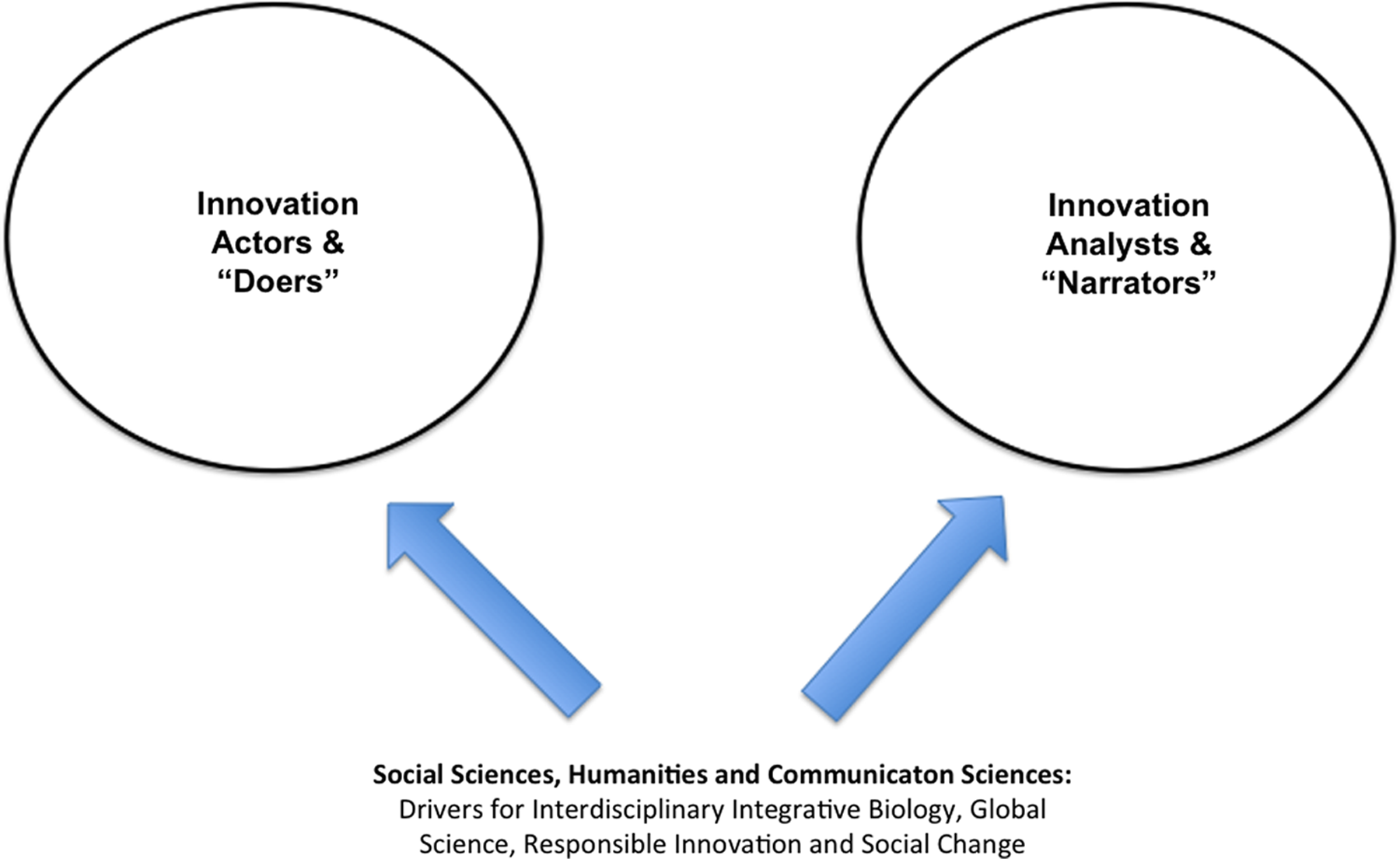
Designing innovative and inclusive 21st century conferences whereby conferences serve the dual scholarships of knowledge translation and exchange as well as science, governance, and diplomacy instruments.
Social innovation can be defined as a new idea, process, and/or product that is grounded in societal values, priorities, and one where the public contributes to the upstream deliberation and design of new science and technology from their outset. That is, the public can make enormous contributions throughout the entire knowledge trajectory from design to translation to implementation, rather than a passive knowledge consumer role.
It is in these contexts and ethos that the upcoming 2016 SANKO University Innovation Summit in Medicine and Integrative Biology (May 5–7, 2016; http://www.tiptainovasyon2016.org/default.aspx) was designed to include and give voice to both scientists and scholars who will examine the regional and global innovation ecosystem at arms length, for in-depth insights on technology futures, opportunities, and challenges on the critical path to science diplomacy, societal development, and knowledge-based innovation.
We shall emphasize that the conference venue, the city of Gaziantep, is unique as a geography that has been continuously inhabited for over 5000 years, as a gateway to the Silk Road and Mesopotamian scholarship (Figs. 2 and 3). Most recently, Gaziantep has been listed among the UNESCO Creative Cities Network in the field of gastronomy (http://en.unesco.org/creative-cities/events/47-cities-join-unesco-creative-cities-network), not to be missed by scholars worldwide.
Gypsy Girl mosaic of Zeugma Museum; a Roman mosaic fragment discovered in Gaziantep, representing the regions' long history of civilizations. It is the chosen symbol of the 2016 SANKO University Innovation Summit. Illustration by Ahmet Sınav, MD, CMI.

Gaziantep Homes: A forum where the east and west meet to foster Mesopotamian and Silk Road scholarship on integrative biology and 21st century medicine.
In summary, this open letter serves as an innovation policy call that is of broad interest to citizens and scholars who have a genuine interest for making a responsible difference in 21st century medicine, for a world that is mindful of both global and local (glocal) scientific and societal realities, values, and priorities.
Footnotes
Acknowledgment
No funding was received in support of this analysis. This is a policy innovation analysis and conference announcement, in support of global science and 21st century conference design, as an open letter from under-represented communities and global citizens to members of the life sciences, humanities, and social sciences communities. The views expressed are the personal opinions of the authors only and do not necessarily reflect the views of their affiliated institutions or funding agencies.
Author Disclosure Statement
No conflicting financial interests exist.