






Abstract
Abstract
Science and its practice always had a subtext, subject to influence by scientists', funders', and other innovation actors' values and assumptions. The recent emergence of post-truth, authoritarian and populist penchants, in both developed and developing countries, has further blurred the already fluid boundaries between material scientific facts and their social construction/shaping by scientific subtext, human values, powers, and hegemony. While there are certain checks, balances, and oversight mechanisms for publication ethics, other pillars of science communication, most notably, scientific conferences and their governance, are ill prepared for post-truth science. Worrisomely, the proliferation of spam conferences is a major cause for concern for integrative biology and postgenomic science. The current gaps in conference ethics are important beyond science communication because conferences help build legitimacy of emerging technologies and frontiers of science and, thus, bestows upon the organizers, funders, enlisted scientific advisors, speakers, among others, power, which in turn needs to be checked. Denis Diderot (1713–1784), a prominent intellectual during the Enlightenment period, has aptly observed that the very act of organizing brings about power, influence, and control. If the subtext of conference practices is left unchecked, it can pave the way for hegemony, and yet more volatile and violent authoritarian governance systems in science and society. This begs for innovative solutions to increase accountability, resilience, and capacity of technology experts and scientists to discern and decode the subtext in science and its communication in the current post-truth world. We propose that the existing undergraduate and graduate programs in life and physical sciences and medicine could be redesigned to include a rotation for exposure to and training in political science. Such innovative PhD+ programs straddling technical and political science scholarship would best equip future students and citizens to grasp and respond to subtext and embedded opaque value and power systems in scientific practices in an increasingly post-truth world. Political science scholarship unpacks the inner workings, subtext, and power dynamics in science and society. Thus, knowledge of political science competency is akin to molecular biology in life sciences. Both make the invisible (e.g., cell biology versus subtext of knowledge) visible. The ability to read subtext in science and claims of post-truth knowledge is a new and essential form of societal literacy in 21st century science and integrative biology.
Conference Ethics—Not So Simple, Nor Value Free
I
We are prompted to write this analysis article for several topical reasons. First, spam conferences are a veritable cause for concern for governance of science communication. Second, science communication and its governance have tended to focus on “the end of the research pipeline,” scientific publications. Credible and useful publication ethics guidelines and organizations do exist such as the Committee on Publication Ethics (COPE) and the International Committee of Medical Journal Editors (ICMJE). By contrast, scientific conference governance and its ethical aspects have been relatively overlooked in integrative biology and postgenomic medicine as if scientific conferences are value-free, apolitical simple gatherings without consequences on science and society. Third, scientific conferences help build legitimacy of emerging technologies and frontiers of science and, thus, bestow upon the organizers, funders, enlisted scientific advisors, speakers, among others, power, which in turn needs to be checked. The neglected ethical dimensions of scientific conferences warrant due attention, awareness, and governance instruments for transparency and accountability of the associated power and social capital gained from a conference.
Our analysis does not cover the traditional issues of conference funding, conflict of interests, and other subjects that have been debated over the past decades. This is already available in the technology ethics and science policy literatures. Instead, we address the neglected novel issues, such as post-truth science in relation to conference ethics and governance, and the skill sets currently missing for scientists and integrative biologists, in particular, to be able to read the invisible subtext in scientific knowledge at the intersections of postgenomic and post-truth science. We introduce in this study, for a readership in life sciences and integrative biology, the long-standing idea in social sciences that knowledge/science is social process and that all knowledge (true or false) are a result of social processes.
Bigger Picture on Conference Provenance
In ancient Greece, dialogues and meetings between mentors and mentees (e.g., Socrates and his student Plato) were important to knowledge making and contextualization. Etymologically, the word “conference” predates to 1550s, relating to the “act of conferring” or a “formal meeting for consultation”. Since the early ages, conferences have had importance beyond science communication and consultation, however, for they also constituted gatherings representing, creating, or sustaining power, and the powerful in science and society, and those who fund them.
Still, in modern day, not much has changed. Being a conference scientific advisory and organizing committee member is prestigious and enhances scientists' promotion and recognition for their arduous work. Conferences are instrumental in establishing consensus, identifying knowledge gaps, future research agendas, and importantly, legitimacy in a given knowledge domain. They can help garner international prestige for universities, cities, industries, nation states, and their leaders. In other words, conferences are an important locus of “power” for individuals, societies, and governments alike.
As it is the case with any form and scale of human power, unchecked and unaccounted power can lead to hegemony, authoritarian governance, and manufactured truths in science and innovation ecosystems (Foucault, 1980). Denis Diderot (1713–1784), quoted in the preamble of this editorial, was a prominent intellectual during the Enlightenment period. He observed aptly that the very act of organizing brings about power and influence inherently. This begs the following questions on conference provenance and its ethics:
• Who is represented, who is left out, not only among speakers and scientific topics covered, but crucially, at the design and agenda setting stage of a conference? • Who are the funders, and what is their role in decisions over conference contents and governance? • What are the stated, and the actual, ends to which a conference is intended to contribute? • What is the extent to which a conference engages the local publics and when? • When is the timing and truthfulness of informing the participants on the scientific conference—at the design stage where the conference agenda is still being shaped and open to input by the public, or further downstream after all planning and agenda are completed, thus effectively “end-gaming” and delimiting broader and upstream inputs from society, participants, or those whom the conference is intended to serve?
This list of questions on conference ethics and governance is not limited to the above and can be expanded further. Yet, they are rarely, if at all, on the agenda and mainstream scientific thinking while a conference is being planned.
Scientific practices, including conferences, have always had a subtext and subject to influences by scientists', funders' and other innovation actors' values, assumptions, and prejudices. It is often not mentioned that conferences are formidable money earners for learned societies (and the departments and universities that host them). There is also the unequal political economy of conferences in terms of travel and accommodation costs where some can afford through research grants, but others pay for their own travel despite limited resources. Indeed, many scholars throughout the history of science, technology, and innovation have emphasized the socially constructed and fluid co-construction of technology and culture. Penders has observed, for example:
[S]cience is not an isolated cultural activity but actively shapes politics and society, as well as is actively shaped by them. Such a growing understanding that science is neither pure nor neutral, that the boundaries between society and science are impossible to pin down, that norms and values inform research, and that scientists are people too, is the legacy of decades of research in the history, philosophy, anthropology, and sociology of science. (Penders, 2017)
In other words, it is impossible to separate the “knowledge” from the “knower,” and the “knower” from their social milieu. To the extent that science is designed and executed by humans, and all humans come with their values, assumptions, and prejudices (cognizant or not), it would be naive to assign a pure and value-neutral status to scientific practices (Haraway, 1988). Yet, the latter illusion still remains prevalent among scientists, technology experts, and potentially among publics (Miller, 2017; Özdemir, 2018; Penders, 2017).
Robots designed by humans can also be value laden. For example, the contribution of human values on predictive forecasting, artificial intelligence (AI), and scientific algorithms is noteworthy. The idea that robots and AI used in science and engineering will be bias-free does not appear to hold up. A recent analysis claims that racist robots might emerge from AI and opaque algorithms, which have led to the suggestion that “as our computational tools have become more advanced, they have become more opaque” (Buranyi, 2017).
Buranyi further explains the ways in which science and human values are intertwined and impact the scientific knowledge and sense making:
The program, Correctional Offender Management Profiling for Alternative Sanctions (Compas), was much more prone to mistakenly label black defendants as likely to reoffend—wrongly flagging them at almost twice the rate as white people (45% to 24%), according to the investigative journalism organization ProPublica. [.…] The promise of machine learning and other programs that work with big data (often under the umbrella term “artificial intelligence” or AI) was that the more information we feed these sophisticated computer algorithms, the better they perform.
[T]here is less attention paid to the more immediate problem of how we prevent these programs from amplifying the inequalities of our past and affecting the most vulnerable members of our society. When the data we feed the machines reflect the history of our own unequal society, we are, in effect, asking the program to learn our own biases. “If you're not careful, you risk automating the exact same biases these programs are supposed to eliminate,” says Kristian Lum, the lead statistician at the San Francisco-based, non-profit Human Rights Data Analysis Group (HRDAG).
These small-scale incidents were all quickly fixed by the companies involved and have generally been written off as “gaffes.” But the Compas revelation and Lum's study hint at a much bigger problem, demonstrating how programs could replicate the sort of large-scale systemic biases that people have spent decades campaigning to educate or legislate away. (Buranyi, 2017).
It is surprising that conference provenance, governance, and ethics have not yet received commensurate attention from the policy community, unlike other fundamental pillars of scientific communication such as publication ethics that are carefully scrutinized with oversight mechanism already in place. This blind spot in communications cannot be left unaddressed.
Post-Truth Politics
Impacts on scientific unknowns and subtext
Social scientists and humanists refer to the shaping of material scientific observations, not to mention upstream design, agenda setting, and science funding, by human values, assumptions, and prejudice, as “social construction of science and technology.” Our descriptions and examples noted above can reflect “distortions” of science but refer equally to social construction in the course of “normal science” and its practice on a day-to-day basis. The recent emergence of post-truth, authoritarian and populist tendencies, in both Global South and North, has highlighted these fluid overlaps between material scientific findings and their social construction. Conference governance represents a particularly vulnerable spot to analyze the implications of post-truth politics to understandings of the social construction of normal science, as we explain below.
There is a widely held understanding that we have entered an age of post-truth politics. No aspect of society, including global science and conferences, is immune to post-truth practices driven by popular unsubstantiated claims appealing to citizens' emotions. In other words, post-truth refers to a situation where the substance, content, and material facts in a policy are completely divorced from public opinion and perceptions. “Post-truth politics” was first popularized by David Roberts, a blogger, on the environmentalist website Grist in 2010. Roberts explained it as “a political culture in which politics (public opinion and media narratives) has become almost entirely disconnected from policy (the substance of legislation)” (Roberts, 2010). New debates in social and political science have emerged in attempts to understand the origins and futures of the post-truth politics. The interested reader is referred to this body of emerging interdisciplinary literature on science, technology, and society (Collins et al., 2017; Fuller, 2017a, 2017b; Sismondo, 2017a, 2017b). Interestingly, Merton was concerned about popular rejection of science already in 1942 (Merton, 1942).
In 2016, the Oxford Dictionaries, on both sides of the Atlantic, has chosen “post-truth” to be its international word of the year (Flood, 2016). The dictionary defines it as an adjective “relating to or denoting circumstances in which objective facts are less influential in shaping public opinion than appeals to emotion and personal belief.” The term increased exponentially in usage by about 2000% in 2016 compared to the previous year.
How did the post-truth politics come about, and what will be the impacts on global science? A multitude of factors such as decades of unquestioned alignment to a neoliberal vision of science, technology, and innovation, ensuing disenfranchisement and concerns over livelihood, among other reasons, have collectively cultivated populist anger, skepticisms over experts, expertise and scientific facts, and by extension, emergence of the current global populism and post-truth politics (Birch, 2015; Birch and Tyfield, 2013; Chomsky et al., 2017; Geiselberger, 2017; Springer, 2015; Thoreau and Delvenne, 2012). The post-truth practices vary from context to context but they share “a core ideology linked to concepts such as nativism, authoritarianism, and opposition to elitism, pluralism, and liberal democracy” (Long and Blok, 2017). Two recent and excellent accounts of the post-truth movement are available elsewhere for the interested readers (Geiselberger, 2017; Luce, 2017). In addition, Fisher (2017) has recently analyzed the post-truth politics in a context of responsible innovation:
If expertise is under attack, it is because it has become increasingly associated with the kind of governmental administration that is currently in the political cross hairs (cf. Miller, 2017). The populist skepticism toward free trade, open borders, and scientific management that is at the moment fueling dismissals and deregulation is to a large extent rooted in pervasive experiences of disenfranchisement that in turn stems from overlooked concerns over livelihood, vulnerability, and identity. In short, unhealthy distance between powerful elites and disaffected publics has contributed to a classic case of public alienation (Wynne, 2001).
For the purposes of the present analysis, it suffices to say that post-truth politics and its cultivation of popular skepticism against expertise and of experts, particularly those affiliated with governmental administration and scientific elites (if not all experts) (Miller, 2017), introduce additional space for broader social construction of science and technology and further drift from material facts and scientific observations.
Figures 1 and 2 illustrate, respectively, the inherent tension between materiality of science and its social construction in normal science, and how the social construction component is magnified in the post-truth science context.
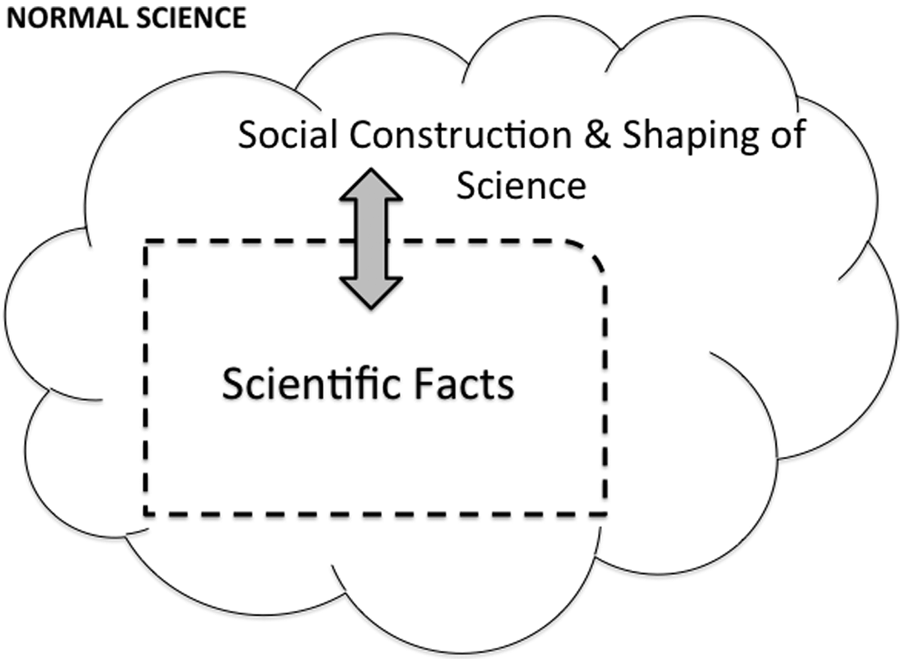
The “normal science” and the social construction of scientific facts and materiality. Dotted square depicts the material scientific facts and observations which are further shaped by social construction (cloud) by scientists' and other innovation actors' values. The line separating alleged scientific facts and materiality and social construction is porous, indicating the highly intertwined and continuous nature of technology and culture, or scientific facts and human values.
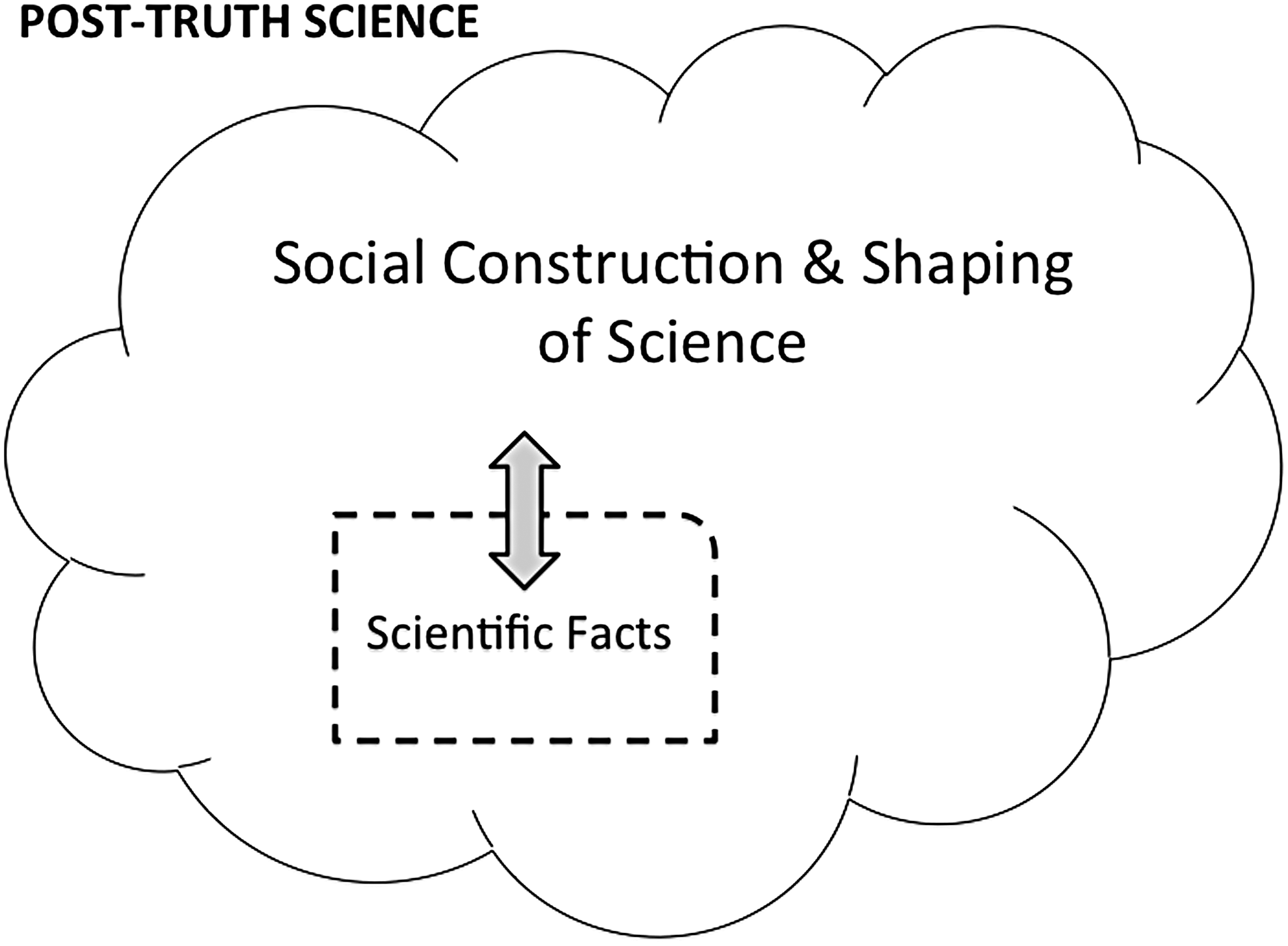
The “post-truth science” and the social construction of scientific facts and materiality. Dotted square depicts the material scientific facts and observations which are further shaped by social construction (cloud) by scientists' and other innovation actors' values. The line separating alleged scientific facts and materiality and social construction is porous, indicating the highly intertwined and continuous nature of technology and culture or scientific facts and human values. Note that in post-truth science, the social construction of science and technology has been greatly augmented compared to that in regular science (see and compare with Fig. 1).
What are the ramifications, then, of post-truth politics on scientific conference governance, accountability, and ethics? In addition to the bulleted questions and scenarios listed earlier, there are several conceivable and anticipated ways in which post-truth science conferences may undermine credibility and communications.
• Post-truth conference scenario 1: Conferences may serve to establish pseudo-consensus on contested scientific issues using authoritarian post-truth governance, for example, by inviting only the experts whose opinions bode well with the desired consensus and its contents. As dissent and opposition are typically not permitted by the post-truth authoritarian governance, a fake consensus may pass and be delivered as a conference outcome.
• Post-truth conference scenario 2: Tensions may escalate further in international scientific conferences. In one scenario, international participants to the conference from non-post-truth geographies and with more independent views and capacities may conflict with the local conference participants whose views are shaped by post-truth authoritarian governance mechanisms in place. Conversely, international conference participants from powerful post-truth countries may dominate over the local non-post-truth country participants. In either case, regardless of whether the post-truth governance is introduced by local, international (or both) participants, the drift from materiality of science would be augmented (Fig. 2), further threatening the credibility, intended purpose, and outcomes of a scientific conference as a credible trustworthy setting to confer with other experts and publics.
These post-truth scientific conference scenarios have particular importance for global health organizations that are driven by science-based development. Their staff often includes both global and local employees who may be affected by and represent post-truth politics, ultimately threatening scientific trust in a conference setting specifically and science-based development broadly.
Whether it is normal science (Fig. 1) or post-truth science social construction (Fig. 2), if the subtext of conference practices is left unchecked, it can result in erosion of equality, paving the way for volatile and possibly, violent, authoritarian systems in science and society (Feyerabend, 2011). This begs for new mechanisms to increase accountability, resilience, and capacity of technology experts to discern and decode the subtext in science and its communication in the current post-truth world.
Web 2.0 as a “Social PCR”
Before the emergence of debates on post-truth politics, new tools from social media have already amplified the potential for a greater scale and speed by which science and technology social construction occur. Therefore, we coin a new term here, “social PCR,” drawing from molecular biology to explain the new ways in which social media can be used to create the social construction of scientific facts rapidly. For example, the PCR technology has provided the opportunity in 20th century to generate millions of copies of a given DNA sequence from a single copy or limited quantity of DNA. In a similar manner, Web 2.0 has served as a social PCR to enable, propagate, and amplify socially constructed claims in science, global populism, and post-truth movement, analogous to a molecular PCR amplifying DNA from a single to millions of copies:
[P]hysical distances and temporal dimensions among persons have diminished with social media and professional networking programs such as Skype, Twitter, LinkedIn, and Facebook. These programs have no or low entry threshold to build social capital rapidly and certainly do not require a person to have significant economic and cultural capital, let alone a great deal of competence in science, technology, or ethics. Acquisition and accumulation of social capital have thus been tremendously facilitated by Web 2.0. (Özdemir et al., 2015).
While the power of Web 2.0 as a social PCR to mobilize masses and garner support through “distant strangers” has been well demonstrated in the past, such social capital appears to be ephemeral, dissolving long before sustained societal changes can materialize (Tüfekçi, 2017). As noted above, use of Web 2.0 as a social PCR is not necessarily laudable as it can bring to the fore post-truth experts inadequately qualified in a given knowledge domain, simply by virtue of the [transient] social capital gained from pervasive social networking.
The long-term viability of the current post-truth movement remains to be seen while it is also likely that the pendulum may swing in the opposite progressive direction as a response to populism in the near future (Fisher, 2017). Still, it would be a grave mistake to ignore the post-truth movement and the escalation in social construction of science and technology, if we are to address the current gaps in science and conference governance. Figure 3 clarifies the definition for post-truth politics and the ways in which it relates to post-truth science.
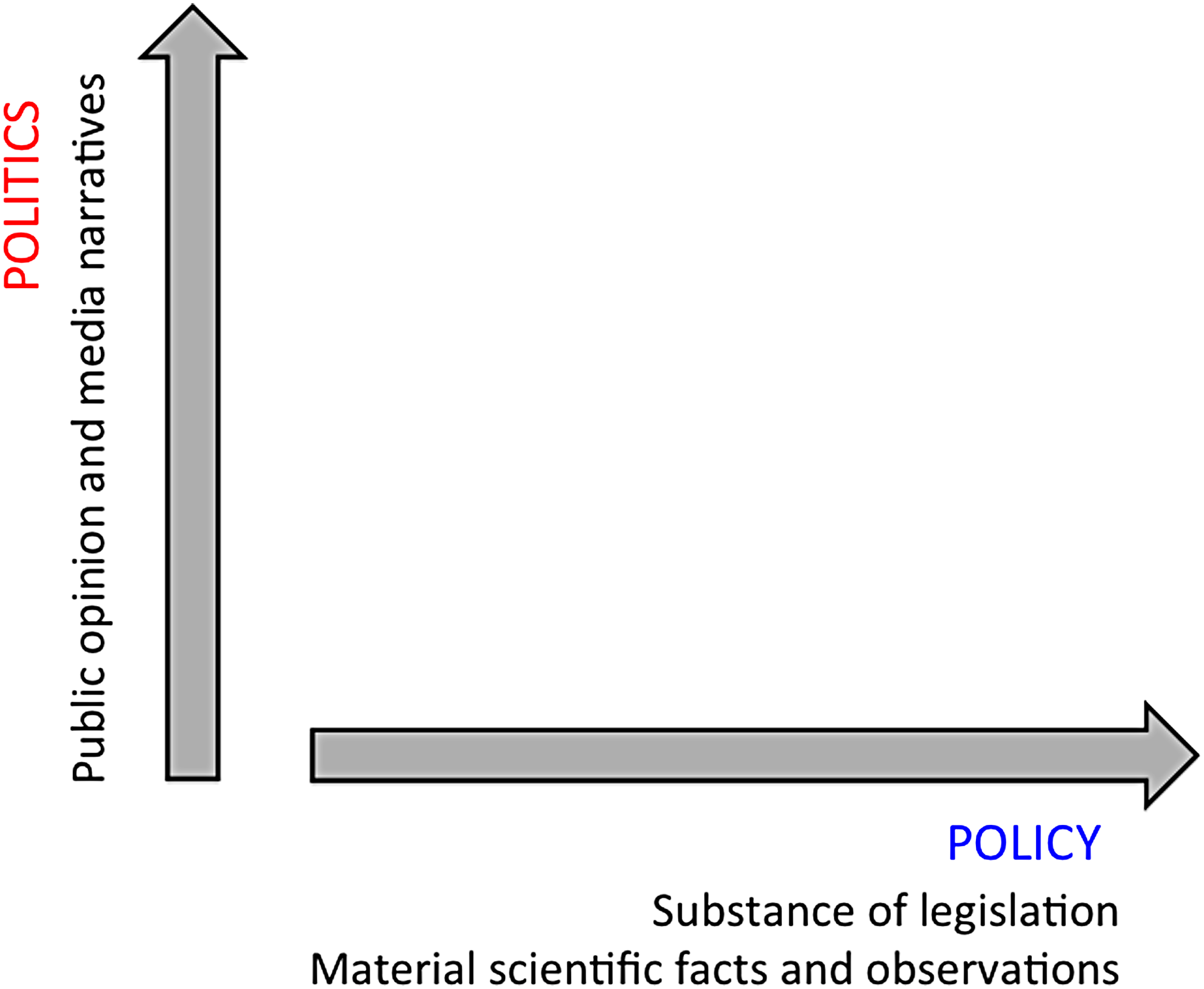
Post-truth politics and post-truth science. This refers to a context when the policy (the substance of legislation) is situated orthogonal to (i.e., at 90° and completely disconnected from) politics (e.g., public opinions and media narratives). For post-truth science, the corollary is the situation when the materiality of science and scientific observations is completely disconnected from what is stated, believed, and understood by public opinion and media narratives.
Conclusions and the Way Forward
Normal science conferences are inherently political practices for they are influenced by human values and power. As such, science and its conferences do have a subtext that often remains opaque and unaccounted for. Many scholars in social studies of science, technology, and innovation have noted, at least since the second half of the 20th century, that the imaginary line that allegedly separates technology from culture or the scientific practice from the values of scientists and other innovation actors, is deeply problematic (Figs. 1 and 2). It persists, however, in the perceptions of scientific communities that still subscribe to a more technocratic and illusionary view of science where the technology and culture divides are rigid and omnipresent (Guston et al., 2009; Özdemir, 2018).
The recognition of how human values and technology coproduce scientific knowledge is important for credibility of science. The alternative understanding, the Enlightenment ideal, and the idea of science as a pure value-free practice subscribe to technocracy and more importantly, leave the social construction of materiality and scientific facts unaddressed.
Our key observation in this analysis is that scientific conferences and their governance represent a particular blind spot in technology policy and innovation governance literatures. This governance gap has become further accentuated with the surge of spam conferences worldwide and post-truth politics and is in sharp contrast with other areas of scientific communications such as publication ethics where fairly effective governance mechanisms are in place.
We propose that the existing undergraduate and graduate programs in life and physical sciences and medicine could be redesigned to include a rotation for exposure to and training in social and political sciences. Such innovative interdisciplinary PhD+ programs straddling technical and sociopolitical science scholarship would best equip the future students and citizens to grasp and respond to subtext and embedded opaque value and power systems in scientific practices in an increasingly post-truth world.
Scholarship in political science and critical human geography unpacks the inner workings and opaque subtext and power dynamics in science and society. Without these crucial lenses that function to make human values, power, and subtext transparent, we may not be able to appreciate that what we see in the global science ecosystem, for example, at local or international conferences, might in some cases represent the most powerful enabled by the emerging authoritarian governance systems and the social construction of science (Özdemir, 2017, 2018). This would prevent us from looking deeper—that for each person attending a post-truth science conference, there may be many not represented or sidelined by post-truth authoritarian governance mechanisms (Chomsky et al., 2017).
Thus, knowledge of sociopolitical science competency is akin to molecular biology in life sciences that makes the invisible (e.g., cell metabolism) visible. The ability to read subtext in science and alleged post-truth claims is a new and crucial form of societal literacy for governance of science and innovation in 21st century.
Multi-omics science has moved the field of integrative biology to new frontiers such as proteomics, metabolomics, culturomics, among others (Gérard et al., 2015; Mourembou et al., 2015; Pirih and Kunej, 2017; Reddy et al., 2015; Shao et al., 2015). Many of these areas will require rigorous debates and be contested before tangible applications in biology and medicine come to fruition. We encourage future postgenomic and integrative biology conferences that will no doubt play a major role in these upcoming debates on multi-omics science. It is time that we address, however, the long-standing issue of spam conferences. Delegating this solely to social scientists and policymakers will not work well. Integrative biologists and postgenomic scientists, too, need to develop the skills to read the subtext in scientific knowledge through additional skill sets in social and political science.
Footnotes
Acknowledgments
No funding was received in support of this innovation foresight and science policy analysis. The views expressed are the personal opinions of the authors only and do not necessarily represent the views of their affiliated institutions. The authors of this science and innovation policy analysis pledge to advocate for a broader community awareness of the subtext in normal science and post-truth science and the ways in which it impacts knowledge production, knowledge claims, and sense making.
Author Disclosure Statement
The authors declare that no conflicting financial interests exist.