







Abstract
Abstract
Omics technologies are key to research and innovation in human health, food and nutrition, drugs, agriculture, and ecology research. Yet, the actual scope of applications is much broader. One emerging possibility is planetary science driven in part by current debates on and possibilities for travel to Mars. In July 2018, radar evidence has suggested the presence of subglacial liquid water in a 20-km-wide zone, likely a saltwater lake, in the Planum Australe region in the south pole of Mars. If confirmed, this will be a promising place to search for microbial life on the red planet. Meanwhile, existential threats to life on earth such as climate change are bolstering the current interests by spacefaring nations for manned long-term space travel to other planets. A new global space industry is also on the rise; Mars-related technology innovation could potentially allow for rapid Earth-to-Earth transport as well, for example, in times of humanitarian and ecological crisis. Against this overarching context, we coin and define here the new concept of “Mars-omics”: the systems level study of how travel to and being on Mars affect human health, and how human presence on Mars impacts the life forms that might already be there, through changes such as space agriculture and other planetary transformations in Mars. Additionally, Mars-omics calls for new ways of thinking about scientific uncertainty and technology futures in such highly novel contexts. For example, how shall we frame scientific uncertainty when extrapolation of scientific unknowns across the planets is vastly difficult, nonlinear, and complex? Is uncertainty an accident or integral part of emerging technologies? These questions are important for achieving new relevance for and future progress in omics system science applications in planetary science and space explorations. In summary, this article suggests that omics has relevance in contexts beyond those on planet Earth. Moreover, past omics applications such as precision medicine may need to be reconceptualized in future novel settings, such as long-term space travel. We conclude the article with the key tenets of next-generation futurists in a context of Mars-omics. Space (still) is the final frontier for humans, medicine, engineering, and omics.
Space: A New Frontier for Omics
P
First, water is essential for microbial life to exist. The area where the subglacial liquid water is thought to exist is in the Planum Australe region in the south pole of Mars. This would be a promising place to search for microbial life on the red planet that has transformed billions of years ago from a warm and wet planet to its present day freeze-dried state.
Next, a new global space industry and engineering is on the rise (Wooten, 2018). Mars-related technology innovation could potentially allow for rapid Earth-to-Earth transport (Musk, 2017, 2018), for example, in times of humanitarian and ecological crisis.
Third, existential threats to life on earth such as climate change are bolstering current interests by spacefaring nations for manned long-term space missions to other planets, such as Mars. For omics system sciences, these developments are important as well (Schmidt et al., 2016). The study of long-term effects of space travel and presence on Mars on human health, physiology, and disease will, no doubt, require a systems approach (Horneck, 2008). Impacts of human presence on life that may be already on Mars and the ways in which humans and novel forms of life interact could benefit from high-throughput and data-intensive omics technologies. Cargo missions to maintain human life on Mars would likely not be sustainable, thus requiring explorations for possibilities of space agriculture and plant omics on Mars (Cao, 2015; Debnath et al., 2011). As with agriculture on Earth, space agriculture and food sciences on Mars would be well served by omics approaches.
Existing omics applications on Earth such as precision medicine and agrigenomics, too, will need to be reconceptualized as the conditions on Mars could have vastly different and unpredictable effects on genomes, proteomes, and metabolomes of organisms.
Mars-Omics and Planetary Science Future(s)
From forecast to foresight
Against the above overarching context, we coin and define the new concept of “Mars-omics”: the systems level study of how travel to and being on Mars affect human health, and how human presence on Mars impacts the life forms that might already be there, through changes such as space agriculture and other planetary transformations in Mars.
Additionally, Mars-omics calls for new ways of thinking about science, technology, and society in highly novel future contexts (Conley, 2018; Fisher, 2018; Garvey, 2018). Travel to Mars is not only one of the most technical deep space missions of any (Hubbard, 2018) but also emerging in a high-risk and high-stakes environment that is highly unpredictable, contested, competing, and collaborative at once. To this end, how shall we frame scientific uncertainty when extrapolation of scientific unknowns across the planets is vastly difficult, nonlinear, and complex? Is uncertainty an accident or integral part of science and emerging technologies (Funtowicz, 2018; Garvey, 2018; Özdemır, 2018)? These questions are pertinent for achieving new relevance for and future progress in system science applications in planetary science and space explorations.
Yet, we know that there are no facts or guarantees from the future. Niels Bohr, the Danish physicist, has allegedly noted, “prediction is very difficult, especially about the future” (Mark Twain was also suggested as a source for the quote, among others). The next generation of technology foresight researchers and futurists, be they omics and planetary scientists, engineers, social scientists, philosophers, medical doctors, or financial investors in emerging technologies, would be well served by rethinking the entrenched dogmas about the relationships among technology unknowns, uncertainty, innovation, and social change.
For example, it is often assumed, falsely, that technologies bring about social change and disruption through a direct impact on society. However, it is not the technologies but the value-loaded, and often unchecked, norms, and decisions made by organizations and people that result in sociotechnical change (Hyman, 2018; Özdemir, 2018; Rip, 2016; Sarewitz, 2016). This observation has important ramifications because it alerts us to the idea that as human beings we are not merely passive receivers to be moulded by new technologies. Instead, examining the human values and unchecked assumptions impacting on such decisions can help to build a broad capacity in anticipating and responding to novel technology uncertainties (Barben et al., 2008; Fisher, 2018; Guston, 2014).
Computer and mathematical modeling to extrapolate from the present continues to be utilized as part of forecasting exercises to “predict” the future. As noted above, however, prognostication is fraud with failures (Guston, 2016). In case of Mars-omics and planetary science, not only do we have an unimaginably large number of variables to model about Mars futures, many of our modeling assumptions are untestable a priori until long-term human presence on Mars is actually realized.
For every technical risk, there are dozens of political risks on the horizon for new ideas and their translation into veritable innovations—something that seasoned scientists instinctively know well but are often reluctant to acknowledge (Didier et al., 2015; Feyerabend, 2011; Guston et al., 2009; Saltelli and Giampietro, 2017). For example, questions on politics of research practice such as “who and which ideas are accepted as priority, or excluded from funding?” directly impact on the quotidian laboratory life and knowledge production by scientists (van Oudheusden, 2014; von Schomberg, 2013). Mars-omics, as a high-stakes technology innovation, is bound to be value-loaded and laden with political risks.
The next generation of futurists in the field of Mars-omics can usefully learn from technology foresight scholars. While predictive forecasting might work in low-stakes science, Mars-omics, by virtue of its high stakes and its contested nature, calls for pluralized (multiple) imaginations of planetary and omics science futures (Fig. 1). Thinking through multiple future scenarios on Mars-omics specifically, and scientific innovations broadly, has two advantages. First, it offers us room to think over a wider range of possible technology futures. If none of the anticipated future scenarios materializes in reality when the present becomes the future, we would still be cognitively more flexible and resilient so as to adapt to the new unanticipated reality. In other words, the aim of foresight research and futures thinking is not so much predicting the future but instead building a broad capacity in our collective abilities to respond to futures known and unknown (Table 1). By contrast, adopting technocracy (technological determinism) to identify a fixed preordained technology roadmap does not offer such cognitive resilience to respond to futures known and unknown (Fig. 2).
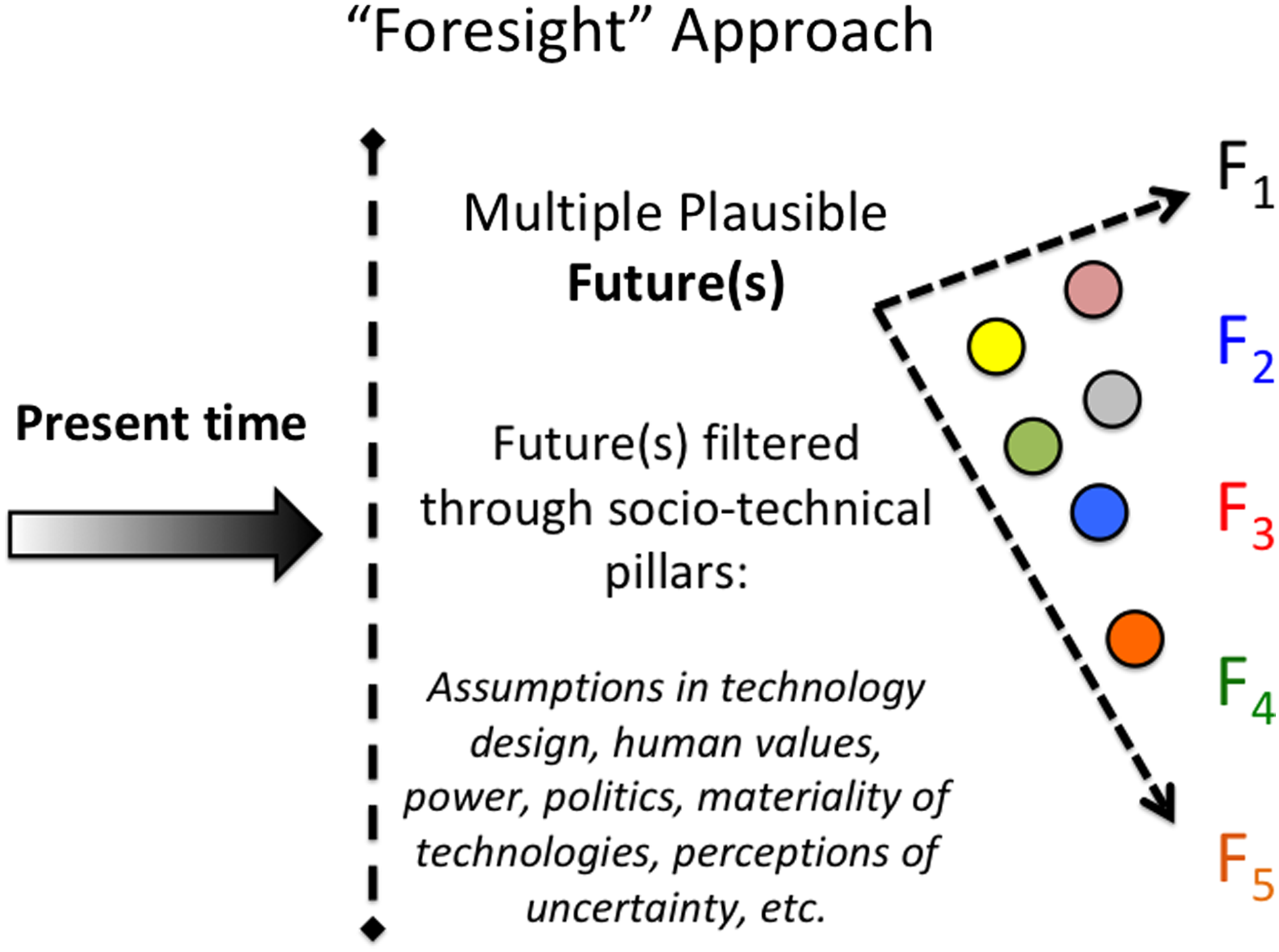
Foresight broadens future(s) and opens up discourses over multiple plausible future trajectories and ways in which future(s) are filtered through and shaped by sociotechnical pillars. When stakes are high, uncertainty and unknowns are profound, and yet, decisions have to be made rapidly, the depicted foresight approach to understanding future(s) is of relevance to planetary science, omics, and Mars-omics.
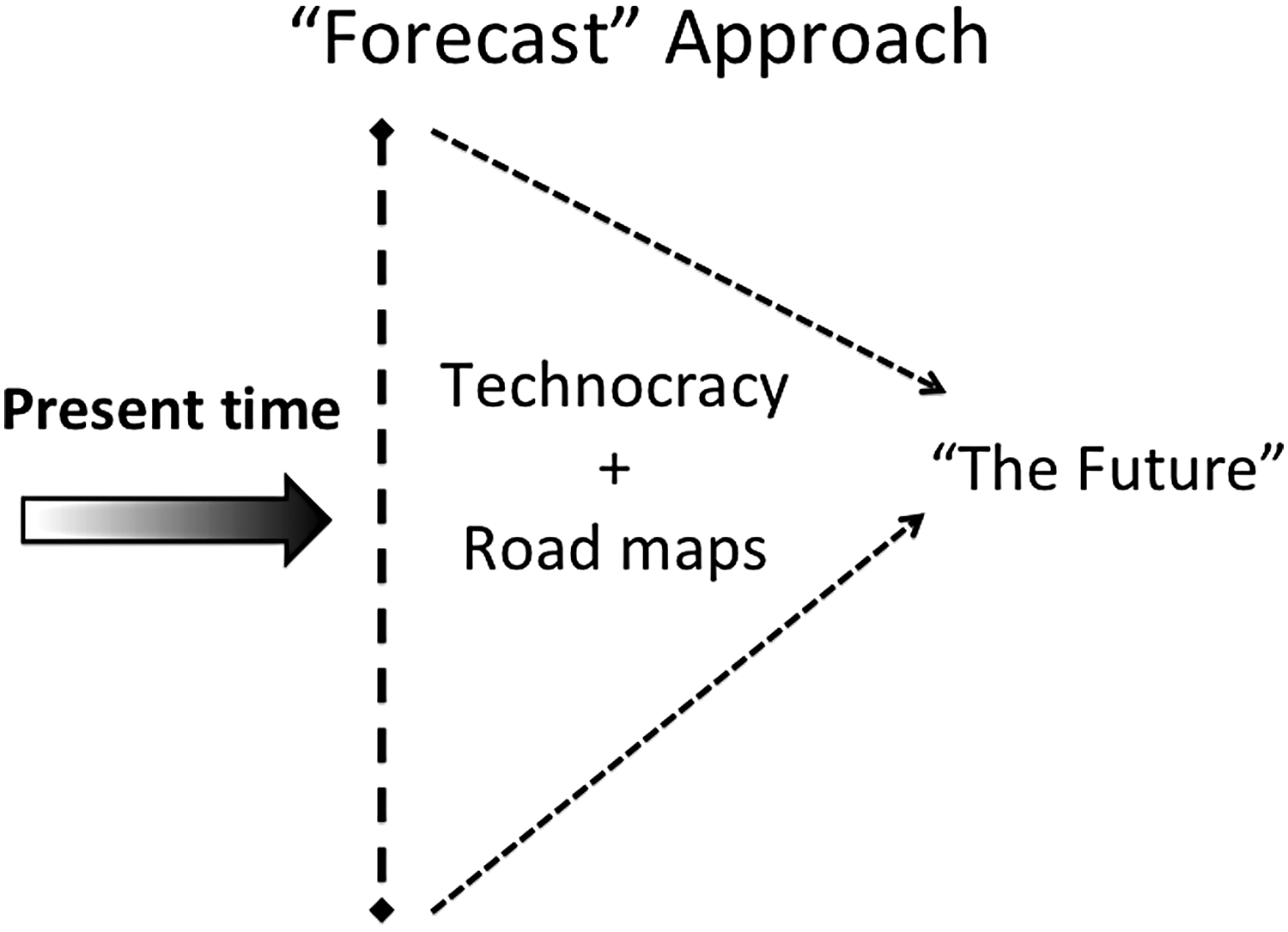
Forecast tends to embody technological determinism and the false idea that social and political forces, contexts or human values and power do not impact scientific knowledge co-production. Forecast is often seen in technology roadmaps and consensus reports and usually focuses on a single future rather than future(s).
Forecast Versus Foresight in Anticipating Technology and Innovation Future(s)
Figures 1 and 2 thus explain the differences between the foresight versus forecast approaches in attempts to map the relationships between technology and social change, and technologies in present time and their future configurations.
We should bear in mind, as engineers, medical doctors, and other foresight researchers, human values shape and guide the entire scientific knowledge co-production trajectory: new idea conception, choices made over which questions to study (or not), research funding, and commercialization of scientific products. Outcomes of science also concern human values: which scientific end points are chosen as priority, which group and population is targeted to benefit or omitted, among others. Without a clear understanding of such political choices made by scientists, regulators, and other innovation actors, foresight and futures research intended to support Mars-omics would be unable to develop a deep understanding of the technology and social change interface.
Finally, it is noteworthy that we may want to avoid the instinctive knee jerk response to develop a consensus statement or definitive road maps upon facing scientific uncertainties in the field of Mars-omics. In this context, scholars in the field of critical social sciences have noted, for example, that consensus is for textbooks; real science depends for its progress on continual challenges to the current state of always-imperfect knowledge (Sarewitz, 2011).
In other words, disagreements in scientific communities help keep technology futures open to debate and thus allow them to be reconciled with a broader range of human values impacting on science and society.
Conclusions
Taken together, we suggest that planetary and omics systems sciences offer multiple synergies and potential overlaps that can empower our responses to complex and a priori unknowable futures in missions to and human presence on Mars and other planets. It would also be timely and prudent to consider the tenets of contemporary foresight research by next generation of futurists who can make important contributions in our onward collective journeys on Earth and Mars.
Disclaimer
No funding was received in support of this article. Views expressed are authors' personal opinions only and do not necessarily reflect those of the affiliated institutions.
Footnotes
Author Disclosure Statement
The authors declare that no conflicting financial interests exist.