






Abstract
Background:
The fourth most common healthy skin phenomenon is aging.
Objective:
To assess the efficacy of Nd:YAG laser with a new handpiece for the treatment of wrinkles and skin laxity.
Methods:
A total of 30 patients underwent three laser sessions at 1-month intervals. The treated areas were cheek, perioral, periocular, and forehead. The visual analog scale, Global Aesthetic Improvement Scale (GAIS), and a photographic evaluation were performed before and at 3 months follow-up after the last treatment.
Results:
After three treatment sessions, an improvement of the patient's skin texture with a reduction of wrinkles was observed. The GAIS score was no change 3%, improved 37%, much improved 57%, and very much improved 3%. The average pain score was 2.6 ± 0.5. None of the adverse effects monitored was detected.
Conclusions:
Laser treatments stimulate collagen without causing epidermal damage, which results in less disability time and postoperative awkwardness.
Introduction
The aging process is the fourth most commonly occurring natural skin phenomenon in Europe. Skin aging is an ongoing process and external factors such as diet, smoking, and general lifestyle can contribute to loss of skin tonicity in all dermal districts. Moreover, the UV light of the sun can cause cutaneous changes such as damage to collagen, solar elastosis, lentigos, erythrosis, and wrinkles. 1
Although there are various current treatment approaches on the market, such as radiofrequency, chemical peelings, skin augmentation, and contouring injectable skin biostimulation and rejuvenation, restoration (redistribution) of fat and volume loss, hormone replacement therapy, or systemic agents, they are invasive and time-consuming. 2
Indeed, the use of lasers and energy-based devices for skin resurfacing and rejuvenation is prevalent. 3
Numerous studies have been conducted to compare various laser techniques and results in photofacial rejuvenation techniques. The use and the efficacy of 1064 nm Nd:YAG laser alone, or in combination with other techniques, have been histologically demonstrated. 4,5
The effect concerning shrinkage and stimulation of new collagen is much more evident and effective the deeper the light energy penetration within the skin. For this reason, the Nd:YAG laser is suggested for this kind of treatment. The deep heating produced by its light diffusion can be used to stimulate collagen shrinkage and neocollagenesis, achieving skin tightening.
For this reason, we present a case series study, in which 30 patients were treated with Nd:YAG laser (Again; DEKA M.E.L.A Srl, Italy) and a dedicated handpiece (Moveo SR) for skin rejuvenation equipped with an integrated contact skin cooling system set at 15°C.
Materials and Methods
The Again device is a fast and high-power laser platform for skin rejuvenation management and a wide range of applications in aesthetic medicine. In addition to the standard emission mode (single-pass), it also employs an innovative multi-pass method (“in motion”) whose effectiveness has already been demonstrated in the treatment of unwanted hair (with Moveo HR), 6 –8 superficial benign pigmented lesions (with Moveo PL), 9 and superficial vascular lesions (with Moveo VL). 10
The “in motion” skin rejuvenation technique uses minimal energy output to decrease pain perception. During the treatment, the operator must continuously move the handpiece in a slow linear/circular motion over an area of 100 cm2 (comparable with a cheek) and make several passes back and forth until a defined energy accumulation (usually 2/3 passes). The emission frequency is set to be higher than the standard procedure (multiple pulses per second).
In the case of skin rejuvenation treatments, the clinical end-point is mild facial reddening related to a perception of warmth that should resolve within a few minutes. Patients' mean age was 46.5 ± 13.0 years (range, 25–72 years; 6 males and 24 females) and the patients' phototypes ranged between II and III (II 57% and III 43%). Three sessions at 1-month intervals, with a fluence range from 15 to 20 J/cm2, a frequency from 3 to 5 Hz, and a dose of 3000–6000 J @ 10 × 10 cm area, were performed. The treated areas were the cheek, perioral, periocular, and forehead.
The visual analog scale (VAS from 0, no pain to 10, worst pain possible) to assess pain (patient discomfort) and a photographic evaluation to evaluate the improvement of fine lines, deep wrinkles, skin tone, laxity, and overall appearance, were performed before and at 3 months follow-up after the last treatment. All patients were evaluated by a digital photographic documentation estimation by two doctors specialized in aesthetic medicine and with vast experience in dermo-aesthetic treatments according to the Global Aesthetic Improvement Scale (GAIS): 3, very much improved; 2, much improved; 1, improved; and 0, no change.
Pretreatments included cleaning the relevant area, removing all impurities that could interact with the light radiation (makeup, lotions, deodorants, ointments, etc.), covering any dark spot that should not be treated (e.g., moles) with a white dermatological pencil and apply a thin layer of colorless ultrasound gel on the area to be treated.
Possible treatment side effects were a slight reddening of the face or a sensation of warmth. Persistent erythema or edema, blistering, burns, crusts, hyper-/hypopigmentations and scarring were also monitored.
Results
In our case series, after three treatment sessions, an improvement of the patient's skin texture with a reduction of wrinkles was observed. In Fig. 1, two different clinical cases are represented. The GAIS score showed satisfactory results: no change by 3%, improved by 37%, much improved by 57%, and very much improved by 3% (see Fig. 2 and Table 1).
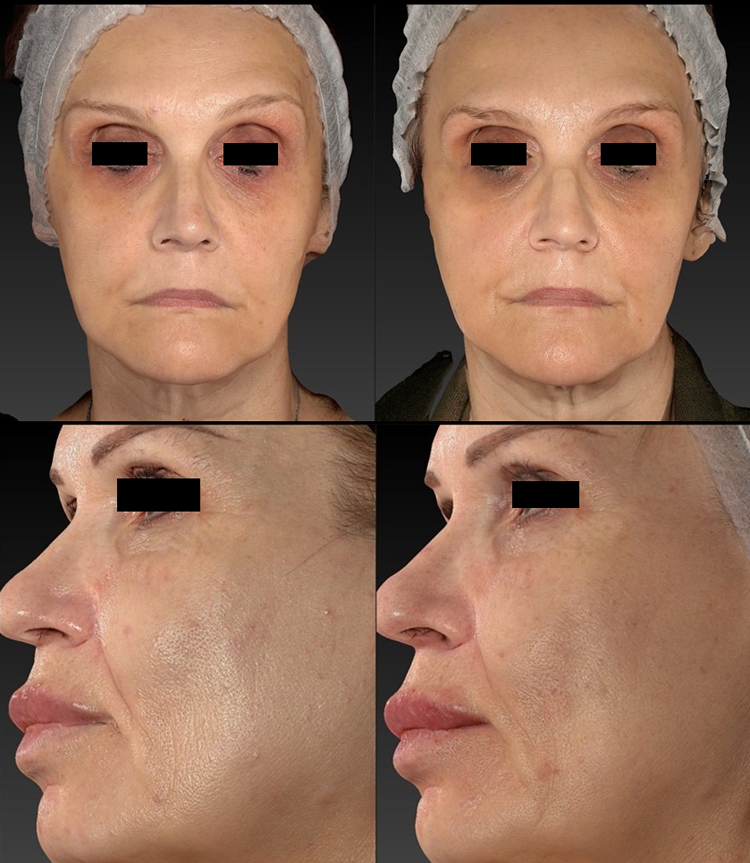
Upper panel: frontal view of 50-year-old female patient before and 3 months follow-up after the last laser treatment with the “in motion” technique. Lower panel: lateral view of 44-year-old female patient before and after 3 months follow-up after the last laser treatment with the “in motion” technique. In both cases, a marked improvement of skin texture with a reduction of wrinkles is observed.
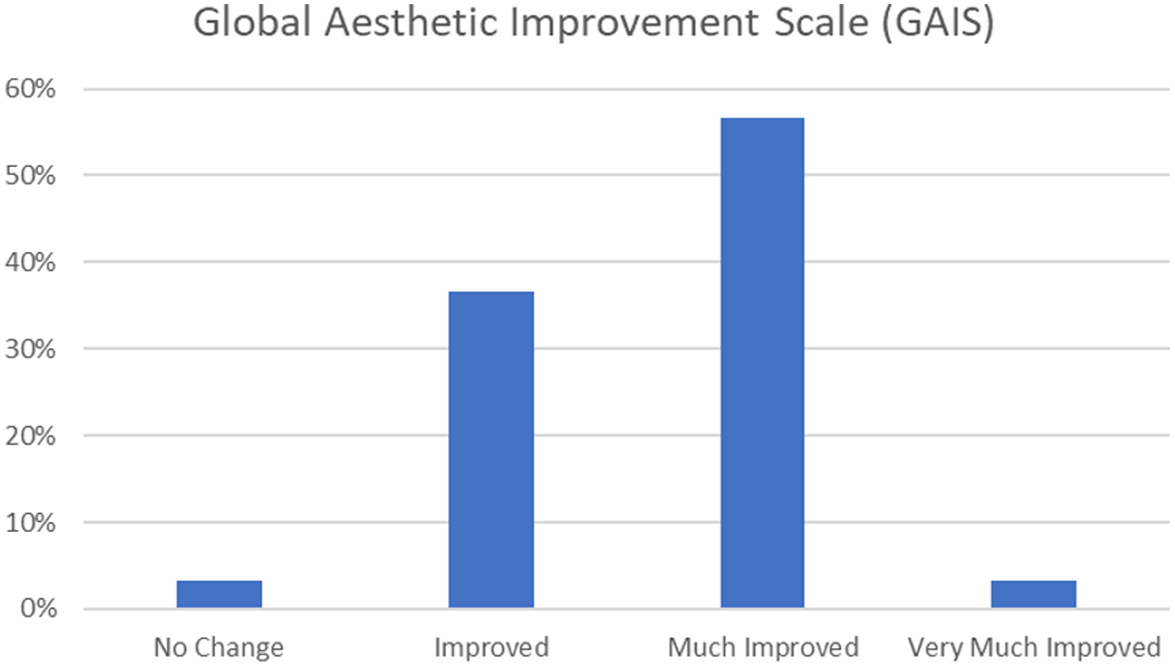
Histogram representation of GAIS scores evaluated at 3 months follow-up after the last laser treatment session. GAIS, Global Aesthetic Improvement Scale.
Global Aesthetic Improvement Scale Results
No adverse effects were detected. Laser treatments stimulate collagen without causing epidermal damage and this results in less disability time and postoperative awkwardness. Indeed, the average pain score measured by VAS was 2.6 ± 0.5.
Discussion
Stationary (single-pass) Nd:YAG laser treatment can result in side effects such as pain, vesiculation, and burns, whereas the multi-pass (“in motion”) methodology can limit side effects while guaranteeing a treatment uniform distribution. This method enables a gradual temperature increase, monitoring skin reactions, and the ability to interrupt or modify the treatment at any time, reducing the usual adverse reactions of the traditional approach.
As represented by photographic assessment and GAIS score evaluation at 3 months follow-up after the last treatment, all the subjects examined showed a visible improvement of skin texture with a reduction of wrinkles without discomfort (the average pain score measured by VAS was 2.6 ± 0.5). The two representative clinical images reported in this case reports better highlighted marked facial aesthetic improvement, with positive change of skin texture and a visible wrinkles reduction after laser therapy. Indeed, the majority of patients (57%) were much improved according to GAIS scale.
In this study, the “in motion” technique with the use of Moveo SR handpiece proved to be an easier, faster, painless, safer, and more effective method for the promotion of skin rejuvenation.
Our study's limitation is represented by a restricted patient sample. Our long-term goal is to increase patient numbers, as well as to extend the follow-up period.
Footnotes
Authors' Contributions
Conceptualization, methodology, validation, formal analysis, investigation, resources, and project administration by D.P., G.C., G.G., and C.C. Software by D.P., G.C., and C.C. Data curation by D.P., G.C., G.G., I.F., and C.C. Writing—original draft preparation by I.F. Writing—review and editing by D.P. and I.F. Visualization and supervision by D.P., G.C., G.G., C.C., and I.F. Funding acquisition by D.P. and G.C. All authors have read and agreed to the published version of the article.
Ethical Approval
The article is in accordance with the Declaration of Helsinki on Ethical Principles for Medical Research involving human subjects. Ethical approval is not necessary as the study device is already CE marked since 2020.
Author Disclosure Statement
G.G. and I.F. were employed by El.En. Group. The remaining authors confirm that no commercial or financial relationships exist that could be construed as a potential conflict of interest during the research.
Funding Information
No funding was received for this article.