







Abstract
Objective:
Assessment of different remineralizing pretreatment casein phosphopeptide-amorphous calcium phosphate (CPP-ACP), proanthocyanidin (PA), carbon dioxide laser (CO2), eggshell solution (ES) on the shear bond strength (SBS) of resin composite bonded to remineralized carious-affected dentin (CAD).
Materials and methods:
Eighty human molars were collected with occlusal caries that extended about halfway into the dentin. Using a water-cooled, low-speed cutting saw, a flat, mid-coronal dentin surface was exposed. CAD was differentiated from healthy dentin. Based on the remineralizing agent used on the CAD surface, the teeth were arbitrarily allocated into five groups (n = 10). Group 1: no remineralizing agent, Group 2: CPP-ACP, Group 3: 6.5% PA solution, Group 4: CO2 laser, and Group 5: ES solution. All samples were bonded to composite and light cured and thermocycled. SBS and failure mode analysis were performed using universal testing and stereomicroscope 40 × . Using SPSS, SBS, and failure mode data were analyzed using analysis of variance and Tukey's honesty significant difference (HSD) test
Results:
Group 3 (6.5% PA solution; 15.59 ± 1.44 MPa) samples established the maximum bond integrity. Nevertheless, Group 1 (No remineralizing agent; 11.19 ± 1.21 MPa) exhibited the minimum outcome of bond strength. Intergroup comparison analysis showed that Group 1 (No remineralizing agent), Group 2 (CPP-ACP), and Group 4 (CO2 laser) established comparable values of bond strength (p > 0.05). Likewise, Group 3 (6.5% PA solution) and Group 5 (EA solution) also revealed equivalent bond integrity (p > 0.05).
Conclusions:
PA and ES are considered potential remineralizing agents used for caries-affected dentin surfaces in improving bond integrity to composite resin. However, further studies are advocated to extrapolate the findings of this study.
Introduction
Clinicians now attempt to remove infected dentin and leave caries-affected dentin (CAD) in the cavity. 1 The cyclic demineralization–remineralization caries process in CAD causes intertubular dentin to have a lower mineral concentration and more porosity than normal dentin. 2 Henceforth, it is anticipated that CAD will be more porous than conventional dentin, allowing for more profound absorption of acidic conditioners and adhesive monomers. 3 However, compositional and physical differences between CAD and regular dentin may influence the bond strength of composite resin to CAD. 4 Therefore, there have been some attempts to remineralize the porous and hypomineralized intertubular dentin in CAD.
Among the various agents used to remineralize the CAD surface, the use of a paste containing casein phosphopeptide-amorphous calcium phosphate (CPP-ACP) has widespread acceptance in the field of dentistry. 5,6 It causes the bioavailable calcium and phosphate ions in the tooth substrate to reach a supersaturated state. 7,8 The diffusion of calcium and phosphate ions into a porous lesion and their subsequent deposition may lead to the remineralization of partly demineralized crystals. 9 Salehzadeh Esfahani et al., in their study, revealed that CPP-ACP causes enamel white spot lesion remineralization. 10 However, data related to its effect on the bond integrity of composite restoration when used for CAD surface remineralization is inadequate and needs further inquiry.
Grape seed extract (GSE) or proanthocyanidin (PA) is a polyphenolic compound that possesses antioxidant qualities. 11 The impact of PA having antibacterial and remineralizing capabilities has been formerly explored on radicular dentin caries. 12 PA has been related to both enhanced collagen synthesis and decreased collagen matrix degradation by enzymes. 13 A study has found that 6.5% PA-treated deep dentin specimens exhibited much better bond strength values than sodium ascorbate-treated specimens. 14 However, data related to its effect as a remineralizing agent on the shear bond strength (SBS) of composite resin are constrained and dubious. Similarly, comparable to the composition of human bone and teeth, eggshells are one of the richest natural sources of calcium. 15,16 A single chicken eggshell solution (ES) of average size contains between 750 and 800 mg of elemental calcium and 26 other microelements. 17 However, its effect on the SBS of CAD bonded to resin restoration needs experimentation.
In addition to chemical and herbal agents used, a carbon dioxide laser (CO2 laser) with a wavelength of 9300 nm has the potential to alter the chemical structure of teeth. 18 It increases the ratio of calcium to phosphorus and converts the carbonated hydroxyapatite of enamel and dentine into the pure hydroxyapatite of enamel and dentin. 19,20 It may alter the surface morphology of a tooth by melting, fusing, and removing dentine and enamel. 21 Nevertheless, literature is scarcely related to its remineralizing impact on CAD-composite bond strength.
According to available indexed literature, it can be stated that data related to the effect of different remineralizing agents (CPP-ACP, PA, CO2 laser, ES) on bond integrity of adhesive restoration to CAD surface is insufficient. The existing study aims to assess the influence of different contemporary remineralizing agents on the bond integrity of resin composite bonded to remineralized CAD. It can be hypothesized that there will be a significant difference in the SBS of composite resin restoration bonded to CAD remineralized using different remineralizing agents (CPP-ACP, PA, CO2 laser, ES) in comparison to the no remineralizing agent group.
Materials and Methods
Specimen preparation
Eighty human molars were collected for the exciting investigation, all of which had occlusal caries that extended about halfway into the dentin. Noncarious, hypomineralized, and fractured teeth were excluded from the study. The study protocol was reviewed and approved by the specialist practice and research center–014-22. An informed consent form was signed by all of the participants. The extracted teeth were kept in physiologic saline at 4°C for no longer than 4 weeks. The teeth were rinsed, scraped, and scaled to eliminate any attached debris after extraction. After soaking for a week in a 0.5% chloramine T solution at 4°C, the teeth were transferred to a container of distilled water and frozen until use. 22,23
Using a water-cooled, low-speed cutting saw (Mecatome T201 A, Presi, Grenoble, France) a flat, mid-coronal dentin surface was exposed by running it perpendicular to the long axis of the teeth. Wet silicon carbide paper with a grit of 600 was employed for further finishing under running water for 20 sec. CAD was differentiated from infected dentin using a combination of the sharp excavator hardness test, ocular inspection, and caries dye detecting solutions. Repeated scraping of infected dentin revealed progressively pink and hard dentin. The radicular part of the tooth was sectioned from the crown 1 mm below the cementoenamel junction and embedded in acrylic resin (Acropars; Marlik Co., Tehran, Iran) present in a mold by placing it perpendicular to the bottom of the mold. 16,24
ES preparation
Thirty chicken ES were washed with distilled water after the contents were removed. The ES was then placed in a 100°C water bath for 10 min to aid membrane removal. They were then smashed using a sterilized pestle and mortar. The crushed particles were then heated for 1 h at 900°C in a muffle furnace (Lava Furnace 200, 3M, USA) and powdered. In a test tube, 1 gm of ES powder was dissolved in 20 mL of 4% acetic acid (India Chemicals, Pvt. Ltd., Mumbai, India). The clear fluid collected at the top was transferred to a beaker. Based on the remineralizing agent used on the CAD surface, the teeth were arbitrarily allocated into five groups (n = 10).
Group 1: No reminerlizng agent
In this group, the CAD surface was not treated without any remineralizing agent.
Group 2: CPP-ACP
After applying the 35% phosphoric acid gel to the surface of the CAD, the surface was aggressively brushed by CPP-ACP containing paste (MI paste; GC Corp, Tokyo, Japan) for 3 min. CAD surfaces were then rinsed with distilled water.
Group 3: 6.5% PA solution
GSE powder (Puritans Pride Inc., Oakdale, NY) weighing 6.50 gm was dissolved in 100 mL of distilled water to provide a 6.5% PA solution. PA solution was used to treat CAD surfaces for 1 min after applying a 35% phosphoric acid gel. CAD surfaces were then rinsed with distilled water.
Group 4: CO2 laser
After applying the 35% phosphoric acid gel to the surface of the CAD, substrate surfaces in this group were irradiated with a CO2 laser (PC 015-D CO2 Laser System, Shanghai JueHua Laser Tech. Development Co., Ltd., Shanghai, China) operated in ultra pulsed mode at 0.5 W average power, 0.44 J/cm2 energy density, 100 sec pulse durations, and the 0.001 sec interval between pulses. 25
Group 5: ES
After applying the 35% phosphoric acid gel to the surface of the CAD, the surface was applied with ES for 3 min. CAD surfaces were then rinsed with distilled water.
Bonding procedure
After the remineralization protocol, a bonding agent (3M ESPE, Saint Paul, USA) was applied which was then cured for 20 sec using light curing equipment. On the CAD surface, a plastic tube 3 × 2 mm (internal diameter × height), respectively, was placed. Composite (Filtek Z350; 3 M ESPE) was built using a plastic tube in 2 mm increments and then exposed to light for polymerization. All the specimens were kept for 24 h at 37°C in a humid incubator (Memmert Universal Oven, Germany). To expose specimens to 8000 cycles at 5°C and 60°C for 30 sec dwell duration, samples were put in a thermocycler (Automated Thermal Cycler; Applied Biosystems, CA). 26
SBS and failure analysis
A universal testing machine was used for shear bond testing (Instron, Z020; Zwick Roell). After securing the samples in a jig, a force was applied to each sample at a crosshead speed of 1 mm/min until failure occurred, with the force being delivered parallel to the bonded interface. Failure mode was analyzed using a stereomicroscope at 40 × . Failure was categorized as adhesive, cohesive, and admixed. Adhesive failure occurs when the bond between the adhesive and one of the substrates fails, leaving the adhesive on one substrate and the other substrate. Cohesive failure occurs when the bond within the adhesive itself fails, leaving the adhesive on both substrates but with a clean break within the adhesive layer. Mixed failure is a combination of both.
Statistical analysis
SPSS version 23 (IBM, Chicago IL, USA) was used for means and the standard deviations (SDs) of investigated groups. Groups were compared using analysis of variance. Tukey's honesty significant difference (HSD) test was utilized for multiple group comparisons. A p value of <0.05 was suggested to be statistically significant.
Results
The means and SD of SBS in MPa among different investigated groups are presented in Table 1 and Fig. 1. The results suggested that Group 3 (6.5% PA solution; 15.59 ± 1.44 MPa) samples established the maximum bond integrity of composite restoration to the CAD surface. Nevertheless, it was observed that Group 1 samples in which no remineralizing agent was used exhibited the minimum outcome of bond strength (11.19 ± 1.21 MPa).
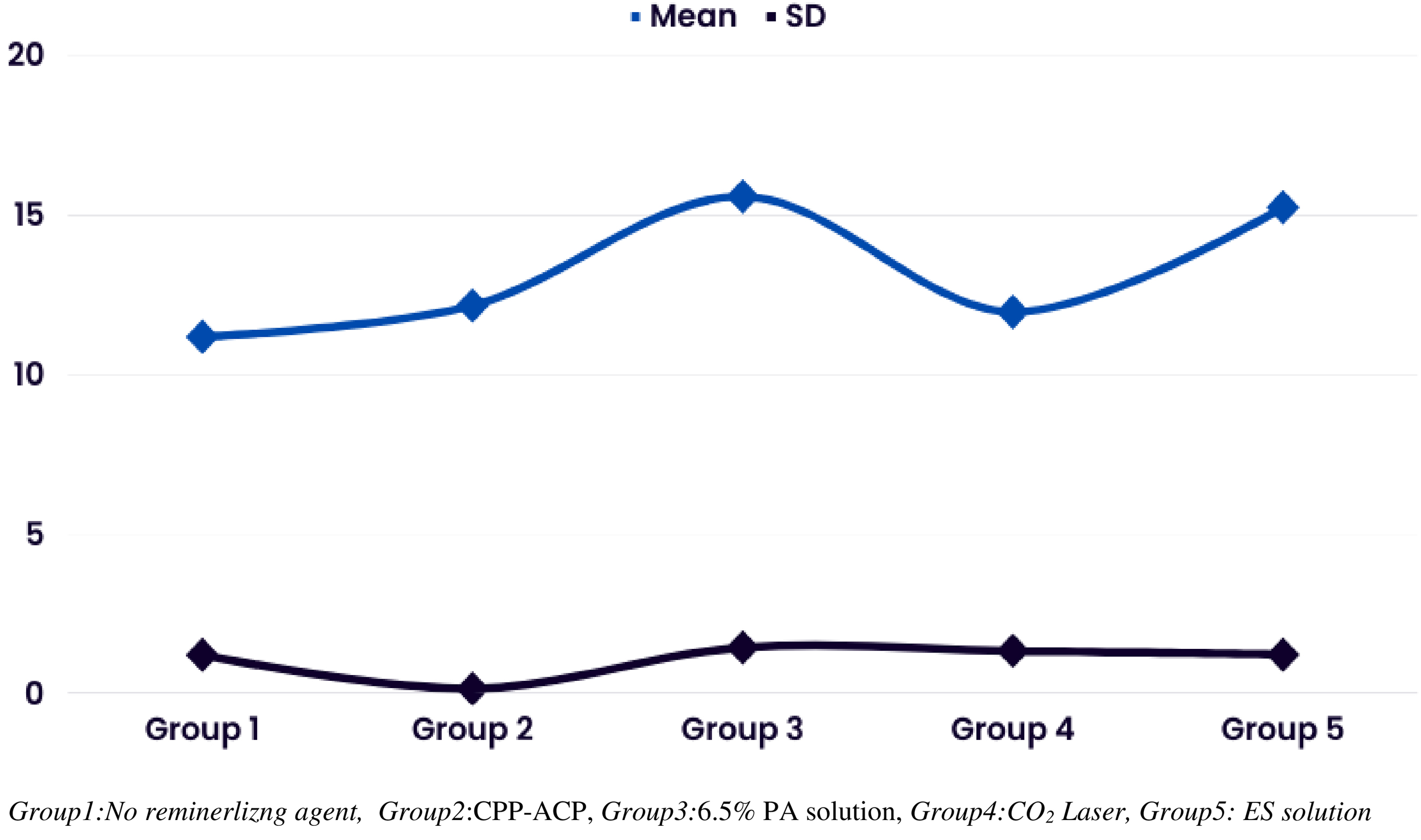
Shear bond strength of CAD after different remineralization protocols. CAD, carious-affected dentin.
Shear Bond Strength of Carious-Affected Dentin After Different Remineralization Protocols
The different small letter denotes statistically significant difference.
Showing significant differences among study groups (ANOVA; Tukey multiple comparison test).
ANOVA, analysis of variance; CPP-ACP, casein phosphopeptide-amorphous calcium phosphate; CO2 laser, carbon dioxide laser; ES, eggshell solution; PA, proanthocyanidin; SD, standard deviation.
Intergroup comparison analysis exposed that Group 1 (No remineralizing agent; 11.19 ± 1.21), Group 2 (CPP-ACP; 12.17 ± 0.15 MPa), and Group 4 (CO2 laser; 11.97 ± 1.34 MPa) established the comparable values of bond integrity (p > 0.05). Likewise, it was also spotted that Group 3 (6.5% PA solution; 15.59 ± 1.44 MPa) and Group 5 (EA solution; 15.25 ± 1.22 MPa) also revealed equivalent bond scores (p > 0.05).
Modes of failure among study groups are displayed in Fig. 2. It was observed that both Groups 3 and 5 experienced predominantly cohesive types of failures. While, Groups 1, 2, and 4 showed adhesive types of failure predominantly.
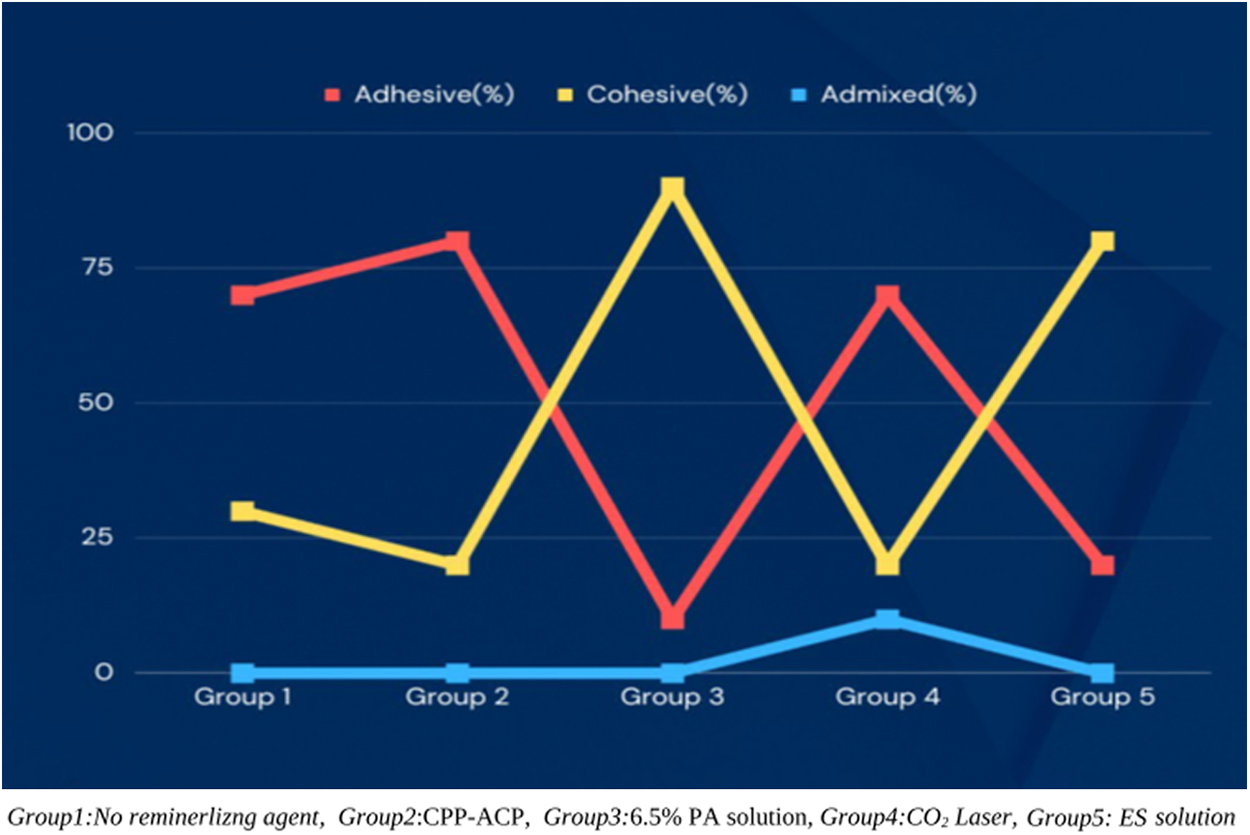
Modes of failure among study groups.
Discussion
The existing study was based on the hypothesis that there will be a significant difference in the SBS of composite resin restoration bonded to CAD remineralized using different remineralizing agents (CPP-ACP, PA, CO2 laser, eggshells) in comparison to no remineralizing agent control group. The postulated hypothesis was partly accepted that PA- and ES-treated group displayed significantly higher SBS than the control group. However, CPP-ACP and CO2 laser displayed comparable bond integrity of composite resin to that of the nonremineralization group. The SBS test is a common and widely used method to measure the bond strength between resin composite and dentin surface in dentistry. This test is based on applying a shear force to the interface of the two materials and measuring the force required to break the bond. 15,27 There are several reasons why the SBS test is a preferred method in dental research and practice. One of the main advantages is its repeatability, which means that the test can be performed multiple times under the same conditions, producing consistent results. 28 The SBS test is relatively easy to perform and requires simple equipment, which makes it affordable and accessible for most dental research labs and clinics. 16 Additionally, the test is less sensitive to the testing method than other types of bond strength tests, such as tensile or peel tests, which can be affected by the geometry and shape of the specimens. 29
Adhesive bond strength to CAD is weaker than that of normal dentin because of the breakdown of the dentin collagen matrix in CAD. 30 With CAD, there is a demineralization of the intertubular dentin. 31 In contemporary exploration, it was witnessed that when PA was employed for CAD remineralization before adhesive application, the maximum bond scores of adhesive resin with the CAD surface were observed. This is in agreement with the results of prior research conducted by Macedo and coauthors. In their study, they revealed that the application of 6.5% PA considerably enhanced the initial bond integrity of composite restoration to the CAD surface. 32 The finding can be justified by the fact that PA displayed both antibacterial and remineralizing properties when tested on the tooth surface. It also plays a crucial role in producing collagen protein. Thus rendering positive effects on the inner mineralizable region of the CAD, which contains fewer collagen cross-links and intact proteins. 33 All of these interactions may promote remineralization and inhibit demineralization of the collagen matrix of the affected dentin surface. 31
Similarly, it was also directed that the ES-conditioned CAD specimens displayed comparable outcomes of SBS to that of PA-treated group. From the available literature, it was discovered that the major component of ES is calcite, the crystalline form of calcium carbonate. 34 A procedure called calcination converts calcite into calcium oxide (CaO) by heating it to 900°C for 1 h. 17 Due to its high alkalinity and high reactivity, CaO promotes remineralization and enhances bond strength. 15 Furthermore, alkaline pH is also responsible for remineralization since it boosts the ion activity of anions like phosphate and hydroxyl ions. The activity of ions is proportional to the amount of each ion present in the solution. As a result, there will be a greater supply of these ions for remineralization and eventually enhancing the bond strength. This is in harmony with the findings of work conducted by Shady et al. 35
Previously, Featherstone reported that CO2 laser irradiation enhances the caries resistance of enamel. In his study, he applied sodium flouride (NaF) to demineralized enamel and subsequently treated it with a CO2 laser. 36 However, the results of this study unveiled that teeth when irradiated with a CO2 laser decrease the SBS of adhesive restoration with the affected dentin. This can be elucidated on the basis that CO2 laser decreases the atomic percentages of calcium and phosphorous in comparison to demineralized teeth. 14 However, this result contradicted the findings of Asl-Aminabadi et al., who observed an increase in calcium and phosphate mean weight percentages in the laser-treated group compared to the demineralized group. 37 The heterogeneous outcome of CO2 can be influenced by laser parameters (power and frequency), exposure time, and power density. Likewise, the CPP-ACP was employed as a pretreatment for CAD because of its remineralizing effects. 38 Following the prior research, the current inquiry found that a CPP-ACP pretreatment of CAD for 3 min did not affect the bond values of composite to CAD surface. 30 Research revealed that in comparison to sound dentin, dentinal tubules of affected dentin have a greater concentration of calcium precipitates. While, applying CPP-ACP may help remineralize CAD's partly demineralized intertubular dentin, which may negatively impact the dentinal tubules by blocking them even more. 31 However, the data are still questionable and need further reconnaissance.
Regarding failure mode analysis, it was determined that the CO2 laser and CPP-ACP treated group displayed the adhesive type of failure the most. However, PA and ES exhibited cohesive failures predominantly. Adhesive failures occur primarily at the tooth/material interface, suggesting a poor contact between composite resin and dentin surface, they are deemed unsatisfactory, whereas cohesive failure is caused by deterioration or a lack of strength in the material or dentin and bond strength is strong.
This study has certain limitations. Primarily, the research was conducted as a lab-based study so caution should be taken when generalizing the outcomes of the existing study. Furthermore, in the future, it can be suggested that modernized technologies should be used to disclose crystallographic and chemical changes that occur following laser and remineralization agent application. Scanning electron microscopy along with atomic force microscopy is essential to see the change postremineralization following the application of different remineralizing agents. As a clinician, extending the duration of exposure to remineralizing agents and assessing the potential impact on the CAD surface becomes clinically relevant. Additionally, investigating whether altering the sequence, such as treating the dentin first followed by the application of the etching agent, yields different results would be valuable in understanding the effects on the CAD surfaces.
Conclusions
PA and ES are considered potential remineralizing agents used for CAD surfaces in improving bond integrity to composite resin. However, further studies are advocated to extrapolate the findings of this study.
Footnotes
Authors' Contributions
Conceptualization, F.A., M.S.B.S., and A.S.A.; Methodology, F.A., M.S.B.S., and A.S.A.; Software, A.S.A. and F.A.; Validation, A.S.A., and F.A.; Formal analysis, F.A., and A.S.A.; Investigation, A.S.A., and F.A.; Resources, F.A., M.S.B.S., and A.S.A.; Data curation, F.A., M.S.B.S., and A.S.A.; Writing—original draft preparation, F.A., M.S.B.S., and A.S.A.; Writing—review and editing, F.A. and A.S.A.; Visualization, F.A.; Supervision, F.A. and A.S.A.; Project administration, F.A., and A.S.A.; Funding acquisition, F.A., M.S.B.S., and A.S.A. All authors have read and agreed to the published version of the article.
Author Disclosure Statement
The authors of this study have no conflict of interest.
Funding Information
The authors are grateful to the researchers supporting the project at King Saud University for funding through the researchers supporting the project (RSPD2023R815), Riyadh, Saudi Arabia.