Introduction
Vaginitis is a common condition affecting millions of women and accounting for more than 10 million office visits annually.
1
–3
By many reports vaginitis is frequently misdiagnosed and opinions differ regarding the most appropriate diagnostic pathway. To address how to best manage patients presenting with symptoms of vaginitis, an expert panel was convened to provide information and guidance for clinicians and improve the patient experience. The group explored the current issues and diagnostic challenges related to vaginitis and developed an algorithm to aid clinicians in the decision making process when evaluating a patient presenting with symptoms of a vaginal infection.
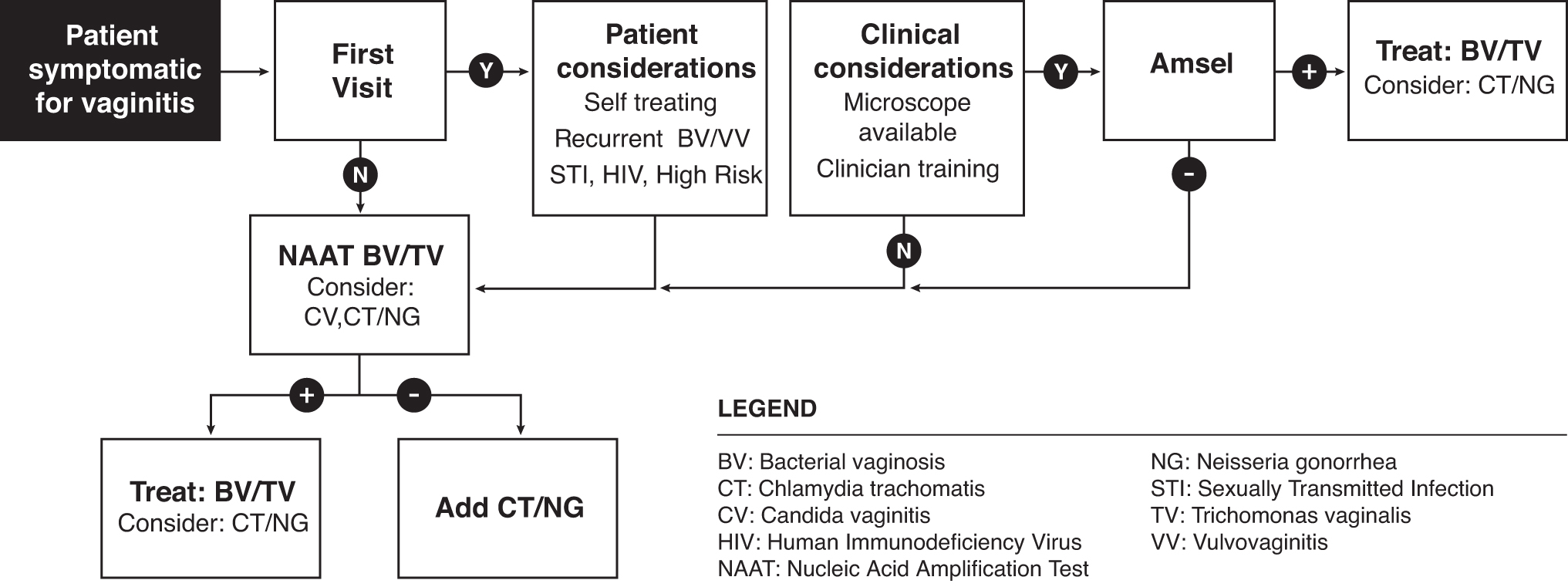
Dr. Goje: You just have to look at the feminine aisle in any store to know the burden of vaginitis: What needs to be done, or what do we need to consider, when we're seeking timely, accurate diagnosis, plus to reduce the burden on those women?
Dr. Nyirjesy: With trichomoniasis, I think people are so satisfied to see all of the trichomonads on a wet mount that they don't think they need to do additional testing—although I think that's starting to change. Then with bacterial vaginosis (BV), there is study after study in which providers just don't bother to do the basic office tests.
I think there's a need to have something that people will do that will fill this gap. For 30 years, except for nucleic acid amplification testing (NAAT) for trichomoniasis, the gold standards and the office tests have remained the same. Providers are very reluctant to do them, and the studies show that this issue hasn't gotten any better.
Dr. Brown: I think the other issue is that patients are miseducated on this. They grow up as adolescent girls with a vaginal discharge that's automatically a yeast infection until proven otherwise. I see as the challenge getting these individuals properly assessed and trying to make an accurate diagnosis, and once we make an accurate diagnosis, we can save them serious emotional morbidity of failed treatment. I think that that's really part of the answer to where we are with individuals who grow up misinformed about the different types of vaginitis, vaginosis and the treatment for these disorders.
Dr. London: I think this is an interesting conundrum, because we have a misdiagnosis rate of 30 to 50% – or even higher false positive diagnosis in some publications. If we had a misdiagnosis rate like other diseases like streptococcal pharyngitis, the medical community would focus on improving testing. From my viewpoint, a major issue related to the current diagnosis of vaginitis is missing the opportunity to test for sexually transmitted infections (STIs) at the initial visit. If women self-diagnose incorrectly vaginitis as “yeast” and treat with over-the-counter (OTC) medication, we miss the opportunity to correctly diagnose and treat BV, trichomoniasis, and concomitant STIs.
Dr. Muzny: Thanks for asking that question; it's a very hot topic. Yes, I personally think that BV is an STI. I believe that for multiple reasons. There is a large body of epidemiological data that suggests BV is sexually transmitted. Women with a new diagnosis of BV are very likely to have gotten it from a new sex partner. For women who have recurrent BV, a big risk factor is having the same sex partner. There is a lot of interplay going on, I think, between BV and other sexually transmitted infections, particularly trichomoniasis, as both being vaginal infections. And I think because that issue has not been resolved, it's hard to figure out the most appropriate diagnosis, treatment, and prevention for women with BV. But of experts that I've talked to, the majority of people think that it is sexually transmitted.
Dr. Nyirjesy: It's a tough question. I'm doing Amsel's criteria automatically. I think that if there were clear criteria saying that women need to be screened for BV just like they're screened for gonorrhea and chlamydia, just like it's starting to change with screening recommendations for trichomoniasis, then I think that would become part of the routine while women visit. But in terms of getting people to actively look for it at every visit, I think that it's going to be very provider-dependent, depending on how concerned people are about BV.
I think the data is really clear that most providers aren't doing those tests at all. The rates of pH testing are about 5%, at least 50% of patients aren't having a wet mount done at all, and so I think that in those situations NAAT testing would really fill that gap. I think that would be really helpful, to get an accurate diagnosis.
Dr. Goje: Do we have negative consequences when we take each of these vaginal entities as a separate entity?
NAAT testing would be helpful in the diagnosis and appropriate management of mixed vaginitis and co-infection in vaginitis. Mixed vaginitis is due to the simultaneous presence of at least two vaginal pathogens, both contributing to an abnormal vaginal milieu and, hence, symptoms and signs of vaginitis – for example, BV and trichomoniasis or BV and candida infection. In mixed vaginitis, both pathogens require specific therapy for complete eradication of concurrent manifestations. In coinfection, although two pathogens are identified, a potential pathogen may be present but may not be a cause of existing vaginal symptoms. One example is a positive chlamydia polymerase chain reaction (PCR) in a patient with malodorous discharge suggestive of BV. Although data remain sparse, mixed vaginitis occurs rarely (<5%). By contrast, pathogen coinfection occurs frequently in women with vaginitis. Approximately 20%-30% of women with bacterial vaginosis (BV) are coinfected with Candida species. Coexistence of BV pathogens and T. vaginalis is even more common, with coinfection rates of 60%-80%. Both coinfection and mixed vaginitis have significant clinical and therapeutic implications and are worthy of further investigation.
We are treating yeast, we are treating BV, we are treating trichomoniasis, gonorrhea, chlamydia. Are there negative consequences to the patient if we look at them as individual infections, is it more beneficial for the patient if we treat each as a separate entity?
Dr. Brown: I think we need to take them individually, because they have different treatment modalities and different impacts on quality of life in relationships.
Dr. Nyirjesy: I think it also comes to an antimicrobial stewardship that if you kind of treat them for everything without having a clear sense of, oh, this is yeast, this is BV. With BV and trichomoniasis there's overlap with the treatment. But still I think, just in general with infectious diseases, you want to tailor whatever medication you give to the infection that the patient actually has.
Dr. Brown: Even when they don't have the co-infections, they have a tendency to treat for the co-infection. “Well, you know, I could treat it like trichomoniasis, but what if I just treat her for both trichomoniasis and BV.”
Dr. Muzny: I also think it's important to treat them individually, because we also have to think about partner management for a certain infection, and what are we doing with the partners? I see it all the time. I think it's very important to separate them so that you know what's going on.
Dr. Goje: Excellent. If we agree that it's more beneficial to take them as separate etiologies because trichomoniasis needs a partner treatment; BV does not, at least as of now; and yeast does not need that. Also, a lot of our residents and trainees have no access to a microscope.
Dr. London: Before we jump into just the diagnosis, let's talk about which providers are actually making the diagnosis. But if you look at the brief time that a nurse-practitioner, a physician's assistant, or a family practice doc has with that patient, including a pelvic exam, and the fact that the microscope is possibly around the corner or even on another floor, it may not be realistic to expect them to perform all the tests for Amsel criteria. My personal impression is that many providers are not very skilled with microscopic diagnosis of vaginal swabs. In current practice, I suspect that the majority of the vaginitis diagnoses are being treated by non-OB/GYNs.
Dr. Brown: I agree. I totally agree with that.
Dr. London: If that's really what's happening in the real world, maybe we should be thinking, let's look at different criteria, best practices, and then the societies can follow up with amending current best practice guidelines.
Dr. Nyirjesy: I would actually humbly disagree. In the patients that I've seen referred to me, I think the nurse-practitioners end up caring a lot more about diagnosing these conditions properly and doing the tests than a lot of the physicians who refer to me. I think that it really comes down to the individual providers. But I actually believe that having nurse-practitioners taking care of these problems is a good thing. I think sometimes they go the extra mile, and they might read the guidelines a little more carefully, whereas an OB/GYN is worried about pregnancy, and learning robotic surgery, and all these other things, and vaginitis is way down on their list of interests.
Dr. Brown: Fifty percent of all counties in the United States don't have a practicing OB/GYN or midwife. The majority of patients are taken care of at federally-qualified health centers and health department clinics by nurse-practitioners. It's very important for the nurse-practitioners to understand the diagnostic criteria for all of these particular vaginal infections and vaginoses, even much more so, because they're going to be treating people on the front line, and they need to follow up, but at the same time, many of these providers do not have Clinical Laboratory Improvement Amendment (CLIA) certification for microscopic criteria/use. They're using whatever tools they have available to assess, diagnose and treat. This is where the type of testing that we're talking about has great benefit for those facilities and providers of women's health care. I think that the idea that the majority of women in this country are not necessarily seen by a physician—whether it be a family physician or whether it be an OB/GYN physician—is very real.
Dr. Muzny: We have very busy patient panels. I think it takes a lot of time in the clinic for very busy clinicians to have to do a pelvic exam, go to the microscope, and look at the wet mount. Yes, in those situations, if you want to just order a BV NAAT in a symptomatic woman, perhaps. But if you have more time, you have a microscope, you have been trained, and you have the capability, I think it's almost situation-dependent to answer that question.
Dr. Brown: They don't have all the bells and whistles. That's where the NAAT diagnostic comes into play. I think that we have a lot that we can do from a patient satisfaction perspective and a provider satisfaction perspective, because people just don't know what they're looking for at times under the microscope to make an accurate diagnosis.
Dr. Nyirjesy: And may I say that that last comment by Dr. Brown has been true for the 30 years I've been in practice, so things haven't changed, and they haven't gotten better. And to talk to Christina's point, I also think that there are plenty of women with symptomatic vaginitis who aren't being diagnosed properly, so just getting those patients evaluated properly would be a big first step. The nice thing about the NAAT is that the swabs are easy to use, it's a reproducible technology, anybody can get a swab, and so life becomes a lot simpler for the people who don't have the bells and whistles that Haywood described, or who aren't sure how to use them.
Dr. Goje: We have an ACOG guideline from 2020, nonpregnant vaginitis, and for BV we talk about Amsel's criteria, and Nugent score for clinical research. In 2021, with syndromic treatments, misdiagnosis, delay in treatment, how do we merge accurate diagnosis vs. overtreatment? Because some of the vaginal DNA probes (or vaginitis panel testing) I see, create the issue of overtreatment, and the need to reeducate people. So how do we merge that, number one? The second question for you is: Do we need to update our guidelines? Do we see the NAAT as equal to Amsel criteria, or everything is in relation to Amsel, since Amsel has been the gold standard in the clinic?
Dr. Nyirjesy: I think that using technologies that have undergone clinical trials, that are FDA-cleared, or at a minimum published, where we know the accuracy of those tests is very important.
Dr. Goje: Should NAAT be a one size fits all?
Dr. Nyirjesy: I think if we're talking about symptomatic women, and there is some overlap between the different conditions, I think the suggestion to get a NAAT that is going to cover the main causes of infectious vaginitis is a good one. When I review charts of patients referred to me, I actually kind of like to see it when there are NAAT results on their charts from their referring providers, because that's firm data that I can really rely on, and I know that those tests are pretty accurate in terms of determining what the patient had when they were seeing that provider.
Dr. Muzny: I think that if we're going to have a test that tests for all three common pathogens, and use that in an asymptomatic patient, I think we need to be ready to know what we're going to do with the results.
Dr. Goje: How should health insurance coverage policies approach BV testing? Because if we say a fungal culture is the gold standard for yeast, and NAAT is the gold standard for trichomoniasis, how does the health coverage go?
Dr. Brown: we have different types of practitioners; practices throughout the United States in rural, in urban, in academic communities. As a result, there are certain settings where the NAAT is going to be highly appropriate. The other thing that we have learned in the world of COVID-19 PANDEMIC is that we have to get used to the fact that self-collection and screening in symptomatic women is going to be part of the new paradigm.
Dr. Goje: Is the value of NAAT vs. the non-amplified DNA probe enhanced given the expensive medications? Not just expensive medications, but the cumulative expense and burden of vaginitis which sometimes people don't see: the loss of work, the multiple doctors' appointments and all that.
Dr. Nyirjesy: I think compared to the non-amplified DNA test, NAAT is clearly superior. If you just look at yeast infections where the sensitivity of the test is 50%, maybe 60%, NAAT compares favorably when it comes to Candida albicans infections. People think it's a trivial condition, but yeast infections alone are a huge issue—with, by the way, two drugs that are fairly close to getting approved in the pipeline, which will end up increasing the cost of treatments for yeast infections, too.
Dr. London: I think one consideration is false-positive tests, and Paul, correct me if I'm wrong, but the NAAT test has many less false-positives for BV than the other test, not amplified.
Dr. Nyirjesy: Absolutely.
Dr. Goje: Are there special considerations for adolescents or teenagers in terms of testing?
Dr. Arrindell: We routinely hear that adolescents are concerned about privacy and explanation of benefits (EOBs); not wanting to go to a doctor because your parents will get the EOB; providers are trying to figure out how to provide privacy, confidentiality for young people.
Dr. Goje: And do you think self-collecting swabs helps that age population?
Dr. Arrindell: I absolutely do. It's one lesson we've all learned during COVID-19 pandemic. I think that home collection will be increasingly important. I think it's important for adolescents. There are definite benefits to sitting with a provider, and I don't know how it all balances out. Home tests, home-collected samples are technologies that will make a huge difference in individuals' lives.
Dr. Brown: I would like to say that I think we're way behind with home testing with regard to those things. People have been doing that for colorectal screening for so long, and I think that for women, particularly for vaginitis, letting the person take their own swab gives them a lot of autonomy. Cap it, send it in, get it analyzed, go see your provider, they make the diagnosis, they help you, and they get you your treatment.
Dr. Muzny: I think many of the studies have included patients' self-collected vaginal swabs, so I think it's a great situation as long as instructions are given to the patient, you know, how to self-collect the swab. I think it's great.
Dr. Goje: We're still talking about special populations, and this is for Dr. Brown: Are there special considerations for underserved populations in terms of testing, choice of test, in terms of self-collection? Thinking about health disparities, thinking about a higher rate of BV in the minorities who might be in that situation, what do you think is the role of NAAT for this group?
Dr. Brown: I think it's a significant role, because, again, the patient autonomy aspect of it is very important. I think the idea of being able to screen yourself, is very, very practical, and it's very real. Particularly as it comes to women who may be at higher risk, or may not be at higher risk, but certainly need to have themselves evaluated. Women are traveling great distances to go to see a provider. Women are working. Underserved women are multitasking as they arrive for the 15 minutes that they get in a provider's office or clinic facility. I think that the reality is that this is the future of high-quality care. Quality vs. quantity is really the new paradigm that we are seeking and seeing.
Dr. Goje: I have a few questions to ask us about the underserved population. And the first one is to Paul: Do you think Medicaid or Medicare will pay for a NAAT test if they think that Amsel's criteria is the primary screening method for BV and is cheaper for Medicaid or Medicare?
Dr. Nyirjesy: I think the unfortunate reality is that the Medicaid programs are probably going to be the last programs to cover NAAT testing. And what would really be necessary are studies that show that NAAT testing improves overall patient health. Unfortunately, vaginal infections are considered trivial problems.
Dr. Goje: Correct.
Dr. Nyirjesy: Even though I firmly believe they're not, which is why I've devoted my career to them, and the studies are going to have to show that NAAT testing improves patient health and quality of life beyond just treating what some people would consider a minor nuisance problem.
Dr. Goje: if we are the drivers, as Haywood said, and I agreed, then we have to write our guidelines in a way that allows every woman the opportunity to get the best test for her condition—that's number one—regardless of what insurance she has, or even if she's self-paying.
Dr. Brown: I think that one of the things that we are still missing is the number of women who self-medicate, and what the extensive cost of self-medication is, before they even come in to get any kind of testing. They've already gone to the pharmacy. They've already spent $50 on this, on that. Maybe it's not an infection, yet they've ordered all these over-the-counter things, and they don't get better. If we begin to add up all that cost, and all that stress, that's another thing that we have to take into consideration and the woman has to take into consideration. Now, is that really the ticket to NAAT? I don't know. But I think the whole story of what I'd like for this panel to say is that we have to take those things into consideration, with the overall cost of care, for any individual woman, and the diagnosis of any BV or any vaginitis.
Dr. Nyirjesy: The self-treatment issue is huge, and there are certainly loads of associated costs, and the studies about self-treatment show that it's incredibly inaccurate. I think that that is a part that is completely ignored. I agree 100%.
Dr. Muzny: I think one of the most important things is that it's highly sensitive and specific for excellent diagnosis of whatever NAAT you're using. I think that's one important thing. Also, the ability to have a patient self-collect their own vaginal swab or a clinician collect a swab for diagnosis is important. On the flip side, you have to think about the costs of that test compared to more traditional methods, and also the turnaround time of the test, when are you going to get the result, and for a patient that you're at risk of not being able to contact after they walk out the door, you may never see them again to even call them to give them their test results. That's something you have to think about, you know, is this the best test?
Dr. Goje: There are so many point-of-care tests for BV that I have never seen before. How does the NAAT test compare to other point-of-care tests?
For the past—how many months now? 12, 15 months—we've learned telehealth, telemedicine, virtual visits, start-up companies are coming up with telehealth platforms. I'm told young people like the idea because, as Deborah talked about stigma, with telehealth there is less stigma. What is the future of vaginitis as far as telehealth is concerned? And how does PCR, NAAT, non-amplified DNA probes tests play a role in telehealth? And number three, what is the synergy? What is the benefit that we can tap into?
Dr. London: in the case of vaginitis, if we had one swab that if it came back positive for BV it could also be used to test for STIs. The patient could send in a vaginal swab, and if it made the correct diagnosis of yeast you might avoid an office visit, and could call her and discuss the diagnosis, and targeted therapy. Despite the convenience of telehealth for member and provider, I don't think as specialists we want to get into the habit of practicing superficial medicine.
Dr. Muzny: But for vaginitis patients, I still think coming into the office, getting that physical exam, pelvic exam is needed, I mean, you're not going to diagnose pelvic inflammatory disease over telehealth or based on, really, any test. That's a clinical diagnosis. What if they have a genital ulcerative lesion that they don't even know about? If they're not looking at their vaginal tissues every single day, which most people don't do, you're not going to diagnose that on a telehealth platform.
Dr. Nyirjesy: I was doing telehealth, too. I found it somewhat dissatisfying, because I felt that I was often guessing at things. And I think I maybe lacked a little of the vision thing, because when I read the editorial by Dr. Nash,
4
I was like, “Oh, yeah! With the NAAT testing, that would be a great bridge between doing the telemedicine to get the history and then getting some tests that are accurate that patients can self-swab for.” I do think that there's a very natural synergy there.
Dr. Brown: Let me agree with you, Paul. I think that telehealth has really worked reasonably well for the establishment. It has not been the best ticket in gynecology for the new patient, for someone you haven't seen before, so that gets back to Christina's point. If you have a patient that you know you've been following, and she's due for whatever, and she doesn't have to have a cervical cancer screen, and so forth and so on, I think that kind of gynecologic telehealth visit, until she comes to the office for all of our other bells and whistles, is really helpful. I see, for instance, for the established patient who calls you, like many of them do every day, who says, “I think I have a yeast infection,” that's a different patient than the patient that you've never seen before. And that's where these NAAT tests can make a big difference for her. She can swab herself; she sends it in, and you could even feel so good that it's accurate that you can probably even send her an empiric prescription and say, “Fill this when you hear from me,” which is what we do all the time. I think that those are the kind of things that telehealth will help us with. And then you can always follow that patient up in the office for a follow-up evaluation, My concern is that we've learned a lot with telehealth and reimbursement.
Dr. Goje: what would you like to see in the future with vaginitis? Both the diagnosis and treatment.
Dr. Arrindell: This conversation about telehealth is really interesting, because we've told people to go to their provider. I always say: Don't forget to educate and listen to women… The real-life implications of vaginitis for women, the impact that it has on their lives, the psychosocial implications.…
Dr. Goje: Any parting words or advice?
Dr. London: I think we're in an exciting time for women with vaginitis, because we finally can make accurate diagnoses. We can know how to accurately prescribe and are going to get better outcomes.
Dr. Muzny: We didn't talk a lot today about social media, but I think social media is so important in the current time period. We found out how important it was during the COVID pandemic with communicating with people. I think we need to definitely incorporate messaging on social media.
Dr. Nyirjesy: Well, I would just harken back to the concept that vaginal infections are not a trivial type of situation, that they should be taken seriously, they should get the proper evaluation, because if they get the proper evaluation, then patients will get better treatments, and there are treatments that are very effective.
Dr. Brown: Let me agree with everything that's been said. I think that we do have to have a significant education campaign around vaginitis. What we've learned is that people spend an awful lot of money self-medicating and treating themselves, and that we have to embrace the innovation of the most appropriate and most sensitive test that we can give women so that they can really make an accurate diagnosis regardless of the setting they're in, because we can ultimately decrease the cost of care and we can ultimately improve the quality of life.







