







Abstract
The role of metallothioneins (MTs) in aging is not completely understood. Several studies have shown evidence that these proteins could represent a defense system against oxidative damage, but survival studies on mice overexpressing MTs are poor. Here we describe a survival study performed on old MT-1–overexpressing mice (MT-TG) and their respective controls (C57BL/6J) fed a standard or zinc (Zn)-supplemented diet. MT-TG mice had significantly increased survival compared with control. Zn supplementation affects the survival curves of MT-TG and C57BL/6J mice differently. This study poses the basis for intervention based on gene therapy with MTs to enhance the health span of laboratory mice.
Introduction
Evidence has now shown that MT is induced by CR and IIS inhibition in invertebrate systems and mice. 11 A recent meta-analysis of microarray data revealed that expression of MT-1 is elevated in hepatic tissue obtained from multiple long-lived dwarf mouse models. 12 Taken together, these properties make MT an appealing research focus from the biogerontologist's perspective. However, observational studies in humans have also led to the hypothesis that MTs might display a potential antagonistic pleiotropic role that could be affected by nutritional zinc. 4 To gain further insight regarding the role of MTs in aging and longevity, we decided to study the survival of old MT-1–overexpressing mice (MT-TG) characterized by Iszard 13 and their respective controls (C57BL/6J) in normal breeding conditions and in presence of zinc (Zn)-supplemented water. The basic features shown by MT-TG mice seem to provide potential for a “robust” mouse model with delayed onset of age-related pathology, but up to now no focused research on longevity of these mice has been performed.
Material and Methods
Animals
The survival study was performed on old male C57BL/6J-Tg(Mt1)174Bri/J (MT-TG) obtained from The Jackson Laboratories (Bar Harbor, ME) and described by Iszard et al. 13 and male C57BL/6J control mice. Animals (n=164 C57BL/6J and n=137 MT-TG male mice) were bred as a closed colony maintained in conventional conditions. Each group was assigned to two experimental subgroups (normal water vs. Zn-enriched water); the mice were housed 4–5 per cage with natural light/dark cycles and fed with standard chow and tap water ad libitum. The mice assigned to the normal water subgroups were: Subgroup A (n=67) C57BL/6J (age at start, 497±32 days); subgroup B (n=63) MT-TG (age at start, 516±61 days). The mice assigned to the Zn-supplemented water subgroups were: Subgroup Az (n=97) C57BL/6J (age at start, 495±34 days); sub group Bz (n=74) MT-TG (age at start, 511±54 days). The amount of Zn supplemented in the water was 380 mg/L in the form of ZnSO4. This dose corresponded to the mean assumption of 2.1 mg Zn/mice per day. The choice of such amount of Zn was based on previous results suggesting that this amount of Zn is near to the largest dose that can be tolerated by mice without acute toxic effects. 14
Survival analysis
Survival data were analyzed using both Kaplan–Meier analysis (SPSS 14.0 package) and the Piantanelli parametric mathematical model of survivorship. 15,16 The fitting of the model to experimental data was performed by Newton–Gauss nonlinear regression analysis. The Piantanelli model contains only two parameters, ω and S0, whose values can be determined fitting specific survivorship curves. The parameters are related to deterministic and stochastic factors: ω, a deterministic component describing the environmental and genetic influence on physiological functions, and S0, a stochastic component representing the fluctuating interaction of the living organism and its environment. Roughly, the deterministic parameter ω is related to the maximal life span of the population studied. This parameter is inversely proportional to the maximal life span, which, in turn, can be roughly estimated by the ratio 4/ω. Conversely, the stochastic parameter S0 is linked to the shape of the curve and reflects the heterogeneity of the population. High values of S0 may be related with high heterogeneity among the individuals forming a cohort, so that the lower the value of S0 the more rectangular the shape of survival curve.
Results
Median life spans for subgroups A, Az, B, and Bz were 710, 724, 839, and 824 days, respectively. Maximum life spans (measured as the age at death of the last survivor) for subgroups A, Az, B, and Bz were 895, 997, 995, and 1,016 days, respectively. Kaplan–Meier survival analysis, using pairwise comparison by log rank, Breslow, and Tarone–Ware tests did not show any significant difference between control and Zn-supplemented mice, both for the C57BL/6J and MT-TG strains. Conversely, significant differences (p<0.001) were observed when survival curves of C57BL/6J (supplemented or not) were compared with those from the MT-TG strains (supplemented or not) independently by the test used for pairwise comparison. Estimation of ω and S0 parameters using the Piantanelli model yielded the following results (expressed as mean±standard deviation [SD]): Group A, ω=0.032216±0.000093, S0=0.374752±0.005956; Group Az, ω=0.030875±0.000102, S0=0.428312±0.003599; Group B, ω=0.027950±0.000035, S0=0.309806±0.004039; Broup Bz, ω=0.028538±0.000034, S0=0.317393±0.004577. These results show that Zn treatment induced a 14% increase of S0 in the C57BL/6J mice, which is significant by observing the overlap between the 95% confidence interval of the estimated parameters (p<0.01). The 13% difference in the ω parameter between control C57BL/6J and MT-TG mice was also significant (p<0.01). Survival functions fitted with the Piantanelli model are shown in Fig. 1.
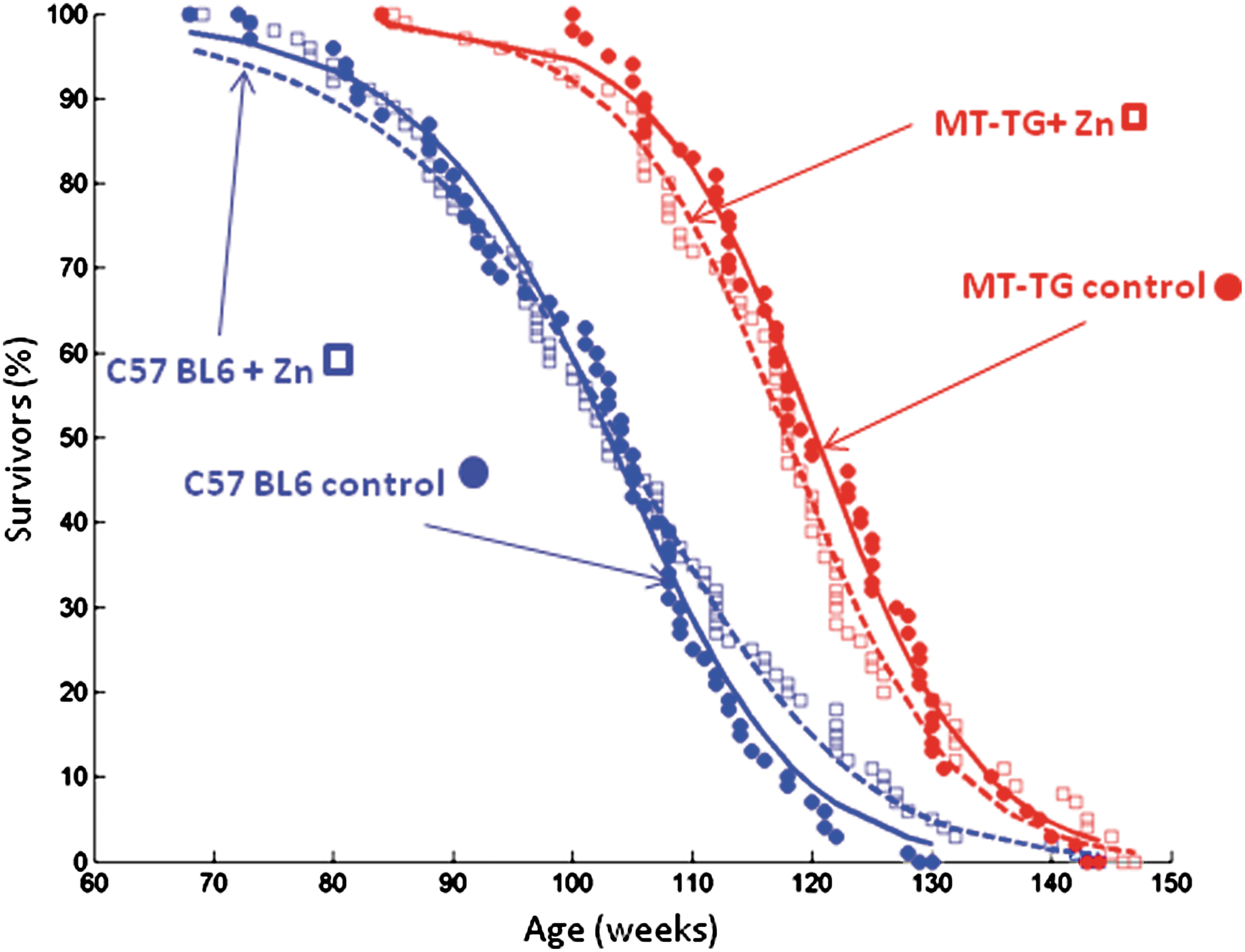
Survival functions fitted by the Piantanelli model of MT-TG and C57BL/6J mice treated with or without zinc (Zn). (Solid blue line with filled circles) C57BL/6J without Zn (ω=0.032216±0.000093, S0=0.374752±0.005956); (dashed blue line with open squares) C57BL/6J supplemented with Zn (ω=0.030875±0.000102, S0=0.428312±0.003599); (solid red line with filled circles) MT-TG without zinc (ω=0.027950±0.000035, S0=0.309806±0.004039); (dashed red line with open squares) MT-TG supplemented with zinc (ω=0.028538±0.000034, S0=0.317393±0.004577). Estimated parameters ω and S0 are reported as mean±standard deviation (SD). (Color image is available online at
Discussion
This preliminary study was aimed mainly at observing the influence of a Zn-enriched environment on the median and maximum life span of normal C57BL/6J and “metal resistant” MT-TG mice. It was expected that the large dose of Zn administered for the whole life span starting from old age could have had a negative impact on life span, especially in the normal C57BL/6J strain. Indeed, it is known that large doses of Zn could display toxic effects, and that mice overexpressing MTs are more resistant to treatment with toxic doses of metals. 17 However, survival analysis by Kaplan–Meier failed to show any significant difference between supplemented and nonsupplemented groups. Conversely, the analysis of survival data with the Piantanelli parametric model suggests that the treatment is able to affect the survival curve of the C57BL/6J mice. The model shows a large difference in the S0 parameter between supplemented and not supplemented C57BL6 mice (≈14%) that deserve some considerations.
The advantage of using a parametric model is the possibility of obtaining a biological meaning from a simple survival analysis. S0 describes the extent of the variability of physiological functions due to combined genetic differences and environmental fluctuations in space and time. The observed differences in S0 suggest that the treatment does not influence all mice in a completely identical way. In other words, the increased S0 suggests that some mice benefit whereas others are negatively influenced by the changed conditions, thus leading to an increased heterogeneity within the population. These changes in S0 were no more evident between supplemented and “not supplemented” MT-TG-mice (≈2.4% difference).
Therefore, it might be hypothesized that Zn treatment might influence the survival of an individual mouse, depending on its ability to produce MT in response to Zn supplementation. Although the mice should be genetically identical, it has been demonstrated that they could display important variation in gene expression that could be attributed to stochastic and microenvironmental factors. 18 These differences could explain the phenotypic consequences of Zn supplementation observed in this study. To confirm this hypothesis, it would be needed to repeat the survival analysis while measuring MTs using noninvasive methods.
The data presented in this form open an interesting perspective in the biological assessment of parameters that are associated with a better or worse response to zinc supplementation in animal models with a potential for translation in humans. This response could be related to the heterogeneous induction of MT in response to Zn treatment that could be different, even among the same strain. 19 Moreover, although the difference in ω was relatively scarce between supplemented and nonsupplemented groups, we observed a large difference (≈13%) between the C57BL/6J and the MT-TG mice strains. These last data are in agreement with the view that improving MT response may be an interesting approach to extended longevity and health span. Om the other hand, the large difference in the median life span observed between the MT-TG strain (839 days for nonsupplemented and 824 for the supplemented mice) and the C57BL/6J strain (710 for the nonsupplemented and 724 for the supplemented mice) is just enough to suggest the relevance of these proteins in counteracting age-associated morbidity and mortality.
It is important to consider that, although all mice were kept in identical conditions, the animals were not kept in a pathogen-free environment. These conditions, although more similar to the human environment, could have affected the survival curves of the laboratory strains, as the median and maximum life span of our C57BL/6J mice were slightly shorter than those reported by others. 20 Therefore, the results presented here on the increased maximum life span of our MT-TG mice compared to normal C57BL/6J should be considered with careful attention. The large increase in median life span of our MT-TG strains compared to the C57BL/6J strain suggests that improving MT production might have an important role to reduce morbidity in old animals. These data confirm the relevance of MT in aging and suggest that further trials using MT gene therapy should be considered for its effect on mortality and morbidity in old animals.
Footnotes
Author Disclosure Statement
The authors do not have financial interests to declare.