







Abstract
Stress is closely linked by its biological mechanisms to inflammation and by its consequences to accelerated aging. Stress triggers a hormonal response along the hypothalamus–pituitary–adrenal (HPA) axis, which can disrupt the ortho/parasympathetic balance essential for a harmonious life. Proper nutrition, adequate physical activity, and limiting the harmful influence of stress play important roles in avoiding the development of disease and promoting healthy aging. d-Limonene, a monoterpene shown to reduce inflammatory parameters in several pre-clinical and clinical models, could also produce an anti-stress action by altering ortho/parasympathetic parameters as well as central neurotransmitter functions. Here we report on a rat model, where a functional observational battery (FOB) was performed by submitting animals to non-pathological stress. d-Limonene or its metabolite perillyl alcohol (POH) were administered per os at a dose of 10 mg/kg. FOB tests were performed 1 hr before gavage and then at 60, 120, and 180 min. These tests confirmed the stressed status of control rats fed vehicle. Conversely, a series of parameters were significantly less disturbed in treated rats, who retained a better activity and displayed less signs of stress. These effects were more pronounced and sustained after ingestion of d-limonene than POH, suggesting the role of endogeneous metabolization of the terpene. These studies show that d-limonene exerts, through its metabolite POH, a significant anti-stress action measurable by behavioral and physiologic parameters under the influence of the nervous system. In addition to its anti-inflammatory effects, a beneficial role as an anti-stress substance could thus be claimed for d-limonene used as a dietary supplement.
Introduction
O
During the course of inflammation, the pro-inflammatory cytokines that are produced by peripheral innate immune cells have an impact on brain functions via neural and humoral pathways. Enhancement of interleukin-6 (IL-6) production induces signs of sickness, including reduction of social exploration, immobility, and body weight loss. 7 Aging, moreover, exacerbates depressive-like behaviors in response to activation of the peripheral innate immune system. 8 In this context, to counteract these dysbalances and restore an efficient ortho/parasympathetic function seems interesting. Nonetheless, it is also known that neurotransmitters of the central nervous system regulate acute and chronic stress, and major mood-modulating drugs used to lower anxiety and depression act at this central level. For instance, they inhibit serotonin recapture at the level of brain synapses. In response to stress, the hypothalamus is able to produce, among others, consistent amounts of dopamine, 9 noradrenaline, and serotonin, which influence the modulation of motor and psychic outcomes.
Until now, it has been clear that neurotransmitter status in the brain as well as certain brain functions/actions (such as appetite, sleep, memory/learning, and emotion) are modified by different nutrients, food components, nutrition conditions, 10 as well as increased stress. 11 In turn, it can be assumed that neurotransmitters participate in inducing the stress defense. Compounds derived from natural substances, mostly edible plants, have been known for centuries as “unusual food,” in that they are not expected to be consumed for energy purposes, but rather to prevent or treat infections, inflammation, and mood disorders. 12 These compounds have recently acquired a new status of “alicaments,” interesting pharmacological candidates for the development of novel drugs preventing, maintaining, and/or curing many body disabilities, the latter being potentially induced or precipitated by stressful events. 13 –15 When added to diet, these natural compounds can act on the autonomic and/or central nervous systems and help to maintain or restore their function. Plants such as valerian, skullcap, and hops have been recognized to activate vagal tone and bring the sympathetic/parasympathetic systems to a balanced alternation. A compound extracted from orange peel, d-limonene, could have an even greater potential, because it has been shown that its metabolite perillyl alcohol ([POH] or perillic acid) induces a peak of dopamine at 4 hr in the hypothalamus after administration of d-limonene. 11
Materials and Methods
Drugs
d-Limonene (C10H16,) of 97% purity and POH ([S]-4-isopropenyl-1-cyclohexenylmethanol; [S]-p-Mentha-1,8-dien-7-ol) of 98% purity were purchased from Sigma-Aldrich (Saint-Quentin Fallavier, France) and prepared each day as a fresh solution by dissolving in corn oil (Olvea, Saint Léonard, France) as vehicle. Stock solutions were 4 mg/mL.
Animal model
Eighteen Wistar HsdBrlHan female rats (175–200 grams) were obtained from EOPS (Harlan Breeding Centre, Gannat, France). At reception, the rats were labeled and maintained in the standardized conditions of an animal house with 22±2°C temperature and 50±10% hygrometry. Food and water were provided ad libitum. The animal house had an inverted light/dark cycle of 12 hr with lights on from 21:00 to 09:00. Rats were allowed a 1-week adaptation period to the laboratory conditions. For the tests, rats were fed with vehicle (corn oil), or 10 mg/kg (2.5 mL/kg) of d-limonene or POH in vehicle, thus composing three groups of six rats.
Functional observational battery
To evaluate the potential properties of d-limonene on stress, a series of tests was proposed to rats in standardized conditions. The battery of functional tests observed was dubbed the functional observational battery (FOB), 16,17 which was used previously to assess functional deficits in rats exposed to chemicals or to quantify neurotoxic effects.
All animals were observed carefully by a trained technician who was blinded with respect to the animals' treatment; the same observer was used to evaluate the animals throughout the experiment. All animals were observed 60 min prior to and 60, 120, and 180 min after oral administration of test substances. They were removed from the home cage and placed in a standard arena for observation in a specific red-lit room dedicated to the experiment. Efforts were made to ensure minimal variations in sound level, temperature, humidity, lighting, odors, time of day, and environmental distractions. Rats of the different groups were all handled in the same way and under the same conditions and were tested during the first hours of their daily active phase.
Around 40 parameters were measured in about 7 min for each passage of each rat in the experimental devices. Spontaneous locomotor activity and emotional state (anxiety) were measured by observing de-ambulation in an open arm or an open field. Balance was assessed using devices in which the rat was placed head down. Vision and motor coordination were tested through grip and suspension as the rat was approached and then placed on an anti-gravity device. Audition was evaluated by producing a rattling sound near the ears. Approach and contact were measured by nearing a stylus for tactile stimulation without or with touching, respectively. Pinching allowed appreciation of pain perception, i.e., proprioception. A flashlight was used for visual testing. Temperature changes were measured with a digital thermometer. The parameters recorded were spontaneous locomotor activity, body position, movement coordination, head-flicking, head-searching, circling, freezing, backward walking, irritability, tremors, vocalization, lacrimation, salivation, piloerection, pupillary reflex, palpebral reflex, position of the tail, pelvic elevation, and muscle tone of the limbs and abdomen. In the inversion and anti-gravity response tests, forelimb/hind limb grip strength was measured. Upon stimulation, the toe and tail pinch reflexes, visual placing response, and startle response (Preyer reflex) were evaluated. Miction, defecation and consistency of feces, body temperature, and heart and breathing rates were also measured in all conditions.
Classification of studied variables
The variables measured can be categorized according to the functions assessed.
• Behavioral effects: Spontaneous locomotive activity, locomotive behavior troubles, anxiety, touch response, irritability, aggression, freezing, somnolence, number of defecations, number of mictions, sensor-motor responses (toe pinch and sound response).
• Neurological effects: Pupillary reflex, palpebral closure, pelvic elevation, tail position, limb and abdominal tones, reversal test, grip test, tremors, and piloerection.
• Physiological effects: Salivation, lacrimation, diarrhea, body temperature, respiratory rhythm.
Statistical analyses
The variables measured were scored on adapted scales for each parameter. Statistical analyses were carried out using the Statview 5 statistical package (SAS, Institute Inc., USA) and MedCalc Software (Mariakerke, Belgium). Non-parametric tests applied were one-way analysis of variance (ANOVA) with Kruskal–Wallis test followed, when significant, by the Mann–Whitney U-test to compare the different study variables. For all comparisons, differences were considered to be significant at the level of p<0.05.
Results
Data collected during the observation or manipulation of the rats before and after gavage were compared between the control group and treated animals at each time point. The evolution of these parameters over time in each group was also considered. Of note, at baseline, the three groups of animals had strictly similar FOB results.
Comparison of the treated groups with the vehicle group
Because only mild stress was applied (manipulation, postural adaptation, acoustic and visual stimulation), no significant variation of neurological parameters was observed. However, significant differences were observed for a series of behavioral and physiological effects.
Table 1 summarizes these significant variations, which varied depending on the time of testing. At 60 min, the most important difference was observed for irritability, which was significantly less after ingestion of either d-limonene or POH. Similarly, treated rats produced less vocalization and reacted less to toe pinch but showed more interest for objects than rats fed corn oil only. At 120 min, the positive effect of d-limonene was retained for irritability, vocalization, and interest for objects. Additional significant effects were less fear reaction to approach with both compounds and less startles upon rattling when fed d-limonene. Significantly less vocalization and more interest for objects was still observed for d-limonene–fed rats at 180 min who also displayed less startles. These rats also performed significantly better in balance tests and crossed more cases (i.e., were more active) than rats who received either vehicle or POH. At 180 min, although both POH- and d-limonene–fed rats showed a decrease in temperature over the entire experiment, this drop became significant only for the latter. Of note, none of these variations remained significant for POH-fed rats at 180 min.
df, degrees of freedom; DL, d-Limonene; PA, perillyl alcohol; V, vehicle; NS, not significant.
Evolution over time compared to baseline
Performance comparison over time confirmed that significant stress was applied to the animals, as demonstrated by the evolution of parameters in vehicle-fed rats (Fig. 1). The latter displayed significantly decreased spontaneous activity and interest for objects, and consistently more time in freezing (i.e., fear) than treated rats. Little significant evolution was seen over time for rats receiving POH (only an increase in cases crossed), and any effect, which usually paralleled that seen in rats having received d-limonene, appeared to be transient.
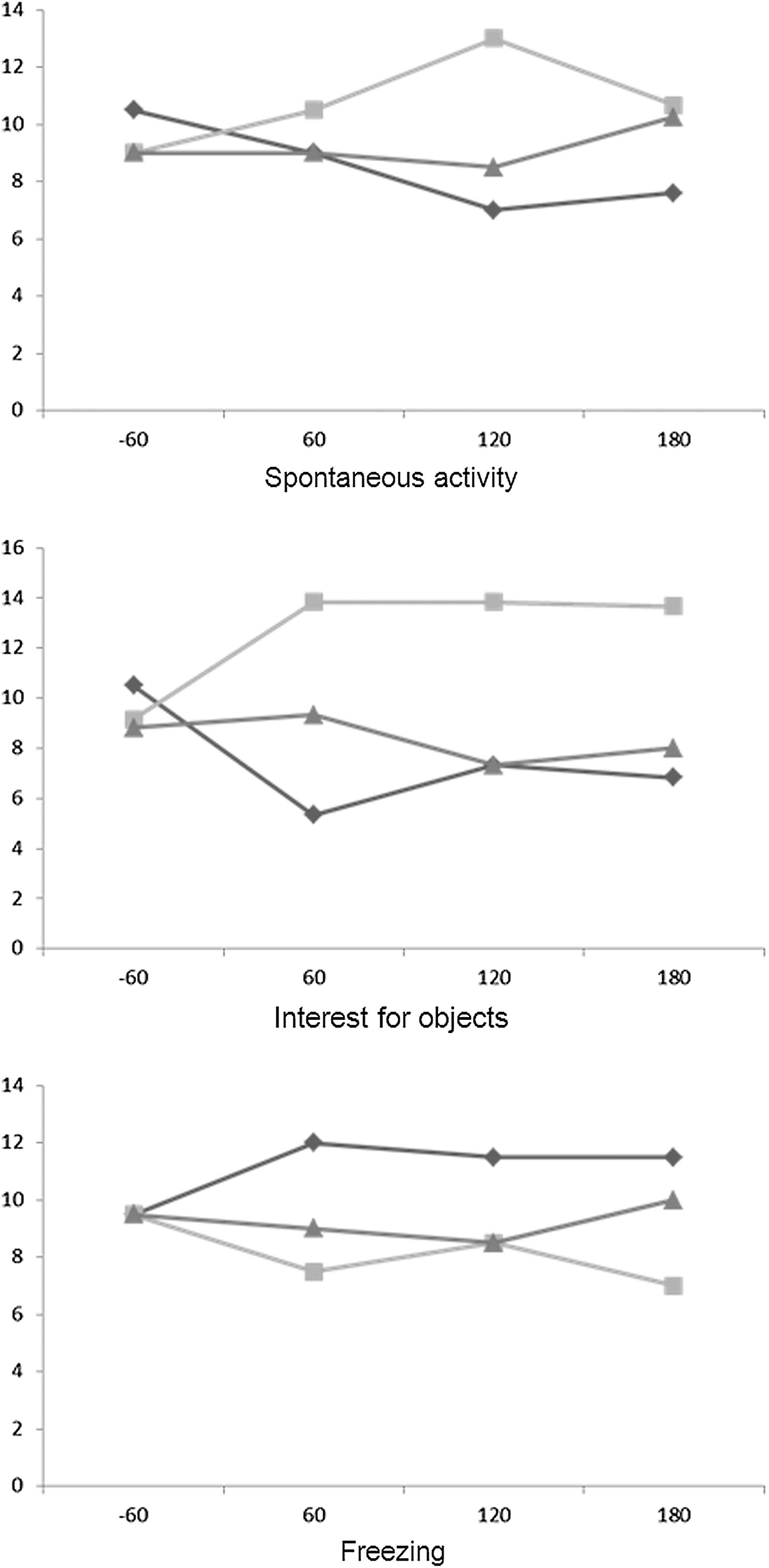
Evolution over time and comparison to the baseline value (−60 min) of three parameters demonstrating the stress imposed on animals fed only corn oil (vehicle, black line with diamonds), and the better behavior of animals who had received POH (dark grey line with triangles) or d-limonene (light grey line with squares). Data are expressed as average ranks of the Kruskal–Wallis test.
Conversely, a large number of parameters differed significantly from baseline in rats fed d-limonene. At variance with control rats for which these parameters remained stable, d-limonene–fed rats showed significantly decreasing reaction to approach, toe pinch, or tail pinch, became less and less startled or irritable, and almost stopped vocalizing. They also significantly dropped their body temperature while retaining or even improving their ability to keep balance. Examples of these evolutions are shown in Fig. 2.
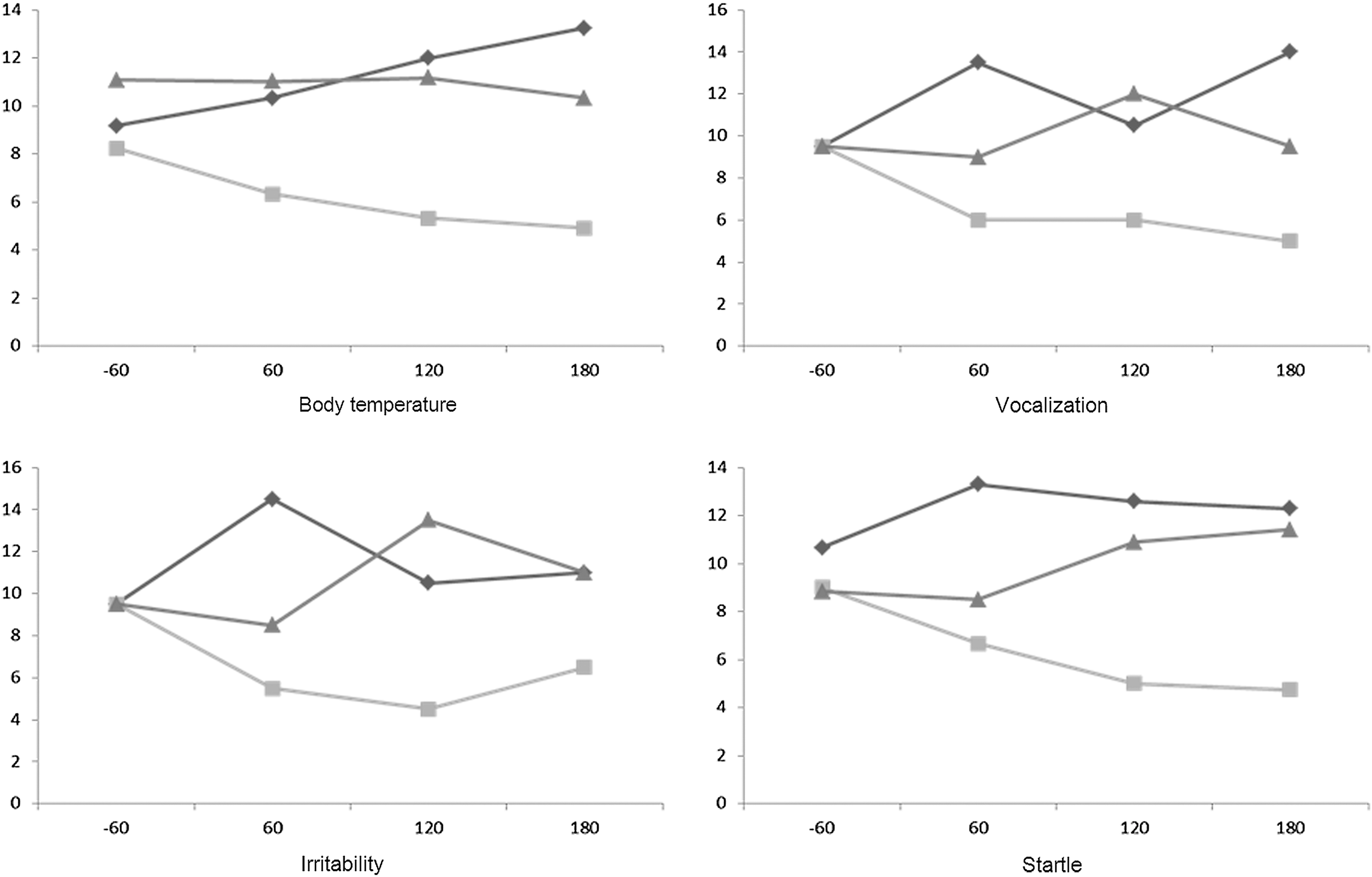
Improved parameters compared to the baseline value (−60 min) and to animals fed only corn oil (vehicle, black line with diamonds), and in rats fed POH (dark grey line with triangles) or d-limonene (light grey line with squares). Data are expressed as average ranks of the Kruskal–Wallis test.
Discussion
The studies reported here, performed by administering d-limonene or POH to rats submitted to non-pathologic mild stress conditions, complete a previous report on the same experiment. 13 As published in 2008, substantial changes in movement parameters as well as motivational aspects revealed the influential effect of d-limonene and POH on the emotional aspects of stress.
This complementary study shows further data regarding physiologic and behavioral changes induced by the oral administration of d-limonene acting on the ortho-parasympathetic system. The capacity of d-limonene to reverse stress consists of a decrease in startles or aggressions. Individual susceptibility toward aggressiveness may thus be a matter of stress, because startles and elevated body temperature are signs of incoming depression, 18 Indeed, in the Ristomed trial 14,15 (performed on healthy 65–85-year-old subjects with high inflammatory scores who benefited from orange peel extract (OPE) supplementation containing a high amount of d-limonene), a significant decrease of peripheral IL-6 levels was observed, associated with a statistically significant effect on depressive mood. 14,15 The pronounced anti-stress effects of d-limonene in an animal model, as well as of the OPE dietary supplement in humans, suggests that this compound could be worthwhile in multi-modal anti-stress therapy concepts. 19
Several natural compounds may have an effect on stress and thereby condition the functional status of many organs. 20 Plants have traditionally been used to manage stress. The rationale of using buckwheat flowers as an herbal medicine is related to its content in vitamin B1, magnesium, and phosphorus. Passionflower has relaxing and sedative properties that could cure not only stress but also insomnia. 21 Finally, hawthorn, a bush that produces white flowers and red fruit, is used for its calming and sedative properties, without causing drowsiness. 22
Here we have presented new evidence of the boosting effect of d-limonene and POH, contained in OPE, as anti-stress agents. Interestingly, although they showed the same trend, the effects of POH were less significant than those of d-limonene. 23 The latter even appeared delayed or persistent over the 3 hr of observation and manipulation of the rats. This suggests that endogeneous metabolization of d-limonene was responsible for the release of its active metabolite POH over the length of the experiment. This is consistent with reports from Yokogoshi 11 demonstrating the ability of POH to induce the release of dopamine and control stress.
Footnotes
Acknowledgment
This study was funded by a grant from the French Ministry of Research to Pr. Patrizia A. d'Alessio, the “Award for Innovative Research,” 2005.
Author Disclosure Statement
No competing financial interests exist.