







Abstract
Sustainability has historically considered the natural world in terms of instrumental value (protecting nature for humanity’s benefit) and intrinsic value (protecting nature for nature’s sake), without consideration of the other ways values are expressed and experienced. This instrumental-intrinsic dichotomy does not acknowledge the intuitive, familial, and spiritual relationships that exist between peoples and the natural world. Recognition of a third set of values—relational values—reflects the relationships between humans and nature and offers a complimentary approach to sustainability education. This semi-systematic literature review synthesizes and contextualizes the nascent construct of relational values to better understand how they can be articulated, applied, and ultimately assessed.
Introduction
Sustainability education’s anthropocentric narrative has historically considered the natural world in terms of instrumental value (protecting nature for humanity’s benefit) and intrinsic value (protecting nature for nature’s sake). The instrumental-intrinsic dichotomy does not acknowledge the intuitive and spiritual relationships that exist between peoples and the natural world (Haidt, 2007; Kahneman, 2011; Raymond et al., 2013). In sustainability scholarship, consideration of a third class of values—relational values (RVs)—is gaining momentum. This third value system acknowledges relational approaches to knowing (epistemology), being (ontology), and doing (ethics) (Walsh et al., 2020) and emphasizes the interdependence of humans and nature (Chan et al., 2016; Himes and Muraca, 2018; Lange, 2018; Walsh et al., 2020). RVs offer a complimentary approach to sustainability education, as they can be important “deep” leverage points for transformative change and provide additional dimensions needed for a commitment to sustainability (Bieling et al., 2020; Horcea-Milcu, 2022).
Background
The publication of the Global Assessment on Biodiversity and Ecosystem Services (2019) formally introduced relational values (RVs) as a broader subset to the “cultural values” section of the millennium ecosystem assessment (MEA). The prior iteration of the value framework had proved insufficient for assessment purposes because cultural values were difficult to define and challenging to conceptualize and quantify (Kenter et al., 2015; Kenter et al., 2011). The 2019 report defines relational values as “desirable, meaningful, and often reciprocal relationships—beyond means to an end—between humans and nature, and among humans (including across generations) through nature (e.g., sense of place, spirituality, responsibility, care, reciprocity, stewardship)” (IPBES, 2019, section 2.2.4.3). This inclusion in the IPBES report mandate marks a significant cognitive and ethical shift. Historically, the ecosystem services framework has commodified and monetized the environment by emphasizing nature’s instrumental value to humans (Hejnowicz and Rudd, 2017). The addition of RVs in the framework is “more inclusive of the social, cultural, and moral dimensions of sustainability” (Frandy, 2018) and an important step toward decolonizing sustainability’s predominant hegemonic narrative.
Why Relational Values?
RVs are likely as old as the evolution of humanity and describe what may be considered the ‘original’ sustainability ethos (Washington, 2015; Washington et al., 2017), the holistic ontological worldview of diverse cultures across the planet (Knudtson and Suzuki, 1992). Many Indigenous peoples engage in knowledge production practices that emphasize more-than-human relational ontologies (Panelli, 2010; Todd, 2016), center community and reciprocity between humans and nonhumans, and value environmental sustainability (Berkes, 2008; Berkes et al., 2000; Gadgil et al., 1993; Graham and Maloney, 2019; Posey, 1999; Rappaport, 1999). These worldviews often express and promote relational values such as kinship toward living and nonliving entities (Curry, 2011; Kimmerer, 2013; Posey, 1999; Suzuki and Knudtson, 1992; Vetlesen, 2019; Washington, 2019). The Indigenous Latin American relational ontology of buen vivir, simply translated as “good living,” is one example. Buen vivir recognizes the interdependence between society and the environment and considers the idea of community not limited to people but encompassing the natural world as well (Kothari et al., 2014; Thompson, 2018). Similarly, the Nguni Bantu term ubuntu describes the social, environmental, and spiritual relationship integral to many traditional African worldviews (Mugumbate and Chereni, 2020; Murove 2014; Murove 2009; Tutu, 1999). Unlike colonialist Western epistemologies, there is no dichotomy of human and more-than-human in many Indigenous ways of knowing. “Everything in nature, including humans, enjoys equal status,” (Aikenhead and Michell, 2011, p. 78).
In modern Western philosophy, relationality is expressed in Aldo Leopold’s “land ethic” (Belshaw, 2014; Leopold, 1949) and his assertion that “the economic parts of the biotic clock will [not] function without the uneconomic parts” (Leopold, 1949, p. 214). Like Arne Naess’ deep ecology that recognizes the many diverse human and more-than-human communities that make up the living Earth (Naess, 1973; Smith, 2014), RVs are considered “an ecologically informed philosophy of internal relatedness,” in which all organisms are not simply interrelated with the environment but also constituted by those very environmental interrelationships (Eckersley, 1992, p. 49).
Muraca (2011) first introduced the term relational values to the philosophical literature. In 2016, Chan et al. helped to situate the philosophical underpinnings of RVs within sustainability science and conservation research and further defined the construct in environmental valuation to include relationships between people and nature. In 2018, Chan et al. situated RVs among other value constructs, which was pivotal, given the varying definitions and uses of the term value in sustainability science (for example, Rohan, 2000; Tadaki et al., 2017). Himes and Muraca (2018) expressed the importance of RVs’ plural valuation or recognition of the diverse values of nature articulated by various stakeholders (Zafra-Calvo et al., 2017). Mattijssen et al. (2020) built on the assertion of Chan et al. (2018; 2016) that RVs are further defined by their reciprocal nature.
While Muraca first articulated them as such, it is important to note that RVs have existed in the literature prior to Muraca’s (2011) writing. The framing of RVs builds upon decades of studies on topics such as sense of place (Brehm et al., 2013; Trentelman, 2009), human–nature connection (Dutcher et al., 2007; Mayer and Frantz, 2004; Nisbet et al., 2009), and experiential relations to nature (Keniger et al., 2013; Soga and Gaston, 2016). Indigenous knowledge (Berkes, 1993; Bradley et al., 1999; Schultz, 2002; Schultz, 2001) and concepts of humanity’s place in nature (Raymond et al., 2013; van den Born, 2008) are also foundational to the construct of relational values.
There is growing recognition that values can be important “deep” leverage points for transformative change and that questioning human domination over nature is a pedagogical imperative (Bonnett, 2002; Horcea-Milcu, 2022; Smith and Stevenson, 2017). The 2022 adoption of the Kunming-Montreal Global Biodiversity Framework and its inclusion of “Different value systems” (in part a response to the 2019 IPBES report) is helping to transcend the dichotomous value perspective that has guided much environmental management and sustainability work. From the new Framework:
Nature embodies different concepts for different people, including biodiversity, ecosystems, Mother Earth, and systems of life. Nature’s contributions to people also embody different concepts, such as ecosystem goods and services and nature’s gifts. Both nature and nature’s contributions to people are vital for human existence and good quality of life, including human well-being, living in harmony with nature, living well in balance, and harmony with Mother Earth. The framework recognizes and considers these diverse value systems and concepts, including for those countries that recognize them, rights of nature, and rights of Mother Earth, as being an integral part of its successful implementation (UN Environment Programme, 2022, section C.9.).
As scholars attempt to understand complex phenomena in terms of relations (Walsh et al., 2020), relational values in sustainability education remain somewhat marginalized (Lange, 2018; Mcphie and Clarke, 2019; Netherwood et al., 2006; O’Neil, 2018; Taylor and Pacini-Ketchabaw, 2019; Williams, 2013). Integrating RVs into sustainability education challenges the Western fixed meaning of what it means to be in relationship with the world. By recognizing that humans and nature are part of one living socioecological system and co-creators with the more-than-human world, RVs articulate and normalize the spirituality and experiences that connect people, land, the living and nonliving, those before us, and those still to come (Abram, 2010; Datta, 2015; Walsh et al., 2020).
The goal of this review is to synthesize and contextualize the nascent construct of relational values to better understand how RVs can be articulated, applied, and ultimately assessed within the field of postsecondary sustainability education. This semi-systematic literature review (SSLR) uses a narrative approach to develop a more structured understanding of relational values across multiple disciplines, systems, and research traditions and to identify any gaps in the research (Snyder, 2019).
To guide interpretation of the literature, the following set of questions are addressed (Table 2):
What are the attributes of Relational Values (RVs)? How do RVs differ from other value orientations? How are RVs contextualized in various disciplines and systems?
Definition of Terms
For this study, the following key terms will be used as defined: (Table 1)
Definition of Terms
Comparison of Instrumental, Intrinsic, and Relational Values
Methodology
The methodology is informed by the four domains of a methodology as conceptualized by Greene (2006) and articulated by Onwuegbuzie and Frels (2016), in which methodology is described as a pathway to knowledge (p. 51) made up of four distinct domains: philosophical assumptions, inquiry logics, guidelines for research practice, and sociopolitical commitments (Greene, 2008; Greene, 2006). While the domains are not always explicitly identified, they are implicit in their use as a framework for organizing and framing this section.
Positionality
As a settler academic, I approach this research from a particular perspective and recognize that the frameworks through which I select and analyze data are subjective, influenced not only by my experiences but by my own assumptions and biases. I have always felt a deep and profound connection to the natural world and as the escalating climate crisis exacerbates the disparities created by enduring colonial injustices and its structures of dominance over nature, it has become my primary goal as an educator to teach others how to be in relationship with the Earth and live in kinship with all beings, be they human or more-than-human. I live and work on unceded Wabanaki territory in what is known as Maine, USA, and I recognize that both my identity and my education are products of colonial processes and the subsequent sociocultural hierarchies they reinforce. I also recognize that decolonization must be led by Indigenous peoples, but I believe settler allies have important roles to play in this process. “Decolonization is a process for both the colonizer and the colonized” (Waziyatawin, 2011). Decolonizing sustainability education calls for many voices and I choose to use my voice to change the dominant hegemonic narrative that excludes non-Western and more-than-human epistemologies and ontologies and call for a transformational SE curriculum “that is more inclusive of the social, cultural, and moral dimensions of sustainability” (Frandy, 2018).
Philosophical Assumptions
According to Onwuegbuzie and Frels (2016), philosophical assumptions direct the inquirer’s gaze to look at specific things in specific ways and offer “appropriate philosophical and theoretical justification for seeing, observing, and interpreting” (Greene, 2006, p. 93). This research is guided by both my philosophical approach and the assxumptions that define my methodological frameworks. My epistemology is trans-systemic and transdisciplinary, a reflection of my holistic perspective and understanding that there are many forms of knowing and many ways of being in the world (Datta, 2015; Drouin-Gagné, 2021; Jukier, 2018; Jukier, 2005). My ontology reflects a “kincentric ecology” (Jacobs and Narváez, 2022; Knudtson and Suzuki, 1992; Salmón, 2000) in which humanity is in relationship with those both living and nonliving (Arrows, 2016; Hettinger and Throop, 1999). While this can be described as ecocentric (Curry, 2011; Kimmerer, 2013; Posey, 1999; Suzuki and Knudtson, 1992; Vetlesen, 2019; Washington, 2019), I choose the term ecocentric constructivism to explain my philosophical approach, which extends “… borders beyond all forms of life to populations and species and from life itself to habitats and ecosystems” (Have and Patrão Neves, 2021) and acknowledges that contradictory but equally valid accounts of the same phenomenon, multiple systems, and multiple realities can coexist (Jukier, 2005; Onwuegbuzie and Frels, 2016).
Theoretical Frameworks
Broad examination of the literature is performed using a relational theory framework. As defined, this framework supports analysis “wherein the primary focus is on the relationships between an individual (or group) and other individuals (or groups) in a socio-ecosystem, and the system is understood not so much as a collection of objects but a web of relationships. These relationships, moreover, are heterogeneous, connecting human and nonhuman, animate as well as inanimate, things” (Lejano, 2019, p. 2760). Relational theory describes humans and more-than-humans as interconnected and interdependent (Datta, 2015; Ingold, 2011) and considers humans and nature as part of one living system—interconnected, complex, and interdependent—an adaptive socioecological system in a constant state of flux (Walsh et al., 2020). Relational theory challenges the Western fixed meaning of what it means to be in relationship with the world and acknowledges the spirituality and experiences that connect people, land, the living and more-than-living, those before us, and those still to come (Datta, 2015). It counters the hegemonic concept of “otherness” (Said, 1993) and deconstructs the anthropocentric Cartesian schism (Capra and Luisi, 2014) that dominates modern dualistic thinking (Datta, 2015).
A trans-systemic framework is also utilized to review the literature. This approach allows for diverse perspectives to emerge and acknowledges that “there is more than one structure of reality” (Jukier, 2005, p. 795). It is my hope that, using a trans-systemic approach, a broader understanding of epistemologies, ontologies, and axiologies in multiple coexisting systems will invite opportunity for greater insights (Jukier, 2018) and may serve to expand definitions and evaluations of relational values.
Analysis
The first question is addressed by defining the term values, then reviewing and synthesizing the attributes associated with relational values in the literature, using relational theory and trans-systemic frameworks. A review of existing RV literature addresses the second question, and an analysis for relational values in cultural and socioenvironmental systems and disciplines addresses the third.
What Are the Attributes of Relational Values?
Values in general vary widely in both characterization and context and are difficult to describe, much less assess (Vakil, 2021). Because they tend to reflect historical and cultural characteristics and are products of both individual and collective experience (Trommsdorff, 2010), value assessment presents methodological challenges. From a psychological perspective, values are deeply held, cognitive elements that deal with preferred states (Jones et al., 2016). They represent stable moral guidelines and are considered “more fundamental, and salient and influential, normatively, emotionally and motivationally than preferences or attitudes” (Reser and Bentrupperbäumer, 2005, p. 141). Schwartz (1994), building upon the work of Rokeach (1973), defines values as beliefs “pertaining to desirable end states or modes of conduct that transcend specific situations, guides selection or evaluation of behavior, people, and events, and [are] ordered by importance relative to other values to form a system of value priorities” (p. 20).
Relational values include social norms associated with eudemonic values, such as the concepts of reciprocity, care, and well-being, as well as the construct of living a good life (Tobin, 2022), and emphasize humanity’s relationship with those both living and more-than-living (Arrows, 2016; Hettinger and Throop, 1999). They describe the multiplex qualities of relationships between humans and nature, are rooted in the relationships themselves (Mattijssen et al., 2020), and reflect a “kincentric ecology” (Jacobs and Narváez, 2022; Salmón, 2000) in which “all living beings cooperate and co-create” (Moran et al., 2018, p. 73). This practice of experiencing the natural world as family emphasizes values that counter the pervasive anthropocentric narrative (Bang et al., 2014). Rather than viewing humans as separate and, in many cases, superior to nature, there is no separation, no human dominance over nature (Washington et al., 2017). All beings are interconnected with each other and to the natural world. “Land is, therefore we are” (Bang et al., 2014, p. 45).
How Do RVs Differ from Other Value Orientations?
As the study of RVs is a nascent field, I look primarily to the research of Chan et al. (2016), Himes and Muraca (2018), Muraca (2011, 2016), and Mattijssen et al. (2020) as leaders in current RV scholarship to address this second question. RVs differ from instrumental and intrinsic values in three distinct ways. First, they emphasize the inherent interconnected qualities that exist in relationships (Mattijssen et al., 2020). For example, the value of a relationship between a person and a beloved pet is not found in either the person or the pet, but in the actual connection between the two. RVs describe humans and more-than-humans not as separate entities, but as interdependent relationships (Knippenberg et al., 2018). Relational values acknowledge the qualities of the relationships themselves (Chan et al., 2016).
Second, RVs are nonsubstitutable (Himes and Muraca, 2018). In the same way a beloved family member cannot simply be replaced by another person with similar qualities, so too are treasured rivers, trees, or birds not easily replaced by rivers, trees, or birds with similar characteristics. “People bond with a specific forest landscape, not with ‘forests’ as a general abstraction” (Mattijssen et al., 2020, p. 403). Because it is the relationship itself that is valued, RVs challenge common biodiversity offsetting practices that merely compensate for the economic (or instrumental) values of nature of biodiversity impacts (Bull et al., 2013).
Third, while the intrinsic value of nature is inherent, and the instrumental value of nature is transactional, relational values describe relationships that are reciprocal. They recognize that humans and nature shape and influence each other through their fundamental mutuality (Mattijssen et al., 2020). Reciprocity is the action of understanding the value of connection and interdependence and is emphasized by activists, scientists, and Indigenous communities all over the world in recognition of the inherent dignity and moral standing of both human and natural systems (Diver et al., 2019; Gould et al., 2019; Skubel et al., 2019).
How Are Relational Values Contextualized in Various Systems and Disciplines?
Relationality and related constructs are found in many cultural and socioenvironmental systems and expressed in and between multiple disciplines (Fig. 1).
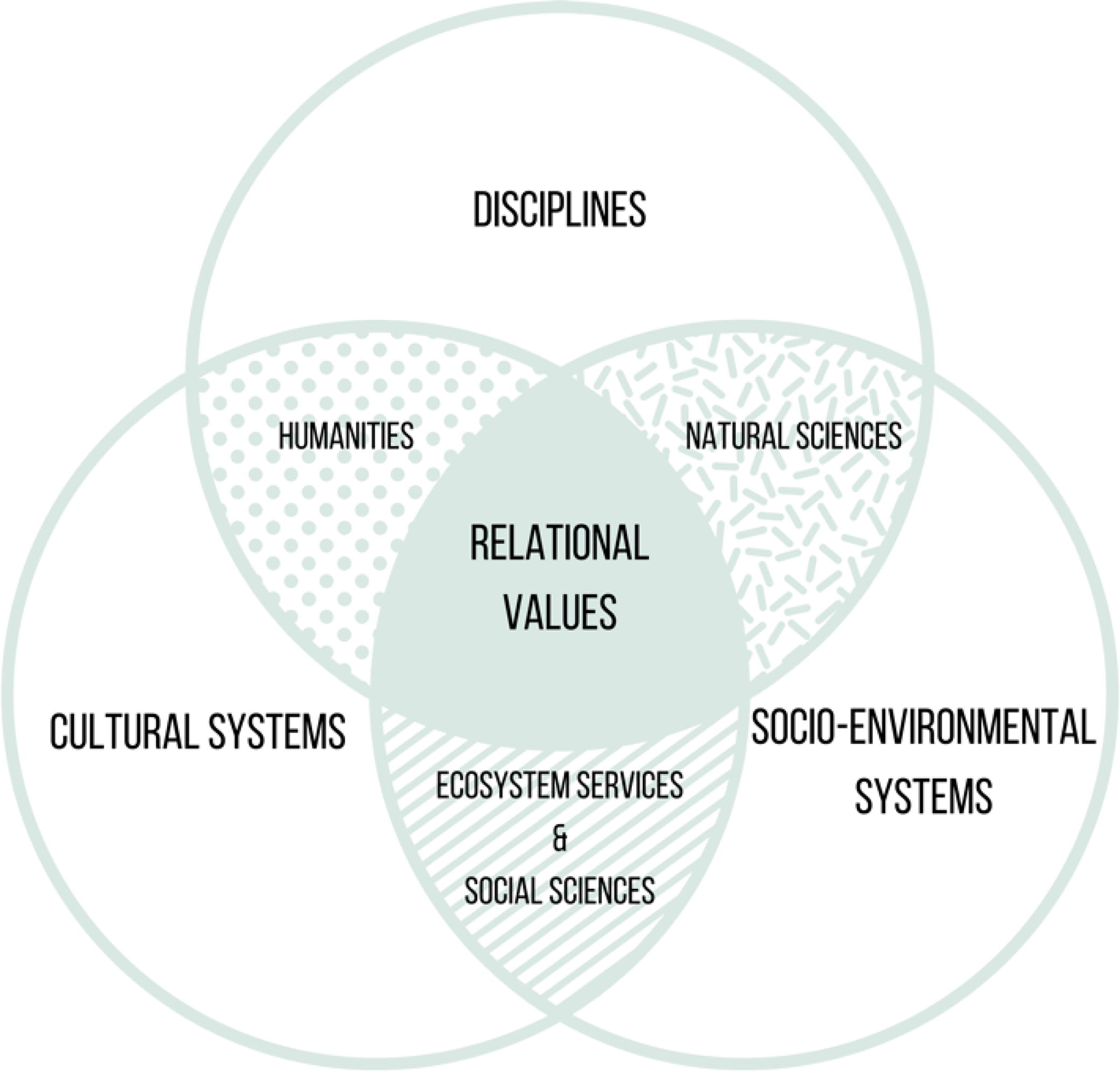
Relational values are expressed in cultural and socio-environmental systems, as well as within and between many disciplines and fields
Relational Values in Cultural Systems
RVs are intimated in many cultural systems, including Indigenous/traditional knowledge and religious and spiritual traditions, and are often expressed as interdependence. In South America, buen vivir is an Indigenous cosmovision that emphasizes harmony and considers the idea of community not limited to people, but encompassing the natural world as well (Thompson, 2018, pp. 973–974). Literally translated as “living well” (Godden, 2021, p. 344), buen vivir is an amalgam of Indigenous wisdom and spirituality with a focus on the interdependent well-being of people and nature that holistically encompasses both (pp. 344–345). This reflects the worldview of many Indigenous peoples, a holistic ontology in which the whole person is seen as interconnected to land and in relationship to others (Arrows, 2016, pp. 262–263). Similarly, the traditional African collection of values and practices known as ubuntu emphasizes interconnectedness and belonging to a greater whole (Murove 2009, 2014; Tutu, 1999), valuing the ecological health of the community, as well as the individual (van der Walt, 2010; Wang, 2013).
In North America, Blackfoot descendent Little Bear describes life’s organizational structure as “a ‘spider web’ of relations” (Little Bear, 2000, p. 79). Papaschase Cree descendant Donald writes that North American Indigenous peoples “recognize the land as relative and citizen” (Donald, 2009, p. 19). This practice of experiencing land as family is a relational view that moves beyond an anthropocentric perspective of nature to incorporate all natural beings into an interdependent system (Bang et al., 2014, p. 55). It reflects a “kincentric ecology” (Jacobs and Narváez, 2022; Salmón, 2000) in which “all living beings cooperate and co-create” (Moran et al., 2018, p. 73).
Many religious and spiritual traditions articulate interdependence as a moral system or value, including Unitarian Universalism’s 7th Principle, respect for the interdependent web of all life (Brandenburg et al., 2020) and Jainism’s scriptural aphorism Parasparopragraho jivinam—all life is bound together by mutual support and interdependence (Fergusson et al., 2018, p. 1628). One of the primary tenets in Buddhist tradition is interdependence, which is expressed as a relational system that emphasizes a deconstruction of boundaries in which nothing exists independently (Nagarjuna, 1995). Buddhism teaches that the universe can be viewed as a network of jewels that form an interconnected web, each jewel simultaneously reflecting the web as if containing another web-like universe within itself—an infinite number of interdependent webs/universes without boundaries (Der-lan Yeh, 2006). In One City: A Declaration of Interdependence, Nichtern (2007) writes that there are five levels of interdependence: interdependence of self; interdependence in relationships; interdependence in communities; global or societal interdependence; universal interdependence, and all levels constantly affect each other (pp. 29–30). He suggests that an understanding of our interdependence pushes us to “deeply examine, critique, and transform the complexes of confusion and suffering that exist” (p. 51) between our cultural and natural systems.
The Catholic Church recognizes interdependence as a call to action. In Laudato Si’: On Care for our Common Home (2015), Pope Francis (2015) entreats us to “promote a new way of thinking about human beings, life, society, and our relationship with nature” (para. 215) and urges a more interdependent world view (para. 164). Rockefeller, chair of the Earth Charter International Drafting Committee, writes that Pope Francis’ theological vision is inspired by a profound understanding of the value and interdependence of all beings. “Laudato Si’ … recognize(s) that there is an ethical and spiritual dimension to the world’s social and environmental crises that must be addressed, if the human family is to find its way to a just and sustainable future” (Rockefeller, 2017, p. 32). This understanding of interdependence is explicit in Catholic teachings: “God wills the interdependence of creatures. The sun and the moon, the cedar and the little flower, the eagle and the sparrow: the spectacle of their countless diversities and inequalities tells us that no creature is self-sufficient. Creatures exist only in dependence on each other, to complete each other, in the service of each other” (Catechism of the Catholic Church, 340).
Relational Values in Socio-Environmental Systems
Relational values in sustainability were first articulated by Brown in 1984. An environmental scientist and resources allocation specialist, he described them as values that emerge from the relationship between one subject and another, and can be tangible (another person, animal, or place) or intangible (a thought, belief, or feeling) (Brown, 1984). Brown argued that values are related to preferences and are experienced at the feeling level and posited a linear relationship between instrumental, intrinsic, and relational values, suggesting that intrinsic values influence relational values, which result in a behavioral expression of instrumental values (Jones et al., 2016). Schroeder (2013) built upon Brown’s work to further explore relational values but rejected Brown’s linear conceptualization and instead emphasized feeling. Schroeder proposed these felt values as “the immediate, subjective feeling of importance, worth, or significance that something has for an individual” (Schroeder, 2013, p. 77) and asserted that felt values could both shape and be shaped by intrinsic and instrumental values. Barkley and Kruger (2013) acknowledged felt values as well, describing them as a reflection of an “internal, personal understanding of lived experience” (p. 93).
Social ecologist Kellert developed a typology of first nine, then later ten values to describe relationships between people and nature: aesthetic, dominionistic, ecologistic-scientific, humanistic, moralistic, naturalistic, negativistic, spiritual, symbolic, and utilitarian (Kellert, 2012; Kellert, 1996). A pioneer in the study of relational values (Ross et al, 2018), his groundbreaking research explains how and why we value nature (Muraca, 2016) by considering the importance attributed to meaningful relationships and responsibilities between humans and nature (Arias-Arevalo et al., 2017). Kellert is probably best known for his development of the biophilia hypothesis with Edward O. Wilson (Kellert and Wilson, 1993), which suggests that humans possess an innate tendency to seek connections with nature and more-than-human forms of life. Kellert asserts that these innate and beneficial connections have evolved through living, surviving, and learning in natural environments, which means humans are dependent upon nature, rather than responsible for it (Ross et al., 2018). In explaining humanity’s propensity to assume responsibility for the natural world, Kellert suggests that relational values are not only predicated upon principles, preferences, and virtues but also human biology (Chan et al., 2016). The human biological dimension of relational values may explain why “people attach meaning and derive benefit from the natural world” (Kellert, 2012, p. xii). This emphasis on meaning transcends the ecosystem services paradigm, which he initially criticized as too narrow with its sole focus on nature’s instrumental value (Bingham et al., 1995). However, Kellert later uses the ecosystem services framework to articulate specific benefits arising from the human–nature interactions that occur under the set of his values (Kellert, 2005).
Relational values overlap with the well-studied concept of human–nature connection (HNC). Riechers et al. (2022) argue that a sense of a place, which is one aspect of HNC, is also a component of RVs (Allen et al., 2018; Arias-Arevalo et al., 2017; Chan et al., 2016; Himes and Muraca, 2018). A sense of place describes the importance of a specific place to one’s sense of self (Allen et al., 2018) and is expressed as a relational value through identity and action (Chan et al., 2016).
Ives et al. (2018) identified five dimensions of HNC: material, experiential, cognitive, emotional, and philosophical, which operate along a spectrum from internal connections (e.g., emotions or worldviews) to external connections (e.g., physical appropriation or interaction). The articulated dimensions do not explicitly refer to the values of human–nature relationships identified by Kellert, but they can include more than one of Kellert’s values in each, as well as the types of relationships, that are both positive and negative for psychological nature connectedness.
Lumber et al. (2017) used Kellert’s (1993) typology as a framework to identify the types of relationship that best predict HNC as measured by psychometric scales. Known as the Pathways to Nature Connectedness, the framework articulates five overarching types of relationships that form pathways to nature connection: senses, emotion, beauty, meaning, compassion. The utilitarian framework was developed with the intention of applying interventions and approaches to affect large scale societal changes across policy areas such as education, health, housing, arts, health, and transportation (Lumber et al., 2017).
Relational Values in Disciplines
While research in the fledgling field of relational values is still relatively limited, similar constructs (such as human–nature connection and interdependence) are articulated and evaluated within, across, and between many disciplines. This speaks to the inherently inter- and transdisciplinary nature of RVs. For instance, Uehara et al. (2022) use the Schwartz human-values theory (Schwartz, 2012) as a framework to explore the relational interplay between socioeconomic impacts and social-ecological systems in Japan, and Constable and Kuasirikun (2018) analyze human agency and socioeconomic structure using a Buddhist-informed relational theory framework that emphasizes giving and reciprocity.
Social Sciences
In the social sciences, RVs and related constructs are described predominantly within the fields of psychology (Bögel and Upham, 2018; Hibbard, 2003; Kahn and Hasbach, 2012; Roszak, 1992b; Skubel et al., 2019), sociology (Alldred and Fox, 2019; Doucet, 2018; Ishihara, 2018; Schröter et al., 2020), and economics (Hodgson, 2017; Jones and Tobin, 2022). Environmental psychology defines RVs as “values that arise from a relationship with nature, encompassing a sense of place, feelings of well-being (mental and physical health), and cultural, community, or personal identities” (Skubel et al., 2019). Ecopsychology explores human relationship with the natural world and provides an epistemological framework for relationality (Hibbard, 2003). In The Voice of the Earth (1992a), Roszak (1992a) articulates a list of principles for ecopsychology, which includes concepts such as “The needs of the planet are the needs of the person, the rights of the person are the rights of the planet” (pp. 320–321). Two years later the following was added: “Healthy human development … must include realization of the interconnectedness and interdependence of the human and nonhuman aspects of the world” (Ecopsychology Roundtable, 1994).
In sociology, Ishihara (2018) describes the relationship between culture, individual cultural practices, and relational values. She writes that RVs are shared among groups of people, “enabling them to act together as a community and creating a sense of duty or belonging … relational values are (re)negotiated as individuals face new situations, creating tension and conflict within the community, and at times changing its power relations” (p. 61). Schröter et al. (2020) conceptualize relational values as including heritage and social identity and describe the ways “nature contributes to the development and maintenance of a sense of individual and social identity” (p. 55), including languages and practices passed on from one generation to the next.
Jones and Tobin (2018) consider how RVs among humans can coexist with instrumental values in sustainable agriculture through substantive economics. Substantive economics separates economic outcomes from economic processes and the values that drive those processes (Hodgson, 2017). This is important to note, as the separation emphasizes the position of many contemporary relational values scholars—that the context within which decisions are made determines the values that can be expressed (Arias-Arevalo et al., 2021; Himes and Muraca, 2018; Ishihara, 2018). Drawing on the work of Polanyi (1957), who describes this view of economic systems as deriving from “man’s … interchange with his natural and social environment, in so far as this results in supplying him with the means of material want satisfaction” (p. 243), Jones and Tobin (2018) argue that RVs are often economic drivers propelled both by relationships among people and between people and nature.
Humanities
Within the humanities, relational values build upon centuries of scholarship, most predominantly in religious studies and ethics. As explored in the previous section, relational values are frequently central to religious thought (Knippenberg et al., 2018) and have been expressed and studied in many traditions, from Islam (Haq, 2003; Said and Funk, 2003) and Daoism (Feng and English, 1973; Hassoun and Wong, 2015; Wong, 2009) to Christianity (De Groot, 1992; Mommaers, 2004) and Buddhism (Constable and Kuasirikun, 2018; Cummiskey and Hamilton, 2017; James, 2003).
In ethics, consideration of relational values has been significantly influenced by the work of environmental ethicist Arne Naess, who fought against anthropocentrism and pushed for a more ecocentric view in which moral status was extended beyond humans to more-than-humans (Brennan and Lo, 2016; O’Neill et al., 2008). However, the term relational value was not part of the standard language of environmental ethics (Stålhammar and Thorén, 2019), although the construct is certainly present. The most detailed considerations of RVs come from philosophers Muraca (2011) and Himes and Muraca (2018), whose work has influenced many others in the field (Chan et al., 2018; Chan et al., 2016; Díaz et al., 2015). Himes and Muraca (2018) define RVs as “non-instrumental anthropocentric” values (p. 3) and consider RVs as “a new and fruitful category for expressing the importance of specific relationships people hold with non-human nature” (p. 1) and subsequently a new category of value assessment (2018). It is important to note that Muraca is lead author in chapter two of the IPBES assessment report, The Diverse Values and Valuation of Nature (Anderson et al., 2022).
Natural Sciences
Relational values are expressed throughout the natural sciences. Darwin (1859) portrayed plants and animals in his iconic “entangled bank” as “dependent on each other in so complex a manner” (p. 489). In his article Tagebücher der Amerikanischen Reise (1803–1804), Von Humboldt (1803–1804) observed that “Alles ist Wechselwirkung (everything is interconnected and interdependent)” (Doherr and Baron, 2011). His numerous records and diaries reflect his belief that a science of the earth needs to represent “the interactions between the earth, the life, and the people” (Doherr, 2015, p. 50). Leopold characterized relationality in terms of food chains: “The oak grows not only acorns; it grows fuel, browse, hollow dens, leaves, and shade on which many species depend for food and cover or other services” (Leopold, 1949, p. 205). Like Von Humboldt, he too viewed humans as part of the same interdependent system and wrote that every species is a link in many chains, all connected. “All parts of the land, including humans, prosper or decline together” (Leopold, 1949, p. 215).
These scientists laid the groundwork for recognition of the interdependent relationality of the biosphere in conservation biology, a branch of science that emerged from ecology in the early 1980s. In What Is Conservation Biology? (1985), Soulé presents the idea that “species are interdependent” (p. 729) and their complex inter-relationality is a consequence of evolution as each species specializes to each other, such as in the case of hosts versus prey. Ecologists and conservation biologists often use the term interdependent to describe causal relationships or sets of relationships that plant and animal populations need for survival (Eliot, 2018).
Allen et al. (2018) characterize RVs in sustainable agriculture as “the importance of relationships between and within human and natural systems” (p. 108) that are demonstrated through behaviors associated with biodiversity conservation. They view relational values as a measurable concept that bridges sustainable agroecosystems with human values and suggest their usefulness in development of “more nuanced agricultural policies for fostering sustainable landscapes and improv[ing] the scope of research prioritization in multifunctional landscapes” (p. 109).
Skubel et al. (2019) explore relational values in marine biology as a tool for shark conservation and management. Following a review of the literature, the researchers outline a workflow for how RVs can be leveraged in scientific inquiry, equitable resource management, and education, while acknowledging financial value in shark tourism. By highlighting shared values ascribed in traditional shark management, an RV framework lays the groundwork for conflict management and mediation, yielding unexpected insights, solutions, and compromises in an increasingly complex conservation landscape.
Ecosystem Services
To date, the interdisciplinary research field of ecosystem services is where RVs are the most ubiquitous. Since the late 1990s, ecosystem services have been used as a tool to communicate the significance of ecosystems to policymakers, but they have also been criticized by many scientists and researchers for their emphasis on nature’s instrumental value, a decidedly anthropocentric perspective (Barnaud and Antona, 2014; Bromley, 2012; Gómez-Baggethun et al., 2010; Kull et al., 2015; Norgaard, 2010). When ecosystem services were included in the 2005 Millennium Ecosystem Assessment (MEA) initiated by the United Nations (UN), academics, governments, and organizations around the world began working to incorporate the concept of ecosystem services into policies and decision-making. The field, which combines social science, economics, and environmental science, is fundamentally an evolving framework for quantifying nature’s value to humans (Hamel and Bryant, 2017; Polasky et al., 2015). Following Muraca’s (2011) formative contribution of RVs to the literature, relational values have evolved into an analytical framework to assess the many ways people articulate the valuation of ecosystem services (Himes and Muraca, 2018). Fish et al. (2016) argue that the contribution of an ecosystem includes cultural practices and “cognitive, non-cognitive, and embodied interactions occurring between people and nature” (Ishihara, 2018). As RVs acknowledge the central and pervasive role that culture plays in defining the values of nature and the relationship between nature and people (Chan et al., 2016; Chan et al., 2012; Díaz et al., 2018; Díaz et al., 2015; Fish et al., 2016; Hirons et al., 2016), they are included as part of the cultural services category in the 2019 publication of the Global Assessment on Biodiversity and Ecosystem Services (IPBES) and subsequent 2022 adoption of the Kunming-Montreal Global Biodiversity Framework (UN Environment Program). This addition is a small but significant step toward recognition of diverse epistemologies, including Indigenous worldviews, local ecological knowledge, and multiple social science disciplines (Ishihara, 2018).
Discussion
The primary purpose of this review was to identify the attributes of relational values, differentiate them from other value orientations, and describe how they are contextualized within systems, disciplines, and fields. A conceptualization of relational values is useful, but RVs are complex. They have been posited as epistemological framing or as a boundary object across disciplines (Stålhammar and Thorén, 2019), or an axiological framework in which they reflect a spectrum of values, from instrumental through intrinsic (Muraca, 2011). Because RVs articulate historical and cultural characteristics and are products of both individual and collective experience (Trommsdorff, 2010), they are difficult to describe. However, being able to analytically distinguish RVs from other valuations can help to identify and potentially monitor shifts in how communities both understand and value their relationships to place and natural resources. While “fuzzy boundaries” (Himes et al., 2023) emphasize the importance of context, particularly when considering diverse epistemologies and ontologies, there still needs to be a way to explicitly articulate the idea that nature, be it a place or a natural feature or a more-than-human entity, is important “because of the unique relationships, history, and traditions” (p. 13) that connects people to it.
Limitations
Relational values bring a critical perspective to the field of sustainability education, but as they are still being defined in the literature, an effective means to assess them is yet to be developed. The broader concept of human–nature connection (HNC) has been studied extensively and there are numerous qualitative and quantitative measures to assess it (Barragan et al., 2022; Clayton, 2003; Dunlap et al., 2000; Keaulana et al., 2021; Mackay and Schmitt, 2019; Mayer and Frantz, 2004; Nisbet et al., 2009; Salazar et al., 2021; Schultz, 2002; Vesely et al., 2021; Whitburn et al., 2019). However, empirical research on HNC has been biased toward Western countries (Ives et al., 2017), and scales specifically relevant to Indigenous peoples’ conception of nature connectedness and global south worldviews are identified as an area for growth. Although existing HNC scales have been used with Indigenous peoples, no scale has been developed that incorporates Indigenous ontologies (Ives et al., 2017; Keaulana et al., 2021). While a handful of scales have been developed that incorporate Indigenous ways of knowing, such as the Cultural Connectedness Scale (Snowshoe et al., 2017), Aboriginal Cultural Engagement Scale (Berry et al., 2012), Awareness of Connectedness Scale (Mohatt et al., 2011), and the Hawaiian Cultural Scale (Hishinuma et al., 2000), their use is not widespread and consequently there are minimal data (Keaulana et al., 2021).
There is also minimal literature that explicitly discusses reciprocity in HNC, and Indigenous land constructs are largely absent (Keaulana et al., 2021). Future HNC and RV studies focusing on Indigenous conception of nature and worldviews should be explored.
Finally, while RVs are expressed in religious and spiritual traditions, spiritually-based scales identify connectedness with nature as a dimension of spirituality, rather than a dimension of the human–nature connection itself (Keaulana et al., 2021). An example is the Spiritual Attitude and Involvement List (SAIL) (de Jager Meezenbroek et al., 2012), which measures Connectedness with Nature and Transcendent Experiences as elements of spirituality in the universal human experience (Bohlmeijer et al., 2023).
Conclusion
Given the rapid rise of RVs and applicability across diverse fields, there is a growing body of sustainability science literature addressing the potential of relational values for sustainability transformations, particularly in terms of pro-environmental behaviors and well-being (Helne and Hirvilammi, 2015; Jax et al., 2018; Schulz and Martin-Ortega 2018; Thiermann and Sheate 2020). While RVs are a relatively new consideration in sustainability education, their inclusion has the potential to be transformative. From a leverage point perspective, challenging and transcending the Cartesian dualism that separates humans from the natural world is a powerful way to nurture transformative change (Fischer and Riechers, 2019; Meadows, 1999; Riechers et al., 2021; West et al., 2020).
It is important to recognize that relational thinking can feel complicated, as it calls for new paradigms of understanding and refined abilities to articulate the importance of relational approaches both within sustainability and for avenues of change, such as activism, engagement, and policy (Seibt, 2012; West et al., 2020). As the nascent field of relational values continues to evolve, sustainability researchers must continue to work toward better understanding of the many diverse ways that humans live in relationship with the natural world. As Stålhammar and Thorén (2019) so aptly wrote, “There are diverse ontological and epistemological starting points (and associated assumptions) for understanding both values and relations” (p. 1202). These are not abstract concepts detached from lived experiences—they are intricately connected to the ways in which individuals interact with their environment and with one another. The escalating climate crisis and its devastating impacts on human and natural systems only emphasize the imperative to better understand how and in what ways people experience connection to nature (Keaulana et al., 2021).
Footnotes
Author Contribution
K. Post is the sole author of this review.
Author Disclosure Statement
The author declares that she has no material financial interests that relate to the research described in this article.
Funding Information
This work received no funding or outside support.