







Abstract
Newspapers play a crucial role in the dissemination of environmental conservation information to raise public awareness for ensuring environmental sustainability. This study assesses the level of coverage and prominence given to environmental conservation information in the selected Tanzanian newspapers. Using a quantitative content analysis method, the analysis systematically identifies, quantifies, and analyzes coverage and prominence of information about environmental conservation in the four selected Tanzanian newspapers namely, The Guardian, Daily News, Mwananchi, and Habari Leo for over 5 years’ period. The findings reveal that environmental conservation information received minimal attention, with only 432 (0.032%) articles published over 5 years, with an average of only 86.4 articles annually. Furthermore, prominence was so limited, as only 24 (5.6%) articles appeared on front pages across all newspapers within the study period, equating to a yearly average of only five articles for all newspapers and only one article for each newspaper per year. The limited coverage and prominence suggest that newspapers in Tanzania do not adequately pay attention and prioritize reportage of environmental conservation, potentially hindering public awareness and action. The study underscores the need for policy and educational support to enhance citizen interest and thereby align newspaper financial incentives with demand for pro-environment information dissemination.
Introduction
Environmental sustainability is a prerequisite for the survival of humankind. The significance of the environment is arguably multichannel. It is found in the components of the environment, which include the physical factor’s surroundings human beings, including air, land, water, climate, sound, light, odor; as well as micro-organisms, the biological factors of animals and plants; in turn, this is reflected in cultural resources and socioeconomics (United Republic of Tanzania [URT], 2021). The environment is regarded as one of the basic needs for all living organisms because it is required for existence; thus, environmental conservation is imperative for achieving sustainable development (Abidat & Nugraheni, 2024).
Tanzania is one of several developing countries that is facing serious environmental threats resulting from human activity in the environment. Such activities have resulted in land degradation, deforestation, pollution, climate change, drought, floods, poor sanitation, lack of clean and safe water, and poor agricultural practices, among others (World Bank, 2019). These threats may be associated with the increased population pressure coupled with anthropogenic activities which have been one of the major causes of environmental degradation particularly in the third world countries where people depend solely on the natural resources for their sustenance. For example, forests face threats from illegal and unsustainable levels of legal logging, unsustainable firewood collection, poor land management, overgrazing, air pollution, and water pollution, resulting from unsuitable hazardous waste disposal and deforestation caused by poor forest management (Freedman, 2020). Environmental threats have heightened concerns about the need for conservation practices aimed at protecting the environment as a fundamental requirement for achieving sustainable, balanced, and inclusive growth (Matar, 2020).
Environmental Conservation
Environmental conservation refers to the protection and sustainable utilization of natural resources to ensure the highest possible quality of life for humanity (Lee & Chen, 2024; Smith & Johnson, 2023). It involves the preservation, restoration, and responsible management of ecosystems and natural resources, including air, water, soil, plants, and animals. Effective conservation efforts help to mitigate environmental degradation, prevent habitat destruction, safeguard endangered species, reduce pollution, and promote sustainable development (Carvalho, 2023). The benefits of environmental conservation are extensive, including improving the quality and availability of essential resources such as water, air, and soil; preserving genetic diversity and species’ evolutionary potential; supporting the livelihoods and cultural heritage of indigenous and local communities; maintaining the aesthetic, recreational, and spiritual significance of nature; and reducing the risks and impacts of natural disasters such as floods, droughts, landslides, and wildfires.
There are different ways of conserving the environment such as forest conservation, soil conservation, waste management, and pollution control. However, the sustainable development cannot be achieved by any government at its own level until the public has a participatory role in it. This will ensure that strategies and practices that minimize environmental impacts and optimize resources utilization are adopted by all stakeholders. Suresh (2016) is of the views that public participation is possible only when the public is aware of the environmental issues through the use of media such as newspapers.
Communicating environmental conservation issues is important because it can lead to increased public awareness, knowledge, and proactive behavior changes that contribute positively to environmental conservation efforts (Banjo & Obun-Andy, 2023). It involves the sharing and exchange of information and ideas about the environment through various media to foster awareness, understanding, and, ultimately, positive action toward preserving and protecting the environment. Such communication can be done through communication media such as print, including newspapers, and broadcast media, including radio and television.
Newspapers and Information Dissemination
Newspapers are regarded as one of the important sources of credible, trusted, and factual information (Clow & Baac, 2022) as they play a significant role in the dissemination of up-to-date information for creating awareness about developmental issues in the society such as environmental issues (Oladele & Boago, 2011). They are the chief agent in the fight against environmental degradation through coverage of information (Obasi & Msughter, 2023). Newspapers form the right avenue for enabling reporting of environmental information, which is a step in the right direction towards environmental conservation. Salathong (2007) reported that newspapers have the advantage of being at ease in which they can be archived and easily used as an educational tool in environmental education. Environmental conservation, in turn, is possible when the necessary environmental information is shared among the stakeholders using media such as newspapers (World Bank, 2019). Maidunoma and Falmatani (2018) added that communication tools can depict the real picture for the audience to visualize various environmental issues such as sanitation and hygiene practices, global warming, waste management, safe water, climate change, deforestation, air pollution, and afforestation.
Furthermore, coverage of environmental conservation information is important for creating and raising awareness about the threats posed by environmental degradation and thus being the base for changing people’s attitudes and behavior toward environmental protection, which will subsequently lead to environmental sustainability. Through awareness raising about the problems facing the environment, people can participate in appropriate practices aimed at minimizing harm, thus reducing any negative impacts, which, in turn, can lead to environmental protection (Misra, 2021). It has been reported that the media such as newspapers have the responsibility of covering balanced, timely, and accurate environmental information to the public for informing and educating them (URT, 2021; Varna & Poornananda, 2022). Newspapers are responsible for telling the public not only what is happening at the present but also the reasons behind them as well as their consequences in the future, which is made possible through access to the current and relevant information about the environmental conservations and management. Furthermore, print publications have a stronger agenda-setting impact than other media (Boykoff, 2010; McCombs, 1977). In addition, newspapers have been argued to serve as “inter media agenda setters” (McCombs, 2004).
The importance of disseminating environmental information cannot be overemphasized. Environmental information increases people’s knowledge of the environment and the management of its natural resources (Mutshewa, 1999). Since our environment is deteriorating at a very fast rate, there is therefore an urgent need to conserve it. This can be achieved by a society that is well informed about natural resources conservation and their importance in the development of the human race (Mutshewa, 1999). Environmental information increases people’s knowledge of the environment and natural resources. People can take the initiative to conserve the environment if they have the right information disseminated to them through all possible methods (Mutshewa, 1999).
Media such as newspapers serve as the sources of information that can significantly increase public awareness of environmental issues (Banjo & Obun-Andy, 2023). Nilsson and Enander (2019) noted that the media represent main sources of information that may influence environmental crisis management and shape public opinion. The media such as newspapers must, therefore, set an agenda for environmental issues and give them priority in order to save lives as well as raise public awareness (Banjo & Obun-Andy, 2023; Boykoff, 2010). Despite the fact that there have been different conservation measures aimed at solving the problems associated with environmental welfare, developing countries such as Tanzania are still plagued by environmental threats such as land degradation, deforestation, pollution, climate change, drought, floods, poor sanitation, lack of clean and safe water, overexploitation of the natural resources, and unsustainable agricultural practices, among others (World Bank, 2019). The threats posed by environmental degradation may be associated with low awareness on environmental conservation issues. It has been documented that print media such as newspapers have the responsibility of promoting, informing, and educating the public by raising awareness about the various environmental conservation issues (URT, 2021; Varna & Poornananda, 2022). However, there are concerns that there is very little visibility of environmental conservation information covered by Tanzanian print media such as newspapers in relation to other news (Aziz, 2003; Nkya, 2017; Rija & Kidegesho, 2020). Furthermore, in Tanzania, much has not been done to establish why environmental conservation information gets inadequate coverage and sparsity in the newspapers for the audiences. The available studies have concentrated in establishing the level of coverage and prominence of other developmental issues in newspapers such as agricultural information (Ogessa & Sife, 2017), climate change information (Elia, 2018; Siyao & Sife, 2018), and health information (Kanyika & Elia, 2021). While climate change, agricultural, and health information are important, environmental conservation information is also regarded as crucial information needed by the people (Ogadimma et al., 2023); thus, a lack of this information and awareness on it may contribute enormously to the persistence of environmental problems (Popoola, 2014; Welzenbach-Vogel et al., 2022).This study established the level of attention and prominence given to environmental conservation information in the selected Tanzanian newspapers for the period of 5 years between 2019 and 2023.
Research Objectives
The present study addresses the level of attention and prominence given to the environmental conservation information covered in the selected Tanzanian newspapers. Specifically, the study parameters include the following:
Quantify the frequency of environmental conservation articles covered in the selected Tanzanian newspapers. Identify and categorize the types of environmental conservation information covered in the selected Tanzanian newspapers. Analyze the yearly trends of environmental conservation articles published in the selected Tanzanian newspapers for over 5 years’ period. Assess the level of priority given to the environmental conservation information in the selected Tanzanian newspapers. Identify and categorize the dominant thematic frames used in environmental conservation articles published in the selected Tanzanian newspapers.
Background
Newspapers provide various audiences with information, news, and facts on different environmental issues and problems for creating the much-needed awareness (MNA) for the adoption of the appropriate conservation measures by the public (Ogadimma et al., 2023). Environmental conservation information reported in the newspapers through featured articles and editorial works can educate the general public about the importance of environmental conservation, sustainable environmental conservation practices such as community engagement in tree-planting exercises, events that ensure environmental cleanliness, and the impact of human activities on the environment (Rija & Kidegesho, 2020). Barkemeyer et al. (2018) opined that higher coverage results in higher levels of public attention and more prominent positions, which are important in setting agenda for the public discussions. This means that the higher the volume of media coverage, the higher the level of public attention (Carvalho, 2005; McCombs & Shaw, 1972; Shoemaker & Reese, 1991), which is expected to influence levels of public attention and potentially shaping policy agenda. Levels of media coverage are therefore an important precondition for policy activity (Crow et al., 2017; Yusuf et al., 2016).
Aziz (2003) conducted a study to identify the extent of coverage of environmental issues in the Bahraini newspapers. The results of that study indicate that the environmental issues were rarely addressed by local newspapers. More than 66 percent of these topics covered two columns, and only 29 percent of these articles used subjective images to reflect the environmental issues they discussed. The environment-related materials published in colored pages were not more than 4 percent, and more than 64 percent of the environmental news was short news that did not provide explanations or deep insights into environmental issues. Al-Said (2015) conducted a study aimed at identifying the role played by Sudanese press in raising awareness on environmental issues in light of the increasing interest in the environment. The results of that study indicate that newspapers do not see environmental issues as exclusives; thus, their news neither hit the headlines nor appear on front pages except in the event of disasters. The study further indicated that newspapers don’t take initiatives to raise awareness of environmental issues, and environment-related organizations and bodies play a weak role in raising the awareness of these issues.
A study conducted by Freedman (2020) indicated that media provide little environmental coverage to their audiences. The topics covered are characterized by being shallow, sparse, and sporadic. The study conducted by Okoro and Nnaji (2012) found that environmental pollution news received low coverage in the print media, and they were largely confined to the inside pages of the newspapers. Marukatat (1991) and Ochieng (2015) added that environmental problems are seemingly neglected by the media partly because the environment is somewhat a new beat for the reporters, which, in turn, makes these issues to get inadequate coverage and sparsity in the newspapers for the audiences.
Prominence of Environmental Conservation Information
Giving priority to the coverage of information in the newspapers is important as it facilitates easy access, promotion, and dissemination of covered information. Granner et al. (2010) reported that news placement on the front pages of newspapers has a greater impact as it can be easily seen by readers and be used by other media outlets such as news commentary programs in television and radio for more information dissemination. If newspapers are to place environmental conservation articles on their front pages, there are more chances of raising environmental conservation issues into the wider public discourse. This, in turn, may contribute to building appropriate behaviors toward environmental conservation issues. In the context of this research, the concept of prominence refers to a priority that information is given in the newspapers’ pages. It is the positioning of an article or story within the prominent pages of the newspapers to communicate its importance. Schooler et al. (1996) operationalized prominence as the extent at which articles appear on the front-page section of the newspaper. Prominence plays a crucial role in shaping media salience because news placement is likely to draw more or less audience attention. Prominence is measured by counting the total number of articles containing a particular issue appearing on the front page of a newspaper against the total number of articles containing the same issue appearing in other pages in the newspapers (Carroll & McCombs, 2003; Lim, 2010). On the contrary, authors such as Bacon (2013), Elia (2018), Mudombi et al. (2014), Narayana and Kumar (2009), Ogessa and Sife (2017), Okorie and Oyedepo (2011) and Tagbo (2010) have repeatedly reported that newspapers give inadequate priority in publishing developmental and scientific issues as compared with political and social issues. Nkya (2017) reported that developmental news affecting the lives of the average Tanzanian citizens hardly receive prominence in the news reported in the media of national status.
Analysis
This study utilized quantitative content analysis method to systematically identify, quantify, and analyze coverage and prominence of information about environmental conservation in the four selected Tanzanian newspapers, namely, The Guardian, Daily News, Mwananchi, and Habari Leo, for the period of 5 years from January 1, 2019, to December 31, 2023. Coverage was calculated as the number of articles mentioning environmental conservation issues as a proportion of the absolute number of articles published in all four selected newspapers for all 5 years. Prominence, on the contrary, was determined by the specific placements of each article on environmental conservation issue on the pages of the selected newspapers. This means that environmental conservation articles that appeared on the front pages were regarded as the most important, while those articles that appeared on the center and back pages were regarded as the least important ones as compared with the front-page articles. Prominence was then calculated by counting the number of environmental conservation articles placed in the front pages alongside the total number of articles containing environmental conservation articles published in other parts of all four selected newspapers for all 5 years.
The population of this study included 39 newspapers published in Tanzania between January 1, 2019, and December 1. The units of analysis were all the articles that contained key terms associated with “environmental conservation issues” or masuala ya uhifadhi wa mazingira in Kiswahili such as “water sources conservation” (uhifadhi wa vyanzo vya maji), “biodiversity conservation” (uhifadhi wa bioanuwai), “environmental conservation policies and enforcement” (sera na utekelezaji wa uhifadhi wa mazingira), “environmental risks” (hatari za kimazingira), “environmental awareness and education” (elimu na ufahamu wa mazingira), “soil conservation” (uhifadhi wa udongo), “pollution” (uchafuzi wa mazingira), “forest protection” (uhifadhi wa misitu), “wildlife protection” (uhifadhi wa wanyama), and many other terms that reflect environmental conservation issues in the selected Tanzanian newspapers. The objective was to retrieve the most articles that substantively discuss environmental conservation issues. Other units of analysis were newspaper journalists who cover environmental issues in their respective newspapers.
Purposive sampling technique was employed to select four newspapers (The Guardian, Daily News, Mwananchi, and Habari Leo) out of 39 registered newspapers for quantitative content analysis (URT, 2015). This sample is 10.3 percent of all registered and operational newspapers in Tanzania. For the purpose of this study, this sample size is representative and manageable one. The newspapers were selected based on criteria such as nationwide coverage of mixed news including environmental conservation, reach and countrywide circulation, existence for more than 10 years, and consistency in publishing their editions with mixed news coverage. Other selection criteria include ownership type (privately and government owned) and language used (see Table 1; Kiswahili and English). The referenced period is prime for media analysis as it has included the time when National Environmental Policy (NEP) of 1997 was under operation and the period after current NEP of 2021 was formulated following review of NEP 1997, which among other things promotes public awareness and knowledge on the environmental conservation and management (URT, 2021). Thus, the referenced time gives the opportunity to compare the status of newspapers’ coverage of environmental conservation before and after formulation of new NEP of 2021.
Selected Tanzanian Newspapers for Content Analysis
Estimation of the total number of newspaper editions for the study from the selected four daily published newspapers was obtained through the following procedure. Four daily published newspapers were selected for 30 days in 12 months in a year for all 5 years, which is equivalent to 4 daily newspapers × 30 days × 12 months × 5 years = 7,200 newspaper editions. To obtain the final sample size for this study from four daily published newspapers, referenced years were divided into four quarters; each containing 3 months. Using lottery method, 1 month was randomly selected from each quarter in a year that is 1 month × 4 quarters × 5 years. Newspaper editions were picked for 3 composite days in a week that is on Tuesday, Wednesday, and Friday, yielding to 4 newspapers × 3 days × 4 weeks in a month × 4 months in a year × 5 years = 960 daily newspaper editions. Hence, the final study sample of the selected newspapers was 960 newspaper editions. These composite 3 days of the week selected randomly have also been used in other similar studies, such as that of Oladele and Boago (2011).
This sample size is 13.3 percent of the total estimated population of 7,200 newspaper editions (Table 2). Wimmer and Dominick (2011) recommend that a sample size between 10 percent and 25 percent is acceptable when determining sample size in content analysis.
Sample Size Tabulation
Authors’ own field work, 2024.
Data Collection Methods and Instruments
Data for this study were collected for about 5 weeks through manual coding scheme adapted from Lynch and Peer (2002) and that of Di Gregorio et al. (2012), which are based on a predefined codebook. The codebook included information about identification particulars, publication dates, and title of articles and position of the articles. Newspaper editions for the study were mainly obtained from Tanzania Library Service Board, Mzumbe University, Morogoro Regional Library, and from Dr. Wilbert Chagula University of Dar es Salaam Library. The codebook was employed to collect data on coverage, prominence, and thematic frames given to environmental conservation information in Tanzanian newspapers; this is provided in Figure 1.
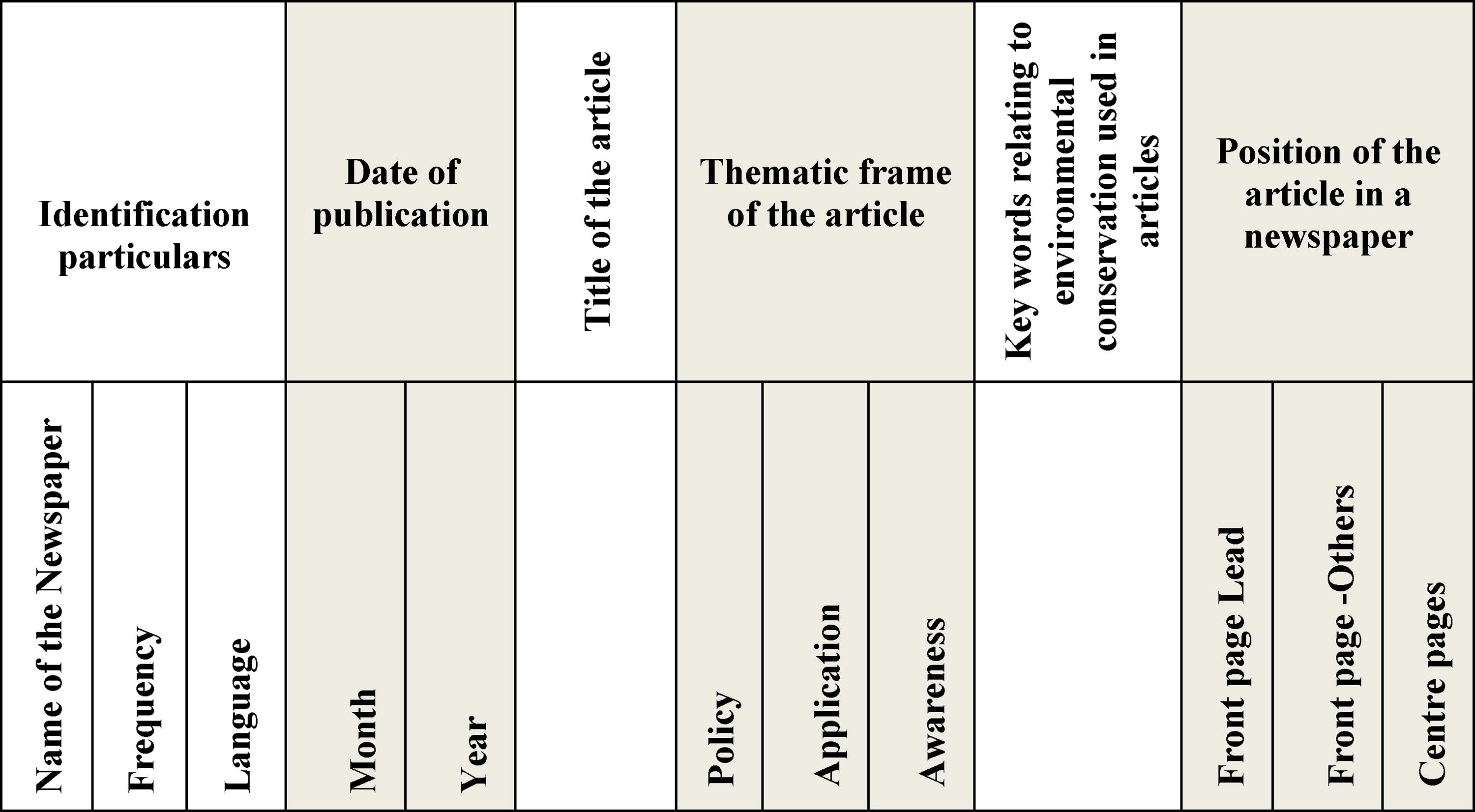
To avoid subjective judgment that could result from a single researcher to perform the task of coding in content analysis studies, four coders with a qualification in Library and Information Studies were trained on how to use a codebook to record environmental conservation information articles. Codebook review was employed to ensure its reliability. Intercoder reliability test was conducted to determine the degree of agreement between the coders and the researchers. Holsti’s coefficient was calculated by dividing the total number of occurrences or agreed-on values for each variable into the sum of the responses of each coder for the same variable. Holsti’s (1969) coefficient of reliability (CR) provides a formula for calculating percentage as follows:
Where:
CR = coefficient of reliability
M = number of coder decisions agreed on
N1 = total number of coding decisions made by the first coder
N2 = total number of coding decisions made by the second coder
The intercoder reliability falling between 0.75 and 0.80 was regarded as an acceptable one as sustained by Holsti (1969) and Neuendorf (2002).
Data Analysis
The data collected were initially entered into Microsoft Excel version 16.0 for cleaning, including identifying and correcting errors, handling missing values, and standardizing formats. Prior to data analysis, information recorded in the codebook was cleaned by removing all unrelated articles. Before cleaning the codebook, there were 444 articles on environmental issues. After cleanliness there were 432 articles. The cleaned data were exported to the IBM Statistics Package for Social Sciences version 20.0, which analyzed data based on descriptive statistics including frequencies, means, percentages, and inferential statistics such as chi-square. Visual representations of the data were created using charts, tables, and graphs to facilitate better understanding and interpretation of results.
Discussion
The findings in Table 3 indicate that there were a total of 1,334,832 articles in all four newspapers for 5 years. Daily News had the highest (550,193; 41.2%) coverage of all articles followed by Mwananchi (277,646; 22.3%) and Habari Leo (262,177; 19.6%), whereas The Guardian had the lowest (224,816; 16.8%) coverage of all articles. The results further indicate that the four selected Tanzanian newspapers had very few (432; 0.032%) articles on environmental conservation information, which is an average of 86.4 articles per each year.
Quantum of Coverage Given to Different Issues in Tanzanian Newspapers
Authors’ own field work, 2024.
Based on the findings in each newspaper, The Guardian newspaper had the highest (176; 40.7%) proportions of all environmental conservation articles followed by Daily News (133; 26.15%) and Habari Leo (97; 22.45%), whereas Mwananchi had the lowest (46; 10.64%) number of articles. This level of coverage of environmental conservation information per each newspaper may be associated with their own carrying capacities. The Guardian and Daily News are broadsheet newspapers with large carrying capacities as compared with Habari Leo and Mwananchi.
Comparisons were made on the level of attention given to environmental conservation information by the newspapers with respect to language and ownership. The findings in Table 3 indicate that the two English published newspapers covered 289 (67%) of all articles in environmental conservation information for all 5 years, comprising 40.7 percent of articles from The Guardian newspaper, whereas Daily News had 26.15 percent of all articles. On the contrary, the Kiswahili published newspapers produced a total number of 143 (33%) of all articles in environmental conservation information, comprising 22 percent from Habari Leo newspaper and 11 percent of all articles from Mwananchi newspaper. With respect to newspapers’ ownership, the findings in Table 3 indicate that the government-owned newspapers covered 210 (48.6%) of all articles in environmental conservation, whereas the privately owned newspapers covered 222 (51.4%) of all environmental conservation articles.
Though there was overlapping of the environmental conservation articles published in the selected Tanzanian newspapers, results of this study in Table 4 indicate that, of the 432 environmental conservation information articles, only 10 categories of keywords used in reporting environmental information were identified such as biodiversity conservation, forest conservation, and marine conservation. However, issues such as soil conservation, waste management and disposal, and water sources conservation were inadequately reported in Tanzanian newspapers.
Categories of Keywords Used in Reporting Environmental Conservation Information
Research own data, 2024.
This implies that newspaper journalists were slanted in reporting negative environmental issues instead of concentrating in conservation strategies for the issues that have obvious effects to lives of living organisms on the earth such as water sources and soil conservations.
The level of coverage given to environmental conservation information by each newspaper per each year is presented in Figure 2. The findings indicate that the number of articles on environmental conservation was high in the year 2022, followed by 2019 and 2020. Less number of articles were published in the year 2021 followed by 2023.
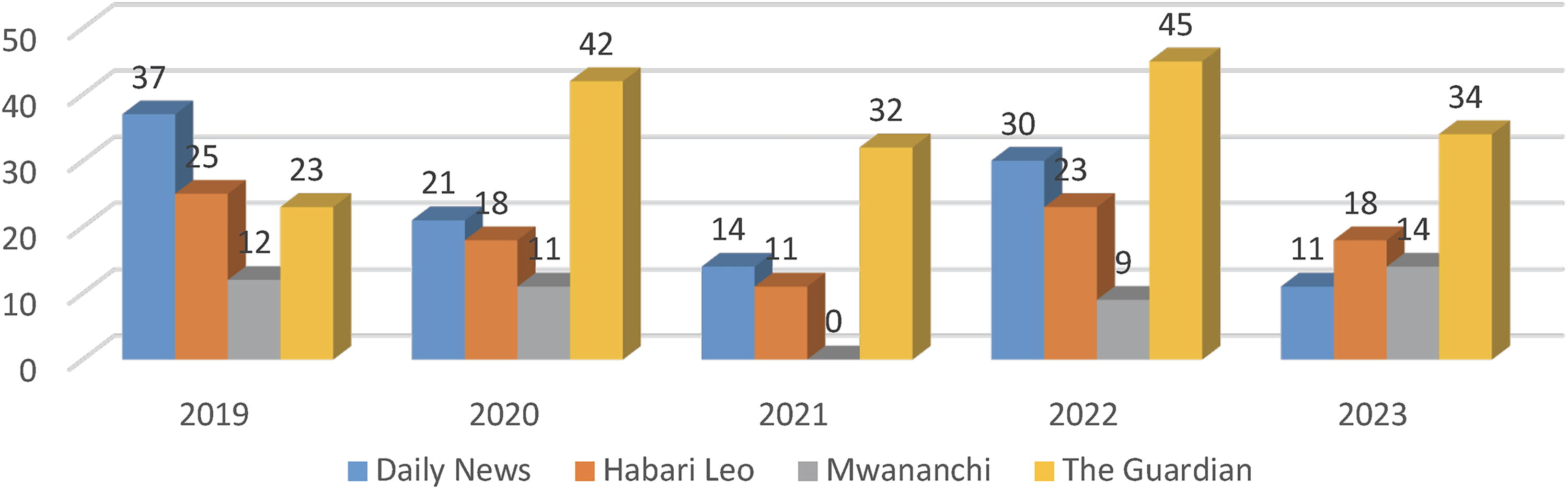
Trends of environmental conservation information reportage. Source: Own data, 2024.
Findings provided in Table 5 indicate that, of the total 432 articles on environmental conservation information, only 24 (5.6%) articles were placed in the front pages of the four Tanzanian newspapers in the referenced years, giving a yearly average of five articles for all newspapers and only one article for each newspaper per year. Of the total articles on the environmental conservation information placed in the prominent positions, The Guardian newspaper had 12 (2.7%), Habari Leo 6 (1.38%), Daily News 4 (0.92%), and Mwananchi only 2 (0.46%) of all articles. On the contrary, 52 (12.04%) articles were placed at the front page-others, whereas the majority (356; 82.4%) of articles in environmental conservation information were randomly placed in the center pages. The chi-square test (χ2 = 470.889a; df = 2; p ≤ 0. 001) shows that significant difference exists between the locations of the number of articles in the front pages and other pages.
Prominence Given to Environmental Conservation Articles
Authors’ own field work, 2024.
Articles in environmental conservation information from the four selected Tanzanian newspapers covered three major thematic frames, namely environmental conservation policies, application, and awareness on environmental conservation. Findings in Figure 3 indicate that majority (232; 53.7%) of the newspaper articles published by the four selected Tanzanian newspapers in the referenced years were on awareness creation with regard to environmental conservation and 159 (36.8%) newspaper articles published were on application of various strategies to conserve the environment. Newspaper articles on application covered issues related to environmental conservation such as soil conservation and afforestation, among others.
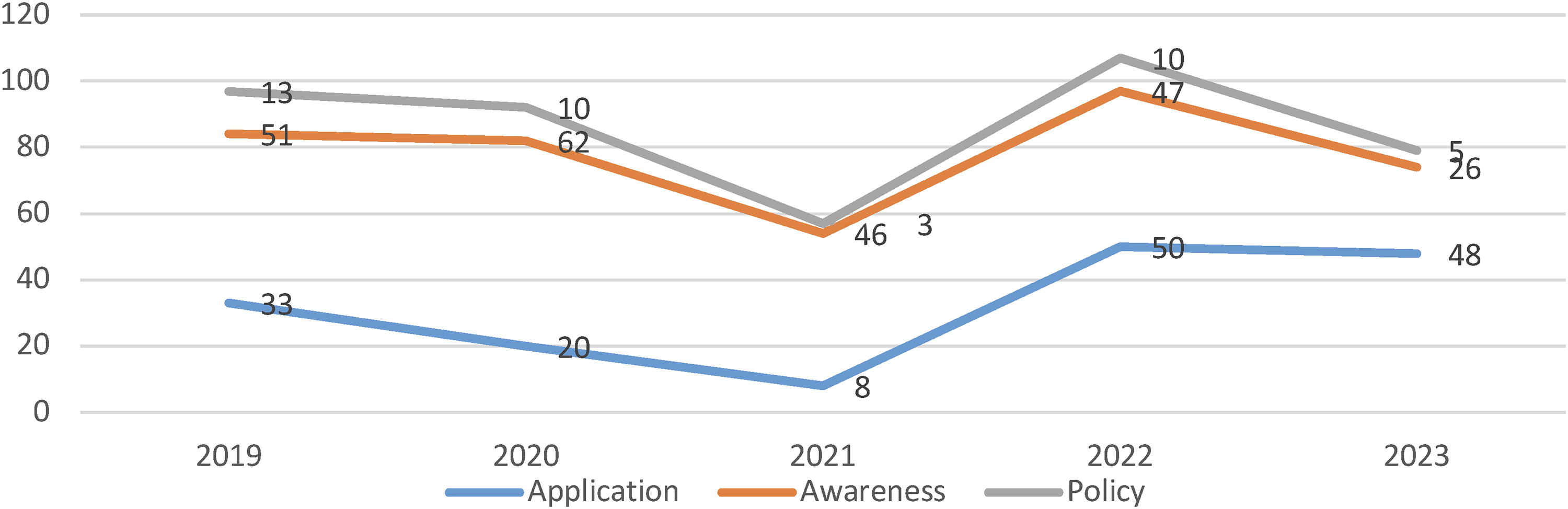
Thematic frames of articles on environmental conservation.
Furthermore, the results of this study indicate that there were only (41; 9.5%) published newspaper articles that covered policy-related issues such as regulations and environmental policy on environmental conservation.
Concluding Comments
The results of this study highlight that environmental conservation information is given little coverage and prominence by the daily newspapers in Tanzania. This may lead to low public MNA about the causes and impacts of environmental degradation and hence inadequate knowledge on the appropriate environmental conservation practices. However, this represents an opportunity.
To the extent that newspapers are incentivized by circulation and readership, ultimately for-profit motivations, increasing interest in the environment can play a significant role in catalyzing environmental news content. The more people are aware of the significance of the environment and the threats specific to environmental health, the more likely the media, in this case newspapers, will be to report on issues related to the environment. Both educators and policymakers may play a role in increasing citizen interest and connection with the environment, representing an opportunity to connect stakeholders through promoting citizen agency. Overall, this study has the potential to influence the development of a more vibrant and democratic media landscape in Tanzania, where newspaper journalists can play a vital role in informing and empowering their communities to change their behavior toward their environment.
However, given that the research for this study was limited to only four Tanzanian published newspapers whose results may lack generalization for other media outlets and information, there is a need for further research. Recommended next steps include increasing the breadth of media assessment, developing an educational pilot to address the relationship between media coverage and citizen interest, and creating a similar assessment related to public policy-based information and environmental awareness campaigns and media coverage.
Footnotes
Acknowledgments
We are grateful to the Directorate of Research and Postgraduate Studies (DRPS) of Mzumbe University for the financial support that made this work a reality. We also acknowledge with thanks to all respondents for taking their precious time to participate in this study.
Authors’ Contributions
P.O.S. developed the research proposal and submitted the article. A.S.M. prepared and arranged all references and ensured proper citations, and A.M.C. analyzed all data used in this study. All authors contributed equally in data collection and writing up the article.
Funding Information
Researchers obtained funding support from DRPS of Mzumbe University.
Author Disclosure Statement
The authors declared no potential conflicts of interest with respect to the research, authorship, and/or publication of this research work. No competing financial interests exist.