







Abstract
High maneuverability and energy efficiency are crucial for underwater robots to perform tasks in engineering practice. Natural evolution empowers aquatic species with skills of agile and efficient swimming, which can be deliberately employed for better robotic swimmers. A critical issue for efficient robotic swimmers is the design and control of an appropriate propulsion system. This study, therefore, presents a completely different realization of a highly flexible and controllable bistable nonlinear mechanism as a “fishtail.” The mechanism combines an elastic spine and a lightweight parallel linkage mechanism. Through active control of the endpoint of the elastic spine, the compliant tail can be empowered with exceptional controllability and tunable bistability for a much more efficient and also the first-ever accurately controlled bistable elastic propulsion system. Experimental results demonstrate that the new bistable fishtail can achieve a faster speed of its size (up to an average speed of 0.8 m·s−1) with an associated higher energy efficiency (corresponding cost of transport as low as 9 J·m−1·kg−1), and greater maneuverability (with an average turning speed of up to 107°/s at a much smaller turning radius of 0.31 body length). This study will definitely provide an efficient controllable and feasible approach to the design of nonlinear compliant propulsion systems for underwater vehicles by exploring nonlinear dynamics.
Introduction
Body-and-caudal-fin propulsion is a popular biomimetic approach for driving bioinspired underwater robots due to its simple implementation, reasonable speed, and high energy efficiency.1–3 This propulsion method produces very little noise and interacts harmoniously with aquatic environments, rendering it more suitable for the close-up observation of marine animals compared to traditional propeller-based systems.4,5 Notably, fish possess an innate capacity for agile swimming maneuvers, facilitated by their sophisticated tail locomotion control. 6 In complex and unstructured underwater environments, exceptional maneuverability is essential for robots to execute diverse tasks. 7 Therefore, it is imperative to endow robotic swimmers with analogous swimming capabilities through ingenious tail design and control.
Many robotic swimmers have been designed in the past two decades with various fish morphologies, which can be classified into discrete and continuous bodies. A discrete body design, such as the multi-joint-link mechanism,8–12 may result in some salient drawbacks such as discrete kinematics and large friction loss, leading to low propulsion efficiency and performance limitations. Compared to rigid structures, soft materials offer benefits including continuous morphology and safe, adaptive interaction with harsh environments. Researchers thus attempt to use soft materials to achieve continuous compliant fish bodies, such as hydraulic or pneumatic soft actuators,13–16 smart soft actuation materials like ionic polymer–metal composites,17–19 macro fiber composites,20,21 and dielectric elastomer actuators (DEAs).22,23 Although these materials have been successfully employed in devising diverse swimming robots, a noticeable issue with these soft mechanisms is that they tend to produce relatively weak thrust and low speed. Additionally, it is difficult to accurately control their body motion for high agility and maneuverability, especially in dynamic water environments. For instance, the hydraulically actuated soft robotic fish, SoFi, achieves a swimming speed of 0.235 m/s (0.5 BL/s), an angular speed of 15°/s, and a turning radius of 78.2 cm. 24 The eel-inspired soft robot, actuated by soft pneumatic elastomer actuators, reaches a maximum velocity of 0.19 m/s (0.36 BL/s) with a corresponding cost of transport (CoT) of 10.72. 13 The soft robotic fish with DEAs achieves a top speed of 76 mm/s (0.76 BL/s), a peak thrust of 14 mN, and a turning radius of 1.25 BL. 23 The reported results indicate that the performance of most of these robots is much worse than that of their biological counterparts.
To address the shortcomings of inadequate force and slow response in existing soft robots, various studies have been conducted. The elastic instability of bistable or multistable structures can induce an interesting snap-through phenomenon, quickly storing and releasing strain energy. 25 During this process, remarkable force amplification and rapid morphing can be achieved, which are two characteristics of elastic instability that can be further utilized to enhance the performance of soft robots effectively. 26 For example, a robotic insect designed by Koh et al. can achieve jumping on water by leveraging the bistable impulsive response of the catapult mechanism consisting of composite materials and planar shape memory alloy actuators. 27 Tang et al. proposed a pyramid-like folding structure driven by the magnetic field, achieving an ultrafast bistable soft jumper, which is advanced in both jumping capability and response time. 28
Bistable mechanisms have also been widely adopted in the design of swimming robots in recent years. Chen et al. designed a soft and untethered robot using shape memory polymers as the muscle connected to a small buckling beam, exploiting bistable actuation to amplify its directional propulsion. 29 Tang et al. utilized rigid linkages and a linear spring to create bistable linkages as the spine of soft terrestrial and aquatic robots to improve their speed and force of locomotion. 30 Soft swimming robots built with hair-clip mechanisms take advantage of bistable actuation to increase speed and efficiency.31,32 Wang et al. devised a soft robotic jellyfish driven by pneumatic bistable actuators, demonstrating improved efficiency and maneuverability compared to the robot without a bistable configuration. 33 Bambrick et al. developed a swimming mechanism using four magnets to realize the bistability and experimentally proved that the well-tuned bistable transmission can increase thrust, swimming speed, and efficiency. 34 Although all these mentioned soft swimming robots can leverage elastic instability to enhance their performance to some extent, they all lack dexterous and accurate controllability, as well as online tunability of the underlying bistable nonlinear dynamics. As a result, they can only exhibit unstable locomotion mode without offline structural adjustment, and their performance, in general, is still far from that of natural fish, posing challenges for potential practical deployment. Thus, the objective of this work is to explore an online controllable and tunable bistable mechanism for achieving agile and efficient swimming robots.
In this study, we propose a highly controllable elastic tail for an untethered robotic swimmer, which is composed of a parallel linkage mechanism and an elastic spine, as shown in Figure 1. By accurately controlling endpoint trajectory of the spine via the parallel mechanism, the tail possesses tunable bistability, consequently enabling flexible switching between motion modes (referring to Fig. 2). The robot can perform smooth swing motion of the monostable mode and rapid impulsive motion of the bistable mode (referring to Fig. 2C and F). With the controllable bistability, the propulsion system demonstrates significantly improved forward and turning speeds (referring to Figs. 4D and 5B), a smaller turning radius (referring to Fig. 5C), and lower energy consumption across a wide range of speeds through motion mode switching (referring to Fig. 4F). It is also noted that the high controllability and continuous morphology of the elastic spine allow the robot to steer with the most effective tail beating trajectory (referring to Fig. 6F), thus leading to good maneuverability.
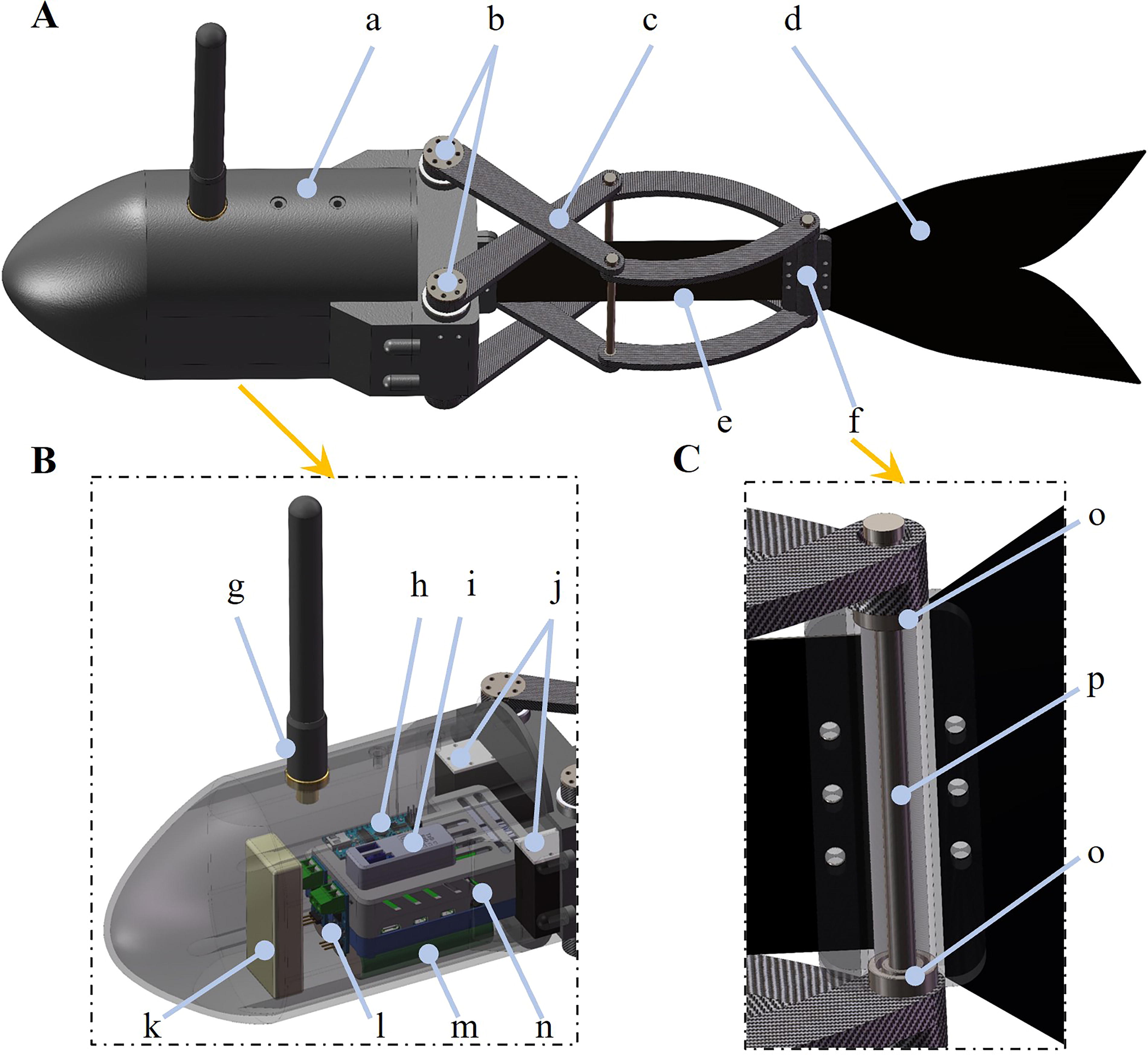
System design of the robot: it consists of a rigid head, an active-controlled flexible tail, and a passive compliant caudal fin.
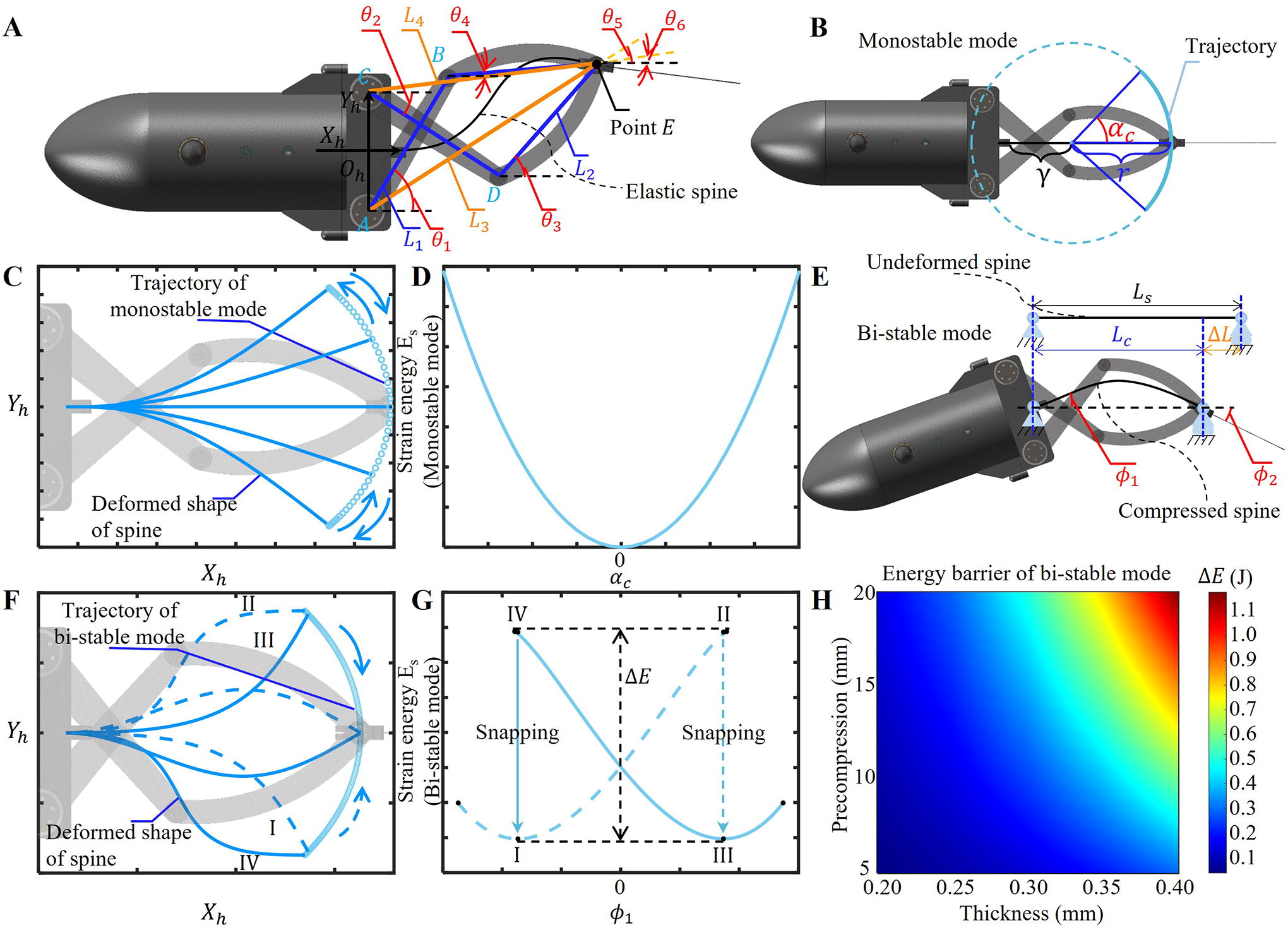
Working modes of the tail: the tunable bistability of spine can be controlled by the predefined moving trajectory of the tail.
Extensive experimental results (referring to Figs. 4 and 5) show that the maximum average swimming speed of the robot can reach 0.8 m·s−1, the energy consumption to maintain the maximum swimming speed is as low as 9 J·m−1·kg−1, and the maximum average turning rate is 107°/s with a minimum turning radius of 0.31 body length (BL), demonstrating its higher energy efficiency and better maneuverability than most existing swimming robots (referring to the comparisons in Fig. 7).
Results
Design and working principles
The designed robotic fish is shown in Figure 1. The robot mainly consists of three parts: a rigid robotic head, an elastic tail, and a compliant caudal fin. The rigid head is a waterproof container to house the electronic components. For the tail, a steel strip connected to the head is adopted as the elastic spine and is actively actuated by a parallel linkage mechanism which is a double-layer X structure composed of eight bars. One side of the parallel mechanism is connected to the head by two active rotational joints, and another side is connected to the spine by a passive rotational joint. The caudal fin is fixed on the passive rotational joint opposite to the spine. The dimensions of the entire robot are 550(L) × 106(W) × 120(H) mm3 and it weighs 1.8 kg. The detailed hardware implementation of the robot is described in Supplementary Data S1. The working modes of the tail are shown in Figure 2. Through the accurate control of the parallel mechanism, the elastic spine connected to the passive rotational joint can follow any motion trajectories to swing. This is a significantly different and important feature compared to all existing nonlinear elastic propulsion mechanisms in the literature. Due to the high controllability of the tail, the robot is capable of swimming in two different locomotion modes: the monostable mode and the bistable mode (referring to Fig. 2). Based on the predefined trajectory, the inverse kinematics (see Supplementary Data S1) can be used to obtain the input of two motors in the active rotational joints to control the parallel mechanism, and the defined parameters of the parallel mechanism for the derivation of inverse kinematics are shown in Figure 2A.
Figure 2B demonstrates the trajectory generation for the monostable mode, which is part of a circle and controlled by three parameters as follows. Here, γ is the distance between the circle center and the starting point of the elastic spine. The distance from the circle center to the controlled rotational joint (point E) is the radius of the trajectory, denoted by r. α c is the angle between the midline of the robot and the radius vector that connects to the endpoint of the trajectory, and it is used to control the tail beat amplitude. The deformed shape of the elastic spine during the motion of the monostable mode is presented in Figure 2C. For each motion cycle of monostable mode, point E passes the point where the elastic spine is in the undeformed state. Hence, the minimum strain energy of the elastic spine is 0 and is located at only one point of the trajectory of the monostable mode as seen in Figure 2D. The theoretical model of the monostable mode is provided in Supplementary Data S1.
Figure 2E illustrates the realization of the bistable locomotion mode. In the initial stage of the bistable locomotion mode, there is a prestored strain energy of the elastic spine due to compression (resulting in a pinned–pinned buckled beam). It is known that there are two stable positions of this mechanism, which are symmetrical about the horizontal line. When the input pivot (
Stiffness coordination between the spine and the caudal fin
The stiffness plays a crucial role in achieving efficient swimming of fish.35,36 In the proposed fishtail, two compliant elements need to be considered, including the elastic spine and the compliant caudal fin. The stiffness of the spine is not only one of the dominant factors affecting the energy barrier of the bistable locomotion mode, but also together with the compliance of the caudal fin, determines the kinematics of the tail during swimming. Therefore, the stiffness coordination between the spine and the caudal fin is important for the swimming performance of the robot, and its influence is first explored for both the monostable and bistable locomotion modes. The stiffness is adjusted by varying the thickness, and other dimensions of the elastic spine and the caudal fin remain unchanged as shown in Figure 3A. The thickness sets of the spine and the caudal fin are {0.25 mm, 0.30 mm, 0.35 mm} and {0.3 mm, 0.4 mm, 0.5 mm}, respectively. So, nine cases in total of thickness combinations for the spine and the caudal fin are tested as presented in Figure 3B. Here, only three cases (spine–caudal–fin combination [SCFC] 1, SCFC5, and SCFC8) are selected to compare, which represent the best swimming performance for the robot with the elastic spine of three different thicknesses. More comparisons are provided in Supplementary Figures S1 and S2 (see Supplementary Data S1).

Comparison of the swimming performance between the fishtail with different thickness combinations of the elastic spine and the caudal fin, revealing the stiff spine and the medium stiff caudal fin enable the robot to swim faster with higher energy efficiency.
Figure 3C (dashed line) and D (dashed line) demonstrate the results of the average swimming speed and the cost of transport (CoT) for the monostable mode. The robot with SCFC1 swims the slowest under different tail beat frequencies. Before the frequency of 2.5 Hz, the robot with SCFC5 is the fastest, however, the speed of the robot with SCFC8 surpasses that of the robot with SCFC5 when the frequency rises above 2.5 Hz, and the SCFC8 achieves the highest speed among all cases for the monostable mode at the frequency of 3 Hz. For the results of CoT, no one case is always the most energy efficient. When the swimming velocity is under 0.25 m/s, the CoT of the robot with SCFC1 is the lowest. When the speed is in the range between 0.25 and 0.44 m/s, the most energy-efficient one turns into SCFC5. And as the speed continues to increase, the best one is SCFC8.
Figure 3C (solid line) and D (solid line) shows the average swimming speed and the CoT for the bistable mode. Similar conclusions about the effect of different cases of stiffness combinations on the monostable swimming mode can be found with the bistable mode, but the differences between different cases are more obvious. When the tail beat frequency is below 2 Hz, the swimming speeds of the robot with SCFC5 and SCFC8 are close to each other, and the robot with SCFC5 is slightly faster than the case of SCFC8, while SCFC8 performs much better on the velocity than other two cases when the frequency is over 2 Hz. And the maximum speed is achieved with SCFC8 as well, which is about 0.60 m/s at the frequency of 3 Hz. When it comes to the CoT, SCFC1 achieves the minimum CoT at speeds below 0.37 m/s. From the speed of 0.37 m/s to 0.53 m/s, the CoT of the robot with SCFC5 is minimal. When the speed exceeds 0.53 m/s, SCFC8 is most energy efficient.
According to the analysis above, no case can produce the best performance both in swimming speed and CoT over the studied range of tail beat frequencies. However, SCFC8 enables the robot to obtain the maximum speed and the lowest CoT at high speeds. Thus, for the subsequent tests, SCFC8 is selected for the robot.
Effects of different trajectories on forward swimming performance
We explored the forward swimming performance of the robot when the tail swings with different trajectories. Due to the structure limitations (

Forward swimming performance of the robot with different control trajectories, revealing the bistable mode enables the robot to swim faster, and the switchable motion modes allow the robot to maintain higher energy efficiency over a wide range of speeds.
Figure 4C demonstrates the swimming speed comparison between bistable (
The consumed currents of two servos for bistable and monostable modes at the frequency of 1 Hz are illustrated in Figure 4E. There is one peak current for each motor in one bistable motion cycle. During one half of the motion cycle, the consumed current of one motor reaches the maximum value, while the other motor gets the minimum current value. It is opposite in the other half of the motion cycle. The results indicate that generating the needed torque to overcome the energy barrier for achieving snapping motion on one side mainly relies on one motor. The curve shape of the consumed current in one monostable motion cycle is significantly different from that of bistable motion, which exhibits two peak values for each motor. In a half of the motion cycle, two motors both reach the maximum current and contribute equally. The average current value of bistable mode is higher. Because the working load on the motors increases due to the precompression of the spine. It is worth noting that a higher current cannot be always considered a drawback. According to the torque-speed-efficiency characteristic of a servo motor as shown in Supplementary Figure S6 (see Supplementary Data S1), the working efficiency of the motor shows the first rising and then dropping trend with the current increasing. Thus, the proposed fishtail mechanism could allow the motor to operate with high efficiency when the tail swing trajectory is properly selected. Figure 4F compares the results of CoT when the robot swims with different tail-flapping trajectories. When the robot swims in the monostable mode, the trajectory with a large
According to the computation method described in equations (28) and (29) of Supplementary Data S1, the specific swimming performance improvement of the bistable mode relative to the monostable mode under diverse frequencies was calculated and summarized in Supplementary Table S1 (see Supplementary Data S1). There is an improvement of about 10–25% in swimming speed across the entire range of testing frequencies, benefiting from the bistable mode. While the monostable mode is more efficient at a frequency lower than 1.5 Hz. When the frequency is over 2 Hz, the swimming efficiency of bistable mode gets an improvement about 5–10% compared to that of the monostable mode. Figure 4G shows the snapshots of swimming comparison between the bistable and monostable modes under the frequency of 1 Hz (Supplementary Videos SV1 and Video SV2). And the swimming comparison under the frequency of 4 Hz is provided in Supplementary Video SV3. Other than the forward swimming speed and swimming efficiency, the thrust of both bistable (
Effects of different trajectories on the turning performance
Next, we compared the turning performance of the robot with different tail beat trajectories. Four trajectories are selected with

Turning performance of the robot with different trajectories, revealing the robot can achieve the fastest turning rate and smallest turning radius simultaneously with the tail beat trajectory of a small radius and a large bending angle (red line in
Figure 5B shows the results of the average turning speed for the robot under various control trajectories. We find that the variation trend of the average turning rate drops initially and then goes up significantly with the decrease in the radius of the tail beat trajectory. The maximum turning speed achieved by the trajectory of
Figure 5D further compares the turning angle in the time domain between the robot driven by the trajectories of large (
Figure 5F demonstrates the snapshots of the turning performance comparison between the robot turns with the tail beat trajectories of large and small radii under the frequency of 4 Hz (Supplementary Video SV5). And the turning comparison under the frequency of 1 Hz is provided in Supplementary Video SV4.
Furthermore, the deformed shapes of the elastic spine under different control trajectories of point E for the turning motion are shown in Figure 6. According to the results, as the values of both

Deformed shapes of the elastic spine under different control trajectories of point E for turning, demonstrating that increasing γ and αc results in a larger bending angle and a smaller swing amplitude of the spine.
Performance comparisons with the reported robotic swimmers
The performance of the robot in this article is compared with several similar reported robotic swimmers.24,31,37–47 The performance indicators include swimming speed, energy efficiency, turning speed, and turning radius. To make the evaluation benchmark more reasonable, the differences in the achievable maximum tail beat frequency and the mass of robots need to be taken into consideration. We use the stride length (
Figure 7A shows the comparison of the stride length. The average SL of fish varies from 0.35 to 0.93 BL/cycle, 50 the part highlighted by the gray color in the figure. Our robotic swimmer achieves the fastest average swimming velocity in the bistable locomotion mode when the precompression length of the spine is 2 cm. Thus, the maximum SL under each tested tail beat frequency ranges from 0.35 to 0.55 BL/cycle, which shows comparable swimming speed with the real fish in nature. And the maximum stride length (0.55 BL/cycle) achieved at the frequency of 1 Hz is higher than most compared platforms and only lower than one platform, active compliant propulsion mechanism (ACPM) robotic fish. 41 But the length of the ACPM robotic fish is much smaller than that of our robot. Figure 7B compares the energy efficiency when the robots swim at the maximum velocity. It is clear to see that the robotic swimmer in this work consumes the minimal energy at its maximum average swimming speed when compared to other platforms, which means our designed robot can achieve fast speed with high energy efficiency. Our robot also exhibits excellent maneuverability when compared with other robotic swimmers (Fig. 7C). The fastest turning rate with the minimal turning radius demonstrates that its maneuverability is strongly superior to other platforms.
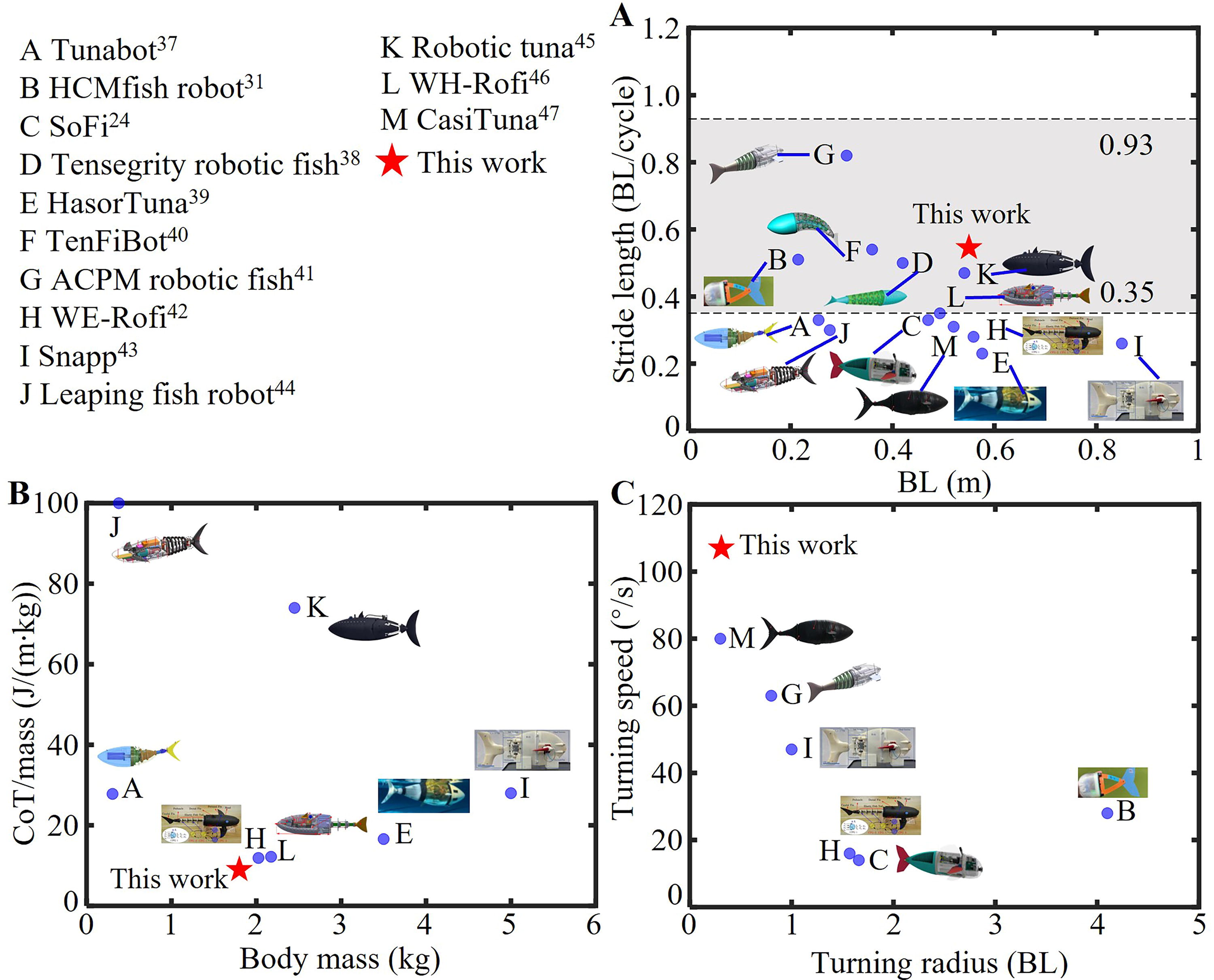
Performance comparisons between the robot in this study and similar robotic swimmers in the literature, demonstrating superior maneuverability and higher energy efficiency of the proposed “fishtail.”
Discussion and Conclusion
In this study, we developed a compliant robotic fish tail based on the bistable nonlinear mechanism, which combines a parallel linkage mechanism and an elastic spine. The active-controlled elastic spine endows the robot tail with high controllability and flexibility, which allows the robot to swim and turn with different predefined tail beat trajectories. The tunable and controllable bistability of the robot tail can perform two different motion modes freely and accurately (monostable and bistable modes).
First, the study on different stiffness combinations of the elastic spine and the caudal fin reveals that the spine thickness and caudal fin stiffness are two fundamental factors for improving swimming performance (see Supplementary Figs. S1 and Figs. S2), and it is noted that a soft spine combined with a soft caudal fin performs better in both speed and CoT when compared to a soft spine combined with other two stiffer caudal fins (see Supplementary Figs. S1 and Figs. S2). It is also noted that a stiff spine with a caudal fin of medium stiffness enables the robot to swim faster (see Fig. 3C), but no combination can exhibit the best energy efficiency over a wide range of swimming speeds (see Fig. 3D). At a lower speed, the robot with a soft spine and a soft caudal fin (compared to stiff or medium ones in Fig. 3B) is more energy efficient, while at a higher speed, the energy efficiency of the robot with a stiff spine and a moderately stiff caudal fin is better.
Second, tunable tail beating modes, benefiting from the accurately controlled spine, not only enable the robotic fishtail to take advantage of the bistability for effectively amplifying the thrust force (see Supplementary Fig. S7) by altering the caudal fin’s kinematics, such as varying the angle of the passive joint (
Third, the maneuverability of the robotic swimmer can be largely enhanced by selecting the most suitable tail beat trajectory for turning. The actively controlled spine allows the robot to simulate the smooth and continuous motion morphology of fish, which is difficult to be realized by other robotic fish built by discrete rigid linkages. 10 This property enables the robot to turn with the most efficient tail motion morphology like a real fish (the red tail beat trajectory in Fig. 5A). Based on the results of turning tests, the tail beat trajectory of a small radius and a large bending angle empower the robotic swimmer to have a faster turning rate (see Fig. 5B) and a smaller turning radius (see Fig. 5C).
The robotic swimmer successfully demonstrates its superior performance in terms of swimming speed, maneuverability, and energy efficiency through extensive comparisons with other similar robots in the literature (see Fig. 7). In the comparisons, several platforms have similar tail actuation mechanisms but can only realize single motor-actuated reciprocating motion with high tail beat frequency.37,43–46 Thus, the swimming speed of these robots can be faster. However, the robots of this kind are difficult to realize turning motion, as a result, their maneuverability is relatively worse and some even can only swim forward. Moreover, most electronic components of a platform, Tunabot, 37 are placed outside the robot. All these mentioned drawbacks show a high restriction on practical applications. It is noted that the robot of this study can achieve a reasonable forward speed (although not the fastest because of the tail beat frequency), and it is more applicable to marine environments due to these features as discussed before including self-contained compact system, high energy efficiency, and excellent maneuverability.
Therefore, the proposed tail mechanism provides a more reliable way for reproduction of real fish swimming skills and the results definitely unveil a benchmark solution for the development of soft actuation of underwater robots. For example, using two such tails to imitate frog swimming, or using three or four tails to simulate the motion of octopus, etc., which will be investigated in further studies. In this article, we preliminarily and partially investigated the optimal configuration and control approach, including the preferable stiffness combination of the elastic spine and the caudal fin, switching motion mode to maintain efficient swimming across a wide range of swimming speed, and the most effective swing trajectory and deformed shape of the spine for achieving excellent steering capability. A more general structural and control optimization using model-based method or learning method will be conducted in future work. Additionally, to further improve the performance by reducing drag force, we plan to develop a more compact prototype using components with small size and cover the tail structure with an appropriate soft material in the future as well.
Footnotes
Acknowledgments
The authors appreciate and acknowledge the constructive comments and suggestions from anonymous reviewers.
Authors’ Contributions
X.C. developed the concept, conducted the simulations, designed the experiments, analyzed the data, and wrote the original draft. I.M. helped with the experiments. D.N.A. supervised and reviewed the draft. X.J. conceptualized and supervised the research; prepared, reviewed, and revised the article; and funded all materials and facilities needed.
Author Disclosure Statement
No competing financial interests exist.
Funding Information
This study was supported by a Shenzhen-HongKong-Macau Scheme-C fund (9240115), an Innovation and Technology Fund of Hong Kong Innovation and Technology Commission (ITP/003/24LP), a booster fund of City University of Hong Kong (7030015), and a startup fund from City University of Hong Kong (Ref. 9380140).

References
Supplementary Material
Please find the following supplemental material available below.
For Open Access articles published under a Creative Commons License, all supplemental material carries the same license as the article it is associated with.
For non-Open Access articles published, all supplemental material carries a non-exclusive license, and permission requests for re-use of supplemental material or any part of supplemental material shall be sent directly to the copyright owner as specified in the copyright notice associated with the article.
