







Abstract
To the Editor:
E
Antibiotic application to the surgical incision can reduce the risk of post-operative osteomyelitis. Compared with systemic administration, this approach has the advantage of maximizing the drug dosage at the targeted site producing a lower incidence of antibiotic-resistant pathogens. Synthetic bone grafts serve as ideal carriers for local delivery of antibiotic agents, as these materials have been used commonly as bone void fillers in orthopaedic operations [2]. We have been incorporating carboxymethyl cellulose (CMC), a biocompatible and biodegradable sugar-based polymer [3], to manipulate the handling and resorptive properties of a calcium phosphate-based cement (CPC) for non-load-bearing applications. Our most recent study evaluated the antibiotic release capability of this CMC/CPC composite.
The solid phase (powder) of CPC, prepared by a method described elsewhere [4], was blended with 10% w/w vancomycin (VCM), an antibiotic effective against methicillin-resistant Staphylococcus aureus (MRSA), and 10% w/w sodium CMC, sodium alginate, or polyvinyl alcohol (PVA) (all reagents purchased from Sigma, St. Louis, MO, USA), mixed with double-distilled water to form a paste that was molded into 0.1-g pellets and air dried. These pellets were immersed individually in 1 mL of phosphate-buffered saline at 37°C. The amount of vancomycin released was measured by ultraviolet/visible spectroscopy at 280 nm at different time points, and the concentration was calculated using a standard curve of absorbance vs. concentration. Despite the differences in handling properties, all composites exhibited rapid release of the loaded VCM (>50% loaded drug in 4 days and >75% in 7 days), and the drug became undetectable after 2 weeks (Fig. 1A). However, CPC alone or with PVA showed significant burst release. This effect can be prevented by adding CMC or alginate (Fig. 1A). The CMC/CPC composite performed the most sustained release before complete drug release was achieved (Fig. 1A). The VCM remained bioactive, which was demonstrated by the observation that the released antibiotic inhibited MRSA growth compared with an untreated bacterial culture (Fig. 1B). Because the properties of a polymer are determined largely by its chain length, we also investigated CPC containing CMC of various chain lengths, expressed in terms of the molecular weight (90,000, 250,000, or 700,000 Da). The results indicated that adding high-molecular-weight (700,000 Da) CMC retarded drug release from CPC (Fig. 1C), suggesting a critical factor affecting this drug delivery system.
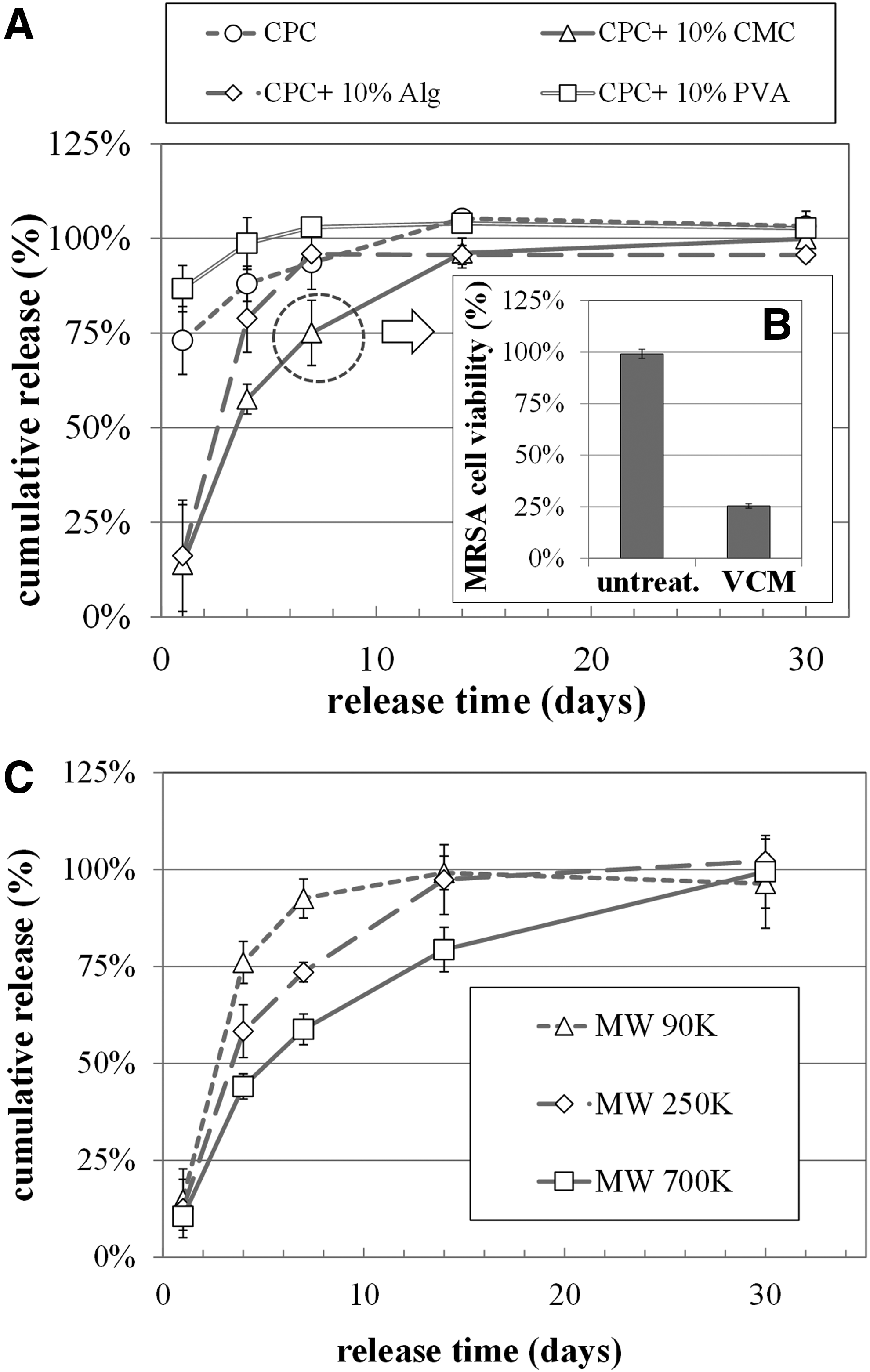
Vancomycin (VCM) release profiles of calcium phosphate-based cement (CPC) and CPC with polymers. (
On the basis of our findings, we propose a simple method for healthcare professionals to prevent osteomyelitis by utilizing a CMC/CPC composite with optimized drug release capability to deliver antibiotics at the surgical site.
Footnotes
Acknowledgments
This work was supported by the National Science Foundation Industry/University Cooperative Research Center at The University of California at San Francisco, CA, and The University of Toledo, Toledo, OH.