





Abstract

Books
Ecological Restoration in the Midwest: Past, Present, and Future
Christian Lenhart and Peter C. Smiley, Jr., editors
University of Iowa Press, 2018, $45
https://www.uipress.uiowa.edu/books/9781609385736/ecological-restoration-in-the-midwest
https://us.macmillan.com/climateofhope/michaelbloomberg/9781250142078/
The first part of this book is a review of the history of restoration and the theories and practices that helped shape the field. The editors report that the Midwest has been at the forefront of ecological restoration. Starting more than 80 years ago, the region shaped the practice of, and scientific theory about, restoration of degraded or damaged ecosystems. The book highlights the contributions of pioneers in the field of ecology and landscape architecture and how their efforts to protect and restore ecosystems led to an interest in restoration.
In Part II, the book contains several case studies about restoration of prairies, wetlands, streams and urban ecosystems in Iowa, Indiana, Illinois, Wisconsin, Michigan, Minnesota, and Ohio. The case studies include cleaning up contamination from auto plants in Ohio and restoring native prairie grasses along an Iowa highway. Much of the work has been done by volunteer groups and interested citizens.
Part III looks toward the future of ecological restoration, increasing ecosystem resilience while dealing with climate change; managing invasive species; restoring the agricultural watershed; and building legacies. The editors encourage readers to continue collaborating to meet the common goal of ecological restoration.

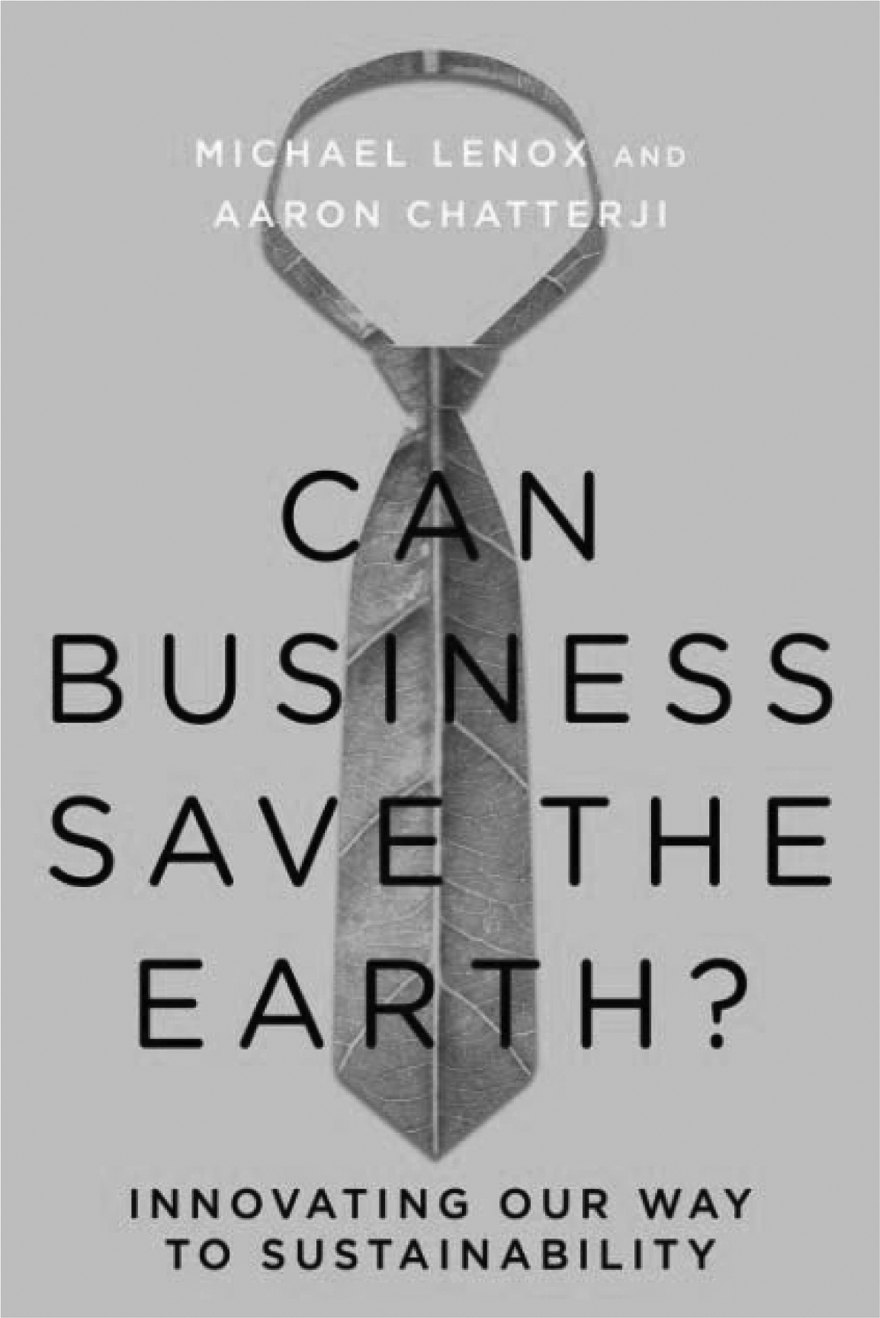
Can Business Save the Earth? Innovating Our Way to Sustainability
Mike Lenox and Aaron Chatterji
Stanford University Press, 2018, $29.95
https://www.sup.org/books/title/?id=24012
The private sector can reduce environmental damage while still driving economic growth, but it will take simultaneous “dramatic innovation across multiple sectors,” report academics Mike Lenox and Aaron Chatterji in this book. The authors outline how inventors, executives, customers, investors, activists, and governments can come together to support “green growth.”
The business community has the power and resources to “save the Earth,” just as it has created jobs, improved people's welfare, and reduced poverty. Innovators and entrepreneurs can help to deliver a sustainable future, if they have the will. At the same time, they can earn money doing it.
While businesses have the potential to change, the authors contend that the private sector cannot do it alone. Addressing environmental damage will require collaboration between business, government, academics, and individuals. The authors use Tesla and Nest as examples of investors, innovators, government financial incentives, and consumers coming together in support of electric cars and smart thermostats. Businesses are in the best position to commercialize recently developed sustainable technologies. The private sector also can create more sustainable and environmentally friendly supply chains.
The book discusses the role of innovators, managers, investors, and customers, with the system serving as the catalyst for change. It warns of dangers associated with sustainability challenges, particularly climate change, and urges everyone to serve as catalysts to support innovation that will help the planet survive.
Eat for the Planet: Saving the World One Bite at a Time
Nil Zacharias and Gene Stone
Abrams Books, 2018, $19.99
https://www.abramsbooks.com/product/eat-for-the-planet_9781419729102/
The industrialized food system is a primary driver of climate change and even small changes in the way people eat could have a lasting effect on the planet, according to the authors of this new book. That would require switching from a meat‐based diet to a plant‐based diet.
During the past 200 years, agriculture has evolved into a colossal business, with factory‐like entities producing large quantities of milk, eggs, and milk products. Agriculture uses half of the planet's land, with livestock—more than 20 billion animals—occupying 35 percent more space on Earth than humans. (The authors report that 95 percent of the 7.5 billion people on Earth occupy only 10 percent of the land.) Many more resources are needed to produce beef than vegetables, legumes, and fruit.
Animal agriculture contributes to climate change, as farm animals release the greenhouse gas methane. Farm animals also produce manure—2.7 trillion tons annually in the United States—which contains another greenhouse gas: nitrous oxide. And transporting farm animals from farms to slaughterhouses to grocery stores also produces greenhouse gases.

Reports
Protecting the Health and Well‐Being of Communities in a Changing Climate
National Academies Press, 2017
Available as a free download at:
The National Academies of Sciences, Engineering, and Medicine released a report from a 2017 workshop convened by the Roundtable on Environmental Health Sciences, Research, and Medicine and the Roundtable on Population Health Improvement. During the workshop, participants explored possible strategies to mitigate the health effects of climate change. The report includes regional perspectives from the South, West, Midwest, and Northeast.
Climate change results in more than rising temperatures and seas; it also produces more flooding, blizzards, droughts, and other massive weather events. Such weather extremes incur crop damage but they also can lead to more vector‐borne diseases, heat stress, asthma, and infectious diseases.
Among the key points derived from the workshop was that climate change is an urgent matter that affects public health. In addition to being an environmental issue, climate change also is a moral, health, and national security challenge. Cost‐effective approaches to addressing the issue exist, especially at the local level, in urban planning, energy, and food and agriculture. Additionally, people need to discuss climate change, accept that it is real and happening now, and know that it can be mitigated.
The report concludes with participants' reflections on the meeting. The roundtables did not produce specific recommendations for addressing climate change.
The 2018 GlobeScan‐SustainAbility Leaders Survey
SustainAbility, 2018
Available as a free download at:
http://sustainability.com/our-work/reports/the-2018-sustainability-leaders/
Corporate leadership on sustainability requires making sustainability part of the core business, incorporating sustainability in the businesses values, and having executives lead the way, according to this report. Every company has the chance to advance sustainability, regardless of its size. More companies need to embrace the challenges and innovations for success.
Unilever again, for the eighth year in a row, received the top ranking for its sustainability leadership, with 47 percent of surveyed experts citing the company as first. Patagonia ranked second, and Interface third while it continued as the most admired company. In all global regions, Unilever and Patagonia were recognized as strong sustainability leaders.
Apple and Danone made the list of most recognized companies for the first time. Other highest ranked companies include: IKEA, Marks & Spencer, Tesla, Nestlé, Natura, and Walmart. World Wildlife Fund and Greenpeace were named most widely recognized nongovernmental organizations, with strong support from experts ages 18 to 35.
More than 700 sustainability experts from around the world completed the survey, including people from government, corporations, academia, service sectors, media, and nongovernmental organizations. The respondents agreed that for younger participants, consumer behavior and political participation are key to advancing sustainability goals. Older experts suggested volunteerism and influencing employers as more important than younger people.
Deloitte Resources 2018 Study: Energy Management: Businesses Drive and Households Strive
Deloitte, 2018
Available as a free download at:
Consumers and businesses share concerns about climate change and decreasing their global footprint, and a willingness to act, according to this report. Consumers want more options to manage their energy use and more environmentally responsible services and products. Businesses are listening and developing clean‐energy solutions.
The study found 68 percent of residential consumers have concerns about climate change and their carbon footprint, a new high; 74 percent believe human actions are causing climate change. Participants reported that time‐of‐use for electricity was motivating them to change their energy‐use habits. Nearly half of consumer respondents without solar panels, 49 percent, said they would be interested in solar systems if one could be combined with a battery storage unit.
Seventy percent of businesses reported that their customers want a percentage of the company's electricity to come from renewable sources, and 48 percent are working to secure more electricity from renewable sources. The need to meet supplier/business partners' requirements is a motivator for 21 percent of the businesses.
The report suggests that the pressure from consumers and supply chains for businesses to reduce carbon footprints will not abate. Not only will businesses that choose to wait lose revenue, but they also may find it more difficult to find and keep workers.

Films
Pandas
David Douglas and Drew Fellman, directors
Warner Bros. Pictures and IMAX, distributors
2018, 40 minutes
Now playing in select theaters
This IMAX original documentary follows one researcher at a captive breeding program in China, where scientists are working to ensure that pandas will continue to exist for future generations. The film chronicles the experience of a panda cub born in captivity as it is prepared for life in the wild. Only about 2,000 pandas exist in the wild, and more than 300 are in captivity.

Jane
Brett Morgen, director
National Geographic Documentary Films
2017, 90 minutes
Amazon Prime, $5.99 rental; $9.99 purchase
https://www.nationalgeographic.com/jane-the-movie/
This documentary highlights the early years Jane Goodall spent with chimpanzees in Gombe. As a young woman, she set out into nature to study the animals, and it became her life's work. The film draws on more than 100 hours of recently rediscovered footage held in the National Geographic archives. The film provides a close and moving look at a trailblazer who became an admired conservationist.
Editor's Note: For more on Jane Goodall, read her recently published Commentary in this journal at: http://www.liebertpub.com/doi/10.1089/sus.2017.29116.jg

Websites
Yale Program on Climate Change Communication
Yale University has created a webpage about the project, Climate Change in the American Mind. The site shows the data behind its opening statement that “Americans overwhelmingly support teaching our children about the causes, consequences, and potential solutions to global warming—in all 50 states, including Republican and Democratic strongholds.”
The website explains how some states, Idaho and nine others, are debating education standards associated with climate change science. Many of these debates stemmed from groups seeking to exclude climate change science from the classroom. The site adds: “As depicted in [the map], however, a large majority of citizens supports climate change education in each of these states.”
ANU Climate Coaster
http://gravitron.com.au/climatecoaster/
The Australian National University (ANU) Climate Change Institute and the ANU Design Lab have created a website that uses the Bureau of Meteorology's data to compare long‐term temperature averages at 112 locations throughout Australia. The site also provides information about daily maximum temperatures and monthly averages. Copies of the information can be downloaded for printing or social sharing.